Sink Sourcing Risks
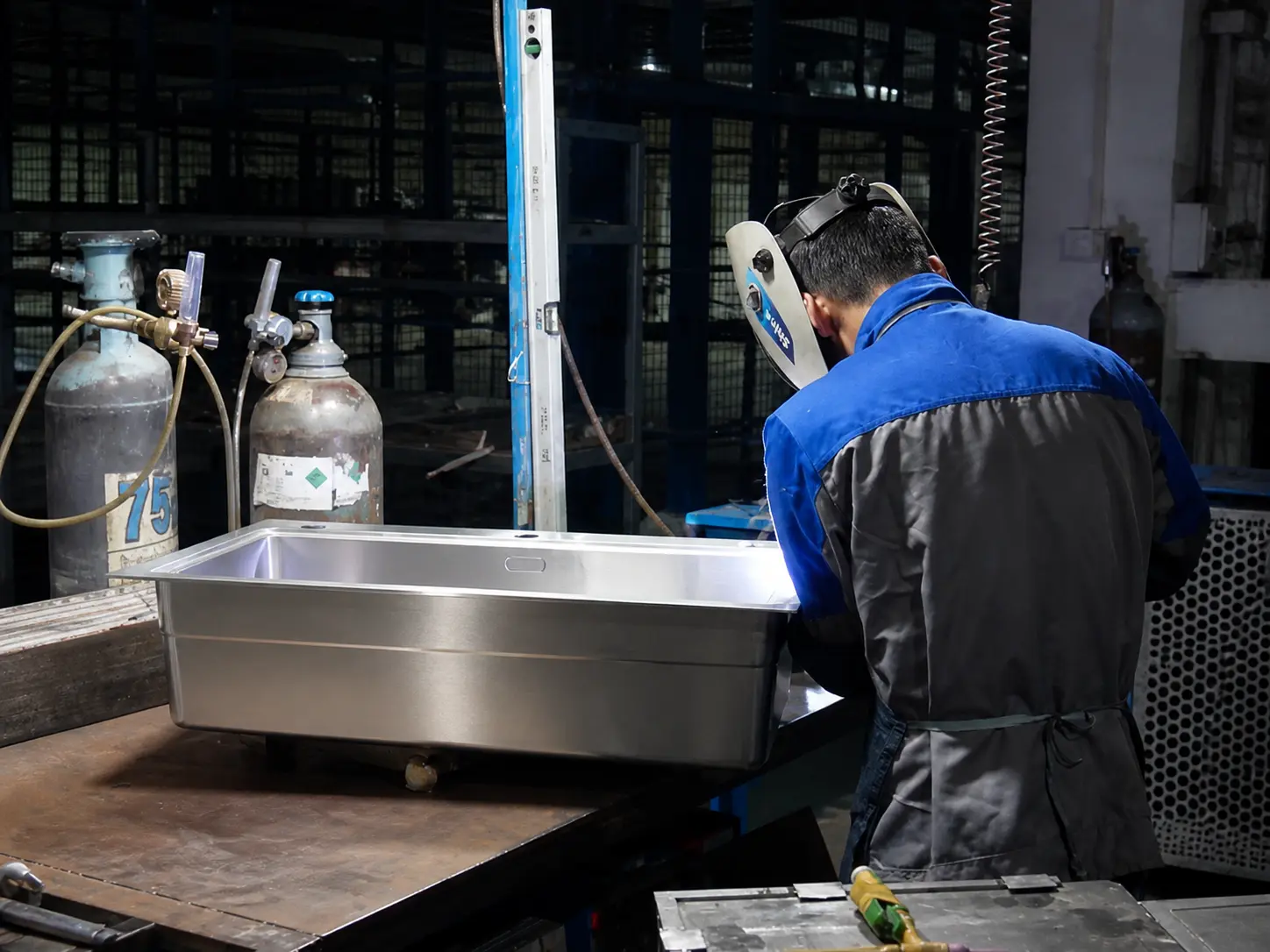
The most expensive sink problems often hide behind low quotes, unclear specifications, attractive sample photos, and missing installation details. This guide helps importers, distributors, private-label brands, and project buyers identify material, thickness, finish, fitting, accessory, packing, label, and order-planning risks before production.
"The lowest sink price can become the most expensive decision if it leads to rust complaints, thickness disputes, unmatched cut-out sizes, wrong drain positions, missing accessories, finish variation, packing damage, or project delays."
The Cheapest Sink Is Not Always the Lowest-Cost Sink
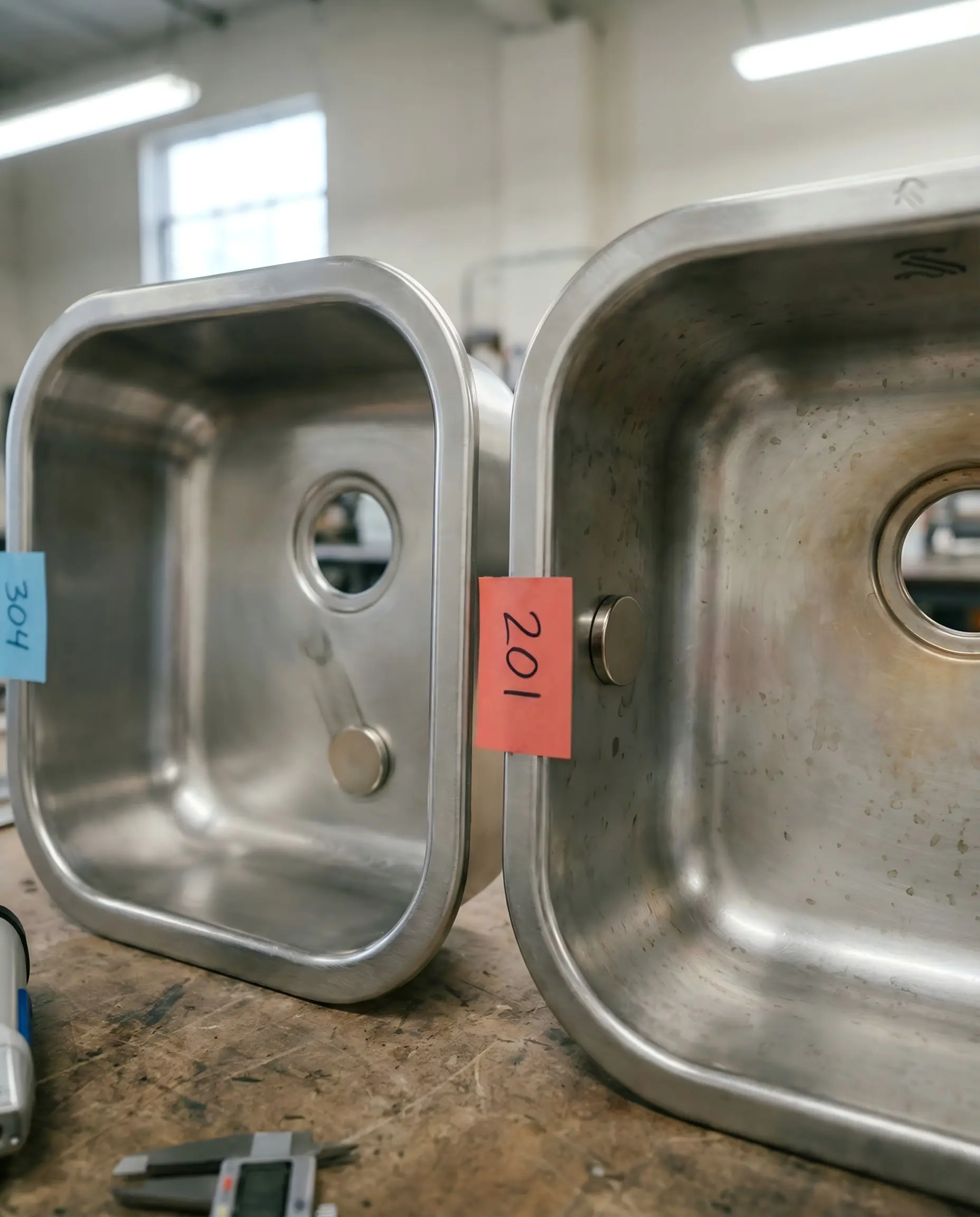
A lower unit price can disappear quickly when buyers face rust complaints, thickness disputes, wrong cut-outs, mismatched accessories, finish variation, packing damage, return cost, or project delays. In sink sourcing, the real cost is often created by the details that were not confirmed before production.
Many sink problems are not visible in a quotation sheet or product photo. They usually appear later during installation, warehouse handling, project delivery, online reviews, after-sales service, or repeat orders.
A quote does not define the whole product.
Material grade, thickness tolerance, finish, accessories, packing, labels, and inspection standards should be confirmed in writing.
A sample does not protect the buyer unless details are locked.
A sample should become a production reference for material, finish, accessory set, packing method, label details, and QC standards.
A sink is not only a product. It is part of an installation system.
Cut-out size, cabinet fit, drain position, faucet holes, accessories, labels, and packing all affect the final result.
Uncomfortable Truths in Sink Sourcing
These are the sourcing details that often create cost after the order looks "confirmed".
A SUS304 stamp is not a quality control system.
Quoted thickness is not always finished thickness.
Sink projects do not fail on price. They fail on fit.
A product photo cannot replace a cut-out drawing.
A faucet hole is not just a hole.
A workstation sink is a system, not a sink with free accessories.
A beautiful PVD sample photo does not guarantee repeat order consistency.
A good sample does not automatically guarantee a good container.
Packing is not a cost item. It is a damage-control system.
Low MOQ does not save a scattered SKU plan.
Where Sink Projects Actually Fail
Many buyers negotiate price for weeks, but the real losses often come from details that were never confirmed before production. A project buyer may save a few dollars per sink, but lose much more when the sink does not match the countertop opening, cabinet structure, drain layout, faucet position, installation template, or project packing plan.
Projects Do Not Fail on Price. They Fail on Fit.
A lower unit price cannot fix an unmatched cut-out size, wrong rim width, wrong drain position, unclear installation template, or mismatched accessory set.
- • Cut-out drawing & Overall size
- • Rim width & Installation type
- • Drain & Faucet hole position
A Product Photo Cannot Define a Project Sink. A Drawing Can.
A product photo can show style, but it cannot confirm cut-out size, bowl radius, rim width, drain position, faucet hole, mounting structure, or cabinet clearance.
- • 2D drawing & Cut-out drawing
- • Installation diagram
- • Tolerance range & Sample measurement
Accessories Can Decide Whether a Sink Feels Expensive or Cheap.
The sink body gets attention, but accessories often create the review. A missing, loose, or poorly fitted accessory can make a good sink feel like a poor product.
- • Accessory list & Fit test
- • Grid foot position & Board size
- • Drain kit compatibility
Good Sinks Can Become Bad Products Inside the Carton.
A well-made sink can arrive with scratches, bent corners, missing accessories, damaged PVD finish, crushed cartons, or mixed SKUs if packing is not designed properly.
- • Foam edge & Corner protection
- • Accessory separation & Pallet method
- • SKU / barcode & Project label
A Good Sample Does Not Automatically Become a Good Container.
A sample only protects the buyer when its details become written production standards. Otherwise, mass production can drift in finish, accessory set, packing, labels, or QC standard.
- • Approved sample reference
- • Material & Thickness standard
- • Finish & QC checklist
Low MOQ Does Not Save a Bad SKU Plan.
A focused trial order is safer than a scattered low-MOQ order with too many models, colors, finishes, sizes, and accessory combinations.
- • First SKU focus & Target channel
- • 2–3 core models, 1–2 finishes
- • Unified packing logic
Why Sink Sourcing Problems Happen
Most kitchen sink sourcing problems come from unclear assumptions. The buyer assumes one thing, the supplier quotes another thing, and the final product reveals the gap after shipment, installation, or customer use.
What Buyers Often Assume
- ✕ SUS304 marking means the whole sink is 304
- ✕ Quoted thickness means finished thickness everywhere
- ✕ A good sample guarantees a good container
- ✕ A workstation sink is just a sink with accessories
- ✕ A nice PVD photo is enough for approval
- ✕ A product photo can define the same sink
- ✕ Packing is only a carton
- ✕ Low MOQ means low risk
- ✕ Project labels are only decoration
- ✕ Instructions are just paperwork
What Should Be Confirmed
- ✓ Material grade and batch consistency
- ✓ Thickness tolerance and measuring point
- ✓ Sample-to-production standards
- ✓ Accessory fit and packing layout
- ✓ Physical finish sample and batch reference
- ✓ Drawing, size, finish, and measurement details
- ✓ Packing method by sales channel
- ✓ Focused SKU and trial order plan
- ✓ Model label, batch mark, and project references
- ✓ Installation guide and care instruction
Sink Sourcing Risk Map
What Buyers Should Check Before Ordering. Designed for B2B buyers who source stainless steel, handmade, pressed, workstation, PVD, outdoor, RV, commercial, granite composite, and private-label sink programs.
Material & Specification
What looks clear in a quotation may still be unclear in production.
- 1. SUS304 marking
- 2. Nominal thickness
- 3. Gauge marketing
- 4. Pressed sink stretching
- 5. Handmade welding
Fit, Opening & Installation
Projects do not fail on price. They fail when the product does not fit.
- 8. Cut-out mismatch
- 9. Drain position
- 10. Faucet hole
- 11. Faucet matching
- 12. Apron front cabinet fit
Finish, Surface & User
The surface that wins the order can also create the complaint.
- 16. PVD finish risk
- 17. Black sink expectation
- 18. Scratch-proof claim
- 19. Outdoor environment
- 20. Care instruction
Accessories & Packing
A sink can be produced correctly and still fail inside the carton.
- 23. Workstation accessory
- 24. Accessory packing
- 25. Drain kit compatibility
- 26. Packaging damage
- 27. Container loading
Business & OEM
Many sourcing failures are business-structure problems.
- 30. Low MOQ trap
- 31. Too many SKU risk
- 32. Sample vs mass prod.
- 33. Supplier switching
- 34. Private label logo
Material & Specification Risks
What looks clear in a quotation may still be unclear in production.
A SUS304 Stamp Does Not Prove the Whole Sink Is 304
Assumption: A SUS304 marking or catalog claim is enough to prove material grade.
What goes wrong: Material grade may not be documented. Parts may have different sources. Real stainless steel can show rust if contaminated.
What to check: Material declaration, spec sheet, sample review, batch consistency.
We define material expectations before production and review specs, samples, and surface finish as part of the program.
Quoted Thickness Is Not Always Finished Thickness
Assumption: 1.2 mm or 16 gauge means the same thickness across every part.
What goes wrong: Raw material, finished bowl, rim, and measured thickness differ. Pressed sinks thin out. Without defined measuring points, disputes arise.
What to check: Nominal thickness, actual tolerance, measuring point, drawing confirmation.
We clarify how thickness is defined and where it should be checked before confirming samples.
16 Gauge Is Not Automatically a Better Business Decision
Assumption: Thicker material is always better and easier to sell.
What goes wrong: Increases cost, weight, shipping, and retail price. In price-sensitive markets, it may not be the safest starting SKU.
What to check: Target market, price range, shipping cost, product positioning.
A Pressed Sink Can Look Thick on Paper but Thin in the Bowl
Assumption: Raw sheet thickness fully represents final thickness.
What goes wrong: Drawn areas (bowl bottom, corners) thin out during forming. Only checking raw sheet misses local differences.
What to check: Finished bowl thickness, corner areas, forming process tolerance.
A Handmade Sink Is Only as Good as Its Welding Control
Assumption: Handmade sinks are automatically better.
What goes wrong: Depends on cutting, welding, polishing. Poor fabrication leads to uneven welds, rough corners, or ledge fit problems.
What to check: Welding seam, corner polishing, bowl squareness, final inspection standard.
Fit, Opening & Installation Risks
Sink projects fail when the product does not fit the site.
Sink Projects Do Not Fail on Price. They Fail on Fit.
Assumption: Focus on lowest quote; installation details are secondary.
What goes wrong: Wrong cut-out size means countertop rework, stopped installers, and rising project costs.
What to check: Cut-out drawing, rim width, installation type, template accuracy.
A Product Photo Cannot Replace a Cut-Out Drawing
Assumption: A photo is enough to define the sink.
What goes wrong: Same-looking sinks have different radiuses, rim widths, drain positions. A photo doesn't protect from mismatch.
What to check: 2D drawing, cut-out drawing, tolerance range.
A Drain Hole in the Wrong Place Breaks Installation
Assumption: Focus on sink size, overlook drain position.
What goes wrong: Affects plumbing layout, cabinet space, garbage disposal fit. Major after-sales issue.
What to check: Center/rear/offset drain, cabinet space, plumbing layout.
A Faucet Hole Is Not Just a Hole
Assumption: Hole quantity/location is minor.
What goes wrong: May not match faucet base, wall clearance, or usage habits (especially top mount/utility sinks).
What to check: Hole diameter, position, faucet base size.
Finish, Surface & User Expectation Risks
The surface that wins the order can also create the complaint.
PVD Photo Does Not Guarantee Consistency
Photos hide color tone, gloss, and lighting differences. Repeated orders vary without physical samples.
Check: Physical sample, batch reference.
Black Sinks Raise Expectations
Users expect them to be scratch/water-spot proof. Dark finishes show marks more obviously in real use.
Check: Cleaning instructions, product claims.
"Scratch-Proof" is Dangerous
Over-promising performance leads to refunds and bad reviews. Stainless steel shows use marks over time.
Check: Bottom grids, realistic descriptions.
Outdoor Sink Complaints
Humidity, salt air, BBQ grease cause issues if positioned wrong. Not all 304 handles outdoor equally.
Check: Climate, maintenance instructions.
Care Instructions Are Crucial
Incorrect cleaning tools or harsh chemicals create stains users blame on the sink.
Check: Care sheet included in packing.
Accessories & Packing Risks
Workstation Sink is a System
Ledges may not fit correctly, boards wobble. Check ledge dimensions and fit test.
Accessories Can Damage the Sink
Poorly packed grids/boards scratch the sink in transit. Check accessory separation.
Packing is Damage-Control
Weak packing = bent edges. Check foam, corner protection, and carton strength.
Warehouse Label Problems
Poor labeling causes wrong picking and mixed colors. Check SKU/Barcode logic.
Business & OEM Risks
Low MOQ & SKU Trap
Scattered orders with too many models make inventory management difficult. Focus the first SKU plan.
Sample vs Mass Production
Mass production details drift if not locked. Define sample details as written standards.
Supplier Switching Risk
Same photo doesn't mean same sink (radius, gauge, welding). Recheck drawings and samples.
E-Commerce Returns
Heavy sinks are costly to return. Source for returns (strong packing, clear instructions) not just sales.
Risk Review by Buyer Type
Matrix helps buyers review the risks that match their sales channel.
Importers
Material claim, thickness, container loading, repeat consistency.
Distributors
SKU confusion, packing damage, warehouse handling, labels.
Project Buyers
Cut-out mismatch, cabinet fit, drain position, batch packing.
Online Sellers
Finish expectation, return cost, weak packing, bad reviews.
Private Label
Logo method, product family matching, packaging identity.
Kitchen Sink Sourcing Risk Checklist
| Risk Area | Buyer Assumption | What Can Go Wrong | What to Confirm |
|---|---|---|---|
| Material | SUS304 marking is enough. | Grade/batch consistency unclear. | Material declaration, spec, batch control. |
| Thickness | Quoted = finished thickness. | Pressed areas measure differently. | Nominal, tolerance, measuring point. |
| Cut-Out | Installation handled later. | Countertop mismatch = project delay. | Cut-out drawing, template, rim width. |
| Drain Pos. | Drain location is minor. | Plumbing and cabinet fit problems. | Center/rear/offset, cabinet space. |
| Accessories | Simple add-ons. | Mismatched/missing creates complaints. | Accessory checklist, fit test, packing. |
| Packing | Packing is just a carton. | Scratches, deformation, breakage. | Foam, corner protection, carton strength. |
How Matrix Reviews Sink Risks Before Production
The goal is not to make sourcing complicated, but to make important details visible before they become after-sales problems.
Confirm Application
Review if sink is for retail, project, e-commerce, outdoor, or RV use.
Review Material & Thickness
Confirm grade, gauge, tolerance, and measuring points.
Check Drawing Details
Review cut-out size, drain pos, faucet holes, installation type.
Confirm Finish Sample
Review brushed, PVD, color tone, and repeated-order reference.
Match Accessories & Packing
Check grids, boards, drain kits, and placement inside carton.
Review Labels & Docs
Confirm SKU labels, barcodes, marks, care instructions.
Trial Order Plan
Start focused trial before expanding SKU range.
Confirm QC Checklist
Define inspection points before bulk order.
When Should You Request a Risk Review?
Comparing Very Different Quotes
Check thickness, finish, packing before choosing only by price.
Supplying a Project
Review cut-out, drain pos, labels, site delivery reqs.
Switching Suppliers
Recheck drawings, samples, finish instead of assuming photo matches.
Selling Online
Check e-commerce packing, return triggers, barcode labels.
FAQ About Sink Sourcing Risks
Does a SUS304 stamp guarantee the sink is made from 304 stainless steel?
Why does a stainless steel sink show rust-like marks?
Why is quoted thickness different from finished thickness?
Why do sink projects fail because of cut-out mismatch?
Is scratch-proof a safe claim for stainless steel or colored sinks?
Not Sure Which Sink Risks Apply to Your Order?
Send Matrix your target market, sink type, drawing, finish requirement, accessory set, packing method, current supplier concern, or project requirement. We help review details before sampling, trial order, project delivery, or bulk production.
"A better sink sourcing decision is not only about finding a lower price. It is about confirming the details that protect your product, project, brand, warehouse, and customer experience."