
Stainless Steel Sink Production Detail
16 Gauge Premium Sink Programs 18 Gauge Project & Retail Supply OEM Sink Thickness Control

16 Gauge vs 18 Gauge Sink: Which One Should Buyers Choose?

16 gauge and 18 gauge stainless steel sinks can both be good choices — but they serve different product goals. This page helps buyers compare thickness, sound, dent resistance, cost, shipping weight, product positioning, and the hidden sourcing risks behind sink gauge claims.

The Fast Buyer Answer

16 gauge is thicker, heavier, and usually positioned as more premium. 18 gauge is lighter, more cost-efficient, and practical for many standard residential, retail, and project programs. The right choice depends on your market, price level, sink size, installation type, and after-sales expectations.

16 Gauge Premium Sink
16 Gauge

Choose 16 Gauge When the Product Must Feel Premium

Best for:

  • premium kitchen sink lines
  • large single bowl sinks & workstation sinks
  • deep bowls & higher-end retail programs
  • buyers who sell "solid feel" and lower noise

Buyer takeaway: 16 gauge supports stronger perceived quality, better rigidity, and more premium positioning. But buyers should still verify actual finished thickness, not just the quotation.
18 Gauge Practical Sink
18 Gauge

Choose 18 Gauge When You Need a Practical Price Balance

Best for:

  • standard residential sinks
  • apartment projects & retail boxed programs
  • cost-sensitive wholesale ranges
  • high-volume supply & smaller sink sizes

Buyer takeaway: 18 gauge can work well when the sink structure, sound pads, undercoating, finishing, and material grade are controlled properly.

What Does 16 Gauge and 18 Gauge Actually Mean?

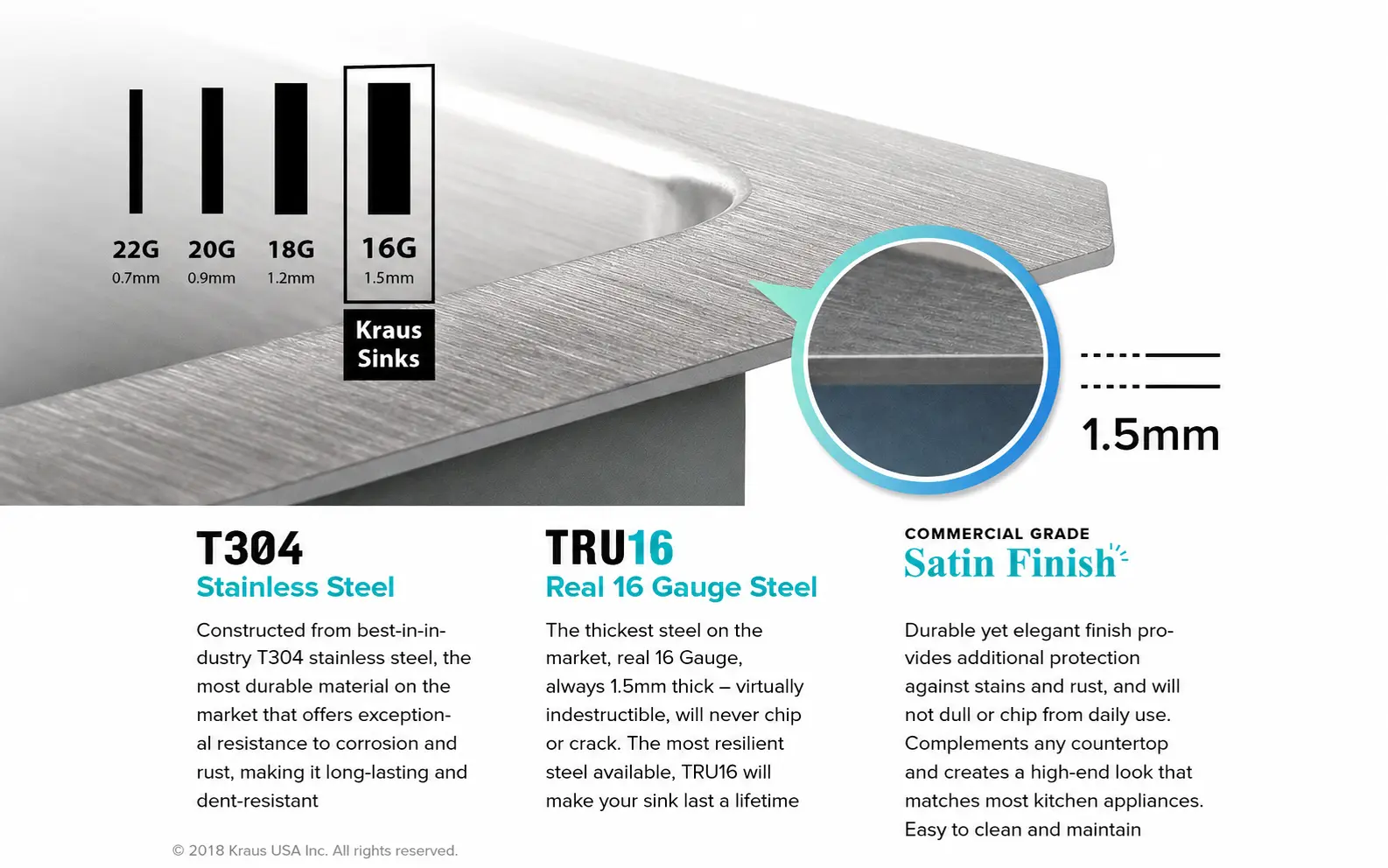
Gauge is not intuitive. A lower gauge number means thicker stainless steel. Buyers should not only ask for the gauge number — they should also confirm the actual millimeter thickness, tolerance, and measurement method.

16 GAUGE

Approx. 1.59 mm

0.0625 inch

Lower gauge number
= thicker steel
18 GAUGE

Approx. 1.21–1.27 mm

0.0478–0.0500 inch

Gauge conversion may vary slightly by chart and standard. Before placing an order, confirm the agreed thickness tolerance and whether the number refers to raw sheet thickness or finished sink thickness.

A quotation that says “16 gauge” is not a quality guarantee by itself. Ask where and when thickness is measured.

16 Gauge vs 18 Gauge Sink: Buyer Decision Matrix

For B2B buyers, the question is not simply “which is better?” The better question is: which gauge fits the product channel, price point, sink size, and after-sales risk?

Which is thicker?
16 Gauge:Thicker stainless steel, commonly around 1.59 mm depending on the agreed standard.
18 Gauge:Thinner stainless steel, commonly around 1.21–1.27 mm depending on the agreed standard.
Decision:Use 16 gauge when thickness is part of the selling point.
Which feels more premium?
16 Gauge:Heavier and more solid, especially in larger bowls.
18 Gauge:Still acceptable for many standard residential and project sinks.
Decision:Premium showrooms and higher-end brands usually prefer 16 gauge.
Which is quieter?
16 Gauge:Usually lower vibration and less sharp metallic noise.
18 Gauge:Can perform well with good sound pads and undercoating.
Decision:Do not evaluate noise by gauge alone. Check sound pad design.
Which resists dents better?
16 Gauge:Better resistance to denting and flexing.
18 Gauge:Suitable for many standard sizes, but large flat areas need care.
Decision:For large bowls and workstation sinks, 16 gauge is safer.
Which controls cost better?
16 Gauge:Higher material cost and heavier shipping weight.
18 Gauge:More cost-efficient for standard programs.
Decision:Use 18 gauge when price competitiveness matters.
Which is better for high-volume orders?
16 Gauge:Good for premium volume, but cost is higher.
18 Gauge:Better for cost-controlled large-volume supply.
Decision:Project and retail buyers often use 18 gauge for standard SKUs.
Which is better for workstation sinks?
16 Gauge:Usually better for ledges, accessories, and large bowls.
18 Gauge:Can work for simpler workstation designs.
Decision:Use 16 gauge when accessory support and premium feel matter.
Which is better for apartment projects?
16 Gauge:Suitable for premium apartments or upgraded specs.
18 Gauge:Practical for standard apartment and rental projects.
Decision:Match gauge to project grade and budget.
Which affects freight more?
16 Gauge:Heavier, increasing freight and handling impact.
18 Gauge:Lighter and easier to ship in bulk.
Decision:For volume exports, weight affects landed cost.
What is the biggest hidden risk?
16 Gauge:The order says 16 gauge, but finished thickness may not meet expectation.
18 Gauge:The sink may feel thin if structure, pads, and coating are weak.
Decision:Inspection must check actual thickness, structure, pads, and batch consistency.

What End Users Actually Notice

Most end users do not read gauge charts. They notice sound, denting, flexing, water spots, rust claims, drainage, and whether the sink feels solid. Gauge matters — but it is only one part of the sink experience.

Noise

“Will the sink sound thin or hollow?”

16 Gauge: Usually quieter because thicker steel reduces vibration.

18 Gauge: Can still be acceptable with proper sound pads and undercoating.

Buyer note: Sound pad coverage matters almost as much as gauge.

Dent Resistance

“Will pots and pans dent the bowl?”

16 Gauge: Better resistance, especially for large bowls.

18 Gauge: Works for standard sinks, but structure must be controlled.

Buyer note: Large flat surfaces need stronger material and better forming control.

Solid Feel

“Does the sink feel premium?”

16 Gauge: Heavier and more solid in hand.

18 Gauge: Can feel practical but less premium in large formats.

Buyer note: For showroom and retail display, touch and sound influence perceived value.

Cost and Margin

“Can this SKU hit the target price?”

16 Gauge: Higher material cost, higher perceived value.

18 Gauge: Better for cost-sensitive volume programs.

Buyer note: The right gauge should protect both sales price and margin.

Shipping Weight

“Will freight cost increase?”

16 Gauge: Heavier and may require stronger packaging.

18 Gauge: Lighter and easier for volume logistics.

Buyer note: Gauge affects landed cost, not only factory price.

Choose Gauge by Product Program, Not by Marketing Claim

A premium sink line, a retail boxed program, an apartment project, and a private-label range do not need the same gauge strategy.

Mostly 16 Gauge

Premium Kitchen Sink Brand

Premium buyers notice weight, sound, bowl size, and overall feel. 16 gauge supports large single bowls, workstation sinks, and stronger product positioning.

Often 18 Gauge

Apartment or Rental Project

Project buyers usually need stable dimensions, controlled cost, repeatable supply, and easy replacement. A well-made 18 gauge sink can be practical for standard projects.

Use Both

Retail Boxed Product Line

18 gauge can serve entry-level and mid-range SKUs. 16 gauge can support premium boxed sets with accessories and stronger shelf value.

Prefer 16 Gauge

Workstation Sink Program

Workstation sinks often carry cutting boards, roll-up racks, colanders, and bottom grids. Thicker material supports a stronger product feel and better premium positioning.

18 Gauge or Mixed

Cost-Sensitive Wholesale Range

For fast-moving standard SKUs, 18 gauge may be more competitive. The key is to control sound pads, finish, structure, and packaging.

Build a Price Ladder

Private-Label Brand

A private-label range can use 18 gauge for standard models and 16 gauge for premium models, creating a clearer product ladder instead of one flat product line.

The Hidden Risk: Paying for 16 Gauge Without Receiving a True 16 Gauge Sink

The problem is not only the gauge number. It is how the gauge is defined, measured, and controlled in production.

A buyer may confirm “16 gauge” on the quotation, sample label, or purchase order. But the finished sink can still disappoint if the thickness is based only on raw sheet material, if local areas become thinner after forming, or if polishing and finishing reduce measurable thickness. In bulk orders, the risk becomes bigger when material control, sound pad coverage, and batch inspection are not clearly documented.

Raw Sheet Thickness vs Finished Sink Thickness

A supplier may quote the raw stainless steel sheet thickness, but buyers care about the finished sink. Bowl, rim, corner, and stress areas should meet the agreed tolerance.

Buyer question: Where is the thickness measured?

Sample Thickness vs Bulk Order Thickness

The sample may look solid, but bulk orders need the same material grade, gauge, sound pad coverage, finish, and packaging.

Buyer question: How do you control batch consistency?

16 Gauge Claim with Weak Structure

Thicker steel does not fix weak ledges, poor welding, uneven bottom structure, thin undercoating, or weak packaging.

Buyer question: What is included in the inspection checklist?

304 Grade Claim Without Verification

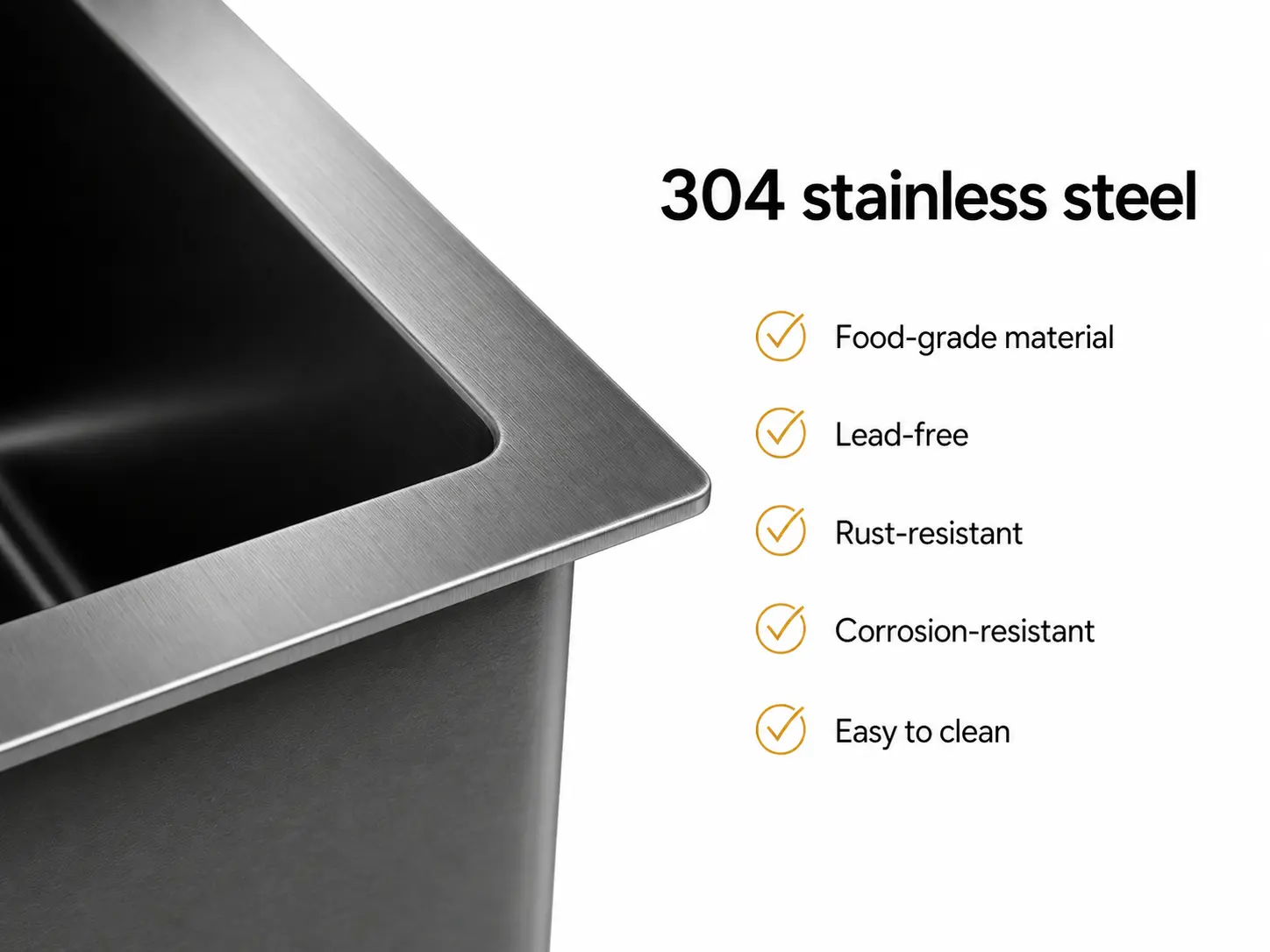
Gauge is not the same as material grade. A thick sink made from the wrong stainless steel may still create corrosion or warranty risk.

Buyer question: Can the material grade be verified when needed?

A serious buyer should not ask only, "Is it 16 gauge?"

A serious buyer should ask, "How do you prove it stays within tolerance after production?"

Ask Matrix for a Gauge Inspection Checklist

What Buyers Should Check Before Confirming the Order

Before approving a 16 gauge or 18 gauge sink program, buyers should define what will be measured, where it will be measured, and how batch consistency will be controlled.

Gauge and mm thickness
Why:Gauge alone can be confusing without actual thickness.
Ask:What is the agreed mm thickness and tolerance?
Measurement location
Why:Thickness can vary across bowl, rim, corner, and formed areas.
Ask:Where will thickness be checked?
Raw sheet vs finished sink
Why:Forming and polishing may affect measurable thickness.
Ask:Is the gauge based on raw material or finished product?
Material grade
Why:304, 201, and 430 stainless steel perform differently in corrosion resistance.
Ask:Can material be verified if required?
Sound pad coverage
Why:Noise complaints depend on both gauge and sound control.
Ask:What percentage of the bowl is covered?
Undercoating quality
Why:Coating helps reduce noise and condensation.
Ask:Is coating thickness and coverage inspected?
Bowl and rim flatness
Why:Flatness affects installation and perceived quality.
Ask:How is flatness controlled before packing?
Drain position
Why:Incorrect drain position affects installation and accessory fit.
Ask:What tolerance is used for drain position?
Accessory fit
Why:Workstation accessories need accurate ledge and bowl dimensions.
Ask:Are cutting boards, grids, and colanders test-fitted?
Packaging protection
Why:Heavy 16 gauge sinks need proper protection during export.
Ask:How is packaging tested for shipment?

Matrix Helps Buyers Choose the Right Gauge for the Right Program

Matrix supports stainless steel sink programs across different gauge, installation, finish, structure, accessory, and packaging requirements. Instead of pushing every buyer toward 16 gauge, we help match the gauge to your market, sales channel, target price, and product positioning.

16 Gauge Premium Sink Programs

For premium handmade sinks, workstation sinks, deep bowls, large single bowls, stronger shelf value, and higher-end private-label programs.

Explore 16 Gauge Sinks →

18 Gauge Standard Sink Programs

For standard residential sinks, apartment projects, retail boxed programs, cost-controlled wholesale ranges, and repeatable volume supply.

Explore Stainless Steel Sinks →

Mixed Gauge Product Lines

Use 18 gauge for standard SKUs and 16 gauge for premium SKUs. Matrix can help build a clear product ladder for your market.

Request Product Program Advice →

Matrix can support:

gauge selection
material grade control
size & installation
handmade & pressed
finish options
accessory matching
logo & carton support
sample development
batch inspection
repeat-order control

FAQ: 16 Gauge vs 18 Gauge Sink

Is a 16 gauge sink better than an 18 gauge sink?
16 gauge is thicker and usually feels more premium, quieter, and more dent-resistant. But 18 gauge can still be a good choice for standard residential, retail, and project programs when the structure, sound pads, finish, and material quality are controlled.
What is the thickness difference between 16 gauge and 18 gauge stainless steel?
16 gauge stainless steel is commonly around 1.59 mm, while 18 gauge stainless steel is commonly around 1.21–1.27 mm depending on the gauge chart and standard used.
Is 18 gauge too thin for a kitchen sink?
Not always. 18 gauge is commonly used for many residential and project sinks. It becomes a problem when the sink is poorly designed, lacks sound pads, has weak structure, or uses inconsistent material.
When should buyers choose 16 gauge?
Choose 16 gauge for premium product lines, large single bowls, workstation sinks, deep bowls, higher-end retail programs, and buyers who want stronger perceived quality.
When is 18 gauge a better choice?
18 gauge is often better for standard sink ranges, apartment projects, retail boxed products, cost-sensitive wholesale programs, and high-volume supply where price balance matters.
Does 16 gauge make a sink quieter?
Usually yes, because thicker stainless steel can reduce vibration. However, sound pad coverage and undercoating also play a major role in noise control.
Can a supplier claim 16 gauge but ship thinner sinks?
The risk exists if thickness is not clearly defined and inspected. Buyers should confirm whether the gauge refers to raw sheet thickness or finished sink thickness, and ask for measurement records when needed.
Is gauge more important than stainless steel grade?
No. Gauge and material grade both matter. A thicker sink made from the wrong stainless steel may still create corrosion or warranty risks. Buyers should check both thickness and stainless steel grade.
Should a private-label brand use only 16 gauge sinks?
Not necessarily. Many private-label ranges use 18 gauge for standard SKUs and 16 gauge for premium SKUs to build a clearer price ladder.
What should buyers ask before confirming a gauge?
Ask for the agreed millimeter thickness, tolerance, measurement location, whether the thickness is checked before or after forming, material grade verification, and batch inspection method.
Can Matrix help choose the right gauge?
Yes. Matrix can review your target market, price level, order quantity, installation type, finish, accessory plan, and packaging needs to recommend a suitable gauge strategy.

Not Sure Whether 16 Gauge or 18 Gauge Fits Your Market?

Send us your target market, expected price level, sink size, installation type, finish, order quantity, and packaging needs. Matrix can help you decide whether 16 gauge, 18 gauge, or a mixed gauge product line fits your program better.

Direct Contact:

Email: tenly@matrixsink.com

Phone: +18520999956

Request Sink Gauge Advice

Tell us your target sink type, market, size, finish, quantity, and packaging requirement. Matrix will help review whether 16 gauge, 18 gauge, or a mixed product line fits your program better.

Matrix will reply with practical product direction, not just a price list.