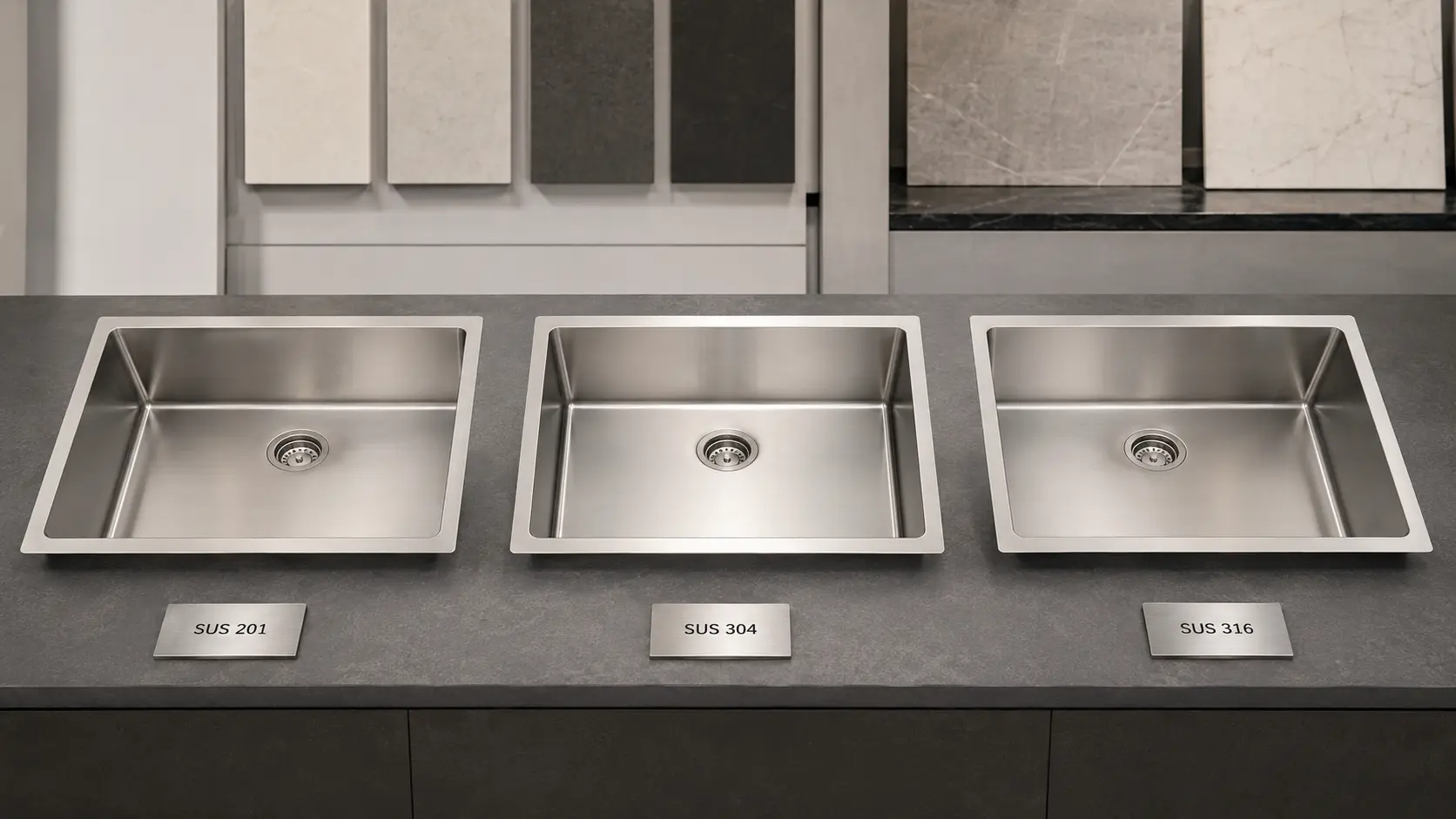
The usual answer is simple: 201 is the budget option, 304 is the standard choice, and 316 is the premium choice.
It is also incomplete.
The steel grade mainly changes the sink’s corrosion margin. It does not tell you whether the bowl drains well, the rim stays flat, the finish hides scratches, or the packaging survives export.
For most indoor kitchen programs, a well-made 304 stainless steel kitchen sink is the practical benchmark. A 201 sink can work for a value-led range when the application and care expectations are controlled. A 316 sink makes sense when chloride exposure—not premium wording—is the real concern.
The short answer
| Grade | What changes | Best fit | Main buyer risk |
|---|---|---|---|
| 201 | Uses more manganese and less nickel than 304; generally has a lower corrosion margin | Cost-sensitive indoor programs where 201 is accepted and care conditions are clear | Selling it into an environment or price tier that expects 304 |
| 304 | Balanced corrosion resistance, formability and market acceptance | Most residential, retail, private-label and general project sink programs | Assuming a “304” stamp proves the full specification |
| 316 | Adds molybdenum for better resistance to pitting and crevice corrosion in chloride environments | Coastal, outdoor or chloride-heavy applications after the exposure is reviewed | Paying more without improving the issues customers actually notice |
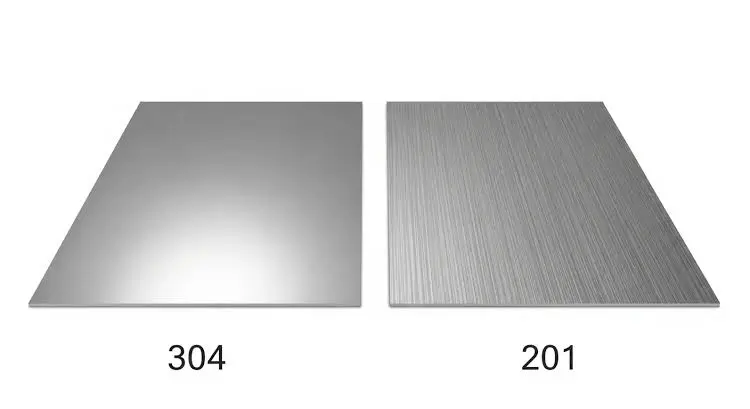
The practical rule: choose the grade for the environment, then judge the sink as a complete product.
At Matrix Sink, we treat material grade as one part of a B2B sink specification. Our current public material range includes SUS201 and SUS304 for selected sink programs, with the final choice reviewed against the model, construction, gauge, finish, target market and order requirements.
Counterintuitive truth #1: 316 does not automatically make a better sink
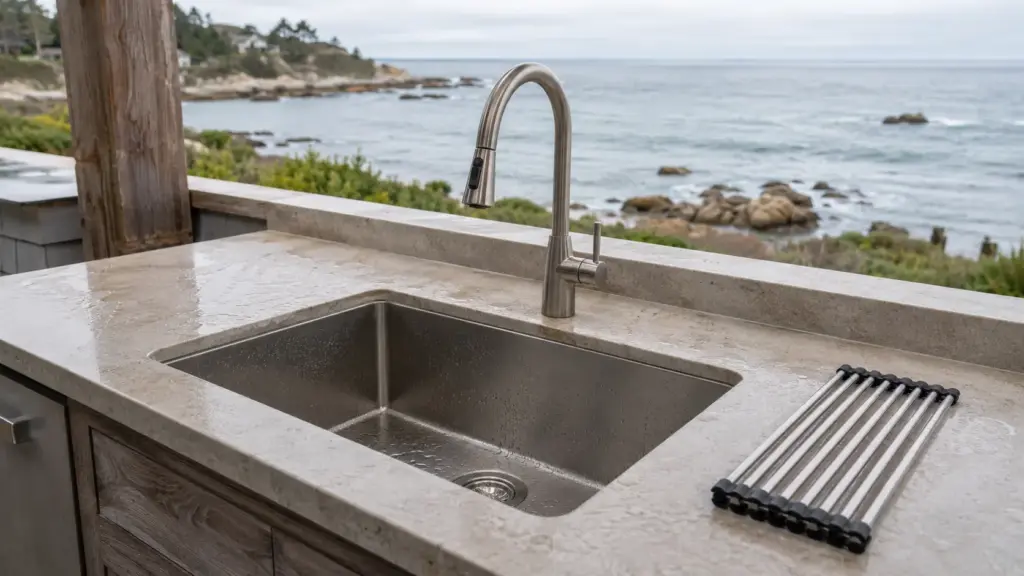
316 stainless steel offers a real technical advantage. As worldstainless explains, its molybdenum content improves resistance to localized corrosion, especially in chloride-containing environments.
But changing 304 to 316 does not automatically improve:
- Sheet thickness or finished bowl thickness
- Drainage slope or water evacuation
- Rim flatness and cut-out accuracy
- Sound pad coverage
- Welding and polishing
- Scratch visibility
- Accessory fit
- Export packaging
A poorly engineered 316 sink can still be a poor product. A well-engineered 304 sink can be the better commercial choice for a normal indoor kitchen. This is why professional buyers should review the wider sink sourcing risks instead of relying on the alloy number alone.
For a distributor, the useful question is not “Can we put 316 on the carton?” It is “Will our use environment justify the extra material cost and support the retail price?”
Counterintuitive truth #2: 201 is real stainless steel
According to the worldstainless overview of stainless steel grades, 201 belongs to the 200-series austenitic stainless steel family. It is not automatically fake steel.
Its alloy design replaces part of the nickel used in 304 with manganese and nitrogen. This helps control cost and can provide useful strength after forming. The trade-off is a lower corrosion margin than 304, particularly among lower-nickel, lower-chromium 200-series variants.
That makes 201 a positioning decision, not a universal substitute for 304.
201 may suit:
- Value-led indoor sink ranges
- Price-sensitive retail or project programs
- Markets where the grade is clearly disclosed and accepted
- Applications with controlled cleaning and limited salt or chloride exposure
It is a weaker fit when the product will face coastal air, outdoor exposure, aggressive chloride cleaners, prolonged salty residues, or a market that treats 304 as the entry expectation.
The biggest risk is often not the grade itself. It is a mismatch between the material, the sales claim and the use environment.
Why 304 is the default for most kitchen sink programs
304 is commonly described as “18/8” stainless because its nominal composition is around 18% chromium and 8% nickel. Outokumpu describes 304 as a widely used grade that balances corrosion resistance, formability and weldability.
For B2B sink buyers, 304 usually offers the simplest route to:
- Broad market acceptance
- Familiar product positioning
- Reliable forming for pressed and handmade sinks
- A reasonable corrosion margin for normal indoor kitchens
- Easier comparison across suppliers and product ranges
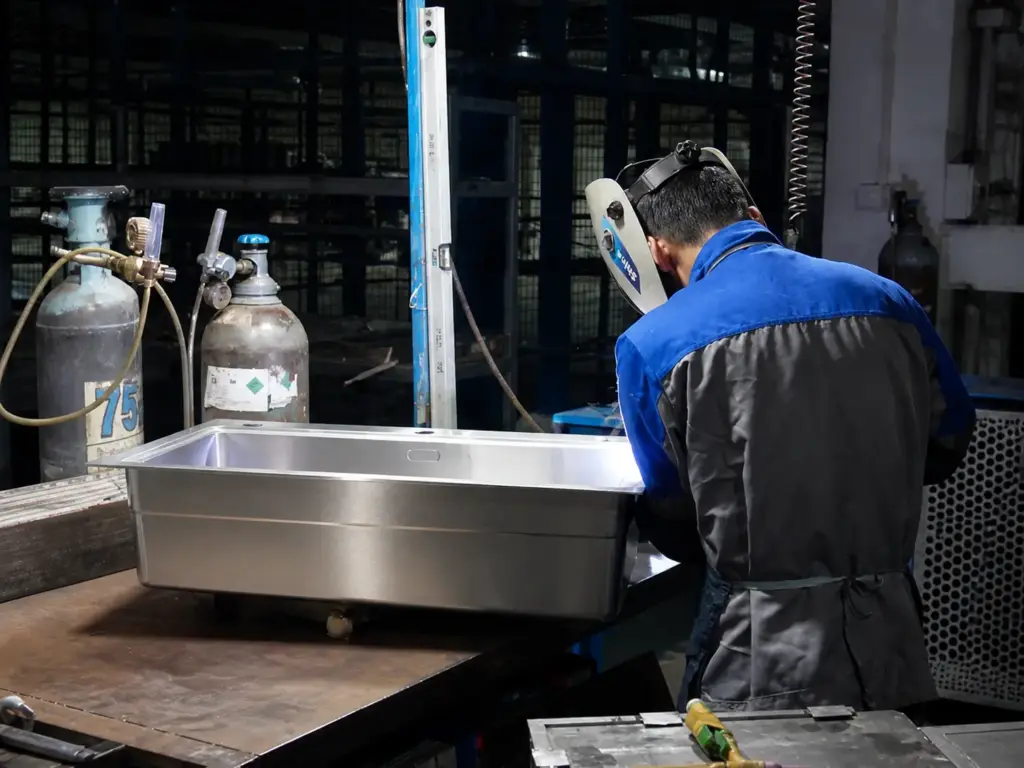
That does not make every 304 sink equal. Material grade is only one line in the specification. Matrix develops both handmade stainless steel sinks and pressed/drawn sinks, and the manufacturing route changes what buyers need to control after the grade is selected.
When 316 is worth considering
316 becomes relevant when the sink faces a more aggressive chloride environment. Examples may include:
- Coastal or marine locations
- Outdoor kitchens near salt air
- Applications exposed to frequent salty residues
- Selected commercial or specialist environments using chloride-bearing chemicals
Even here, “outdoor” does not automatically mean “316.” Exposure severity, cleaning frequency, surface finish, contaminants and maintenance all matter. Buyers planning an exterior range should therefore review the complete outdoor kitchen sink program rather than changing the bowl grade in isolation.
For a 316 program, buyers should first establish:
- What is the actual exposure?
- Is chloride-driven corrosion a known warranty problem?
- Will the channel pay for the upgrade?
- Are the drain, accessories and other metal parts specified for the same environment?
- Can the material requirement be verified consistently?
If those questions are unanswered, 316 may be an expensive label rather than a useful product improvement.
A magnet cannot prove that a sink is 304
This is one of the most persistent sink-buying myths.
The Nickel Institute notes that annealed austenitic stainless steels are generally non-magnetic, but cold working can make them partly magnetic. A formed 304 sink may therefore attract a magnet more strongly around corners, drawn areas, drilled holes or worked edges.
So:
- Magnet attraction does not automatically mean the sink is not 304
- No magnet attraction does not prove that it is 304
- A magnet cannot reliably separate 201, 304 and 316 on its own
If material identity matters, define the grade in the purchase specification and agree on an appropriate chemistry-verification method. Do not use a refrigerator magnet as the acceptance standard.
Stainless steel is corrosion-resistant, not rust-proof
Even a genuine 304 or 316 sink can show rust-like staining.
Possible causes include:
- Iron or carbon-steel contamination during production, storage or installation
- Metal particles left by tools or abrasive pads
- Chloride-containing cleaners
- Salty residue left on the surface
- Standing deposits and poor cleaning
- Contamination from other items placed in the bowl
This matters for after-sales teams. A rust complaint should trigger an investigation into the material, stain pattern, cleaning history and possible contamination—not an instant conclusion based on a photograph.
What matters beyond 201, 304 or 316
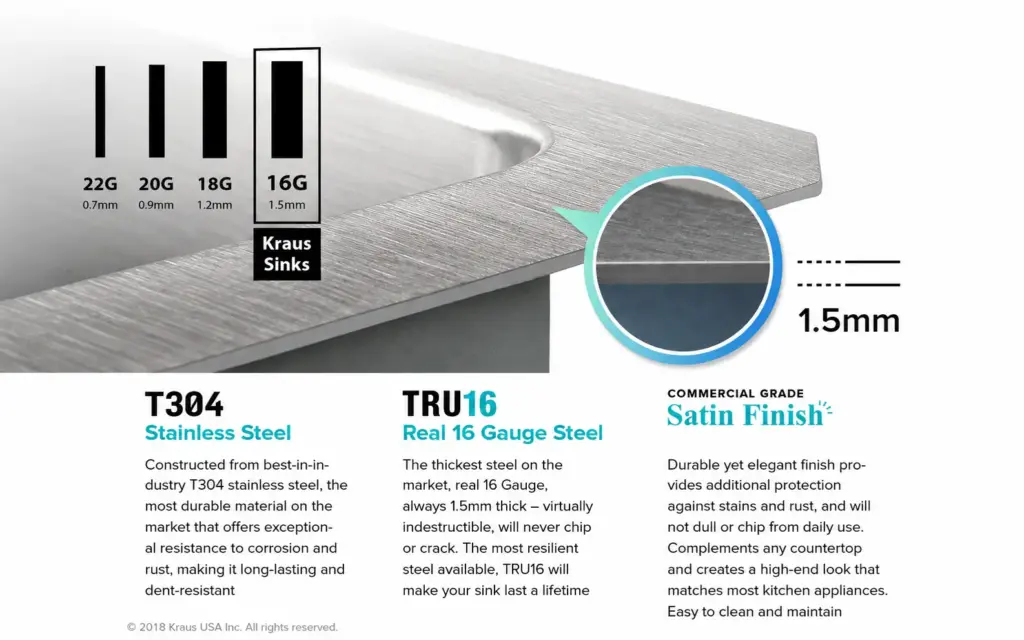
End users rarely evaluate alloy chemistry. They notice whether the sink feels solid and works properly.
For a reliable product program, review the grade together with:
1. Finished thickness
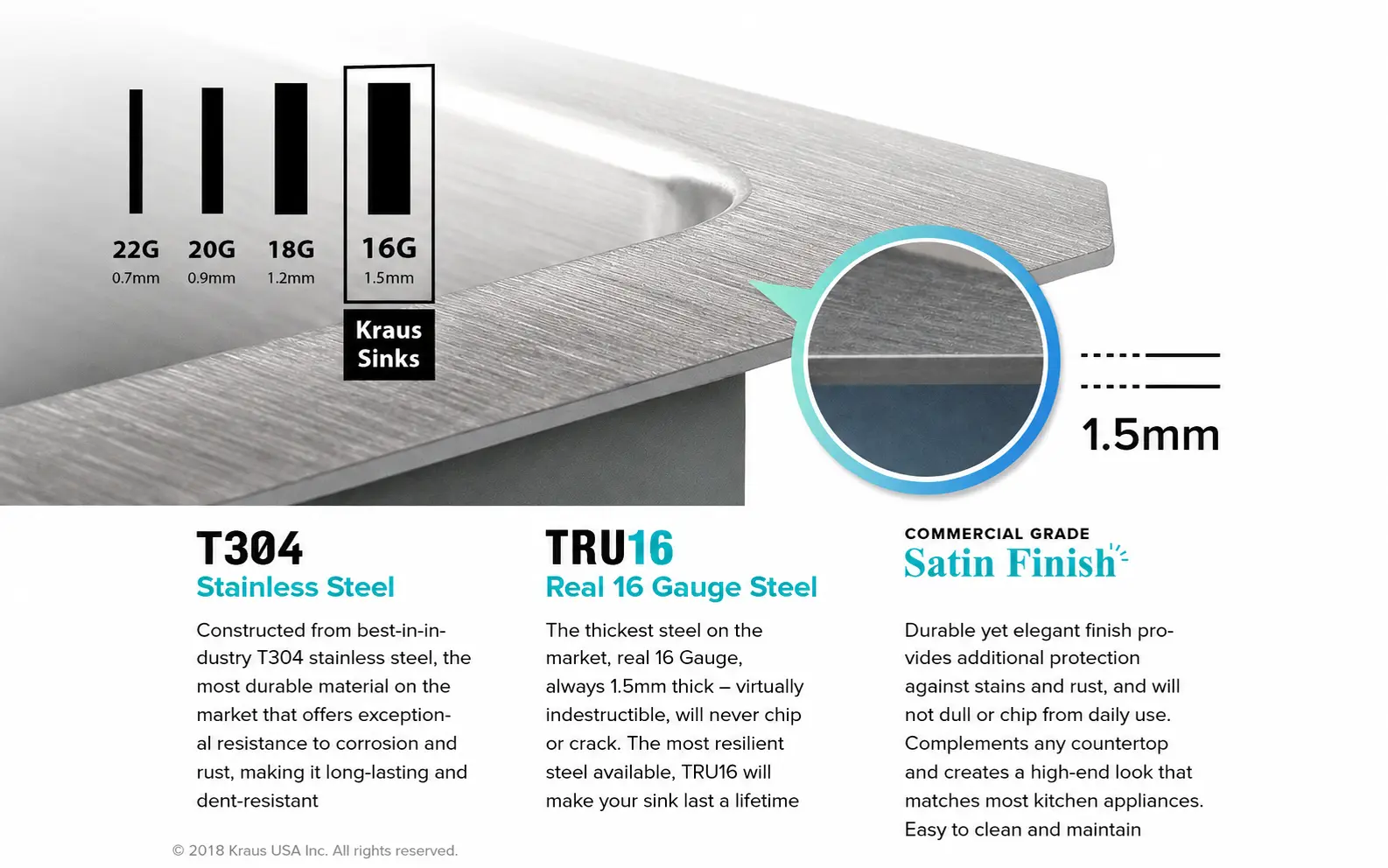
Raw sheet thickness and finished bowl thickness are not always identical, especially after deep drawing. Define where and how thickness will be checked. The 16 gauge vs 18 gauge sink guide explains why grade and thickness need separate acceptance criteria.
2. Surface finish
Brushing direction, polishing consistency and surface cleanliness influence appearance, scratch visibility and ease of care. “Satin” or “brushed” should not be the entire finish specification.
3. Drainage
Bottom geometry and drain position affect water pooling. A more expensive alloy cannot correct a flat or poorly controlled bowl bottom.
4. Forming, welding and rim control
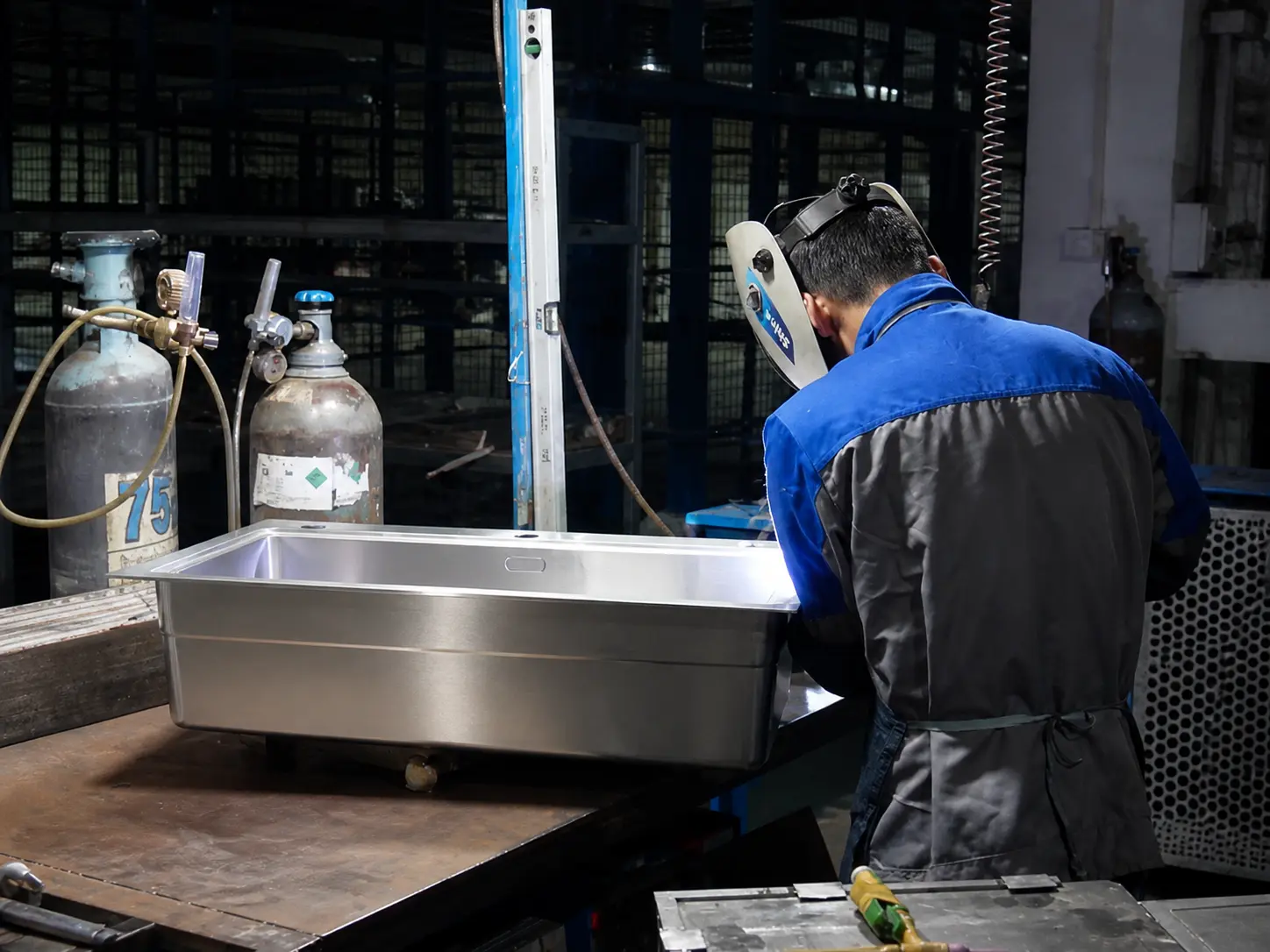
Pressed sinks need stable forming and trimming. Handmade sinks need controlled welding, corner finishing and rim flatness. Buyers can review both production paths in Matrix’s stainless steel sink manufacturing overview.
5. Pads, coating and packaging
Sound pads, undercoating and export protection affect perceived quality and after-sales risk. None of them is defined by the steel grade.
A practical selection framework for B2B buyers
Choose 201 when:
- The program is clearly value-led
- The intended market accepts 201
- The sink is for controlled indoor use
- Material disclosure and care guidance are clear
- Cost savings are more valuable than additional corrosion margin
Choose 304 when:
- The sink is for a mainstream indoor kitchen
- The product needs broad wholesale or retail acceptance
- The range includes private-label, project or general residential models
- You need a balanced material specification without unnecessary cost
Consider 316 when:
- Chloride exposure is materially higher than in a normal kitchen
- The application is coastal, marine-adjacent, outdoor or specialist
- Corrosion-related warranty exposure justifies the upgrade
- The whole sink set—not only the bowl—is reviewed for the environment
What to put in the purchase specification
A verbal “304 quality” request is not enough. At minimum, define:
- Stainless steel grade
- Nominal and finished thickness expectations
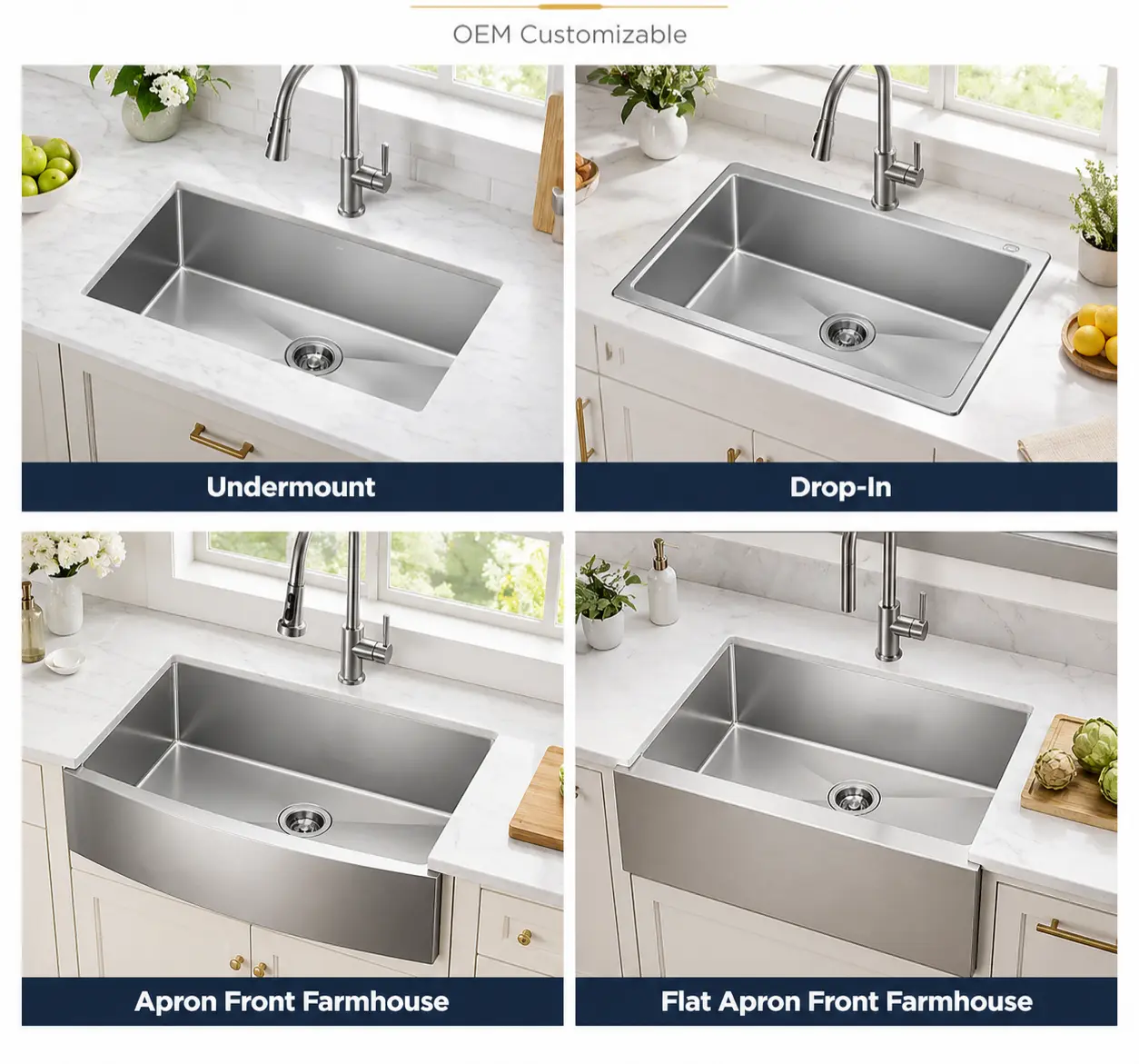
- Sink construction and installation type
- Bowl size, depth, radius and drain position
- Surface finish and visible-surface standard
- Sound pad and undercoating requirements
- Accessory materials and fit
- Packaging method
- Sample approval and repeat-order consistency requirements
- Material verification method, if required
A grade stamp is a label. A controlled specification is a purchasing system.
For OEM buyers, these requirements should be connected to the approved sample, logo position, accessory list, packing reference and repeat-order standard. Matrix’s private-label sink programs are structured around that complete product definition—not simply adding a logo to a generic sink.
How Matrix applies this to B2B sink programs
Matrix Manufacture Co., Ltd. is a kitchen and bath manufacturer based in Zhongshan, Guangdong, China. We work with importers, wholesalers, distributors, kitchen and bath brands, online retailers and project suppliers.
Our stainless steel sink work covers handmade and pressed/drawn production, model selection, drawing review, sample development, accessory matching, OEM branding, export packing and repeat-order specification review.
When a buyer asks whether to use 201 or 304, we start with four commercial questions:
- Where and how will the sink be used?
- What grade does the target channel expect?
- What price tier and warranty exposure must the product support?
- Which construction, gauge, finish and packing specification belongs with that grade?
This prevents two common mistakes: under-specifying a sink that will generate complaints, or paying for material performance the market neither needs nor recognizes.
Final recommendation
For most indoor kitchen sink programs, 304 is the sensible starting point—not because it is the highest grade, but because it offers the best balance of performance, acceptance and cost.
Use 201 deliberately for value-led programs. Consider 316 when the environment creates a real chloride-corrosion case. Then evaluate thickness, finish, drainage, structure, accessories and packaging before calling one sink “better” than another.
Matrix supports B2B buyers in developing SUS201 and SUS304 stainless steel sink programs for wholesale, project and private-label applications. Exact material availability and specifications should be confirmed for the selected model before sampling.
If you are comparing material options for a new or existing sink range, send us your target market, intended application, sink size, installation type, gauge, finish, estimated quantity and current reference model.
Discuss Your Stainless Steel Sink Program
Frequently asked questions
Is 316 stainless steel always better than 304 for a kitchen sink?
No. 316 provides more resistance to localized corrosion in chloride environments, but it does not automatically improve thickness, drainage, noise control, finish or workmanship. For most normal indoor kitchens, 304 is the more practical balance.
Is 201 stainless steel suitable for kitchen sinks?
It can be suitable for value-led indoor programs when the market accepts the grade and exposure is controlled. It has less corrosion margin than 304, so it should not be positioned as an identical substitute in every environment.
Can a magnet identify a 304 stainless steel sink?
No. Cold forming can make austenitic stainless steel partly magnetic, especially around worked areas. A magnet alone cannot reliably distinguish 201, 304 and 316.
Can a genuine 304 stainless steel sink show rust stains?
Yes. Rust-like marks can result from iron contamination, chloride cleaners, salty deposits, tools or other metal particles. The cause should be investigated before deciding that the material grade is wrong.
Is 316 stainless steel more scratch-resistant than 304?
Do not use the grade alone to make a scratch-resistance claim. Scratch visibility and field performance also depend on surface finish, polishing, use, cleaning method and protective accessories.
What is the best stainless steel grade for an outdoor kitchen sink?
It depends on the environment. A sheltered inland installation and a coastal installation do not have the same exposure. For salt air or significant chloride exposure, 316 may provide a useful advantage, but the full sink and accessory specification still needs review.