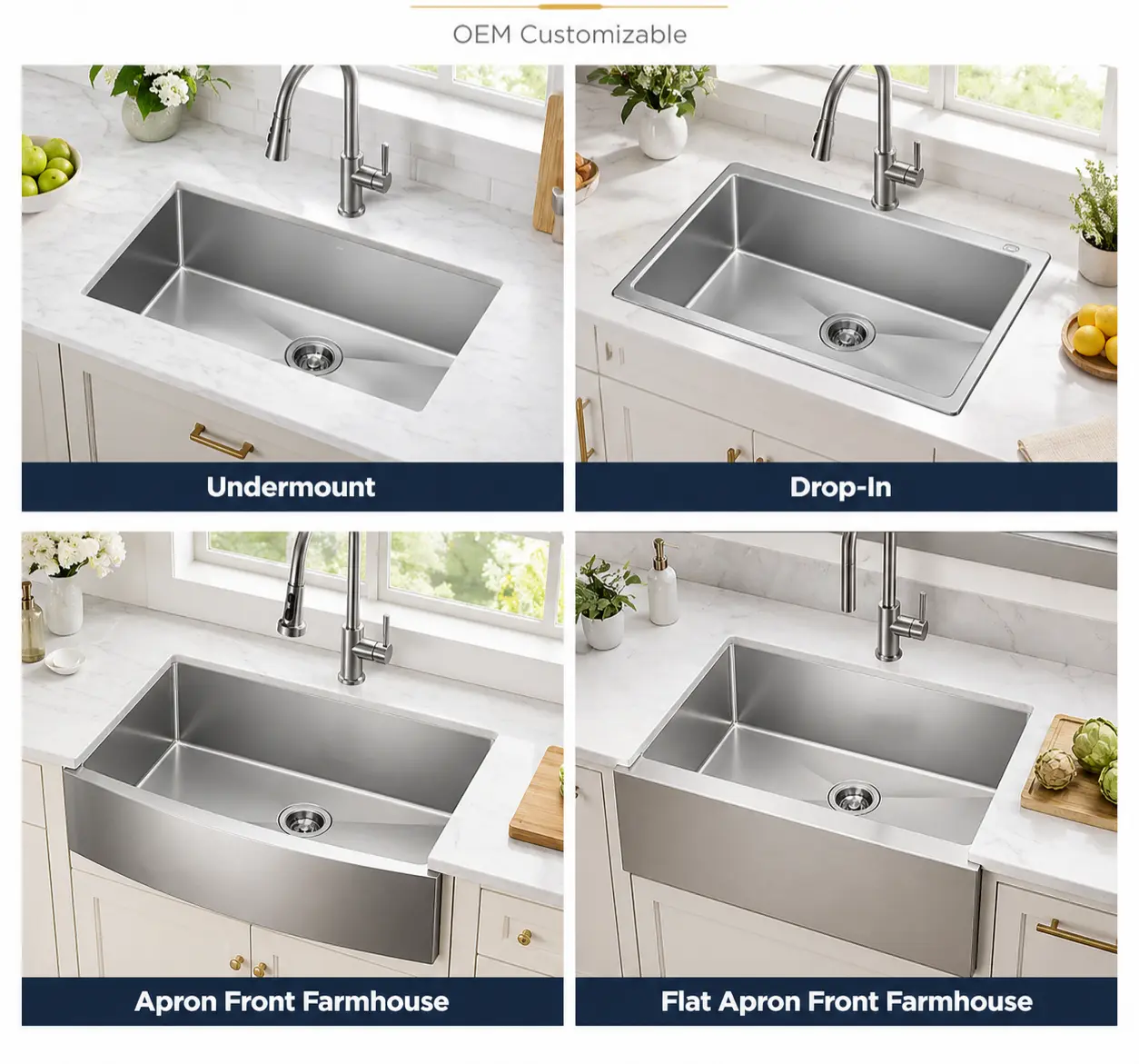
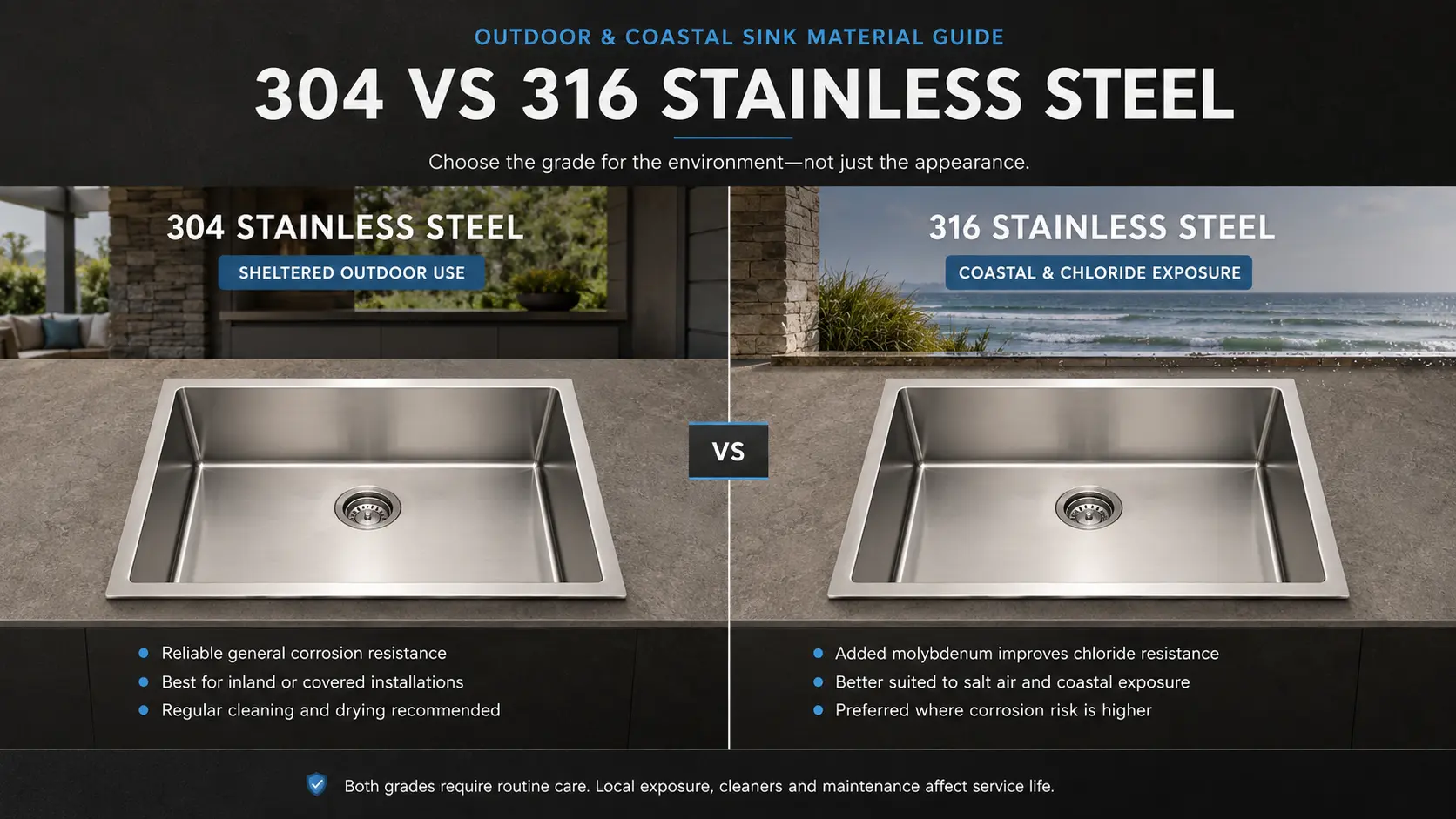
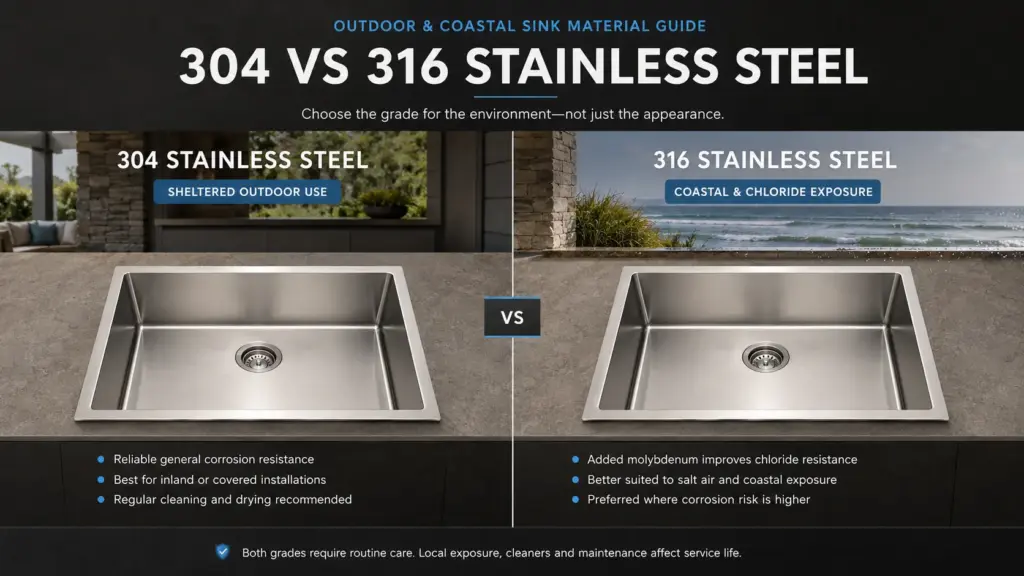
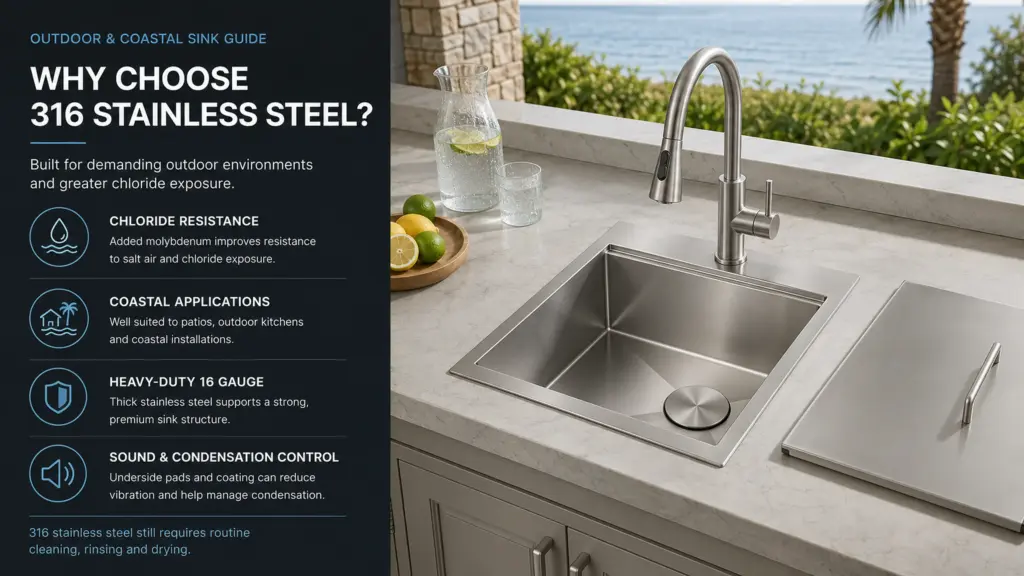
304 stainless steel is usually the best balance of performance and cost. For a coastal, salt-air, humid or poolside kitchen, 316 is generally the safer starting grade because its molybdenum improves resistance to chloride-related pitting and crevice corrosion.
For direct seawater splash, warm brine or continuously wet salt exposure, do not assume 316 is sufficient without a site-specific material review.
The most important point is:
316 provides more corrosion resistance than 304, but grade alone does not make an outdoor sink corrosion-proof.
Surface finish, weld cleaning, salt retention, drainage, accessory materials, iron contamination and freshwater maintenance can determine whether either grade performs well.
When comparing a 304 vs 316 stainless steel outdoor sink, select the exposure class first. Compare price, gauge and appearance only after the environment is understood.
60-Second Selection Guide
Choose 304 stainless steel when:
- The outdoor kitchen is inland.
- The sink is covered or only mildly exposed.
- Salt air and pool chemicals are absent.
- Freshwater cleaning is routine.
- The project prioritizes value and broad availability.
Choose 316 stainless steel when:
- The site is coastal or receives airborne salt.
- The sink is beside a swimming pool.
- Humidity is high and surfaces remain wet.
- The sink is sheltered from rain washing.
- Appearance complaints or maintenance access are major concerns.
Request a more specialized material review when:
- The sink receives direct seawater.
- Saltwater is allowed to stand.
- Warm chloride solutions contact the sink.
- The application is in a severe splash zone.
- Cleaning is infrequent or impossible.
- The project requires a defined long-term corrosion-life commitment.
304 vs 316 Stainless Steel: What Actually Changes?
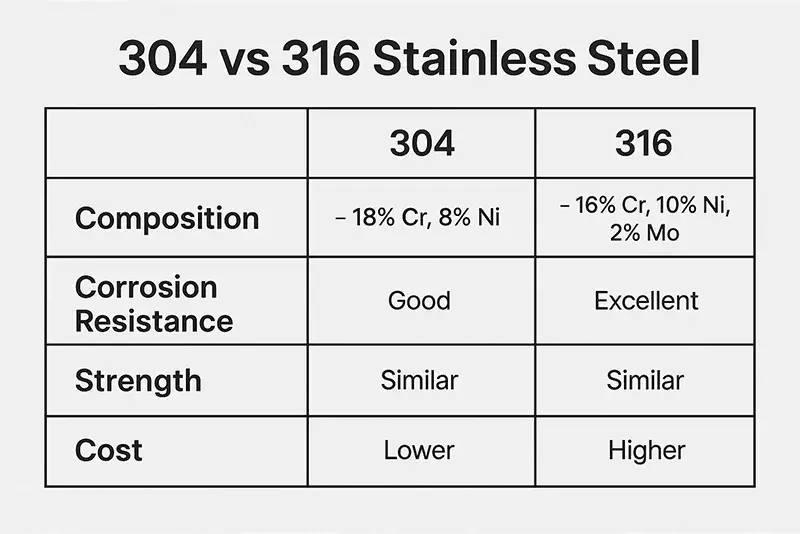
Both 304 and 316 are austenitic stainless steels. Chromium supports the passive oxide film that gives stainless steel its corrosion resistance, while nickel helps stabilize the austenitic structure and supports fabrication performance.
The key outdoor difference is molybdenum.
| Grade | Typical alloy direction | Practical meaning |
|---|---|---|
| 304 | Chromium-nickel stainless steel without a deliberate molybdenum addition | Strong general corrosion resistance for indoor and mild outdoor kitchens |
| 316 | Chromium-nickel stainless steel with roughly 2–3% molybdenum | Better resistance to localized chloride attack |
| 304L | Lower-carbon version of 304 | Useful for controlling welding-related sensitization; not a major upgrade for chloride pitting |
| 316L | Lower-carbon version of 316 | Useful for welded fabrication while retaining 316-type chloride resistance |
The Nickel Institute describes molybdenum-containing 316 as more resistant to pitting than 304 in chloride-containing service. See its stainless material guidance.
Actual chemical limits depend on the applicable material specification. Do not approve a grade from a marketing name alone.
Why Molybdenum Matters Near Salt
Stainless steel protects itself with a thin, chromium-rich passive film.
In a clean and oxygenated environment, this film can remain stable and reform after minor damage. Chloride ions make localized breakdown more likely.
The simplified corrosion chain is:
- Salt lands on the surface.
- Humidity or water dissolves the salt.
- Evaporation concentrates the chloride solution.
- Chlorides attack a weak point in the passive film.
- A small pit or crevice becomes chemically more aggressive.
- Localized corrosion continues even while most of the surface still looks clean.
Molybdenum increases resistance to this localized attack. It delays the start of pitting and crevice corrosion under many chloride exposures.
It does not remove chlorides, drain water, clean welds or eliminate crevices. Those functions still depend on design, manufacturing and maintenance.
Four Outdoor Exposure Classes
The phrase “outdoor sink” covers very different environments. Use the following classes as a practical project-screening tool.
E1: Protected Inland Outdoor Kitchen
Typical conditions:
- Covered patio or BBQ island
- Far from surf and salt aerosols
- No pool splash
- Moderate humidity
- Regular household cleaning
Recommended starting point:
- 304 is commonly appropriate.
- 316 may be chosen for a premium specification or lower maintenance risk.
Main concerns:
- BBQ grease
- Hard-water deposits
- Condensation
- Construction contamination
- Standing water
E2: Open, Humid or Polluted Outdoor Kitchen
Typical conditions:
- Semi-open or fully exposed installation
- High humidity or frequent rain
- Urban or industrial deposits
- Long periods of non-use
Recommended starting point:
- Review 304 and 316 against the actual microclimate.
- 316 provides additional margin where deposits and wetness are persistent.
Main concerns:
- Time of wetness
- Pollutants
- Debris and organic residue
- Cabinet ventilation
- Difficult cleaning access
E3: Coastal Atmosphere or Poolside Kitchen
Typical conditions:
- Airborne marine salt
- Salt fog after storms
- Pool splash or wet equipment
- Warm and humid microclimate
- Sheltered surfaces without rain washing
Recommended starting point:
- 316 or 316L is generally preferred.
- Specify finish, fabrication cleaning and freshwater maintenance as part of the system.
Main concerns:
- Tea staining
- Pitting
- Crevice corrosion
- Accessory corrosion
- Salt concentration under grids and rims
E4: Direct Seawater, Severe Splash or Stagnant Brine
Typical conditions:
- Dock, boat, bait-preparation or waterfront service use
- Direct seawater rinsing
- Repeated wet-dry salt cycles
- Warm saltwater
- Seawater retained in crevices
Recommended starting point:
- Do not treat standard 316 as an automatic solution.
- Obtain specialist review of alloy, finish, joint design and maintenance.
Main concerns:
- Rapid localized corrosion
- Shielded wet crevices
- Biological deposits
- Concentrated salt after evaporation
- Inadequate freshwater flushing
The British Stainless Steel Association notes that 316 is widely used in marine applications but has limitations in seawater and cannot be considered corrosion-proof under all conditions. Review its seawater guidance.
Distance from the Ocean Is Not a Complete Specification
Distance is useful for screening, but it does not describe actual salt deposition.
Corrosivity also depends on:
- Prevailing wind
- Wave and surf activity
- Storm exposure
- Elevation
- Nearby buildings
- Temperature
- Humidity
- Industrial pollution
- Rain washing
- Shelter
- Surface orientation
Industry guidance commonly treats locations close to surf as higher-risk, but salt effects can extend much farther under unfavorable wind, temperature and shelter conditions. The Australian Stainless Steel Development Association notes that tea staining is most common close to surf but can occur much farther inland when local conditions are aggressive. See its coastal tea-staining guidance.
Do not write “316 required within X kilometers” as the only project rule. Use location plus microclimate and maintenance conditions.
The Sheltered-Coastal Paradox
A roof may protect a sink from leaves, direct rain and sunlight. Near the coast, that same roof can prevent freshwater rain from washing away airborne salt.
Salt gradually accumulates. Humidity repeatedly dissolves the deposit, and drying concentrates it again.
This is why a sheltered coastal sink can develop more staining than a freely rain-washed surface nearby.
The conclusion is not that every sink should be left exposed. It is:
If natural washing is blocked, planned freshwater cleaning becomes more important.
The International Molybdenum Association identifies sheltered, hot and humid coastal areas without rain washing as conditions where even 316 may develop tea staining unless finish and design are improved. See its coastal-environment guidance.
Salt Air Is Different from Direct Seawater
Atmospheric Coastal Exposure
Salt particles settle from the air. The surface may become damp from humidity, condensation or rain.
Typical risks:
- Tea staining
- Local pitting
- Salt retention in brush lines
- Crevice corrosion below accessories
316 is commonly effective when finish, design and cleaning are appropriate.
Direct Seawater Exposure
The sink receives liquid seawater or concentrated splash.
Typical risks:
- Much higher chloride loading
- Stagnant saltwater
- Splash-and-dry concentration
- Biofouling
- Deep crevice corrosion
The recommendation “use 316 near the coast” should not be copied automatically into a seawater-handling specification.
Chloride Is Not the Same as Chlorine
The terms are often mixed together.
- Chloride is the ion found in sea salt and many dissolved salts.
- Chlorine-containing pool or cleaning products may release aggressive oxidizing chemicals and chlorides under use conditions.
Both can damage stainless steel, but the exposure chemistry is not identical.
Poolside risk may come from:
- Splash water
- Wet pool equipment placed in the sink
- Hypochlorite residue
- Concentrated pool chemicals
- Chemical fumes in a closed cabinet
- Warm, humid air
Do not store leaking or open pool-treatment chemicals below the sink. Do not leave concentrated chemicals on either 304 or 316.
Tea Staining, Pitting and Crevice Corrosion
Tea Staining
Tea staining is brown surface discoloration associated with coastal exposure. It is usually treated as an appearance issue rather than evidence of immediate structural failure.
It still matters commercially because:
- Customers may interpret it as “rust.”
- It increases maintenance.
- It can indicate an exposure/finish mismatch.
- It may develop around welds or sheltered details.
Pitting Corrosion
Pitting creates small localized cavities.
Warning signs include:
- Pinpoint dark holes
- Rust repeatedly returning at the same spot
- Rough cavities remaining after appropriate cleaning
- Attack under salt deposits or grid feet
Pitting can be deeper than its visible opening suggests.
Crevice Corrosion
Crevice corrosion occurs where a narrow shielded space traps liquid and limits oxygen renewal.
Common sink locations include:
- Beneath the rim
- Around drain flanges
- Under grid feet and mats
- At incomplete welds
- Around fasteners
- Beneath old protective film
- Between a sink and trapped sealant residue
316 resists these mechanisms better than 304 but is not immune.
Transferred Rust Is Not Always Sink Corrosion
Carbon-steel contamination can rust on top of stainless steel.
Possible sources include:
- Steel wool
- Carbon-steel wire brushes
- Grinding dust
- Construction fasteners
- Metal cans or tools left wet
- Shared fabrication equipment
- Nearby cutting or masonry work
A sink can show orange marks even when the stainless substrate has not pitted.
Before rejecting the grade:
- Identify the stain pattern.
- Remove accessories and inspect contact points.
- Review recent construction and cleaning.
- Use an approved cleaning method.
- Inspect for a remaining cavity.
Do not aggressively grind a brushed or PVD sink before the cause is known.
Surface Finish Is Part of the Corrosion Specification
“304” or “316” identifies alloy chemistry. It does not define the final surface.
A smoother, clean and consistent surface generally:
- Retains less salt
- Drains more freely
- Is easier to clean
- Has fewer localized initiation sites
A rough surface, deep scratch or poorly blended weld can reduce the practical advantage of 316.
For an outdoor sink, review:
- Finish process
- Surface roughness where critical
- Grain depth and direction
- Weld blending
- Corner texture
- Drain-recess finish
- Tool contamination control
- Approved physical sample
The term “No. 4,” “brushed” or “satin” may describe appearance without providing enough information about roughness or cleanability.
How Smooth Should a Coastal Finish Be?
Architectural coastal guidance often recommends a smooth finish and may use a surface roughness value around Ra 0.5 μm as an important reference for abraded surfaces.
That value should not be copied blindly into every sink specification because:
- Bowl forming changes the surface.
- Welded corners require local finishing.
- Kitchen buyers may expect a particular brushed appearance.
- Measurement location and direction affect results.
- Sink interiors face scratches and daily use after installation.
For demanding coastal programs:
- Agree on a physical finish sample.
- Define measurement method and locations if Ra is controlled.
- Inspect welded and formed areas separately.
- Confirm the finish is cleanable.
- Match marketing expectations to maintenance reality.
ASSDA emphasizes that specifying only a generic abraded finish is inadequate for severe coastal exposure. Review its detailed surface guidance.
Brushed vs Polished Outdoor Sinks
Brushed Finish
Advantages:
- Familiar kitchen appearance
- Hides some normal scratches
- Easy to coordinate with indoor sink programs
Risks:
- Deep grain can retain salt
- Cross-grain cleaning can change appearance
- Weld blending may remain visible
Polished Finish
Advantages:
- Smoother surface can retain fewer deposits
- Easier removal of salt and dirt
- Often better atmospheric corrosion performance
Risks:
- Different visual style
- Fingerprints and scratches may appear differently
- More demanding finish consistency
There is no universal best finish for every market. In harsh coastal exposure, corrosion performance may justify a smoother finish even when brushed sinks are more familiar commercially.
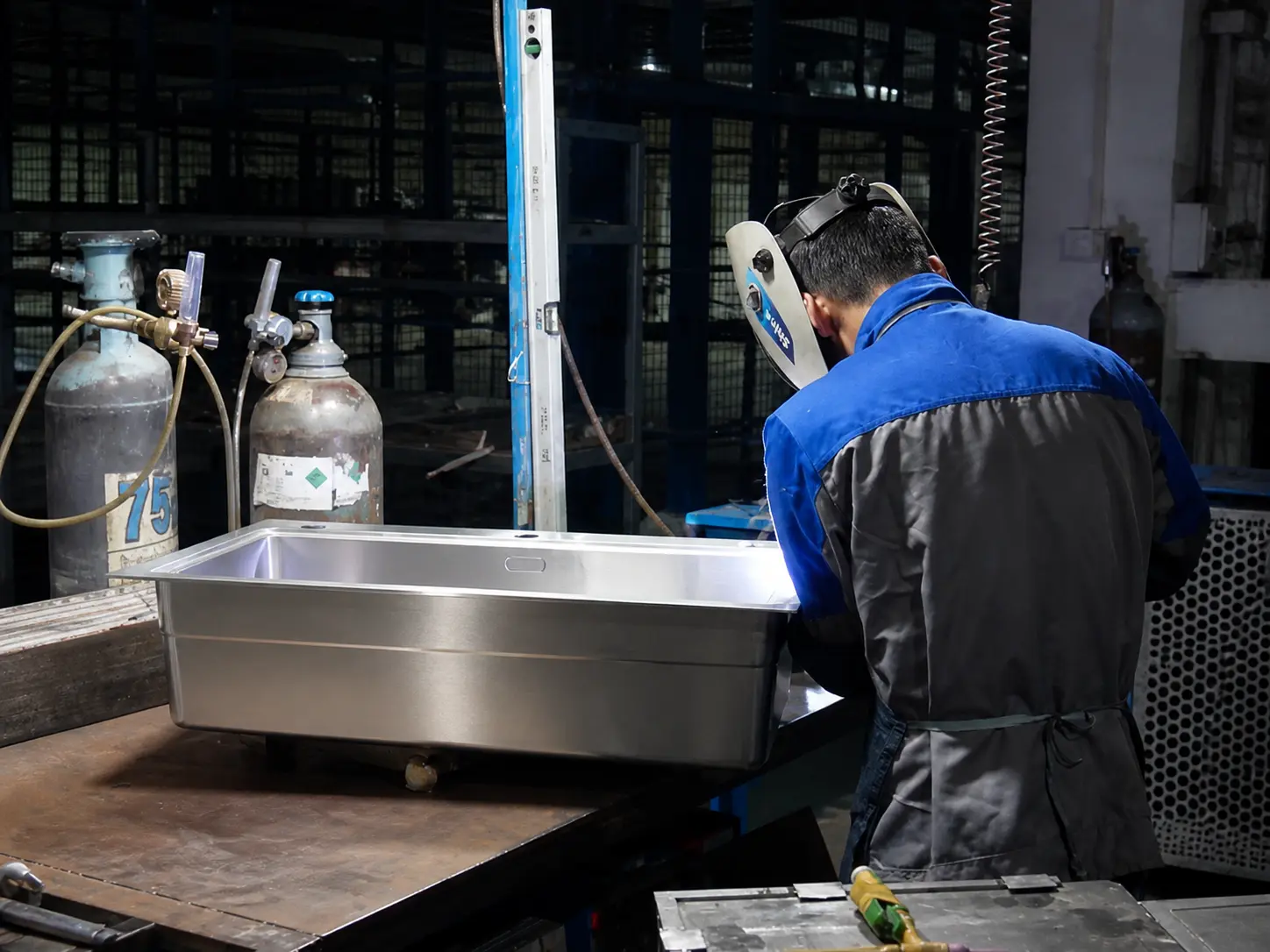
Weld Heat Tint Is Not a Cosmetic Detail
Welding forms a heat-affected oxide around the joint. Dark heat tint can be associated with a chromium-depleted layer below the oxide, reducing local corrosion resistance.
If the visible bowl looks like 316 but corrosion starts along the weld, the problem may be post-weld condition rather than bulk alloy grade.
Inspect:
- Inside corner welds
- Apron-to-bowl joints
- Drain-area welds
- Underside seams
- Ground transitions
The World Stainless welding guidance stresses removing heat tint and the affected surface zone through appropriate chemical or mechanical post-weld cleaning. See the World Stainless welding handbook.
Pickling and Passivation Are Not the Same Process
Pickling
Pickling removes heat tint, oxide scale and the chromium-depleted surface layer created by welding. It removes a controlled amount of surface material.
Passivation
Passivation removes certain free-iron contaminants and supports formation of a clean passive surface. It does not necessarily remove heavy weld scale or deep heat tint by itself.
Mechanical Finishing
Grinding or polishing can remove oxide and blend the appearance. If performed incorrectly, it can:
- Roughen the surface
- Embed iron
- Create folds or smearing
- Leave depleted metal below the finish
The correct sequence depends on product design, desired appearance and treatment system.
These are controlled factory or specialist processes. Consumers should not attempt acid pickling with industrial acids at home.
304L and 316L: What the “L” Really Means
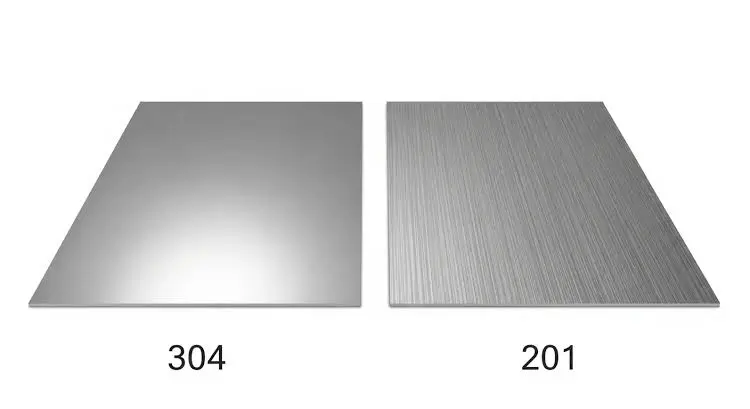
The “L” indicates lower carbon.
Lower carbon helps reduce sensitization and intergranular-corrosion risk associated with some welding conditions.
It does not mean:
- 316L is immune to seawater.
- 316L cannot pit.
- 304L has the same chloride resistance as 316.
- “L” replaces weld cleaning.
For a welded outdoor sink, 316L can be a strong material direction, but weld quality, shielding, finishing and surface restoration remain essential.
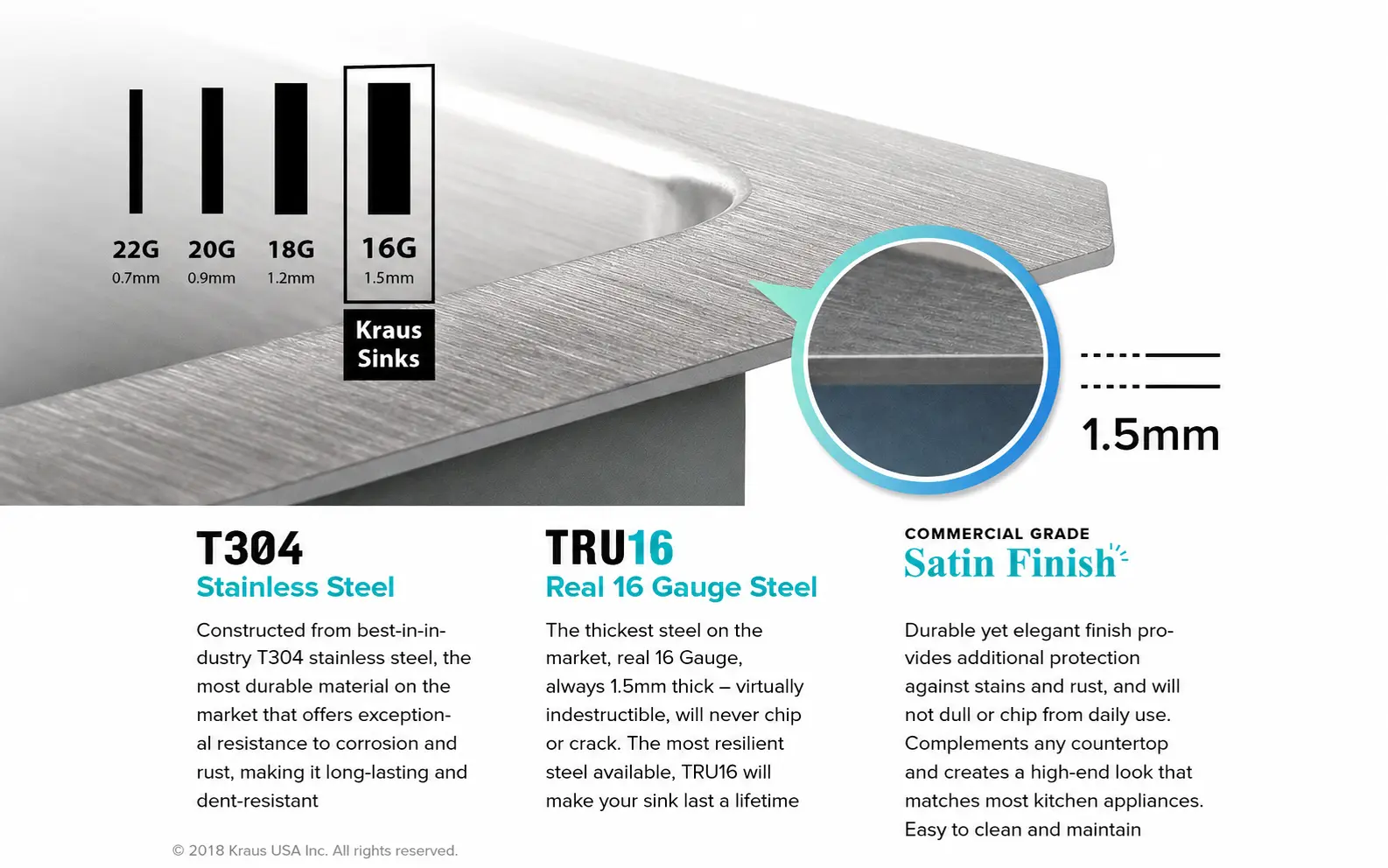
Gauge Does Not Change the Stainless Grade
Gauge influences:
- Sheet thickness
- Rigidity
- Dent behavior
- Product weight
- Fabrication feel
Gauge does not add molybdenum or make the passive film more chloride-resistant.
Therefore:
- 16-gauge 304 is still 304.
- 18-gauge 316 still has the alloy advantage in chloride exposure.
- A thicker sheet is not a substitute for the correct grade.
Severe pitting may take longer to penetrate thicker material, but choosing thickness as a corrosion solution ignores the cause.
PVD and “Nano” Finishes Do Not Turn 304 into 316
A coating or decorative finish can change appearance and some surface behavior. It does not change the alloy beneath it.
Outdoor coating performance depends on:
- Substrate grade
- Surface preparation
- Coating system
- Edge and drain coverage
- UV exposure
- Cleaning chemicals
- Scratch damage
- Grid and accessory contact
If the coating is breached, the substrate determines corrosion resistance at that point.
For a coastal colored-sink program, specify both:
- Stainless substrate grade
- Coating/finish system and care limits
Do not market coated 304 as equivalent to solid 316 without relevant evidence.
A 316 Bowl Does Not Make the Complete Sink Set 316
Common wet components include:
- Basket strainer
- Drain body
- Garbage-disposal flange
- Mounting clips
- Fasteners
- Bottom grid
- Grid-foot pins
- Faucet
- Soap dispenser
- Overflow parts
If one component corrodes, it can create rust-colored runoff or contamination on the 316 bowl.
A professional bill of materials should identify:
- Bowl grade
- Rim or apron grade where separately fabricated
- Drain material
- Grid material
- Clip and fastener material
- Faucet and accessory substrate
- Coated or plated components
The claim “316 sink” should clearly state whether it refers to the sink body only or the complete package.
Outdoor Design Details That Reduce Corrosion Risk
Free-Draining Geometry
Avoid standing water on rims, drainboards and cabinet ledges. Verify bowl slope, drain recess and installed level.
Cleanable Corners
Very tight corners and unfinished joints retain BBQ grease and salt. Cleaning access matters.
Controlled Crevices
Seals, fasteners and grid feet should not create permanent chloride traps.
Ventilated Cabinet
The underside should drain and dry. A hidden leak or condensation can keep welds and mounting hardware continuously wet.
Removable Accessories
Grids and mats should be removable so the bowl can be rinsed beneath them.
Compatible Countertop Joint
Seal the rim appropriately and avoid water entering a porous or moisture-sensitive cabinet structure.
Service Access
The drain, clips and fasteners should be accessible for inspection and replacement.
Sound Pads and Undercoating Outdoors
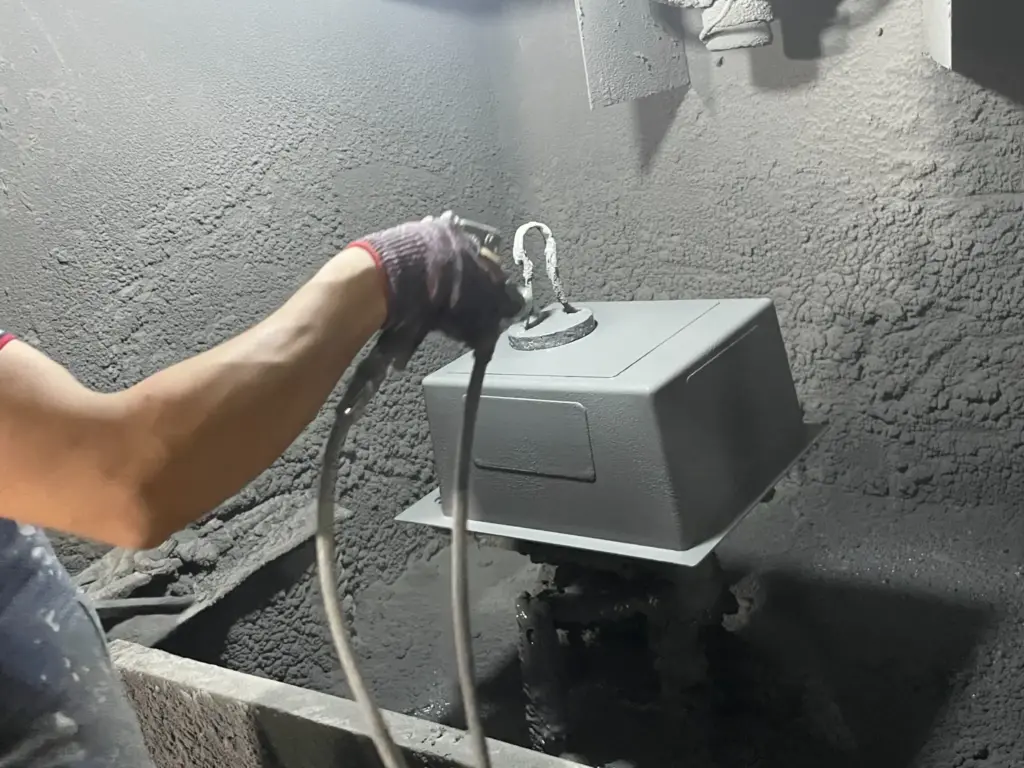
An indoor soundproofing package may not be automatically suitable outdoors.
Review:
- Moisture absorption
- Adhesive performance under heat and cold
- Condensation
- Water trapped at pad edges
- UV exposure where applicable
- Saltwater exposure
- Inspection access
- Freeze-thaw conditions where relevant
Undercoating should not hide a leaking weld or trap chloride-contaminated water against the sink.
Freshwater Cleaning Is Part of the Material System
Stainless steel is low maintenance, not universally maintenance-free.
Basic Outdoor Care
- Remove food, leaves, BBQ grease and metal objects.
- Rinse with clean fresh water.
- Wash with mild detergent and a soft cloth or non-scratch sponge.
- Rinse all cleaner away.
- Wipe with the grain where applicable.
- Dry when practical.
- Remove grids and clean beneath their feet.
- Inspect drains, welds and sheltered edges.
Clean Immediately After
- Direct seawater splash
- Pool-chemical contact
- Salt-heavy storms
- Masonry or metal construction work
- Acidic or chloride cleaner exposure
- Long storage beneath a cover
Avoid
- Steel wool
- Carbon-steel brushes
- Muriatic or hydrochloric acid
- Chloride cleaner left on the surface
- Prolonged bleach contact
- Mixing chemicals
- Wet metal cans and tools left in the bowl
- Abrasive polishing without matching the finish
Cleaning frequency should follow visible salt deposition and exposure—not a universal calendar.
Should You Cover an Outdoor Stainless Steel Sink?
A cover can reduce rain, debris and sunlight. It can also trap moisture and leave salt untouched.
Use a cover correctly:
- Rinse and dry the sink first.
- Use a design that does not hold condensation against the surface.
- Prevent the cover from rubbing on PVD or polished finishes.
- Inspect after storms.
- Remove the cover periodically for ventilation.
A cover is a weather-management tool, not a replacement for cleaning.
When 304 Is the Better Value
304 is often the rational choice for:
- Inland covered patios
- Standard BBQ islands
- Outdoor bars without salt or pool exposure
- Cost-sensitive wholesale programs
- Projects with reliable cleaning
- Products used across indoor and mild outdoor applications
316 may add cost without a meaningful customer benefit in a dry, controlled inland installation.
The most expensive grade is not automatically the best product decision.
When 316 Is Worth the Cost
316 is generally worth the upgrade for:
- Coastal outdoor kitchens
- Beachfront hospitality
- Poolside bars
- Warm and humid sheltered patios
- Premium projects with high appearance expectations
- Installations that are difficult to clean
- Product lines intended for several outdoor exposure markets
The commercial value may include:
- Greater corrosion margin
- Lower staining risk
- Fewer after-sales disputes
- More credible project specification
- Reduced maintenance sensitivity
It is still essential to define finish, weld cleaning and care.
How to Diagnose Brown Marks Correctly
| Pattern | Possible cause | First action |
| Brown haze on coastal-facing surfaces | Tea staining | Review salt exposure and freshwater cleaning |
| Orange dust after construction | Carbon-steel contamination | Remove contamination with an approved method |
| Rings below cans or tools | Transferred rust | Remove the object and inspect for pitting |
| Marks following a weld | Heat tint, contamination or poor finishing | Inspect weld treatment and surface condition |
| Pinpoint recurring cavities | Pitting corrosion | Stop aggressive cleaning and request technical review |
| Corrosion under grid feet | Salt-retaining crevice | Remove grid, clean and inspect feet and bowl |
| Only drain or clips rust | Accessory material mismatch | Identify component material and replace as appropriate |
| Damage after pool treatment | Concentrated chemical exposure | Rinse safely and review chemical handling |
Do not polish away evidence before recording the location, pattern and exposure history.
Why a Magnet Is Not a Reliable Grade Test
304 and 316 are normally austenitic, but cold working and welding can make some locations partially magnetic.
A magnet:
- Cannot measure molybdenum.
- Cannot reliably distinguish 304 from 316.
- May react differently at corners, welds and flat sheet.
- Does not prove corrosion performance.
For B2B control, use:
- Traceable raw-material records
- Controlled material storage
- Grade-specific production identification
- Agreed positive material identification where required
- Finished-product sample verification
The verification method must be capable of distinguishing the molybdenum-bearing alloy.
B2B Exposure Questionnaire
Before specifying the sink, ask:
- Where will it be installed?
- How close is it to surf, a pool or industrial emissions?
- Does it receive direct seawater or only airborne salt?
- Is it covered, semi-open or fully exposed?
- Does clean rain reach the surface?
- What are the temperature and humidity conditions?
- Can the sink drain and dry completely?
- Is freshwater rinsing readily available?
- Who will clean it and how often?
- Are pool or cleaning chemicals stored nearby?
- Which countertop and cabinet materials are used?
- Which accessories remain in contact with the bowl?
- What appearance change is acceptable?
- What after-sales claim is the seller making?
If the exposure cannot be described, the corrosion claim cannot be defined responsibly.
Copyable B2B Outdoor Sink Specification
Application
Outdoor kitchen sink for the documented E1, E2, E3 or E4 exposure condition. Record coastal, poolside, sheltered, rain-washed and direct-saltwater conditions.
Material
Specify 304, 304L, 316, 316L or another approved alloy for each fabricated sink component. Do not use “marine grade” as the sole grade description.
Thickness
Define sheet thickness separately from corrosion grade.
Manufacturing Method
State handmade/welded, pressed/drawn or other construction, including any separately fabricated rim or apron components.
Surface Finish
Define the approved physical finish sample, finish direction and any roughness requirement with measurement method and locations.
Weld Condition
Define allowable heat tint, weld blending, oxide removal, post-weld cleaning and surface restoration.
Contamination Control
Use tools, abrasives, handling and storage practices that prevent carbon-steel contamination.
Drainage and Crevices
Review bowl slope, drain recess, rim drainage, fasteners, grid feet and joints for water and salt retention.
Accessories
List drain, grid, clips, fasteners, faucet and wet accessory materials separately.
Undercoating
Confirm outdoor moisture, temperature and inspection suitability for pads, adhesives and coating.
Care Guidance
Supply freshwater-rinsing and cleaning instructions matched to the documented exposure.
Packaging
Protect the finish from carbon-steel debris, moisture, rubbing and mixed-grade components.
Verification
Define material, finish and component-verification methods agreed for sample and batch production.
This template must be adapted to the actual exposure, product design and market requirements.
B2B Approval Matrix
| Area | Approval question |
| Exposure class | Is the project E1, E2, E3 or E4? |
| Grade | Does the alloy match chloride and maintenance risk? |
| L-grade | Does welded construction justify 304L or 316L? |
| Surface | Is the finish smooth, consistent and cleanable? |
| Welds | Have heat tint and affected surface layers been addressed? |
| Contamination | Are carbon-steel tools and dust controlled? |
| Crevices | Can salt and water drain from rims, feet and fasteners? |
| Accessories | Are material claims defined for every wet component? |
| Undercoating | Can moisture escape and critical areas be inspected? |
| Maintenance | Is freshwater cleaning realistic at the site? |
| Claims | Do “outdoor,” “coastal” and “marine grade” statements have clear limits? |
| Packaging | Is the surface isolated from rusting steel and trapped moisture? |
| Repeat orders | Are grade, finish, components and revisions controlled by SKU? |
Quality-Control Checklist
Inspect:
- Material identity and production traceability
- Sheet thickness
- Finish sample match
- Surface roughness where specified
- Weld heat tint and blending
- Free-iron or grinding contamination
- Internal corners and drain recess
- Crevices under rim and hardware
- Drainage and standing-water locations
- Grid, strainer and fastener material
- Sound-pad and coating edges
- Protective-film removal guidance
- Packaging cleanliness
- Mixed-SKU and mixed-grade risk
Accelerated corrosion testing may help compare controlled samples, but it does not automatically predict a specific number of outdoor service years. Test preparation, finish, geometry, exposure cycle and acceptance criteria must be defined.
Common Claims That Cause After-Sales Problems
Avoid:
- “316 stainless steel never rusts.”
- “Marine grade is safe for direct seawater.”
- “304 cannot be used outdoors.”
- “A covered sink does not need rinsing.”
- “Thicker gauge prevents corrosion.”
- “316L cannot pit.”
- “PVD converts 304 into marine-grade steel.”
- “The bowl is 316, so every accessory is 316.”
- “A magnet proves the grade.”
- “No. 4 finish guarantees coastal performance.”
- “Passivation removes all weld heat tint.”
- “One salt-spray test guarantees ten years outside.”
- “Stainless steel is maintenance-free.”
Use exposure-specific, conditional language instead.
Frequently Asked Questions
Is 304 stainless steel good for an outdoor kitchen sink?
Yes. It is commonly suitable for covered or mild inland outdoor kitchens with low chloride exposure and regular cleaning.
Is 316 better for an outdoor sink?
It is better when chloride, coastal, poolside, humid or chemically aggressive exposure is significant. It may be unnecessary in a dry, protected inland kitchen.
What makes 316 more corrosion-resistant than 304?
316 contains molybdenum, which improves resistance to localized chloride-induced pitting and crevice corrosion.
Can 316 stainless steel rust?
Yes. Salt buildup, rough surfaces, contaminated welds, crevices and aggressive chemicals can stain or corrode 316.
Is 316 really marine grade?
It is commonly described that way, but the term does not guarantee suitability for every seawater or splash-zone condition.
Can 316 be used in direct seawater?
Only after the specific exposure is reviewed. Stagnant, warm or continuously wet seawater can cause pitting and crevice corrosion in 316.
Is a covered coastal sink protected from salt?
No. Airborne salt can enter while rain is blocked. Sheltered sinks may need deliberate freshwater washing.
How far from the ocean should 316 be used?
There is no universal distance. Wind, surf, shelter, humidity, heat and maintenance can be more important than distance alone.
What is tea staining?
Tea staining is brown surface discoloration associated with stainless steel in coastal conditions. It is usually cosmetic but indicates that exposure, finish or cleaning should be reviewed.
Is tea staining the same as pitting?
No. Tea staining affects appearance at the surface. Pitting forms localized cavities below the surface.
Is 316 recommended beside a pool?
It is generally the better starting grade, but concentrated pool chemicals can attack 316 and must not remain on the sink.
Is 316L better than 316?
Its lower carbon is advantageous for some welded fabrication. Its chloride resistance remains in the 316 family, and it can still pit.
Does thicker stainless steel resist coastal rust better?
Gauge does not change alloy chemistry. Grade, finish, fabrication, exposure and maintenance are more important to corrosion initiation.
Does a polished finish perform better than brushed?
A smoother polished finish generally retains less salt and is easier to clean. The best commercial finish still depends on appearance, manufacturing and use requirements.
Should a coastal sink be passivated?
Appropriate post-fabrication cleaning and surface restoration may improve performance, especially after welding or contamination. The required process should be defined by the manufacturer or specialist.
Can passivation remove dark weld heat tint?
Passivation alone may not remove heavy oxide or the depleted layer. Pickling or controlled mechanical removal may be needed before final passivation.
Can I verify 316 with a magnet?
No. A magnet cannot measure molybdenum or reliably separate 304 and 316.
Why is only the drain rusting?
The drain may use a different material or finish from the sink body. Inspect every wet component separately.
Can a bottom grid cause coastal corrosion?
It can trap salt and moisture beneath its feet or create metal-contact contamination. Remove and clean beneath it regularly.
How often should a coastal sink be washed?
Often enough to prevent visible salt accumulation. Severe sheltered sites may require frequent rinsing, especially after storms or direct splash.
Should every outdoor sink be 316?
No. 304 can be the better-value choice for mild inland environments. Use 316 where the added chloride-corrosion margin is justified.
Final Answer
For an E1 protected inland outdoor kitchen, 304 stainless steel is usually a practical, professional choice.
For an E3 coastal, salt-air or poolside kitchen, 316 or 316L is generally the safer starting specification.
For E4 direct seawater, severe splash or stagnant salt exposure, standard 316 should not be accepted automatically without further review.
The complete decision should account for:
- Exposure class
- Chloride deposition
- Time of wetness
- Surface finish
- Weld cleaning
- Crevice and drainage design
- Accessory materials
- Iron contamination control
- Freshwater maintenance
- Product and marketing claims
The most professional specification is not simply “316 marine grade.” It is:
Verified alloy + controlled finish + clean fabrication + free-draining design + compatible wet components + realistic maintenance.
That system is more important than any single grade label.
Develop 304 and 316 Outdoor Sink Programs with Matrix
Matrix supports outdoor and coastal kitchen sink programs for brands, importers, wholesalers, BBQ-island manufacturers and project buyers.
Development options can include:
- 304, 304L, 316 or 316L material directions
- Handmade and pressed/drawn sink structures
- Outdoor top-mount and undermount sinks
- BBQ-island, bar/prep and workstation sinks
- Center, rear and offset drain layouts
- Finish-sample and weld-detail review
- Bottom-grid, strainer and faucet matching
- Outdoor care instructions
- OEM/private-label packaging
- Project labels and repeat-order controls
Explore Matrix outdoor kitchen sinks and stainless steel kitchen sink programs.
To discuss an exposure condition, material option or sample, contact Matrix.