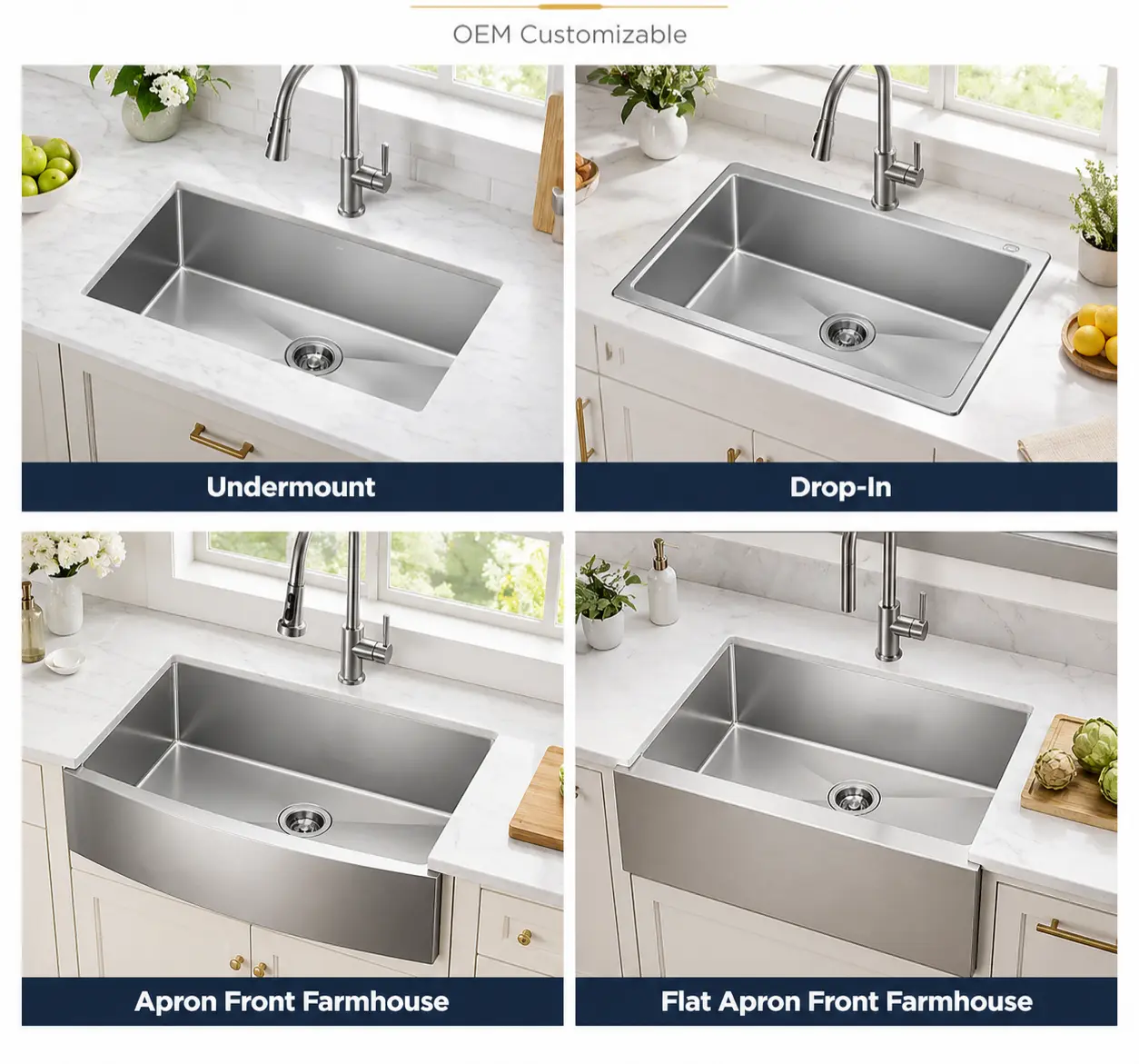
A workstation kitchen sink is worth it if you regularly prepare, rinse or dry food over the sink, especially when countertop space is limited. It is less worthwhile if you want a completely open bowl, rarely cook or do not want to clean and store fitted accessories.
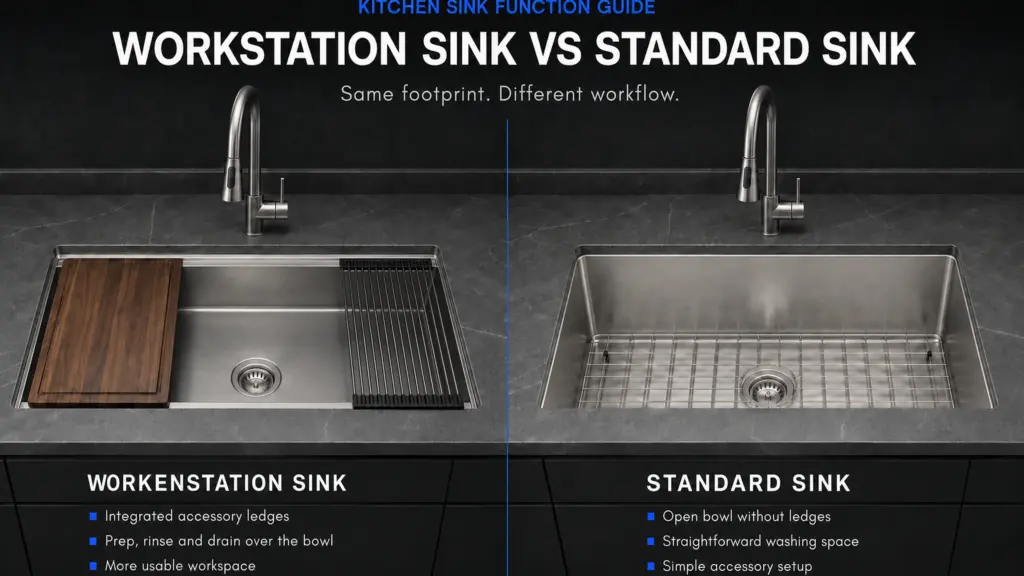
The decisive factor is not how many accessories are included—it is whether the ledge, bowl, accessories, faucet and cabinet work as one system.
The Short Answer
| A Workstation Sink Is Usually Worth It If… | A Standard Sink May Be Better If… |
|---|---|
| You prepare food several times a week | You mainly use the sink for quick rinsing |
| Counter space is limited or frequently crowded | You already have generous prep space |
| You regularly use a cutting board, colander or drying rack | Most accessories would remain in storage |
| You want water and food scraps contained over the bowl | You prefer the simplest cleaning routine |
| You can buy replacement accessories for the exact model | You want universal, easily replaced accessories |
| The cabinet, cutout, faucet and plumbing are planned together | You are replacing a sink in a difficult fixed cutout |
For most households, the workstation concept becomes genuinely useful when at least two core accessories support tasks the user already performs. A long accessory list alone is not evidence of value.
What Is a Workstation Kitchen Sink?
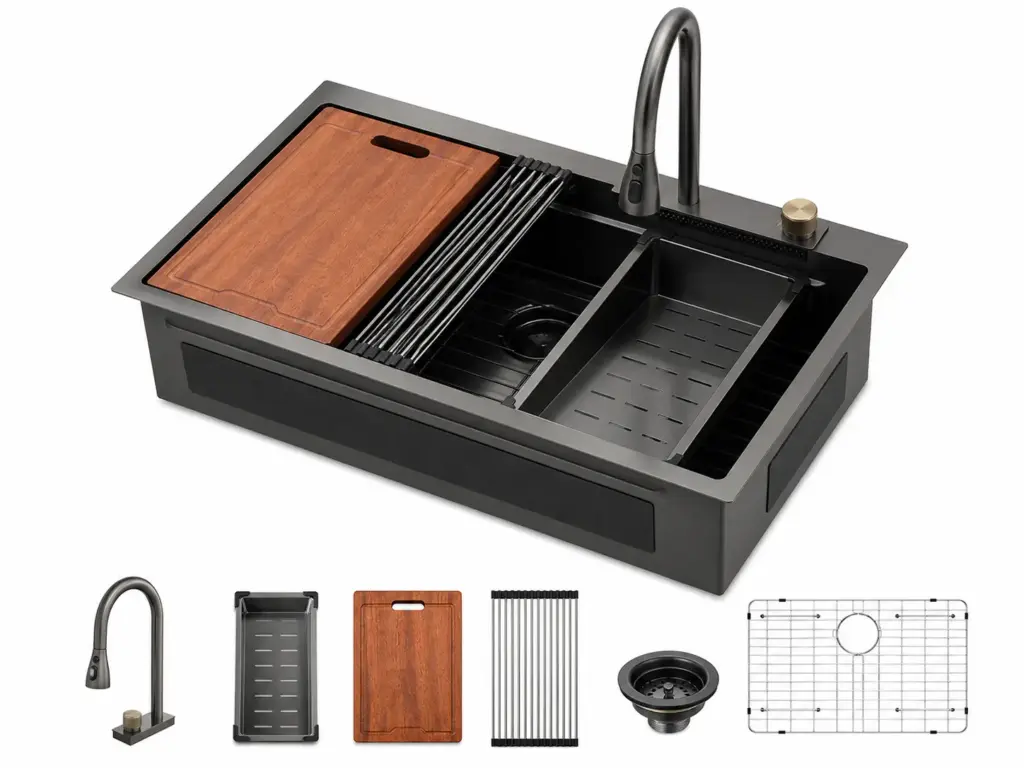
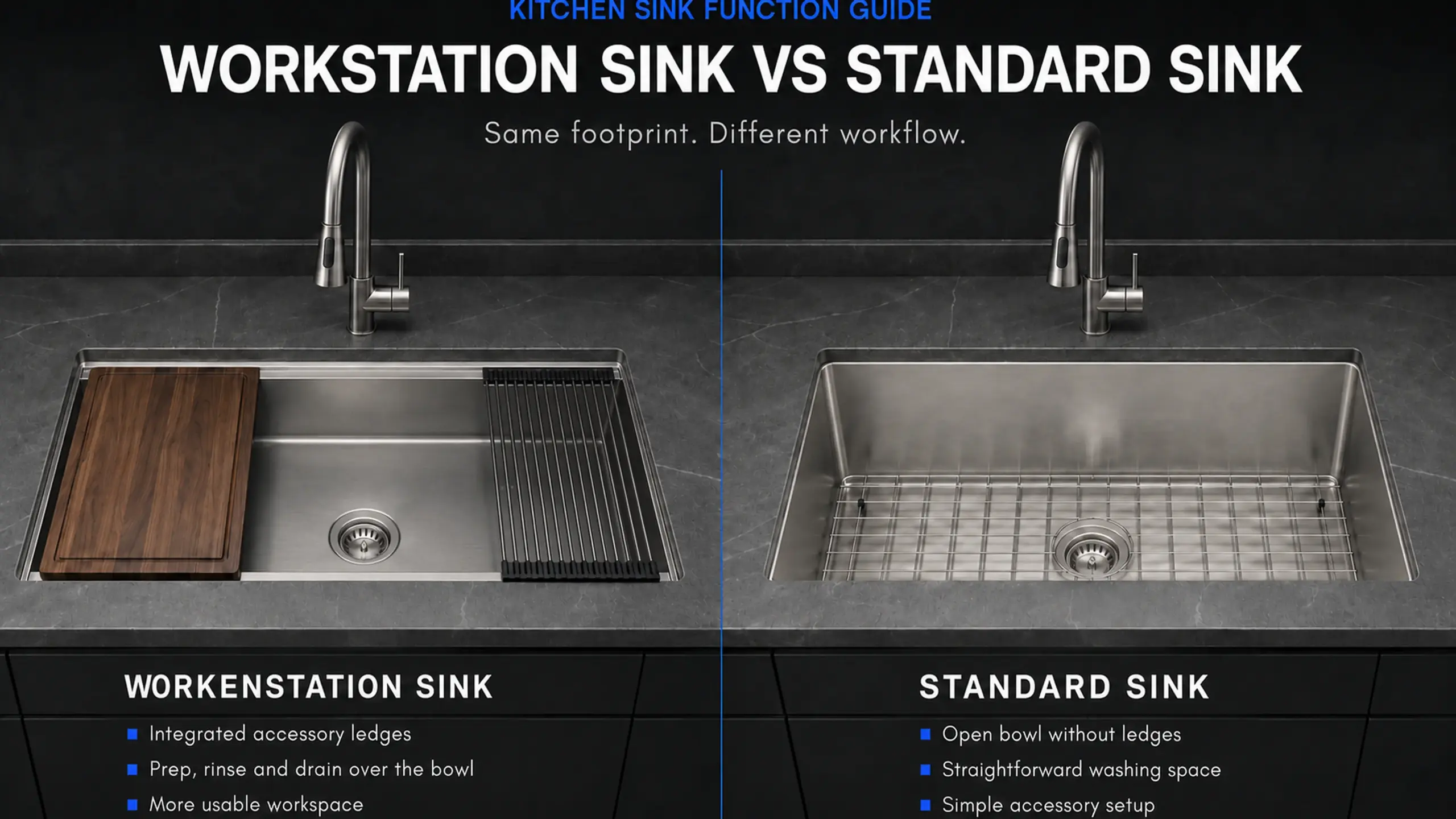
A workstation kitchen sink—also called a ledge sink—has an integrated internal ledge that supports fitted accessories over the bowl. Common accessories include a cutting board, colander, roll-up drying rack, drainboard, wash bin and bottom grid.
The ledge allows the sink area to perform more than one function:
- Washing cookware
- Rinsing produce
- Cutting and preparing food
- Draining ingredients
- Drying dishes
- Holding temporary prep containers
A regular sink sold with a loose cutting board is not necessarily a true workstation sink. A genuine workstation system is designed around the relationship between the sink opening, ledge dimensions, accessory contact area and usable bowl space.
See Matrix workstation kitchen sinks for stainless steel, granite composite, top-mount, undermount and private-label product programs.
The Counterintuitive Truth: More Accessories Do Not Make a Better Sink
The most common way to market a workstation sink is to show as many accessories as possible. That creates an impressive product image, but it can hide the questions that matter more:
- Does the cutting board sit flat?
- Can the colander slide without binding?
- Can one accessory be used without blocking most of the bowl?
- Does the faucet reach the working position?
- Can the accessories be cleaned and stored easily?
- Can replacements be ordered by model?
- Are all included parts protected during shipping?
A workstation sink with three well-matched accessories can offer more daily value than a sink with eight rarely used pieces.
The ledge and accessory system—not the accessory count—should be the basis of comparison.
Seven Real Benefits of a Workstation Sink
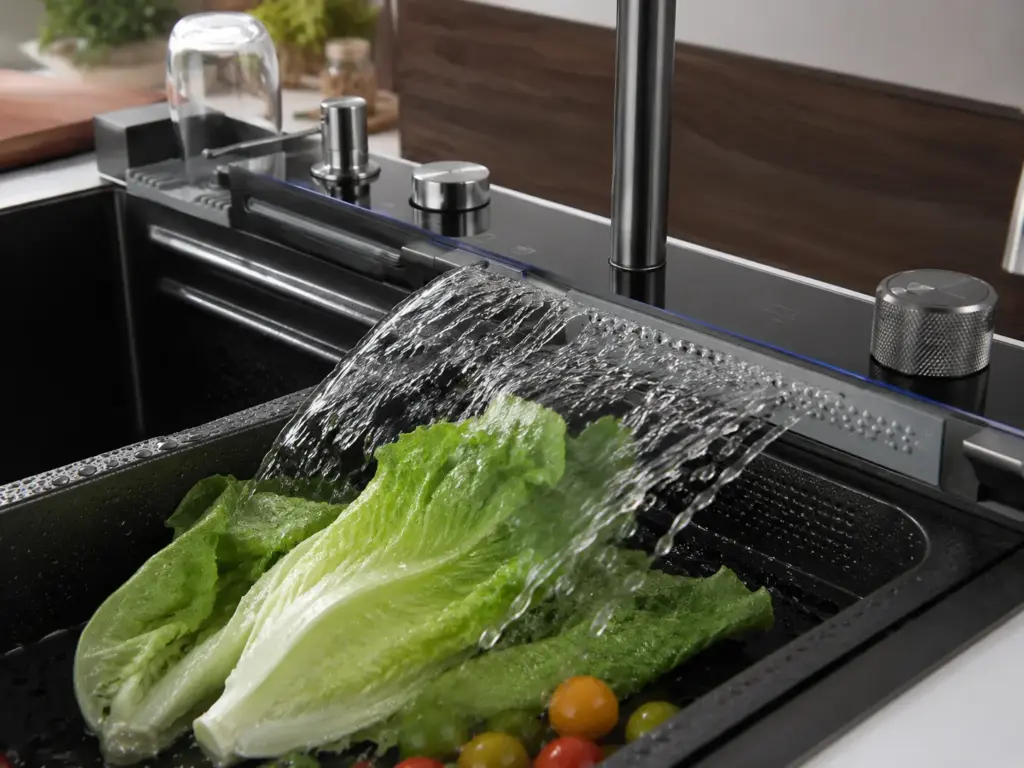
1. It Creates Temporary Prep Space
A fitted cutting board converts part of the sink opening into a temporary work surface. This is particularly useful in apartments, galley kitchens, kitchenettes, small islands and secondary prep areas.
The word temporary matters. The sink does not create new floor area. It allows one area to switch between washing and food preparation.
2. Wet and Messy Tasks Stay over the Bowl
Produce can move from faucet to colander to cutting board without dripping across the countertop. Peels, crumbs and juice can fall into the bowl instead of spreading over the surrounding worktop.
This can reduce movement and make cleanup more direct, but it does not make the sink maintenance-free. The ledge and accessories still need to be cleaned.
3. It Supports a More Continuous Workflow
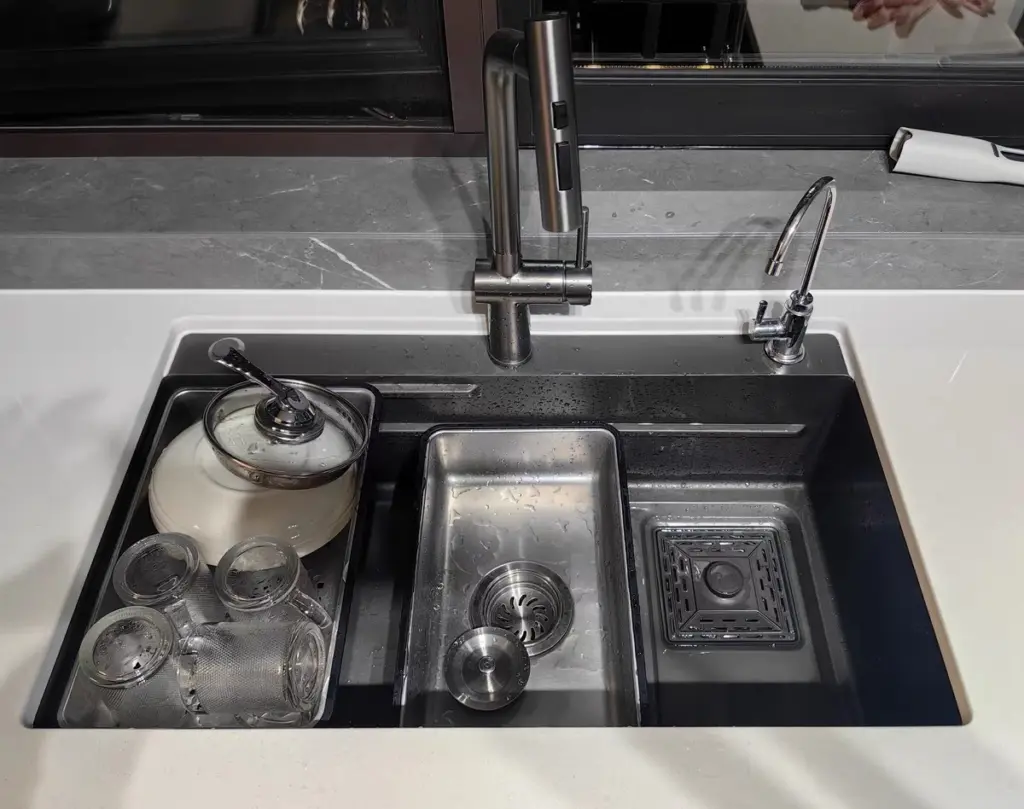
A useful workstation sequence may look like this:
- Place produce in the colander.
- Slide the colander under the faucet.
- Move it aside to drain.
- Cut food on the fitted board.
- Transfer scraps directly into the bowl.
- Roll out the drying rack during cleanup.
The real benefit is not that the sink performs each task better than every separate tool. It is that the tools remain organized around one wet-working zone.
4. It Can Keep More Countertop Available
A roll-up rack can replace a permanent countertop drainer for light drying tasks. A cutting board can cover part of the bowl when extra preparation area is needed.
This advantage is strongest where countertop space is scarce. In a large kitchen with a separate prep sink and long worktops, the same feature may be convenient rather than essential.
5. Accessories Can Be Repositioned
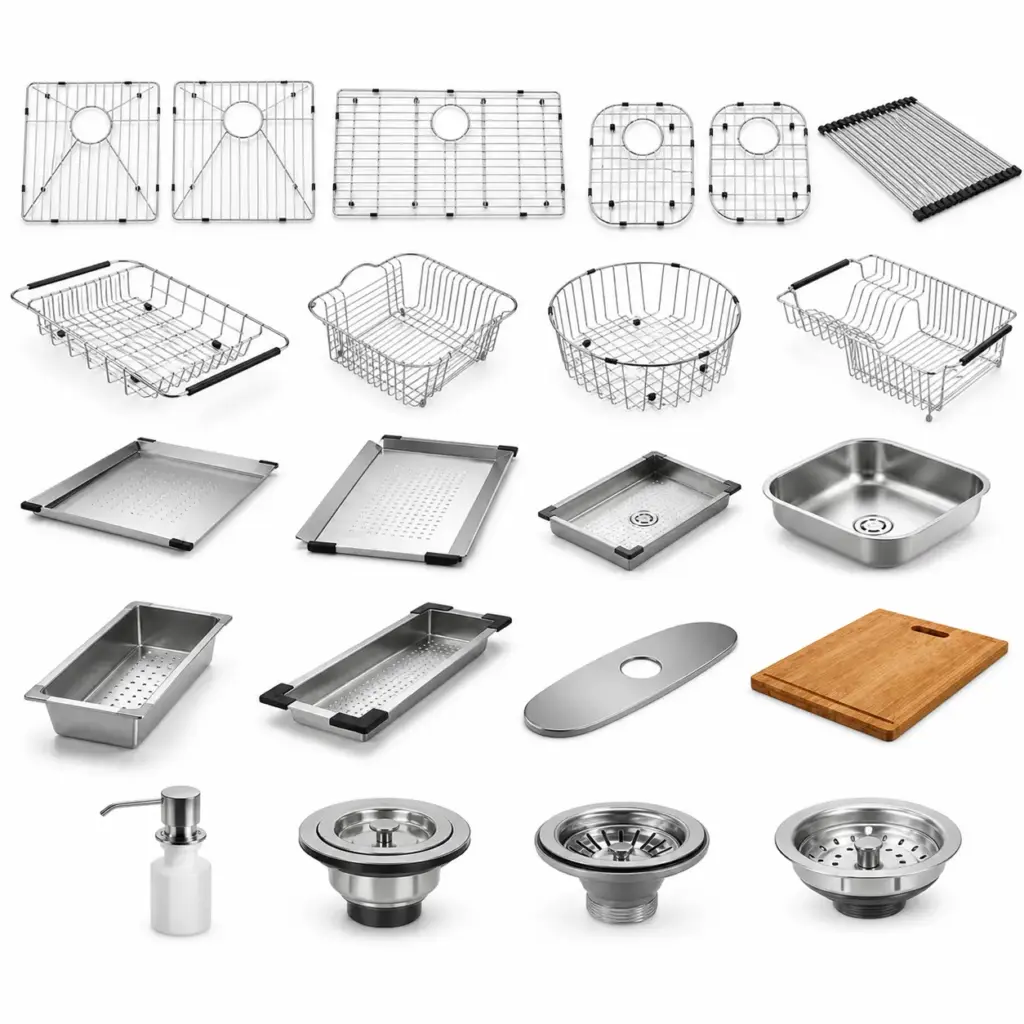
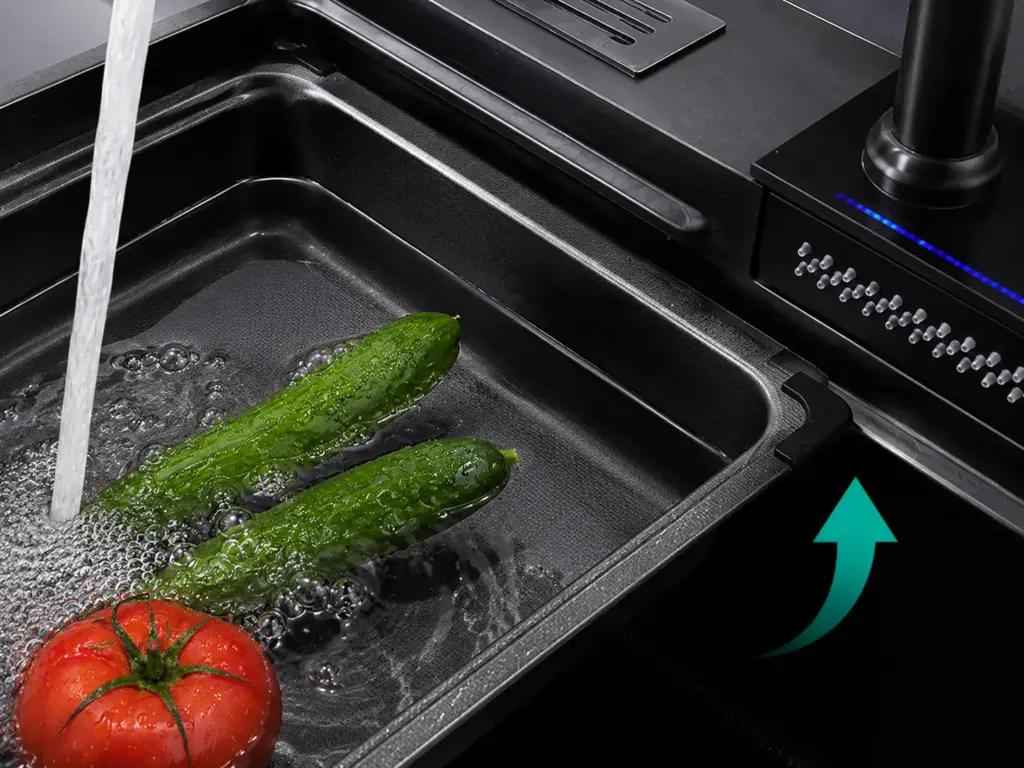
Properly fitted accessories can slide along the ledge. The user can move the colander under the faucet, expose the drain or leave one side of the bowl open for washing.
The movement should feel controlled. An accessory that is too loose may rattle or tip; one that is too tight may jam or rub against the finish.
6. A Large Single Bowl Remains Flexible
When the accessories are removed, a large single-bowl workstation sink can still accommodate sheet pans, stockpots and oversized cookware. Accessories add temporary task separation without permanently dividing the bowl.
This is one reason a workstation can appeal to users who want both a large open bowl and some of the organization associated with a double bowl.
7. It Creates a Coordinated Product System
For professional buyers, the workstation format can create a higher-value retail or project package containing:
- Sink body
- Drain or strainer
- Bottom grid
- Cutting board
- Colander
- Roll-up rack
- Mounting hardware
- Cutout template
- Care and accessory guide
The product becomes easier to demonstrate and merchandise. However, a larger set also requires stronger specification, packaging and replacement-part control.
Seven Real Disadvantages and Problems
1. The Ledge Adds Another Surface to Clean
Food residue, soap and minerals can collect on the ledge, particularly around corners and accessory contact points. A well-designed ledge should be reachable with a cloth or soft sponge.
The problem is not the existence of a ledge. It is a ledge with poor cleaning access.
2. Accessories Need Cleaning and Dry Storage
The cutting board, colander, rack and grid must be removed and cleaned. A wood or bamboo board should not remain continuously wet against the sink.
Before buying a large set, decide where every accessory will go when it is not being used.
3. Accessories Reduce the Open Bowl Area While in Use
A board may create prep space above the bowl, but it also covers part of the sink opening. In a compact sink, even one accessory can make the remaining washing area feel narrow.
Compare the following dimensions—not just the advertised sink width:
- Clear bowl opening
- Distance between ledges
- Bowl-bottom length and width
- Accessory width
- Open space remaining beside the accessory
4. Replacement Accessories May Be Model-Specific
Two boards with similar advertised dimensions may not fit the same sink. Compatibility depends on ledge spacing, support-lip design, corner shape, tier height, wall angle and allowable clearance.
If the original cutting board warps or a colander is lost, the buyer may need the exact replacement part. Long-term replacement availability is often more valuable than an oversized original accessory set.
5. Poor Fit Can Cause Rocking, Rubbing or Tipping
An accessory should have enough support to remain stable during its intended task. Problems can include:
- A board that rocks diagonally
- A colander that falls between the ledges
- A rack that barely reaches both sides
- A metal accessory that scratches a coated finish
- A board that swells and becomes difficult to remove
Fit should be checked on an actual production-equivalent sink, not inferred from a catalog rendering.
6. The Complete System Usually Costs More
The buyer is paying for more than the bowl. The price may include ledge fabrication, multiple accessories, protective packaging, additional inspection and replacement support.
The extra cost is justified only when the system improves a repeated task.
7. More Parts Create More After-Sales Risk
A workstation package has more opportunities for missing, damaged or incorrect components. Common complaints include:
- Missing cutting board or strainer
- Wrong grid for the drain position
- Bent roll-up rack
- Board damaged by moisture or impact
- Accessory rubbing against the sink in transit
- Product images showing parts not included in the SKU
For B2B supply, accessory control is part of sink quality—not a separate detail.
Who Actually Needs a Workstation Sink?
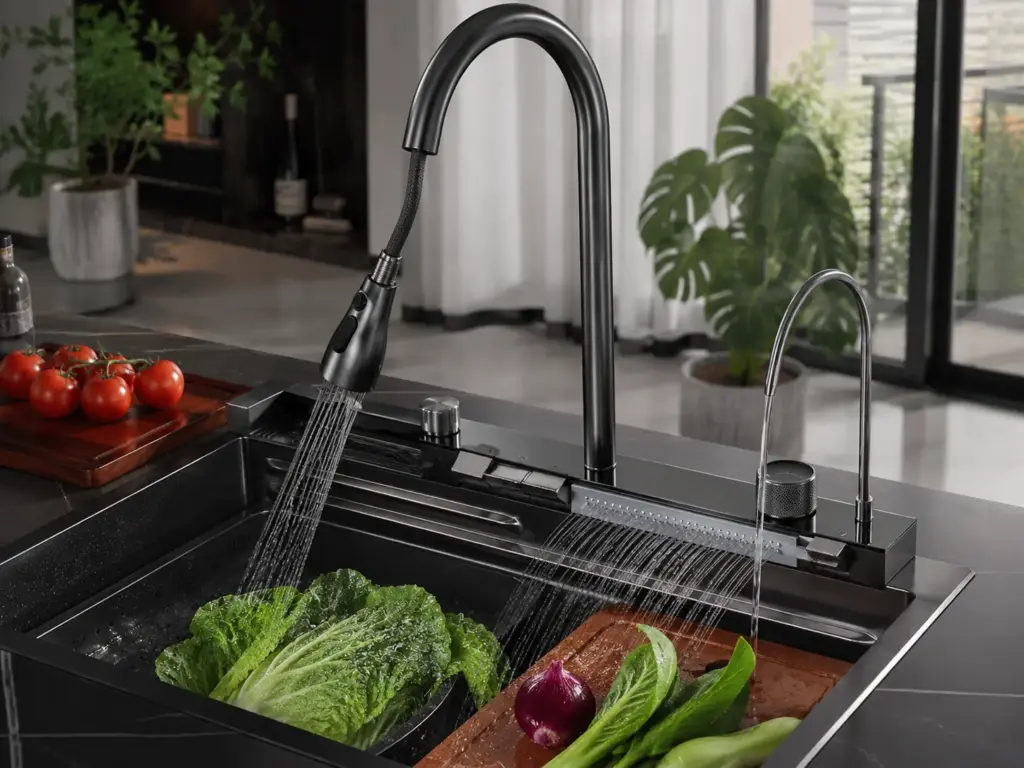
Frequent Home Cooks
Users who rinse, chop, drain and clean ingredients several times a week are most likely to benefit. The sink supports an existing routine rather than trying to create a new one.
Small-Kitchen Owners
A fitted board or rack can temporarily recover working space above the bowl. However, an oversized sink can also consume too much base cabinet and counter length.
Small kitchens need the right proportion, not automatically the largest workstation available.
People Who Wash Large Cookware
A single-bowl workstation can provide a wide open bowl after the accessories are removed. Check the bowl-bottom dimensions, not only the top opening, to confirm that pans can lie flat.
Households without a Permanent Draining Area
A roll-up rack or ledge-supported drainboard can provide temporary drying space without keeping a large freestanding rack on the counter.
People Who Entertain Frequently
The ledge can support preparation containers, garnish trays, colanders or a temporary beverage setup. Large models are particularly useful when more than one person works around the sink.
Brands, Wholesalers and Project Buyers
A workstation range can support premium positioning and a complete sink-set offer. It is most suitable when the buyer can control drawings, accessory part numbers, packaging and repeat-order consistency.
Who Probably Does Not Need One?
A standard sink may be more practical when:
- Most dishes go directly into a dishwasher
- Food preparation happens on a large island or separate counter
- The user wants the least possible cleaning and maintenance
- Accessories are likely to be lost in rental or shared housing
- The existing countertop cutout cannot be altered
- Universal replacement parts are a priority
- The user mainly needs an unobstructed wash bowl
- The budget is better spent on cabinet, faucet or countertop improvements
Workstation Sink vs Regular Sink
| Question | Workstation Sink | Regular Sink |
| Primary function | Washing plus modular prep and drying | Washing and drainage |
| Integrated accessory ledge | Yes | Usually no |
| Temporary prep surface | Yes, with a fitted board | Only with a separate over-sink accessory |
| Open bowl access | Reduced when accessories are installed | Normally unobstructed |
| Cleaning effort | Higher because of ledges and accessories | Usually lower |
| Replacement-part importance | High | Lower |
| Initial system cost | Usually higher | Usually lower |
| Best use case | Repeated food prep or limited counter space | Simple washing and low maintenance |
Can You Turn a Regular Sink into a Workstation?
An over-sink board or expandable rack can add some similar functions, but it does not create the same guided sliding track as an integrated ledge.
This may be a sensible low-cost test. If the user regularly uses an over-sink board or rack, a true workstation may provide a more stable and coordinated version during the next renovation.
How to Choose the Right Workstation Sink
1. Start with the Cabinet—not the Nominal Sink Size
The minimum cabinet size refers to the cabinet box required to contain and support the sink and its mounting system. It is not the same as the door opening or visible front width.
Confirm:
- Internal cabinet width
- Side-panel thickness
- Sink rim and bowl width
- Mounting clips or support rails
- Apron-front modification, if applicable
- Disposal and plumbing clearance
Never assume that a sink will fit because its nominal width appears smaller than the cabinet label. Use the specification drawing for the exact model.
2. Verify the Countertop Cutout
For an undermount sink, the cutout determines the reveal and whether the ledge remains accessible. For a top-mount sink, the outer rim must cover the cutout while leaving enough surface for sealing and clips.
Check:
- Exact cutout dimensions
- Corner radii
- Positive, zero or negative reveal for undermount installation
- Countertop thickness
- Faucet and accessory clearance
- Location of countertop seams
Use the final physical sink or an approved model-specific template before cutting expensive countertop material.
3. Compare Usable Bowl Space
The outside dimensions can overstate how large the sink feels in use. Ask for:
- Inside bowl dimensions at the top
- Bowl-bottom dimensions
- Ledge-to-ledge distance
- Bowl depth
- Corner radius
- Space remaining with the largest accessory installed
A 33-inch sink does not provide 33 inches of open internal workspace. Rim width, ledges, wall taper and corner geometry all reduce usable space.
4. Choose Bowl Depth for the User and Cabinet
Deeper is not automatically better.
An 8-inch bowl can be easier to reach and may preserve more under-sink space. A 9-inch bowl is a common balance for residential kitchens. A 10-inch bowl can contain large cookware and splashing but may increase reaching depth and reduce disposal or storage clearance.
The final working depth also includes countertop thickness and undermount position.
5. Decide Between Single-Tier and Multi-Tier Ledges
| Ledge Type | Best For | Trade-Off |
| Single tier | Cutting board, colander and rack used one at a time | Simpler fit and cleaning |
| Two tier | Overlapping accessories and separate working heights | More dimensions and surfaces to control |
| Multi-tier | Large, workflow-driven workstation systems | More complexity, cost and compatibility risk |
More tiers are not automatically more professional. Each tier should serve a defined accessory and task.
6. Select the Material by Use—not Fashion Alone
Stainless Steel Workstation Sink
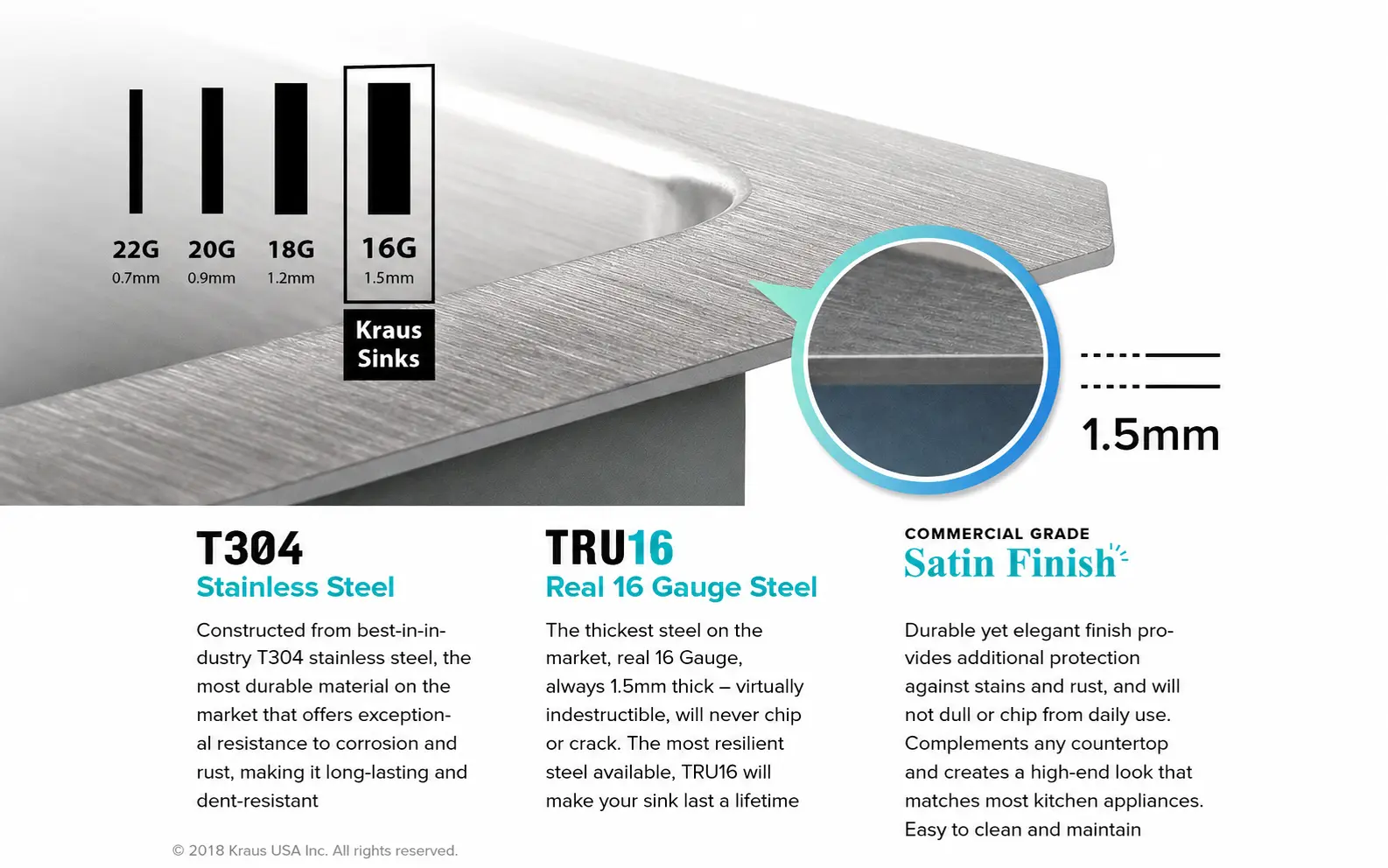
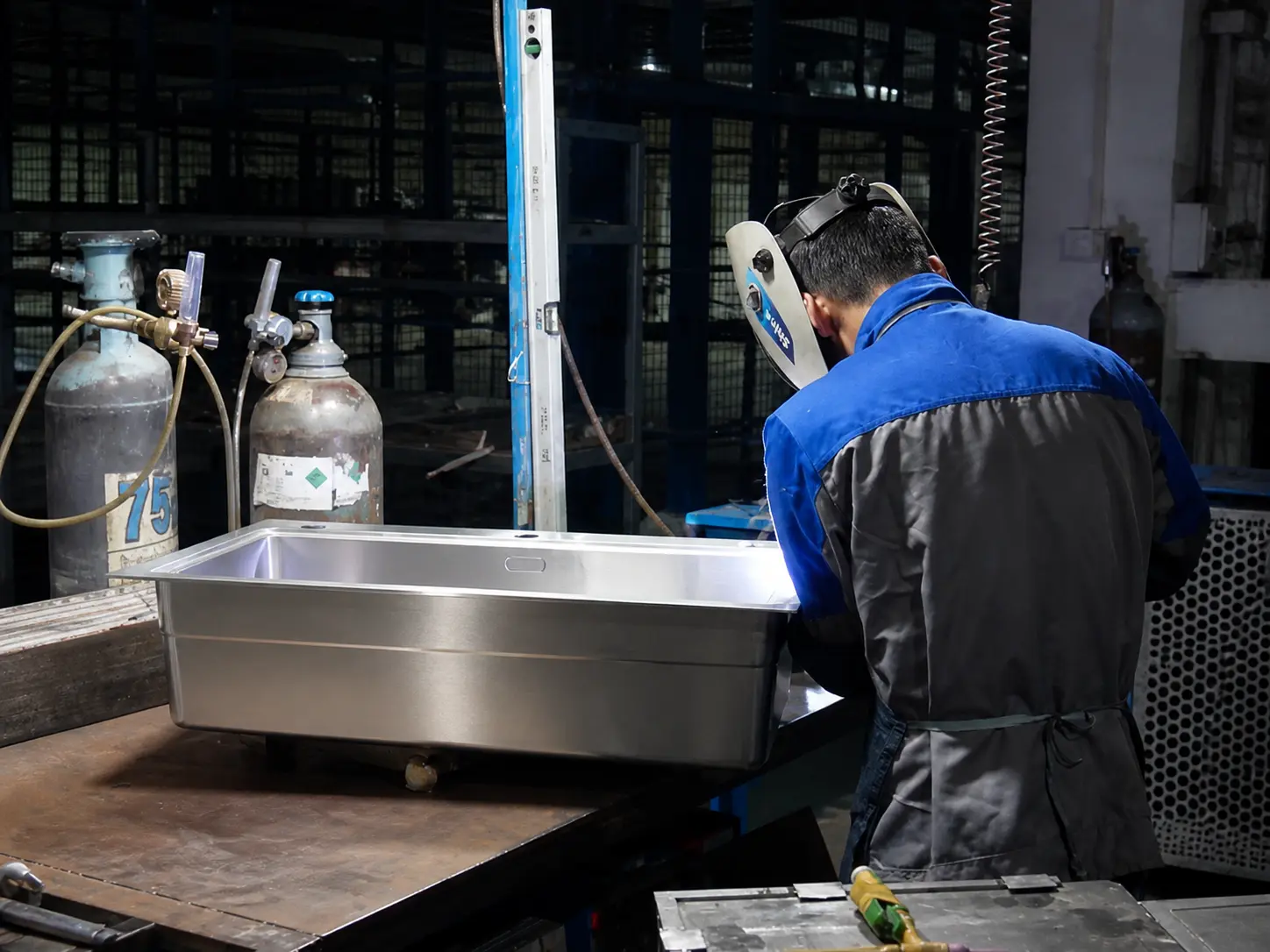
A stainless steel kitchen sink provides broad size options, lower weight and flexible handmade construction. It suits customized ledges and accessory programs.
Check steel grade, thickness, rim flatness, weld finishing, brushing consistency, sound pads, undercoating and accessory contact with the finish.
Granite Composite Workstation Sink
A granite composite sink provides a matte, stone-like appearance and multiple color options. Its molded ledge must remain dimensionally consistent, and packaging needs to protect the heavier, rigid body.
Check the actual color sample, surface texture, ledge accuracy, faucet-hole plan, cabinet support and care instructions.
Material does not determine workstation quality by itself. A precise ledge and compatible accessory set matter more.
7. Choose the Installation Method
Undermount
Best for a clean countertop transition and wiping debris directly into the bowl. Confirm countertop suitability, cutout accuracy, reveal, support and accessory clearance below the counter edge.
See Matrix undermount kitchen sinks for professional supply options.
Top Mount or Drop-In
Often easier for replacement projects and compatible with a wider range of countertop materials. Confirm rim flatness, cutout coverage, clip positions, faucet-hole layout and sealant area.
Apron Front
Creates a visible sink front and may reduce the countertop barrier between the user and bowl. It requires cabinet modification, front alignment and structural support planning.
8. Match the Faucet to the Accessory Positions
The faucet should reach the colander and open bowl without creating excessive splash.
Confirm:
- Spout reach
- Spout height
- Water landing point
- Pull-down hose movement
- Clearance above boards and racks
- Handle clearance from the backsplash
- Soap dispenser and secondary faucet positions
A tall faucet is not automatically better. Excessive height and flow can increase splashing when water hits a shallow accessory.
9. Check the Drain, Disposal and Cabinet Interior
Drain location affects the grid opening, accessory workflow, disposal position and usable cabinet space.
Confirm:
- Drain-hole diameter
- Strainer or disposal connection
- Disposal body dimensions
- P-trap and wall-drain height
- Water-supply valves
- Pull-out waste bins
- Water filter or hot-water unit
- Bottom-grid drain opening
An offset drain may preserve open cabinet space in one area, but no drain position is universally best.
Which Workstation Accessories Are Actually Useful?
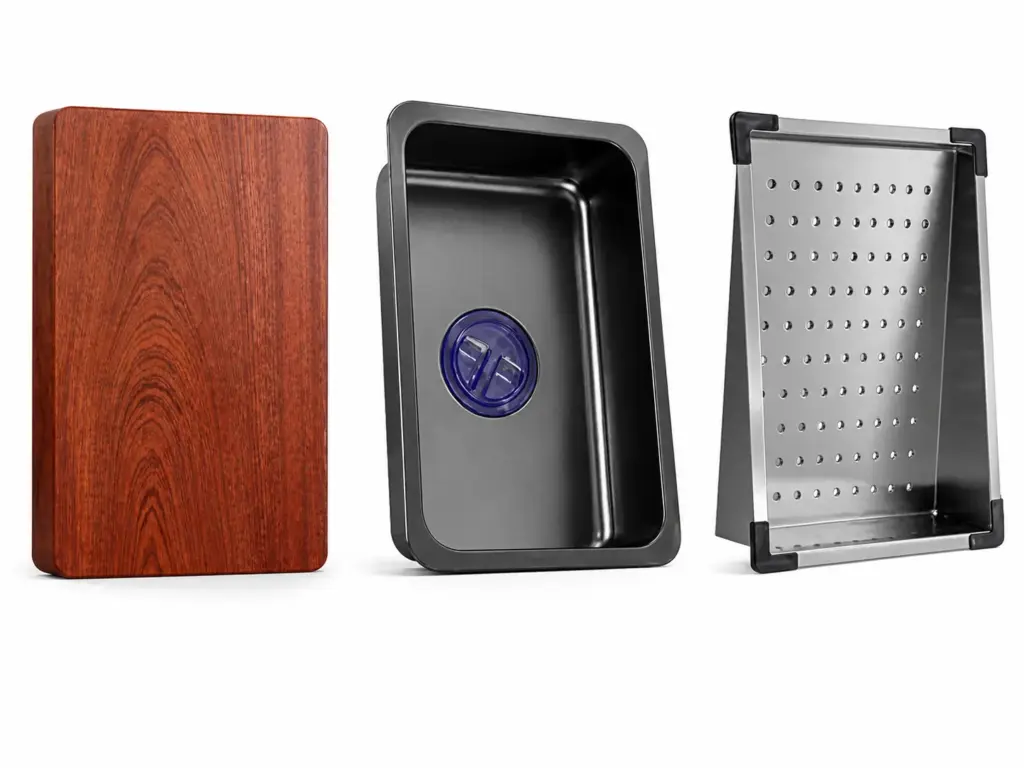
| Accessory | Best Use | What to Check | Typical Priority |
| Cutting board | Chopping and temporary prep surface | Ledge contact, flatness, material, drying and replacement | High for frequent cooks |
| Colander | Rinsing produce and draining food | Stability, faucet reach, drainage and depth | High for produce-heavy cooking |
| Roll-up rack | Light drying and temporary support | Span, end grips, load and heat limits | High where counter space is limited |
| Bottom grid | Keeps cookware above the bowl floor | Bowl shape, feet and drain alignment | Useful but needs regular cleaning |
| Drainboard | Drying and staging | Drain direction, slope, storage and fit | Situation-dependent |
| Wash bin or prep bowl | Separating tasks in a single bowl | Stability, capacity, drain access and storage | Optional |
For most users, the highest-value starting set is a cutting board plus either a colander or roll-up rack. Add more only when each accessory supports a recurring task.
Matrix also supplies model-matched sink cutting boards for workstation and private-label sink programs.
Are Workstation Sinks Hygienic?
A workstation sink can be hygienic when the bowl, ledge and food-contact accessories are cleaned correctly. The integrated ledge does not make the sink inherently clean or unclean.
Follow these principles:
- Wash cutting boards after each use with suitable soap and water.
- Use separate boards for raw meat or seafood and ready-to-eat foods to reduce cross-contamination.
- Replace boards with deep, hard-to-clean grooves or serious damage.
- Allow wood or bamboo boards to dry thoroughly before storage.
- Remove the bottom grid and clean beneath it regularly.
- Clean ledge corners and accessory contact points.
- Follow the care instructions for the exact sink finish and accessory material.
Do not leave food residue trapped between an accessory and the ledge. Do not assume every board material is dishwasher-safe.
Is a Workstation Sink Hard to Clean?
It requires more individual cleaning steps than a plain sink, but good design keeps those steps manageable.
The easiest workstation sinks to maintain have:
- Reachable ledge corners
- Removable accessories
- Smooth transitions
- Enough clearance to wipe around the ledge
- Clearly stated care instructions
- Replacement feet for grids and racks
Tight internal corners may look modern but can take longer to clean than larger-radius corners. The choice should balance appearance, usable space and maintenance.
Is It Worth the Extra Cost?
Do not compare the price only by sink dimensions. Compare the complete system:
- Sink body
- Included accessories
- Installation hardware
- Drain set
- Packaging quality
- Replacement-part availability
- Warranty and after-sales process
The extra cost is usually justified when the user repeatedly gains preparation or drying space and would otherwise buy separate tools.
It is difficult to justify when the accessories are used only for product photography and then stored permanently.
The Two-Accessory Rule
A simple decision rule is:
If you can name two included accessories you expect to use every week, a workstation sink is likely to deliver practical value. If you cannot name even one, choose a well-sized standard sink instead.
This is more reliable than choosing by package size or accessory count.
Seven-Question Workstation Sink Test
Give one point for every “yes.”
- Do you prepare food at the sink several times a week?
- Is your countertop regularly short of working space?
- Will you use at least two fitted accessories each week?
- Do you want rinsing, cutting and draining concentrated in one wet zone?
- Can you clean, dry and store the accessories properly?
- Can replacement accessories be identified by model or part number?
- Have you confirmed the cabinet, cutout, faucet and plumbing requirements?
Results
- 6–7 points: A workstation sink is likely to provide clear daily value.
- 4–5 points: It may be worthwhile; keep the accessory set focused.
- 2–3 points: Compare it carefully with a standard large single-bowl sink.
- 0–1 point: A regular sink is probably the more practical choice.
B2B Workstation Sink Buying Guide
For a brand, wholesaler or project buyer, a workstation sink is not one SKU with free accessories. It is a controlled system of dimensions, materials, part numbers and packaging.
1. Approve the Sink and Accessories Together
The sample review should cover:
- Overall sink dimensions
- Rim flatness
- Bowl dimensions and depth
- Ledge width, height and spacing
- Drain position
- Accessory dimensions
- Sliding clearance
- Contact with visible finishes
- Fit when two accessories are used together
2. Create an Accessory-Specific BOM
The bill of materials should list for every component:
- Part name
- Part number
- Material
- Finish or color
- Dimensions
- Quantity
- Packaging position
- Replacement code
“Full accessory set” is not precise enough for production, inspection or after-sales service.
3. Test Function—not Just Appearance
During sample approval, check whether each accessory:
- Sits flat
- Slides without jamming
- Resists tipping during its intended use
- Can be removed without excessive force
- Leaves practical open bowl space
- Avoids damaging the sink finish
- Works with the faucet and drain position
- Still fits after normal moisture exposure, where relevant
Avoid publishing unsupported weight or heat claims. Test methods and intended use should be defined first.
4. Control Packaging as Part of Product Quality
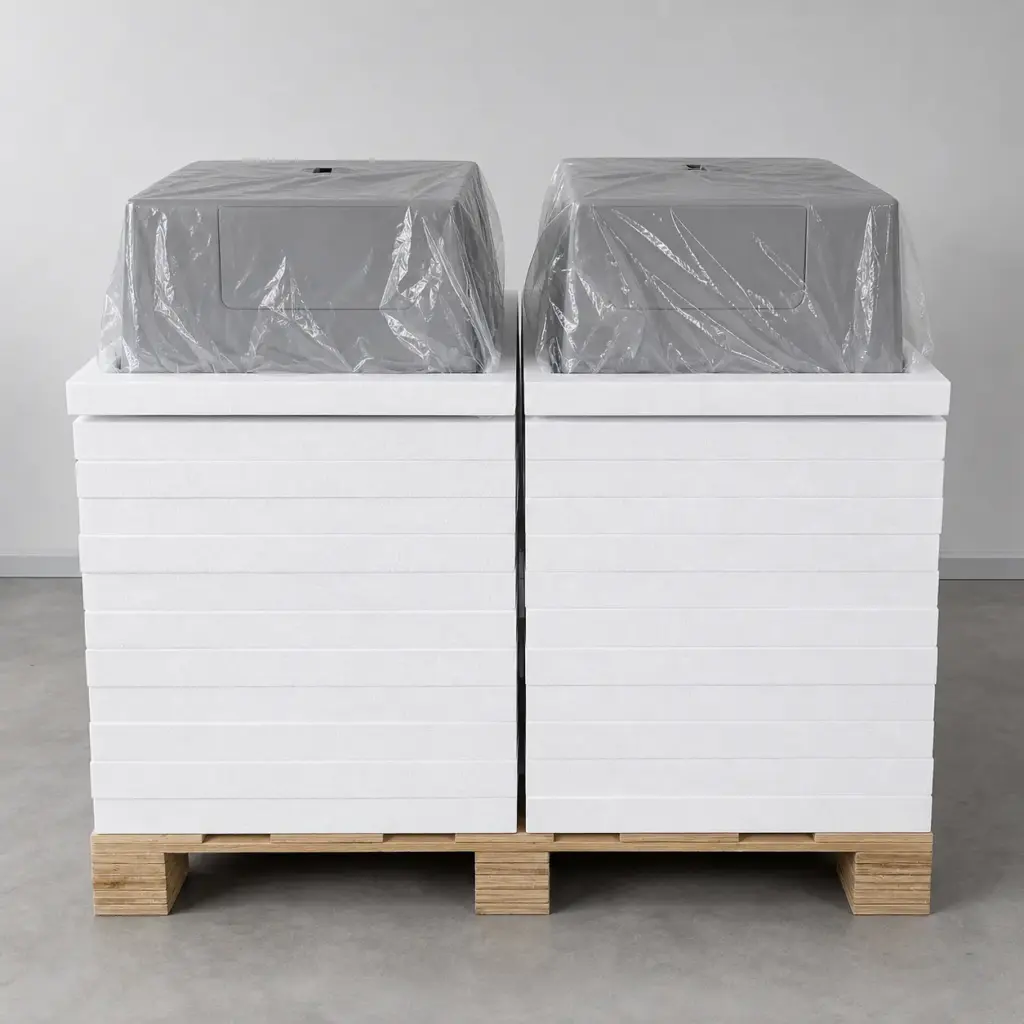
The packaging plan should prevent the accessories from touching or scratching the sink during transport.
Confirm:
- Individual accessory protection
- Fixed positions inside the carton
- Cutting-board moisture and surface protection
- Grid-foot protection
- Separate hardware and drain bags
- Carton accessory checklist
- Correct labels and barcodes
- Drop and transport testing appropriate to the sales channel
5. Plan Replacement Parts Before Launch
Every accessory should be traceable to the correct sink model. Retailers and project teams should be able to identify a replacement without comparing photographs.
At minimum, keep records for:
- Cutting board
- Colander
- Roll-up rack
- Bottom grid and feet
- Drain components
- Mounting hardware
6. Align Product Images with the Actual SKU
If lifestyle images show five accessories but the carton includes three, the difference must be obvious. “Accessories shown” and “accessories included” should never be left ambiguous.
B2B Quality-Control Checklist
| Inspection Area | Approval Question |
| Sink dimensions | Do the actual dimensions match the approved drawing? |
| Rim and installation | Is the rim flat and suitable for the intended mounting method? |
| Ledge geometry | Are ledge width, height, spacing and tiers consistent? |
| Cutting board | Is it flat, stable, correctly sized and properly finished? |
| Colander | Does it drain, slide and remain stable under intended use? |
| Roll-up rack | Does it span the ledge securely without damaging the finish? |
| Bottom grid | Do the shape, feet and drain opening match the bowl? |
| Faucet relationship | Does the water reach the useful accessory positions? |
| Finish | Are contact points protected from rubbing and scratches? |
| Packaging | Are all components protected, counted and correctly labeled? |
| Replacement control | Can every accessory be reordered by part number? |
Common Claims to Avoid
Avoid exaggerated or unsupported statements such as:
- “Doubles your kitchen space”
- “All workstation accessories are universal”
- “Scratch-proof surface”
- “The cutting board will never warp”
- “Supports any weight”
- “Completely eliminates countertop mess”
- “Maintenance-free”
- “Drain grooves guarantee a completely dry bowl”
Accurate specifications build more trust than absolute marketing language.
Frequently Asked Questions
Are workstation kitchen sinks really worth it?
Yes, for users who regularly prepare, rinse or dry items over the sink. They provide less value when the accessories are rarely used or when completely open bowl access is the priority.
What is the biggest disadvantage of a workstation sink?
The biggest practical disadvantage is added complexity. The ledge and accessories require cleaning, storage, model-specific fit and eventual replacement.
Are workstation sinks hard to keep clean?
They require more cleaning than a plain bowl because there are more contact surfaces. Reachable ledges, removable accessories and suitable corner radii make the system easier to maintain.
Do workstation sinks reduce usable bowl space?
The integrated ledge can reduce the clear top opening, and an installed accessory covers part of the bowl. Always compare internal and bowl-bottom dimensions rather than relying on nominal sink width.
Are workstation sink accessories universal?
No. Compatibility depends on ledge spacing, tier height, corner shape, accessory lip and clearance. Use model-specific dimensions or part numbers.
Can a workstation cutting board fall into the sink?
It can if it is undersized, warped or insufficiently supported. The actual board should be tested on the actual sink under its intended working conditions.
Are workstation sinks good for small kitchens?
They can be excellent for small kitchens because the bowl can become temporary prep or drying space. However, an oversized sink can consume too much cabinet and countertop width, so proportion still matters.
Are workstation sinks suitable for large kitchens?
Yes. In larger kitchens, their value comes from workflow, food preparation and entertaining rather than counter-space recovery alone.
Is a single-tier or two-tier workstation sink better?
A single tier is simpler and sufficient for most users. Two tiers are useful when accessories need to overlap at separate heights. More tiers are valuable only when the workflow uses them.
Is stainless steel or granite composite better for a workstation sink?
Stainless steel offers lighter weight, broad sizing and fabrication flexibility. Granite composite offers a matte, colored, stone-like appearance. Ledge accuracy and accessory compatibility are more important than material name alone.
Can a workstation sink use a garbage disposal?
Often yes, but the drain-hole size, disposal connection, bowl depth, cabinet clearance and plumbing position must be confirmed for the exact models.
How many workstation accessories do I need?
Most users need only two or three core accessories. A cutting board plus a colander or roll-up rack is often more useful than a large package of rarely used parts.
What should I measure before ordering?
Confirm the cabinet interior, minimum cabinet requirement, sink dimensions, countertop cutout, bowl dimensions, ledge spacing, depth, faucet location, drain position and under-sink plumbing clearance.
Final Verdict
A workstation kitchen sink is worth it when it improves tasks that already happen in the kitchen. It is most valuable for frequent cooks, compact work areas, produce preparation, flexible drying and coordinated sink packages.
It is not automatically better than a regular sink. A poorly sized workstation with unstable accessories can be less convenient than a simple, well-designed bowl.
Before buying, focus on five things:
- Weekly workflow: Which accessories will actually be used?
- Usable space: How much bowl remains open during use?
- System fit: Do the ledge, accessories and faucet work together?
- Installation: Do the cabinet, cutout, drain and plumbing match?
- Long-term support: Can damaged or lost accessories be replaced?
The best workstation sink is not the one with the most parts. It is the one that makes the kitchen easier to use without creating unnecessary cleaning, storage or compatibility problems.
Develop a Workstation Sink Program with Matrix
Matrix supports workstation kitchen sink programs for brands, importers, wholesalers, showrooms and project buyers. We can review the sink body, ledge structure, material, faucet, drain, accessory fit, packaging and replacement-part plan as one coordinated system.
To request a product review, prepare:
- Target market and sales channel
- Sink dimensions and installation type
- Material, thickness and finish
- Cabinet and countertop requirements
- Required accessory set
- Faucet and drain configuration
- Branding and packaging requirements
- Estimated order quantity
Contact the Matrix team to discuss a workstation sink sample, accessory specification or OEM/private-label program.
Editorial Reference
Food-contact accessory guidance in this article follows current USDA cutting-board cleaning and cross-contamination guidance. Product dimensions, installation requirements and accessory compatibility should always be confirmed from the specification sheet for the exact sink model.