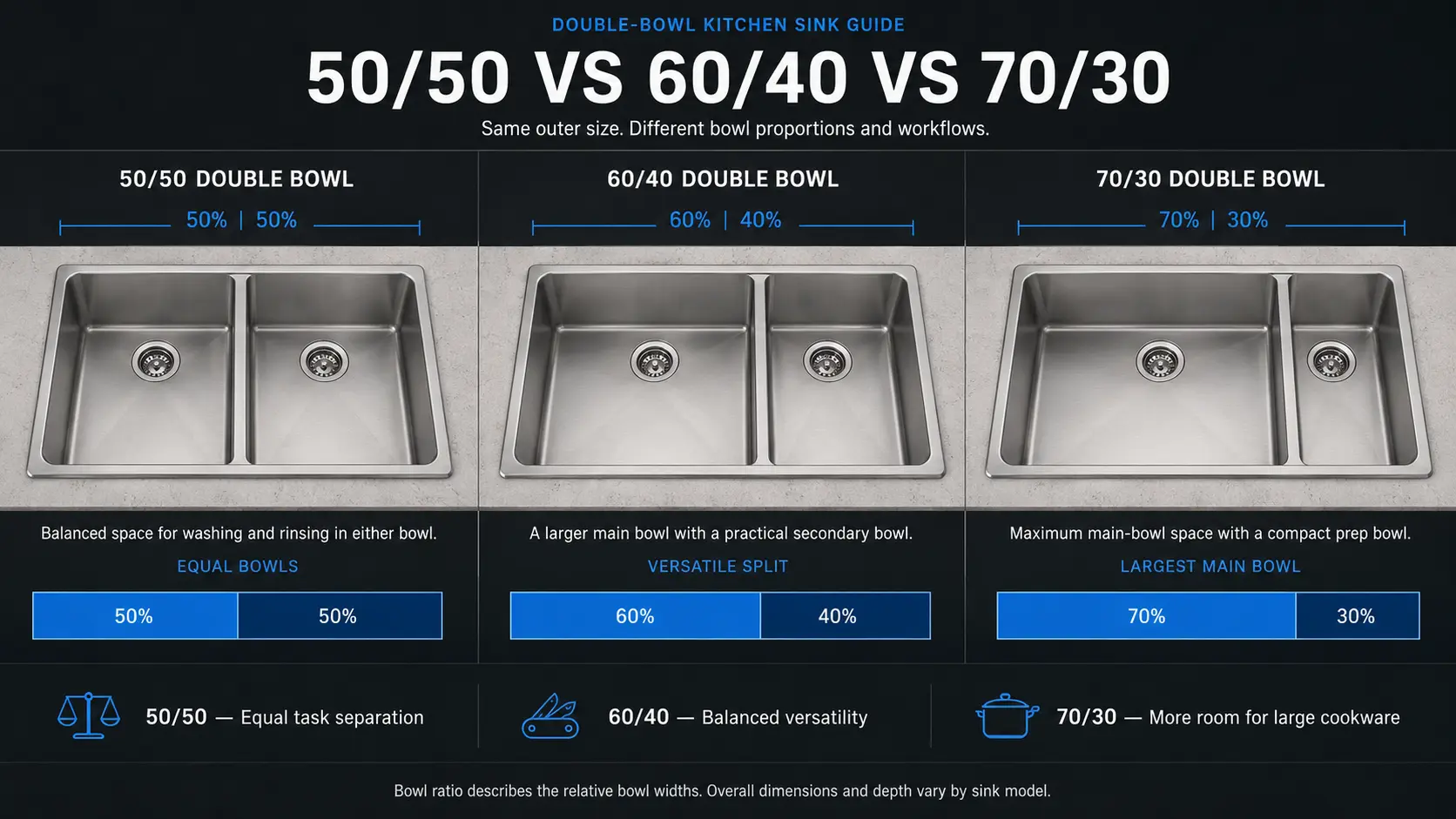
A 50/50 double-bowl sink provides two similarly sized working zones. A 60/40 sink gives one bowl more space while keeping the second bowl practical.
A 70/30 sink prioritizes a large main bowl and turns the smaller bowl into a specialized prep or rinsing zone.
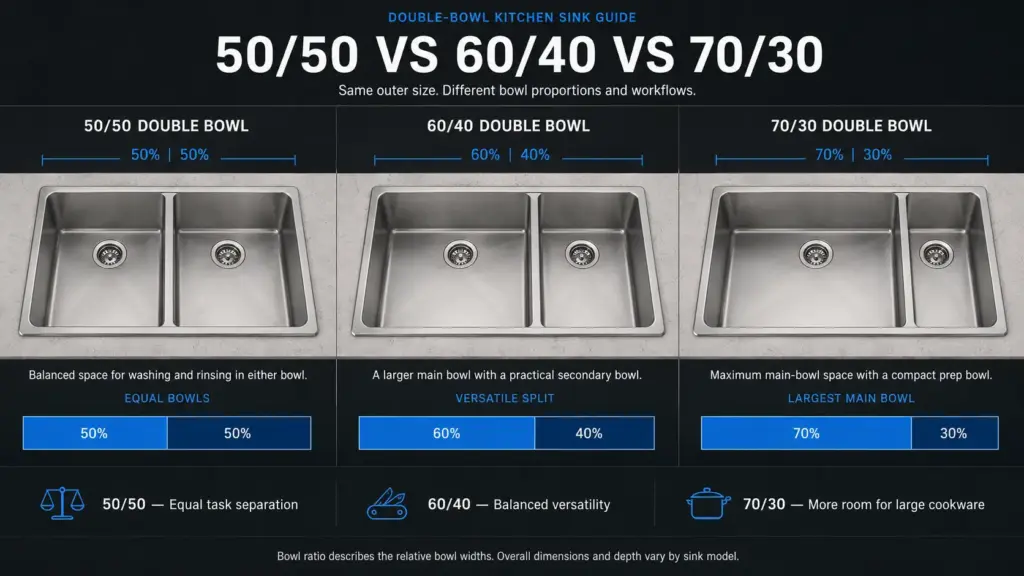
The quick recommendation is:
- Choose 50/50 for balanced washing and rinsing.
- Choose 60/40 for a larger main bowl without sacrificing a useful second bowl.
- Choose 70/30 when large cookware is the priority and the small bowl has a clearly defined function.
- Consider a single bowl if you cannot identify a regular purpose for the second bowl.
However, the ratio is only a label. It does not tell you the exact bowl dimensions, water capacity or largest item the sink can hold.
Quick Comparison
| Bowl Split | Best Feature | Main Limitation | Best For |
|---|---|---|---|
| 50/50 | Two equally useful work zones | Limited space for large cookware | Handwashing, soaking and rinsing |
| 60/40 | Most balanced unequal split | Small bowl may still be too narrow for some tasks | Mixed cookware, prep and cleanup |
| 70/30 | Largest possible main-bowl share | Small bowl can lose practical value | Large cookware plus compact secondary task |
For many mixed-use kitchens, 60/40 is a sensible starting point. It is not automatically the best choice. Actual bowl dimensions and household workflow must still be checked.
Three Facts Most Sink Comparisons Miss
1. The Ratio Does Not Represent Exact Capacity
A 60/40 sink does not necessarily contain exactly 60 percent of its water capacity in one bowl and 40 percent in the other.
The product name may be based on:
- Nominal bowl width
- Top-opening allocation
- Divider position
- Internal plan area
- Product-family naming
Depth, tapered walls and corner radii can produce a very different volume relationship.
2. A 60/40 Sink Can Have a Larger Main Bowl Than a 70/30 Sink
Ratios should only be compared between sinks of similar overall size.
A wide 60/40 sink can have a larger main bowl than a compact 70/30 sink. The ratio describes how one sink is divided; it does not provide an absolute bowl size.
3. The Smaller Bowl Often Determines Whether the Sink Works
Most buyers focus on maximizing the large bowl.
A better approach is to define the minimum useful size of the smaller bowl first. The remaining space can then be assigned to the main bowl.
If the small bowl becomes too narrow for its intended task, the double-bowl layout loses much of its value.
What Do 50/50, 60/40 and 70/30 Mean?
These terms describe the relative allocation of space between two sink bowls.
50/50 Double Bowl
Both bowls are similar in width and usually perform comparable tasks.
60/40 Double Bowl
One bowl is moderately larger. The other remains a meaningful secondary working area.
70/30 Double Bowl
One bowl receives most of the available space. The other becomes a compact support bowl.
The description does not always indicate which side contains the larger bowl.
For an unequal sink, confirm whether the model is:
- Large bowl left
- Large bowl right
A model described as 60/40 by one supplier may be described as 40/60 when the orientation is reversed.
Choose by Workflow Before Choosing by Ratio
The best split depends on what happens at the sink every day.
Choose 50/50 When:
- Dishes are washed in one bowl and rinsed in the other.
- Both bowls need to hold plates or cookware.
- Two people sometimes use the sink simultaneously.
- Oversized cookware is uncommon.
- Symmetry is preferred.
- Either bowl may serve as the main cleanup area.
Choose 60/40 When:
- One larger bowl is needed for cookware.
- The smaller bowl still needs to rinse dishes or prepare food.
- Washing and preparation frequently happen together.
- A compromise between equal bowls and a large single bowl is preferred.
- A low divider is being considered.
Choose 70/30 When:
- Most work takes place in one main bowl.
- Large pots, pans or mixing bowls are common.
- The small bowl has a specific function.
- The user prefers a nearly single-bowl experience.
- The small bowl does not need to hold full-size dishes.
Consider a Single Bowl When:
- The second bowl has no consistent purpose.
- Full-size sheet pans are washed frequently.
- Maximum uninterrupted sink space is the priority.
- Simpler plumbing is preferred.
- One large workstation area is more valuable than task separation.
The Small-Bowl-First Selection Method
Instead of beginning with the large bowl, use this sequence.
Step 1: Assign a Job to the Smaller Bowl
Possible functions include:
- Rinsing plates
- Washing produce
- Holding utensils
- Soaking cutlery
- Collecting food waste
- Supporting a garbage disposal
- Draining a colander
- Defrosting food in a container
- Holding soapy water
Step 2: Measure the Objects Used for That Job
If the small bowl must rinse dinner plates, measure the plate diameter.
If it will hold a colander, measure the colander.
If it will contain a garbage disposal, confirm the drain position and available space below the sink.
Step 3: Establish the Minimum Usable Bowl Size
Compare the object with:
- Internal top dimensions
- Bowl-bottom dimensions
- Bowl depth
- Corner radius
- Drain fitting
Step 4: Allocate the Remaining Width to the Main Bowl
Now compare the main bowl with the largest cookware used regularly.
This method prevents a dramatic-looking 70/30 sink from being selected when the small bowl is too limited to be useful.
50/50 Double-Bowl Sink
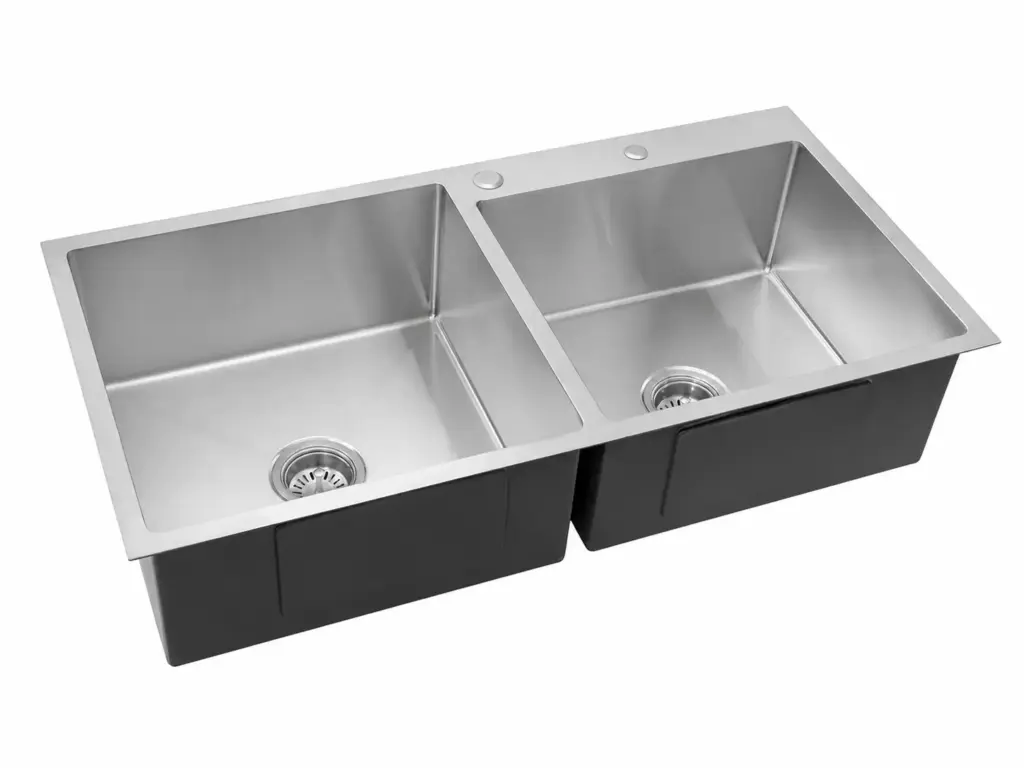
A 50/50 sink creates two balanced basins.
Advantages
- Similar washing and rinsing capacity
- Flexible left-right use
- Convenient for traditional handwashing
- One bowl can soak while the other remains available
- Balanced appearance
- Easier to use when both bowls perform similar tasks
- Identical accessories may be possible when both bowls are truly equal
Limitations
- Neither bowl provides maximum uninterrupted space.
- Large cookware may need to stand at an angle.
- Pan handles may contact the divider.
- Sheet pans may not lie flat.
- Two equal bowls can feel small in a compact sink.
- A full-height divider makes oversized-item washing more difficult.
Best Use Case
A 50/50 sink is strongest when the user values two equivalent water zones more than one large cookware bowl.
It is less suitable when a dishwasher handles most dishes and the sink is mainly used for large pots and trays.
60/40 Double-Bowl Sink
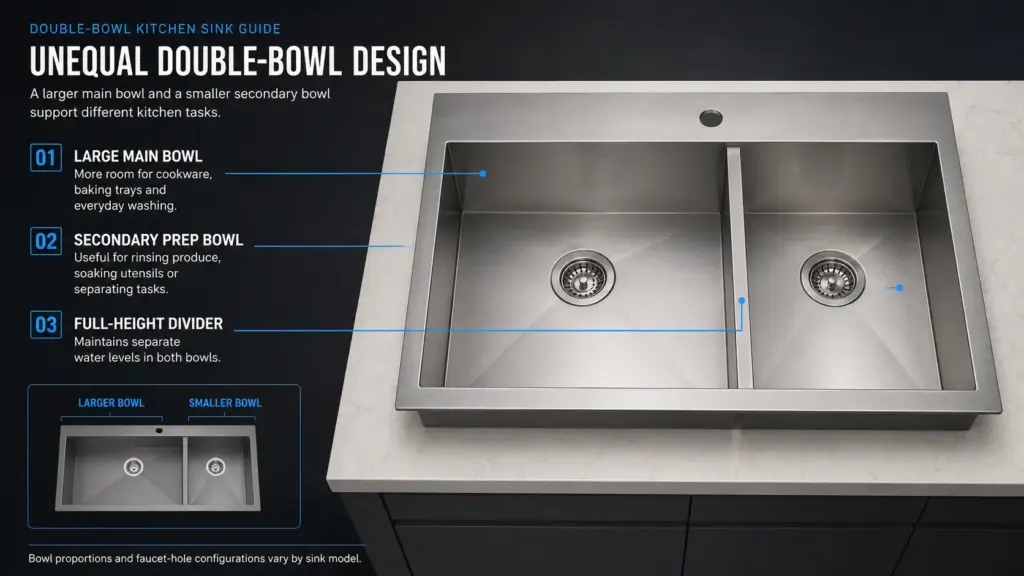
A 60/40 sink is designed to combine a larger cleanup bowl with a still-functional secondary bowl.
Advantages
- Better cookware space than a comparable 50/50 sink
- More useful secondary bowl than many 70/30 layouts
- Clear separation between main and support tasks
- Flexible for washing, rinsing and food preparation
- Works well with full-height or low dividers
- Suitable for households with mixed sink habits
Limitations
- The main bowl is still smaller than a comparable single bowl.
- The secondary bowl may not hold large plates.
- Left-right orientation affects workflow.
- Each bowl generally needs its own bottom grid.
- The asymmetrical shape can complicate replacement.
- Two drains still occupy cabinet space.
Best Use Case
A 60/40 sink is often the safest unequal split when the user needs:
- A larger main bowl
- A separate rinsing area
- Enough flexibility for more than one task
The key is confirming that the 40-percent bowl remains useful.
70/30 Double-Bowl Sink
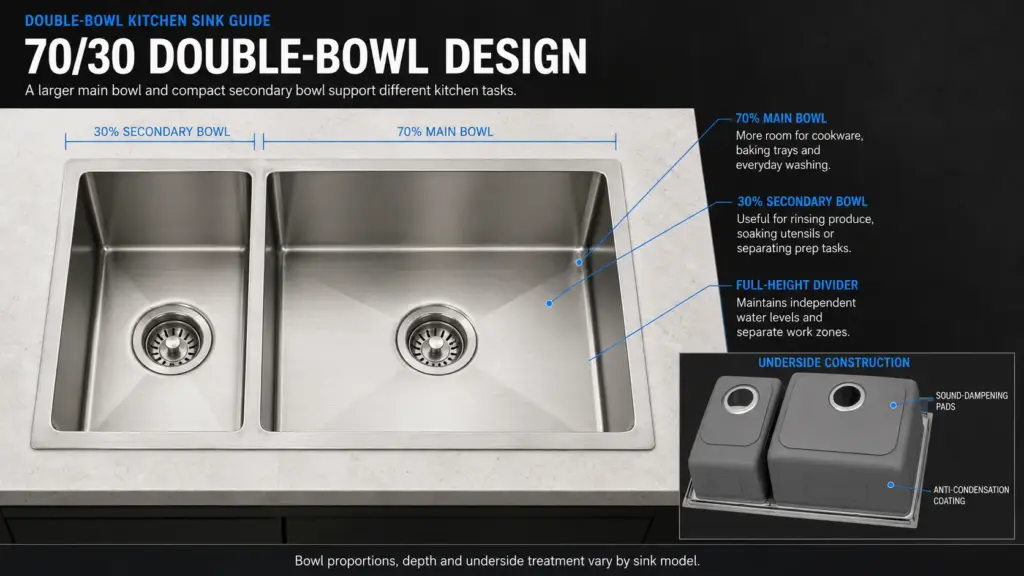
A 70/30 sink gives a dominant share of the available space to the main bowl.
Advantages
- Better accommodation of large pots and pans
- Closer to a single-bowl working experience
- Separate compact preparation or rinsing zone
- Strong distinction between primary and secondary functions
- Works well when most tasks happen in one bowl
- Can become more flexible with a low divider
Limitations
- The small bowl may be too narrow for standard plates.
- Its drain can consume much of the bowl-bottom area.
- The small bowl may be difficult to clean around the drain.
- A second drain still consumes under-sink space.
- Accessories are highly model-specific.
- Orientation has a significant effect on workflow.
- The divider still prevents a completely uninterrupted sink floor.
Best Use Case
A 70/30 sink is appropriate when the main bowl has clear priority and the small bowl only needs to perform a compact, repeatable task.
It is a poor choice when the user expects the small bowl to function as a second full washing basin.
Real Usable Space: The Measurements That Matter
Do not compare only the advertised ratio.
For each bowl, check the following dimensions.
Internal Top Length and Width
These dimensions show whether an item can enter the bowl opening.
Bowl-Bottom Length and Width
Tapered walls and rounded corners can make the bowl bottom considerably smaller than the top opening.
A frying pan may enter the bowl but still not sit flat.
Bowl Depth
Depth affects:
- Water capacity
- Splash containment
- Dish storage
- Ergonomic reach
- Plumbing clearance
- Garbage disposal height
A deeper small bowl can sometimes be more useful than a wider but shallow bowl.
Narrowest Functional Width
The narrowest internal width at the intended working depth may matter more than the top opening.
This is especially important for:
- Plates
- Colanders
- Bottom grids
- Food containers
- Pan bases
Corner Radius
Rounded corners reduce usable rectangular floor area. Tighter corners increase bottom space but may require more cleaning attention.
Divider Width
A wide divider takes space from both bowls.
Two sinks with the same outside width and advertised ratio can therefore have different internal dimensions.
The Five-Object Test
Before choosing a ratio, measure five objects commonly used in the kitchen:
- Largest frying pan
- Largest stockpot
- Largest sheet pan or roasting tray
- Standard dinner plate
- Colander or preparation container
Compare them with the dimensioned sink drawing.
Ask:
- Can the object enter the bowl?
- Can it rest in a stable position?
- Can it be rotated for washing?
- Does the handle remain inside the sink?
- Will it block the faucet stream?
- Will it create excessive splash?
- Can it be removed easily?
An item does not always need to lie completely flat. However, washing should not require unstable balancing against the divider.
Full Divider vs Low Divider
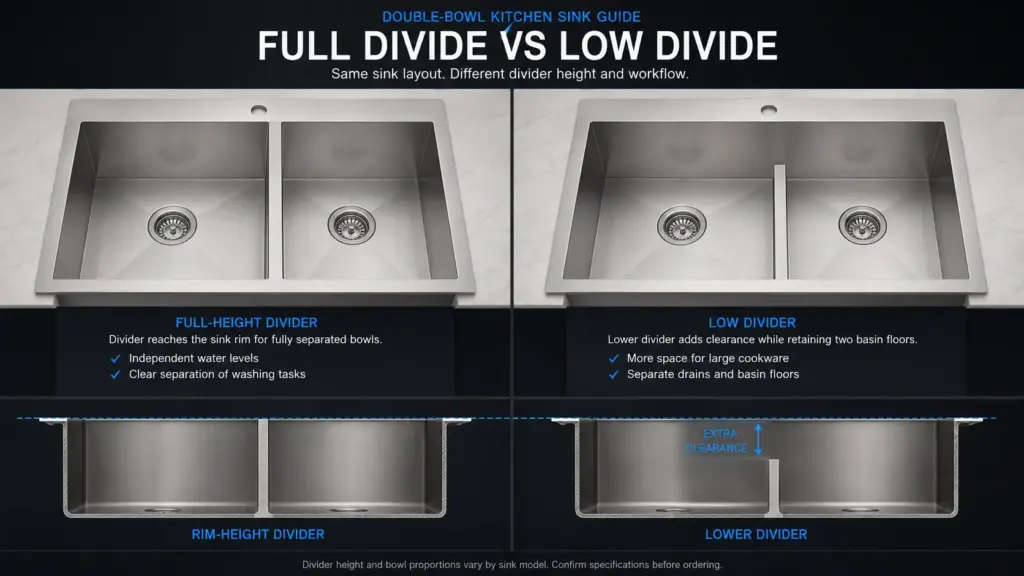
The bowl ratio and divider height should be evaluated together.
Full-Height Divider
A full divider rises close to the top of the sink.
It provides:
- Better separation
- Greater independent water depth
- Less water transfer between bowls
- Clear washing and rinsing zones
Its main disadvantage is reduced flexibility for oversized cookware.
Low Divider
A low divider creates two separate bowl bottoms while allowing long items to extend across both bowls.
It provides:
- Easier washing of pans and trays
- More space for long handles
- Some single-bowl-like flexibility
- Easier movement between the two zones
Its limitations include:
- Lower independent filling depth
- Earlier water transfer between bowls
- Less separation during soaking
- Reduced water depth above a bottom grid
A Useful Comparison
A 50/50 low-divide sink may handle long cookware better than a 70/30 full-divide sink.
This demonstrates why ratio alone cannot predict usability.
Divider Height and Independent Water Depth
A bowl may be described as 9 or 10 inches deep, but a low divider can limit how deeply that bowl holds water independently.
Approximate independent fill depth is determined by:
The vertical distance from the bowl bottom to the top of the divider
If a bottom grid is installed, practical water depth above the grid is reduced further.
Check divider height when the sink will be used for:
- Soaking dishes
- Holding soapy water
- Separating dirty and clean water
- Defrosting food in a container
Large Bowl Left or Right?
Unequal double-bowl sinks require an orientation decision.
Consider the positions of:
- Dishwasher
- Main food-preparation counter
- Drying area
- Waste bin
- Garbage disposal
- Existing drainpipe
- Water filter
- Dominant working direction
Example Workflow
If dirty cookware usually approaches from the preparation side, the large bowl may work better on that side.
If the smaller bowl is used for food preparation, it may be more useful near the primary work surface.
There is no universal correct orientation. The layout should follow movement through the kitchen.
Can a 60/40 or 70/30 Sink Be Reversed?
Only when the model is designed for reversible installation.
Rotation may be prevented by:
- Faucet deck
- Pre-drilled faucet holes
- Drainboard
- Workstation ledge
- Drain position
- Accessory orientation
- Asymmetrical rim
- Mounting clips
- Apron-front structure
- Product logo
For undermount installation, the countertop cutout and reveal may also follow a specific orientation.
Do not rotate an unequal sink without checking its technical drawing and installation template.
Comparison by Kitchen Task
| Kitchen Requirement | 50/50 | 60/40 | 70/30 |
| Separate washing and rinsing | Best | Very good | Depends on small bowl |
| Large cookware | Limited | Good | Best |
| Two equivalent work zones | Best | Moderate | Limited |
| Main bowl plus prep bowl | Acceptable | Best balance | Strong specialization |
| Traditional handwashing | Best | Very good | Less balanced |
| Dishwasher-focused household | May provide unnecessary symmetry | Flexible | Good if large cookware dominates |
| Single-bowl-like use | Limited | Good with low divider | Best with low divider |
| Symmetrical appearance | Best | No | No |
| Simple left-right selection | Best | Orientation required | Orientation critical |
| Accessory interchangeability | Possible with equal bowls | Usually no | Usually no |
Actual results depend on the sink dimensions and divider design.
Bowl Depth: Equal or Unequal?
Some double-bowl sinks use the same depth for both bowls. Others use different depths.
Equal-Depth Bowls
Possible advantages include:
- Consistent working height
- Similar water capacity
- Simpler drain elevation
- More balanced appearance
- Easier comparison between bowls
Unequal-Depth Bowls
A deeper main bowl can improve cookware capacity while a shallower secondary bowl can make small items easier to reach.
Possible disadvantages include:
- Different drain elevations
- More complex plumbing
- Different bottom grids
- Unequal under-sink clearance
- Greater product-specification complexity
Check both bowl depths rather than relying on one overall depth description.
Drain and Garbage Disposal Planning
A double-bowl sink normally requires two drains connected below the sink.
Confirm:
- Drain-center positions
- Distance between drains
- Garbage disposal location
- P-trap arrangement
- Dishwasher connection
- Cabinet depth
- Water-filter position
- Pull-out bin clearance
- Cabinet shelf or drawer interference
A small 30-percent bowl still requires a drain. That plumbing may occupy almost as much cabinet depth as the drain in a larger bowl.
Which Bowl Should Have the Garbage Disposal?
There is no universal correct bowl.
The decision should follow:
- Food-waste workflow
- Dishwasher-hose location
- Drain routing
- Disposal dimensions
- Cabinet storage plan
- Local installation requirements
Installing the disposal in the small bowl preserves the large bowl’s open floor, but the small bowl must still provide enough drain and working space.
Installing it in the large bowl may suit a cleanup-focused workflow but can reduce storage space below the primary bowl.
Cabinet Compatibility
A 50/50, 60/40 or 70/30 ratio does not determine minimum cabinet width.
Cabinet compatibility depends on:
- Overall sink dimensions
- Mounting flange
- Clip clearance
- Cabinet-wall thickness
- Countertop cutout
- Installation method
- Support structure
A 33-inch sink does not automatically fit a 33-inch cabinet.
Use the specified minimum cabinet size and check vertical clearance for:
- Bowl depth
- Drain fittings
- Garbage disposal
- P-trap
- Filter system
- Pull-out waste bins
Replacing an Existing Double-Bowl Sink
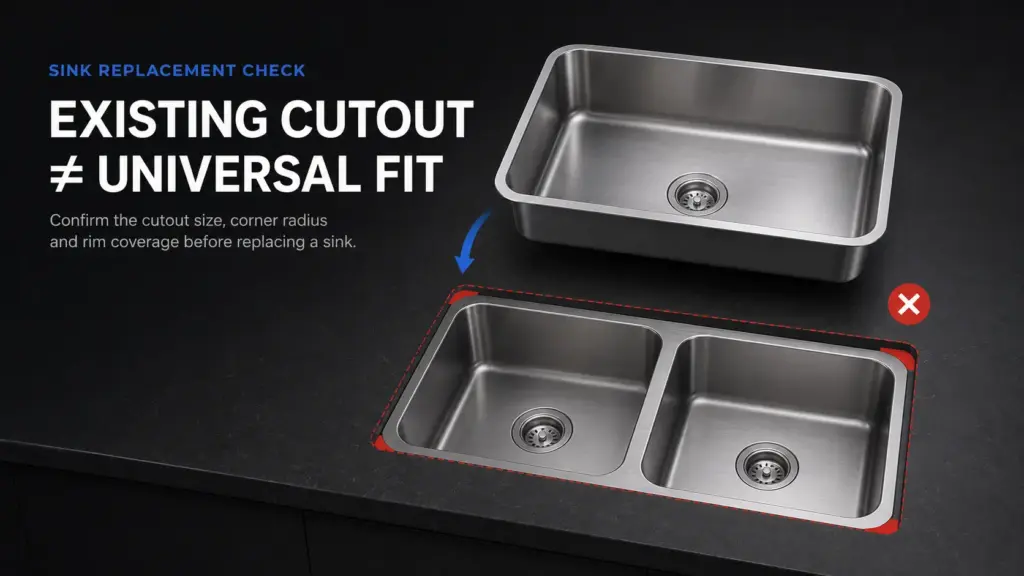
Changing from 50/50 to 60/40 or 70/30 can require more than matching the outside dimensions.
Check:
- Existing countertop cutout
- Sink rim coverage
- Bowl outline
- Divider position
- Corner radius
- Drain locations
- Faucet-hole layout
- Cabinet width
- Installation type
Top-Mount Replacement
A top-mount rim may cover differences in the cutout, but the entire rim still needs proper countertop support.
Undermount Replacement
An undermount cutout remains visible. The new bowl shape, divider and reveal must match the countertop opening.
An equal-bowl cutout may not suit an asymmetrical sink even when the outside dimensions are similar.
Use the actual installation template.
Workstation Double-Bowl Sinks
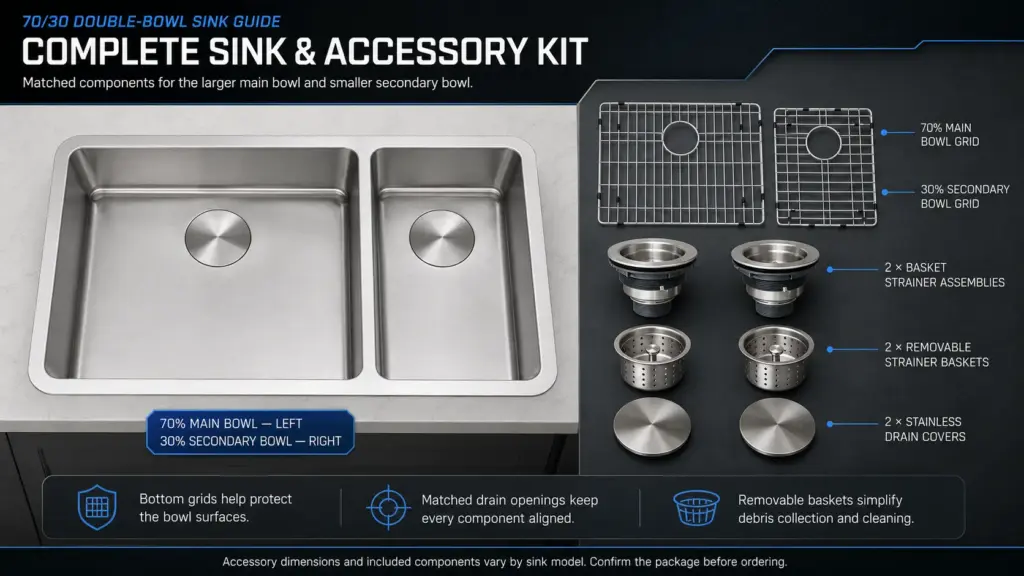
A workstation double-bowl sink also needs accessory planning.
Confirm whether the ledge:
- Runs continuously across the sink
- Stops at the divider
- Uses one or two levels
- Supports accessories over only one bowl
- Uses separate accessories for each bowl
Check:
- Cutting-board travel
- Colander dimensions
- Roll-up rack span
- Divider interference
- Bottom-grid sizes
- Drain-cover position
The main bowl may be large, but the divider or ledge design can reduce accessory movement.
Explore Matrix workstation kitchen sinks for ledge-based product programs.
Material and Manufacturing Method
The bowl ratio can be produced in different sink materials, but the manufacturing method affects the internal geometry.
Handmade Stainless Steel
Handmade construction can support:
- Custom bowl proportions
- Custom depths
- Low dividers
- Specialized drain positions
- Tighter internal corner designs
Feasibility depends on structure, order quantity, production process and approved drawings.
Pressed Stainless Steel
Pressed or drawn sinks use fixed forming tools.
Their bowl taper, depth, radius and divider structure are determined by the tooling.
Changing from 50/50 to 60/40 may therefore require different bowls or tooling—not simply moving the divider.
Molded Composite Sinks
Molded sinks also use defined tooling. Wall thickness, corner radius and divider structure can affect the usable split.
For every material, compare finished internal dimensions instead of assuming the ratio produces the same experience.
Common Selection Mistakes
Choosing by Ratio Without Comparing Overall Size
A larger 60/40 sink may provide more main-bowl space than a smaller 70/30 model.
Maximizing the Large Bowl First
This can leave the smaller bowl too narrow to perform a useful task.
Confusing Bowl Ratio with Capacity
Depth, taper and corner geometry change actual volume.
Ignoring the Bowl Bottom
Cookware may fit through the opening but not sit inside the lower bowl.
Ignoring Divider Height
A full divider and low divider create very different results.
Assuming 60/40 Indicates Orientation
Always confirm which side contains the large bowl.
Assuming the Sink Is Reversible
Faucet holes, drains, accessories and rim geometry may prevent rotation.
Ignoring Two-Drain Plumbing
The secondary bowl still uses cabinet space below.
Ordering Accessories by Ratio
A 60/40 bottom grid is not a universal product. Grids must match the exact bowl dimensions, radius and drain positions.
Assuming an Unequal Sink Fits an Existing Cutout
The divider and bowl outline may not align with the countertop.
Consumer Selection Worksheet
Complete this worksheet before choosing a model.
| Question | Requirement |
| Largest cookware dimensions | ______ |
| Small-bowl function | ______ |
| Minimum small-bowl width | ______ |
| Preferred divider | Full / Low |
| Required independent water depth | ______ |
| Large-bowl side | Left / Right |
| Garbage disposal side | Left / Right / None |
| Minimum cabinet width | ______ |
| Existing cutout dimensions | ______ |
| Required bowl depth | ______ |
| Bottom grids required | Yes / No |
| Workstation accessories required | Yes / No |
A product should not be selected until both bowls have a defined use.
B2B Specification: “60/40” Is Not Enough
For importers, distributors, private-label brands and project buyers, the ratio should be treated as a marketing label supported by measurable specifications.
Define the Ratio Method
State whether the ratio is based on:
- Internal bowl width
- Top-opening allocation
- Internal plan area
- Nominal product-family description
Use one method consistently across drawings, quotations, catalogs and packaging.
Define Both Bowls Separately
The drawing should include:
- Top internal length and width
- Bowl-bottom dimensions where required
- Bowl depth
- Corner radius
- Wall taper
- Drain position
- Bottom-grid part number
Define the Divider
Specify:
- Divider position
- Divider width
- Divider height
- Corner transitions
- Full- or low-divider construction
Define Orientation
Avoid using only “60/40.”
Use unambiguous descriptions such as:
- Large bowl left
- Large bowl right
- 40/60 left-small
- 60/40 left-large
The selected naming rule should remain consistent.
Define Installation Compatibility
Include:
- Overall dimensions
- Minimum cabinet size
- Mounting flange
- Countertop cutout
- Installation template
- Faucet-hole layout
- Reversible or non-reversible status
Double-Bowl Sink QC Checklist
Dimensional Inspection
Check:
- Overall size
- Bowl top dimensions
- Bowl-bottom dimensions where specified
- Individual bowl depths
- Divider position
- Divider height
- Corner radii
- Drain-center positions
- Rim or flange dimensions
Functional Inspection
Check:
- Drainage in both bowls
- Bowl-bottom condition
- Divider alignment
- Bottom-grid fit
- Drain-cover fit
- Workstation accessory movement
- Plumbing layout where included
Orientation Inspection
Confirm:
- Large bowl is on the correct side.
- Drains match the drawing.
- Faucet holes match the orientation.
- Product images match the SKU.
- Installation template matches the supplied sink.
Packaging Inspection
Confirm:
- 60/40 and 40/60 models are not mixed.
- 70/30 and 30/70 models are correctly identified.
- Bowl grids are packed on the correct sides.
- Accessories are protected from the sink surface.
- Carton diagrams show the correct orientation.
- Labels use the approved ratio terminology.
For unequal double-bowl sinks, left-right SKU control is part of quality control—not merely a catalog detail.
How Matrix Supports Double-Bowl Sink Programs
Matrix supplies and develops double-bowl kitchen sinks for importers, distributors, private-label brands and project buyers.
Depending on the program, Matrix can review:
- Equal, 60/40 and 70/30 layouts
- Custom bowl proportions
- Large-bowl orientation
- Full or low divider
- Individual bowl depths
- Drain positions
- Handmade or pressed construction
- Bottom grids
- Workstation accessories
- Finish and soundproofing
- Packaging and SKU identification
Related Matrix resources include:
- Double-bowl kitchen sinks
- Workstation kitchen sinks
- Custom kitchen sink programs
- Kitchen sink installation guides
For an OEM, wholesale or project program, send the target dimensions, preferred bowl split, divider type, orientation and accessory requirements to contact Matrix.
Final Recommendation
Choose 50/50 when both bowls need to perform similar washing and rinsing tasks.
Choose 60/40 when you need a larger cookware bowl but still want a genuinely useful secondary bowl.
Choose 70/30 when the main bowl is the priority and the small bowl has a specific compact purpose.
Before deciding, verify:
- Actual internal dimensions of both bowls
- Bowl-bottom dimensions
- Individual bowl depths
- Divider height and width
- Large-bowl orientation
- Drain and disposal layout
- Cabinet and cutout compatibility
- Grid and accessory availability
The best double-bowl sink is not the one with the most attractive ratio. It is the one in which both bowls have enough usable space to perform their intended jobs.
Frequently Asked Questions
Is 50/50 or 60/40 better?
Choose 50/50 for two balanced washing zones. Choose 60/40 when one larger cookware bowl is more important.
Is 60/40 or 70/30 better?
Choose 60/40 when the smaller bowl still needs to handle meaningful rinsing or preparation. Choose 70/30 when the large bowl is the priority and the small bowl only needs a compact function.
What does 60/40 mean on a kitchen sink?
It describes an unequal double-bowl layout. It does not guarantee an exact volume ratio or identify which side contains the larger bowl.
Can a 60/40 sink have a larger bowl than a 70/30 sink?
Yes. If the 60/40 sink is larger overall, its main bowl can be larger than the main bowl in a smaller 70/30 sink.
Does 60/40 mean the large bowl is on the left?
Not always. Check whether the model is large-bowl-left or large-bowl-right.
Is a 70/30 sink almost the same as a single bowl?
It provides a large main bowl, but the divider still interrupts the sink floor. A low divider improves flexibility but does not create a true single bowl.
Which split is best for washing large pots?
A sufficiently large 70/30 or 60/40 sink usually provides more space. Compare the actual main-bowl dimensions with the cookware.
Which split is best for handwashing dishes?
A 50/50 or sufficiently spacious 60/40 sink usually provides better separate washing and rinsing zones.
Is a low divider better than a full divider?
A low divider is better for handling long cookware across both bowls. A full divider provides greater independent water depth and stronger separation.
Does bowl ratio represent water capacity?
No. Bowl depth, wall taper, divider thickness and corner geometry affect actual capacity.
Can I reverse a 60/40 kitchen sink?
Only when the model is designed to be reversible. Check the drawing, faucet holes, drains, rim and accessory layout.
Which bowl should have the garbage disposal?
The best side depends on food-waste workflow, plumbing, dishwasher connection and available cabinet space.
Can I replace a 50/50 sink with a 60/40 sink?
Possibly, but the cutout, rim coverage, bowl outline, drain locations and cabinet must be compatible.
Are 60/40 bottom grids universal?
No. Bottom grids must match the exact bowl dimensions, corner radii and drain locations.
What is the safest choice for a broad B2B product range?
There is no universal ratio for every market. Validate the split using target-market demand, actual bowl dimensions, common cabinet sizes, installation conventions and customer workflow.