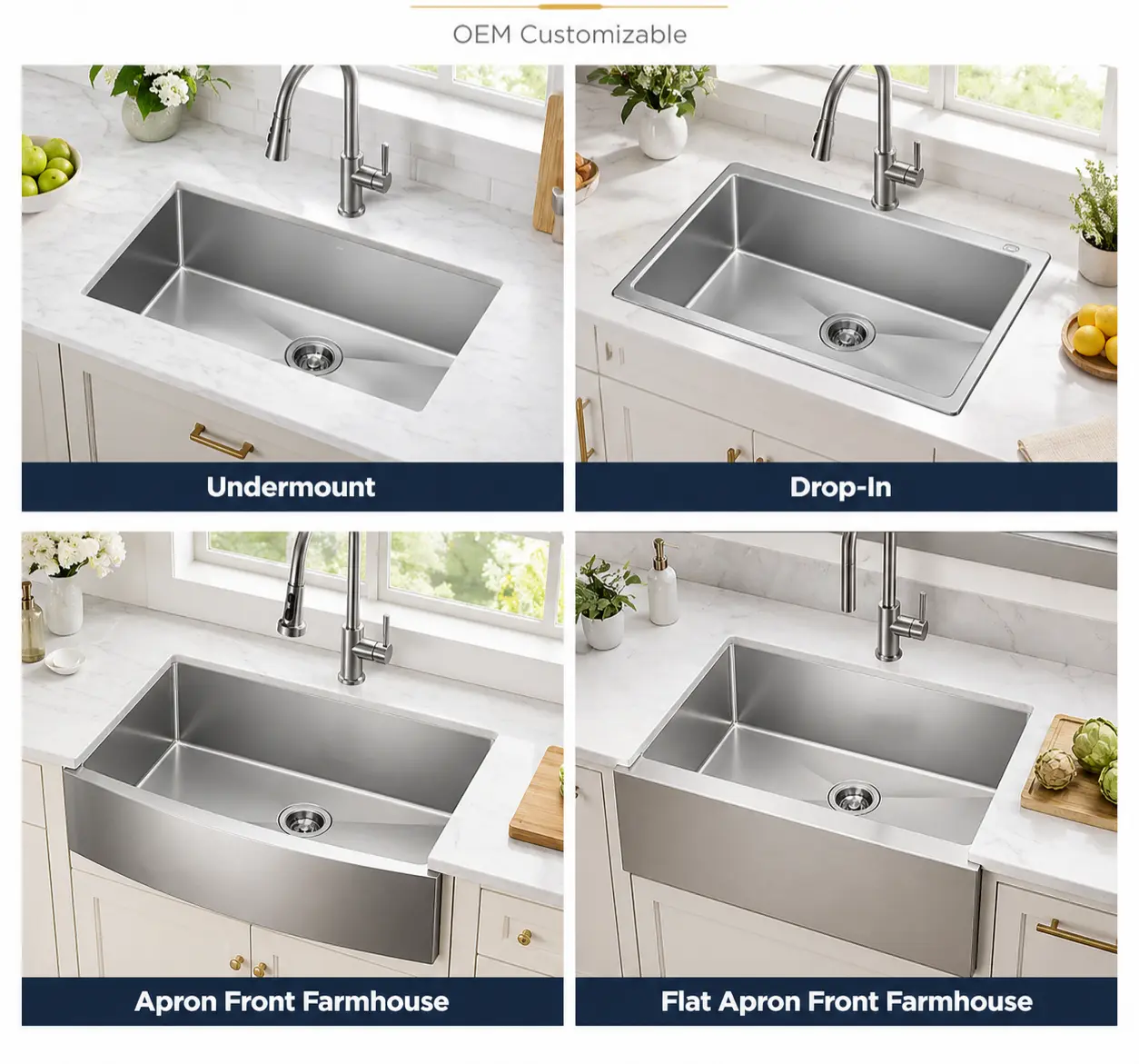
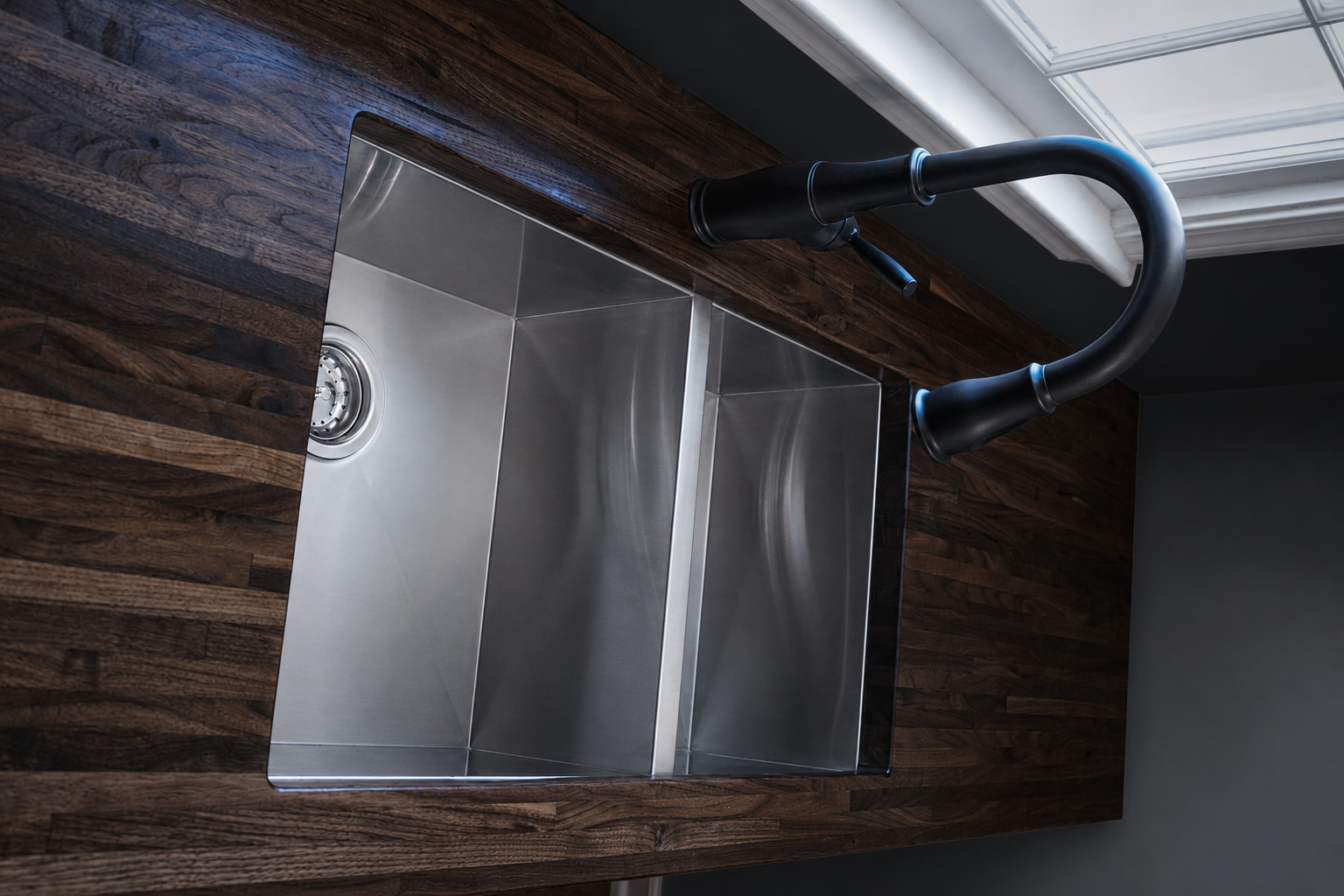
Yes—but not every countertop can use the same undermount sink or installation method.
Quartz is usually the most straightforward of these four materials. Porcelain slab can also work, but its thin, hard cutout edge requires specialist fabrication and support.
Butcher block is possible when the exposed wood is completely sealed and maintained. Conventional laminate requires a sink and fabrication system specifically approved for laminate undermount installation.
The buyer’s question should not be only:
Can an undermount sink be installed?
The better question is:
Can this exact sink, countertop and support system remain watertight and secure after years of water exposure, cleaning, vibration and service?
Quick Countertop Compatibility Answer
| Countertop | Can It Use an Undermount Sink? | Main Risk | Buyer Verdict |
|---|---|---|---|
| Conventional laminate over particleboard or MDF | Only with a specialized approved system | Water entering the exposed core | Do not use a standard stone-countertop method |
| Compact or waterproof laminate | Often possible, depending on the product | Edge preparation and attachment method | Confirm written compatibility |
| Butcher block | Yes, with conditions | End-grain water absorption and finish failure | Suitable only when maintenance is accepted |
| Engineered quartz | Usually yes | Poor cutout, weak support or incorrect anchors | One of the safest common choices |
| Porcelain slab | Yes, with specialist fabrication | Chipped cutout edge and concentrated stress | Suitable when correctly fabricated and supported |
This table describes the general material behavior. The final decision must follow the instructions for the actual countertop, sink and mounting system.
The Countertop Name Is Not Enough
Two countertops sold under the same general name may have different structures.
“Laminate” might mean:
- Decorative laminate bonded to particleboard
- Decorative laminate bonded to plywood
- Compact laminate with no wood-particle core
- A waterproof composite panel with a laminate surface
“Butcher block” may differ by:
- Wood species
- Edge-grain or end-grain construction
- Moisture content
- Joint position
- Finish system
- Maintenance schedule
“Quartz” may be available in different thicknesses and may have seams, overhangs or cutouts close to the sink.
“Porcelain” may refer to thin porcelain slab, sintered material or another dense surface product with its own fabrication instructions.
A buyer should therefore request the exact material name, thickness, substrate and installation manual—not rely only on the category name.
Four Things Decide Whether the Installation Will Last
An undermount sink system succeeds only when four interfaces work together.
1. The Cutout Edge
The countertop edge around the bowl remains exposed after installation.
Depending on the material, this edge may:
- Absorb water
- Swell
- Delaminate
- Stain
- Chip
- Crack
- Show fabrication marks
The cutout edge is not merely decorative. It is one of the most important performance areas in the installation.
2. The Sink Support
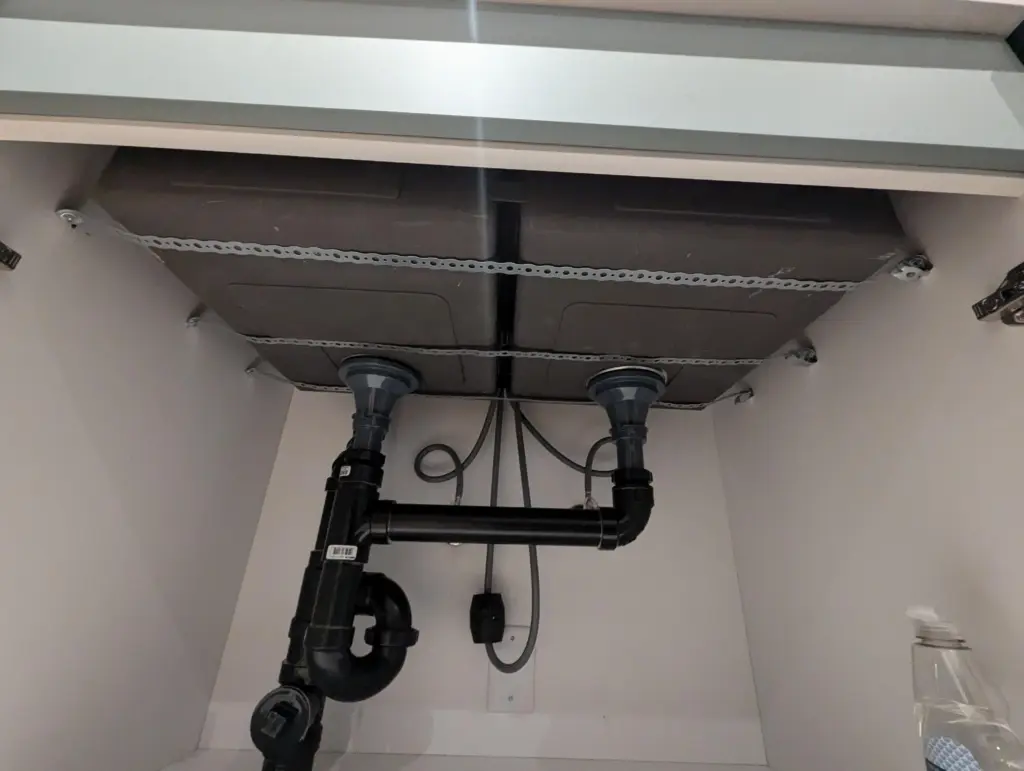
The support system must carry:
- The empty sink
- Water inside the bowl
- Cookware and dishes
- A garbage disposal
- Vibration during disposal operation
- Accidental downward pressure
Silicone is primarily a seal. It should not automatically be treated as the only structural support for a standard kitchen sink.
Depending on the approved installation system, structural support may come from:
- Mounting clips
- Epoxy-mounted anchors
- Rails
- Brackets
- A support frame
- Cabinet-mounted cradles
- An approved permanent bonding system
The correct method depends on the countertop and sink combination.
3. The Water Seal
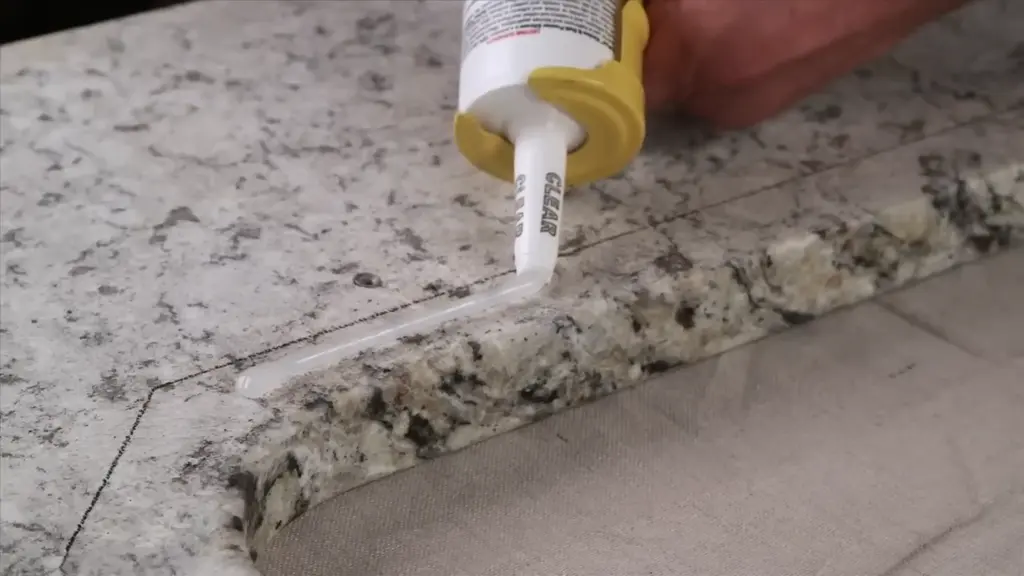
A continuous seal prevents water and food residue from entering the joint between the sink rim and countertop.
The seal must account for:
- Sink-rim flatness
- Countertop flatness
- Surface preparation
- Sealant compatibility
- Correct bead thickness
- Cure time
- Movement between materials
Adding more sealant cannot compensate for a twisted sink rim, an uneven cutout or inadequate support.
4. The Installation Geometry
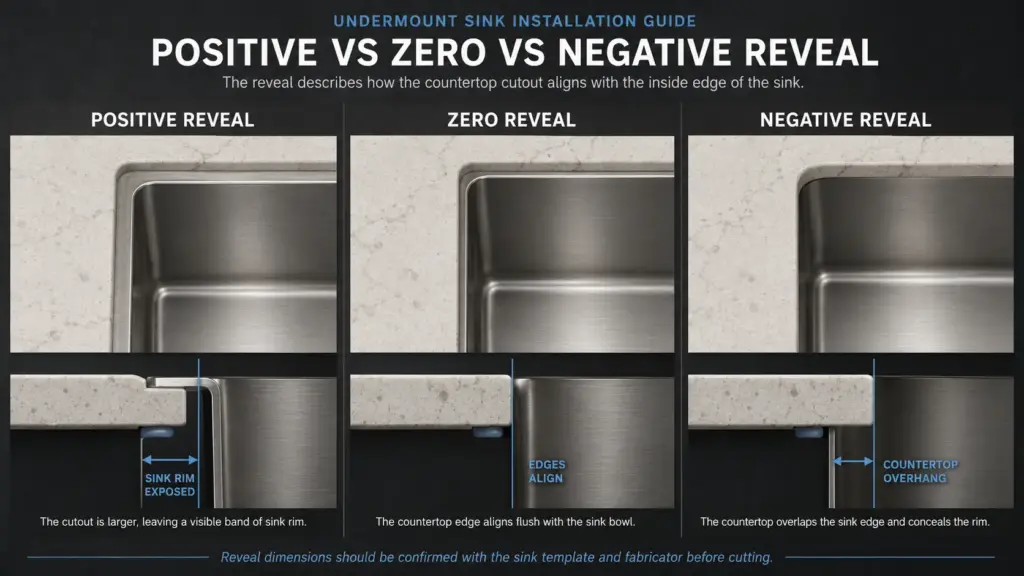
The countertop opening, sink rim and reveal must agree.
The installer needs to know:
- Sink outer dimensions
- Bowl dimensions
- Rim width
- Cutout dimensions
- Corner radius
- Reveal style
- Clip or rail position
- Faucet and drain layout
- Cabinet clearance
If these details are not agreed before the countertop is cut, the installer may be forced to improvise on site.
Can You Install an Undermount Sink with a Laminate Countertop?
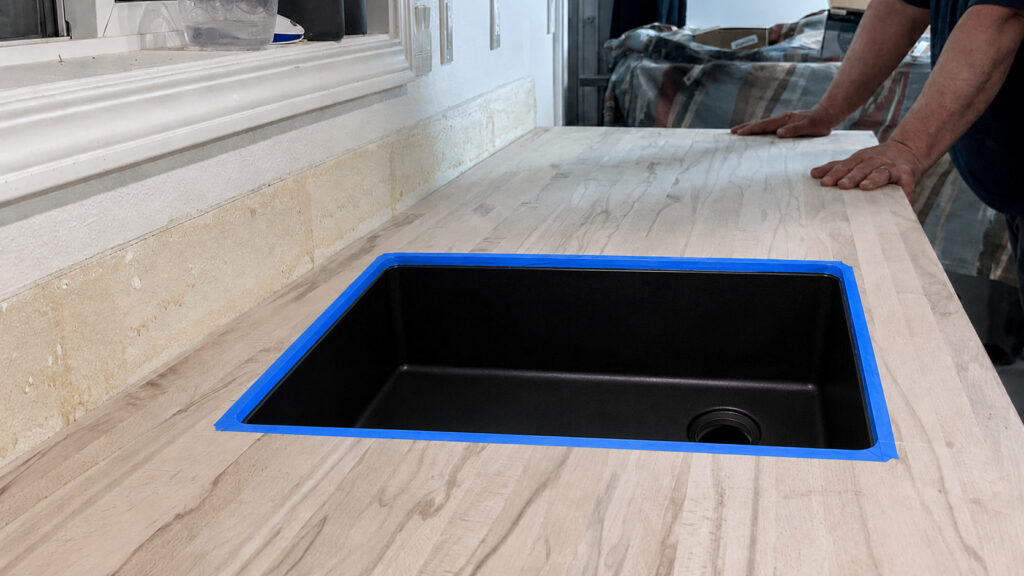
The correct answer is:
A conventional laminate countertop can use an undermount sink only when the sink and fabrication system are specifically designed for that application.
A standard laminate countertop usually consists of a thin decorative surface bonded to a wood-based core. Cutting an ordinary undermount opening exposes that core directly to water.
If water reaches particleboard or MDF, it can cause:
- Swelling
- Softening
- Delamination
- Dark staining
- Loss of support
- Permanent countertop damage
Sealant applied to a raw cut edge is not automatically a reliable long-term solution.
Standard Laminate vs Specialized Laminate Undermount Systems
Standard Stone-Style Installation
A regular stainless steel undermount sink is attached below a cutout in the same way it might be attached to quartz.
This is generally a poor choice for conventional wood-core laminate because the exposed core remains vulnerable.
Specialized Laminate Installation
A system designed for laminate may use:
- A sink with a wide, flat bonding rim
- A rim geometry designed for laminate fabrication
- A permanent structural adhesive
- A fabrication process that protects the countertop core
- A surface transition that prevents water from reaching the substrate
The sink cannot be selected independently from the countertop fabrication method.
Compact Laminate
Compact laminate or another waterproof panel may be more suitable because it does not rely on the same exposed particleboard structure.
However, “waterproof material” does not automatically mean “approved undermount installation.”
The buyer must still confirm:
- Panel thickness
- Cutout-edge finish
- Structural support
- Adhesive compatibility
- Sink-rim requirements
- Fabricator approval
Laminate Buyer Checklist
Before ordering the sink, ask:
- Is this conventional wood-core laminate or compact laminate?
- Is the exact sink approved for this countertop system?
- Does the sink need a special rim width or geometry?
- Who will fabricate the sink-countertop assembly?
- How is the exposed core protected?
- What carries the loaded sink?
- Can the sink be replaced later?
- Is the installation covered by the fabricator’s workmanship warranty?
If the supplier or installer cannot answer these questions clearly, a top-mount or drop-in sink is usually the safer choice.
A top-mount rim covers the cutout edge and transfers much of the sink load onto the countertop surface. This makes it more tolerant of laminate, replacement and renovation conditions.
Can You Install an Undermount Sink with Butcher Block?
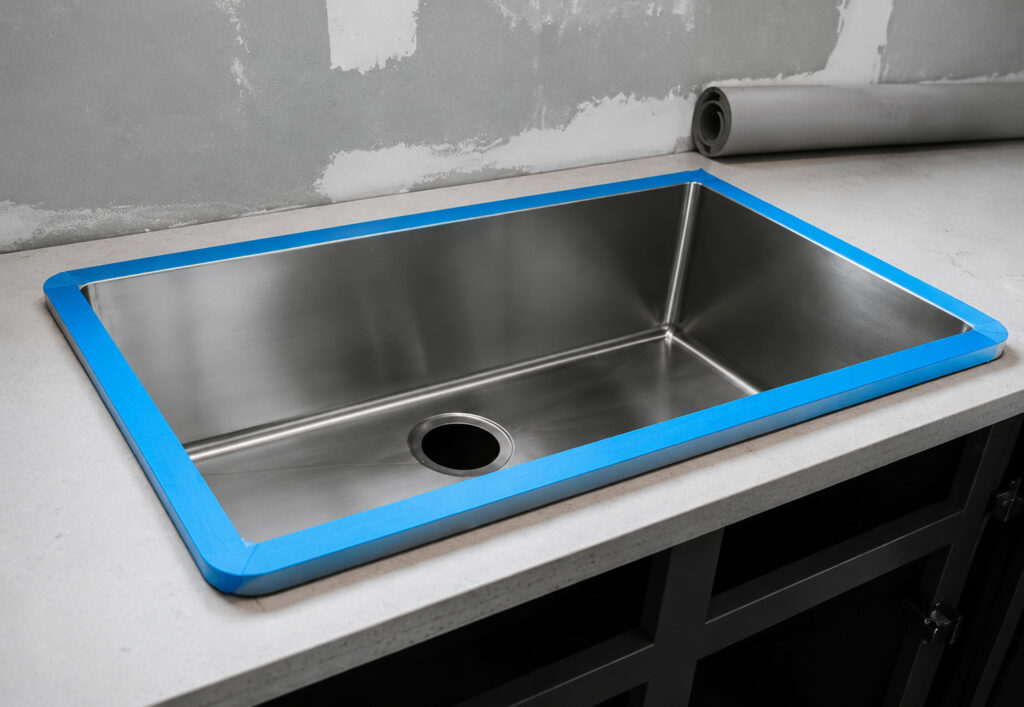
Yes, an undermount sink can be installed with butcher block.
But the buyer must accept that wood near a sink is a maintained surface—not a maintenance-free surface.
The critical area is the exposed wood inside the sink cutout. Cutting the opening exposes fresh fibers and, in some locations, end grain that can absorb water faster than the finished countertop face.
If this area is not completely protected, repeated moisture can cause:
- Darkening
- Raised grain
- Swelling
- Checking or splitting
- Finish separation
- Mold or staining
- Movement at glued joints
What a Butcher Block Installation Needs
Complete Cutout Sealing
The full cutout must be finished, including:
- Top edge
- Vertical cut edge
- Lower edge
- Corner transitions
- Faucet holes
- Any nearby seams
The finish must be suitable for the countertop supplier’s intended use. An oil-only finish may require more frequent maintenance than a film-forming finish around a constantly wet sink opening.
Special Attention to End Grain
End grain can absorb moisture rapidly. It should not be left with thin, inconsistent or incomplete coverage.
Independent Sink Support
Do not rely on the wood finish or sealant to hold the sink.
Use the support method specified for the countertop and sink, such as rails, brackets or a cabinet-mounted frame.
Moisture Control
The user should:
- Wipe standing water from the cutout edge
- Inspect the finish regularly
- Repair damaged finish promptly
- Avoid leaving wet cloths across the edge
- Maintain the countertop according to its finish system
Careful Joint Placement
A butcher block joint next to a sink cutout introduces another moisture-sensitive interface.
When possible, avoid placing a vulnerable joint where water regularly collects. The final layout should be reviewed by the countertop fabricator before cutting.
When Butcher Block Undermount Is a Good Choice
Choose it when:
- The appearance of exposed wood around the bowl is important
- The buyer accepts periodic inspection and refinishing
- The countertop supplier approves the finish system
- The sink has independent support
- The installer is experienced with wood movement and moisture
Choose a top-mount sink when:
- Low maintenance is a priority
- The property is a rental
- Users may leave water standing
- Maintenance responsibility is unclear
- The countertop finish is not designed for repeated water exposure
The undermount option may look cleaner, but top-mount installation is often the lower-risk commercial decision for wood countertops.
Can You Install an Undermount Sink with Quartz?
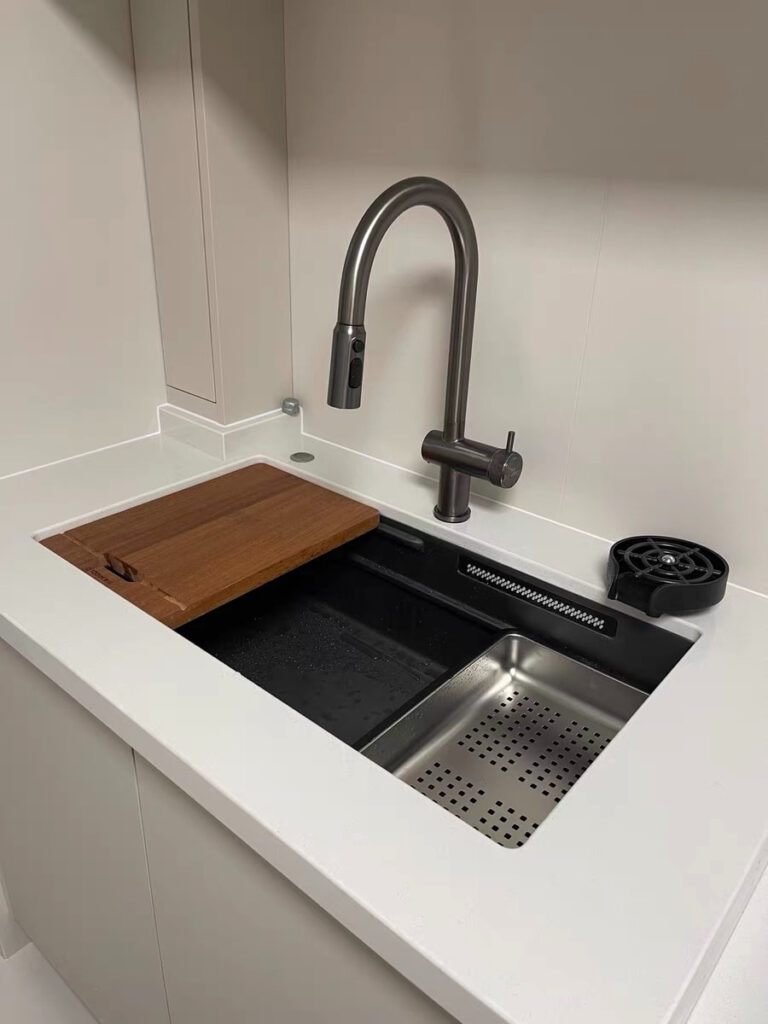
Yes. Engineered quartz is one of the most common countertop materials for undermount kitchen sinks.
It provides a solid, water-resistant cutout edge and can be fabricated into a clean opening with positive, flush or negative reveal.
However, quartz compatibility does not make every installation automatically safe.
What Buyers Should Check with Quartz
Cutout Accuracy
The countertop opening must match:
- The sink model
- The selected reveal
- The corner radius
- The bowl-wall position
- The faucet location
A generic cutout made from catalogue dimensions may not match the physical sink closely enough.
For project or countertop programs, the fabricator should confirm the production sink or an approved template before cutting multiple countertops.
Cutout Edge Finish
The visible edge should be smoothly finished. Sharp internal corners, chips or fabrication damage can create visual defects and stress concentration.
The exact radius and edge treatment should follow the quartz supplier’s fabrication requirements.
Sink-Rim Flatness
The undermount rim must sit evenly against the underside of the countertop.
A bent or uneven rim may create:
- Gaps
- Inconsistent reveal
- Thick sealant areas
- Difficult clip installation
- Leakage paths
Rim flatness should be checked before the sink reaches the jobsite.
Structural Mounting
Quartz installations commonly use an approved combination of clips, bonded mounting bases, rails, brackets or support frames.
Avoid drilling into the slab unless the countertop and mounting-system instructions specifically permit it.
Seams and Narrow Countertop Areas
The sink opening should not be positioned without considering:
- Nearby countertop seams
- Narrow strips behind the sink
- Faucet holes
- Backsplash clearance
- Front rail width
- Cabinet partitions
The fabricator should review the complete countertop layout, not only the sink cutout.
Quartz Buyer Verdict
Quartz is normally the most straightforward undermount option among the four materials in this guide.
It is a strong choice for:
- Residential kitchens
- Apartment projects
- Kitchen showrooms
- Private-label sink programs
- Countertop-and-sink packages
- Workstation sinks
The main risks are inaccurate cutting, poor support, uneven rims and uncontrolled jobsite installation—not water absorption by the quartz itself.
Can You Install an Undermount Sink with Porcelain Countertops?
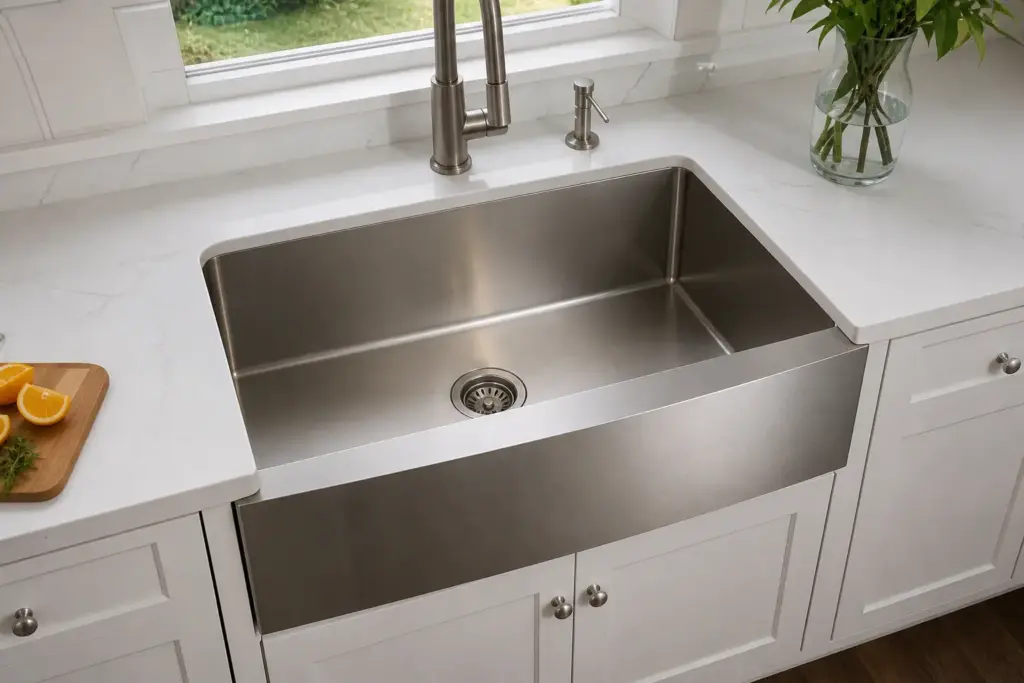
Yes, an undermount sink can be installed below a porcelain slab countertop.
But porcelain requires different thinking from quartz.
Porcelain slabs are hard and water-resistant, but they may be relatively thin. The cutout edge can be more vulnerable to chipping or impact, particularly when heavy cookware strikes the exposed edge.
The Main Porcelain Risks
Edge Impact
With an undermount sink, the countertop edge remains exposed around the bowl.
A sharp edge may be damaged by:
- Cast-iron cookware
- Heavy pots
- Accidental tool impact
- Installation handling
- Garbage-disposal vibration combined with weak support
A rounded or eased edge can reduce the vulnerability of a sharp exposed corner. The exact edge profile must follow the porcelain supplier’s fabrication guidance.
Thin-Slab Support
A thin slab should not be treated as though it were a thick quartz countertop.
The countertop fabricator may need:
- Additional support around the cutout
- A reinforced cabinet structure
- Approved mounting rails
- A sink support frame
- Specific minimum distances from seams and edges
The loaded sink should not place uncontrolled concentrated force on the porcelain cutout.
Specialist Fabrication
Porcelain requires suitable cutting equipment, tooling and handling.
Poor fabrication may produce:
- Chipped edges
- Microcracks
- Inconsistent reveal
- Damaged corners
- Weak narrow sections around the sink
The sink, cutout and faucet holes should be planned before the slab is fabricated.
Service and Replacement
Ask how the sink will be removed if it needs replacement.
A mounting system that is accessible from inside the cabinet is usually easier to service than a permanently trapped installation.
Porcelain Buyer Verdict
Porcelain is suitable for an undermount sink when:
- The slab supplier permits the application
- An experienced fabricator prepares the cutout
- The edge profile is appropriate
- The sink has a proper support system
- Cabinet and slab reinforcement are planned
- Future service access is considered
For high-impact kitchens or uncertain installation conditions, a top-mount or protected flush-mount design may reduce exposure of the cutout edge.
Countertop Material Is Only Half the Decision
The sink itself must also be suitable.
Before approving an undermount kitchen sink, check:
- Rim width
- Rim flatness
- Corner shape
- Overall dimensions
- Bowl depth
- Drain position
- Faucet-hole requirement
- Clip or bracket area
- Garbage-disposal compatibility
- Sink weight
- Accessory clearance
A countertop can be perfectly suitable for undermount installation while the selected sink rim is too narrow, distorted or difficult to support.
Positive, Flush or Negative Reveal?
Reveal describes the relationship between the countertop opening and the sink rim.
Positive Reveal
Part of the sink rim remains visible.
Advantages:
- Easier to inspect the rim and seal
- More tolerance for some cutout conditions
- Clear separation between countertop and bowl
Considerations:
- The exposed ledge can collect residue
- Rim finish and flatness remain visible
Flush or Zero Reveal
The countertop edge aligns closely with the sink wall.
Advantages:
- Clean visual transition
- Minimal visible ledge
- Balanced appearance
Considerations:
- Requires accurate sink dimensions
- Requires precise countertop cutting
- Batch dimensional consistency matters
Negative Reveal
The countertop slightly overhangs the sink.
Advantages:
- Hides the sink rim
- Creates a clean appearance from above
Considerations:
- The underside overhang can collect residue
- Faucet and accessory clearance must be checked
- The exposed countertop edge may receive more cookware impact
- Replacement sink dimensions become more critical
The reveal should be selected before the countertop is cut. It should not be decided by the installer after discovering that the opening does not match the sink.
Sealant Is Not a Substitute for Support
This is the most important installation principle in the article.
A sealant joint helps control water. A structural system controls weight.
A loaded kitchen sink can become significantly heavier because of:
- Water
- Cookware
- Dishes
- A garbage disposal
- User-applied pressure
The support method should be appropriate for the combined load and countertop type.
Possible systems include:
- Countertop-mounted clips
- Epoxy-bonded mounting bases
- Cabinet rails
- Adjustable brackets
- Steel or wood support frames
- Approved structural bonding systems
The buyer should not specify one universal mounting kit for laminate, wood, quartz and porcelain projects.
Three Approval Stages for Buyers
Stage 1: Before Ordering the Sink
Confirm:
- Countertop material and thickness
- Countertop substrate
- Cabinet internal width
- Sink type and weight
- Garbage-disposal requirement
- Installation method
- Reveal preference
- Support concept
Stage 2: Before Cutting the Countertop
Confirm:
- Physical sink or approved production sample
- Technical drawing
- Cutout dimensions
- Corner radius
- Sink-rim width
- Faucet-hole position
- Countertop seams
- Clip or rail clearance
- Front and rear countertop widths
The safest sequence is to finalize the sink before fabricating the countertop.
Stage 3: Before Installation Sign-Off
Check:
- Reveal is consistent
- Rim contacts the countertop evenly
- Structural supports are installed
- Seal is continuous
- Sink does not visibly move
- Faucet and disposal clear the supports
- Drain and plumbing are accessible
- Sealant has received its specified cure time
- No water enters the cabinet during testing
- Installation photos and model records are retained
Do not sign off solely because the installation looks clean from above.
Who Is Responsible for Each Detail?
| Party | Main Responsibility |
| Sink supplier | Sink dimensions, rim condition, bowl structure, cutout reference and packaging |
| Countertop supplier | Material approval, thickness, cutout fabrication, edge treatment and seam planning |
| Cabinet supplier | Cabinet width, support locations and internal clearance |
| Installer | Mounting, sealing, alignment, cure time and water testing |
| Buyer or project manager | Making sure all four parties are working from the same approved specification |
Many undermount failures occur because each component is acceptable individually but nobody controls the complete system.
B2B Buyer Checklist
Brands, importers, countertop companies and project buyers should document:
Sink Specification
- Model number
- Overall dimensions
- Bowl dimensions
- Rim width
- Rim flatness expectation
- Bowl depth
- Drain position
- Material and thickness
- Sink weight
- Accessory list
Countertop Specification
- Exact material
- Slab or panel thickness
- Substrate
- Cutout edge treatment
- Reveal style
- Seam position
- Faucet-hole position
- Support limitations
Installation Specification
- Approved mounting method
- Support locations
- Sealant type
- Surface preparation
- Cure time
- Disposal support
- Water-test method
- Replacement access
Repeat-Order Control
- Approved sink sample
- Approved cutout reference
- Reveal record
- Installation photos
- Mounting hardware list
- Packaging method
- Model and carton labels
A reliable undermount program is based on repeatable interfaces, not only a repeatable sink bowl.
How Matrix Supports Undermount Sink Programs
Matrix supplies stainless steel undermount kitchen sinks for brands, importers, wholesalers, countertop programs and project buyers.
Available product directions include:
- Handmade undermount sinks
- Pressed or drawn undermount sinks
- Single-bowl sinks
- Double-bowl sinks
- Deep sinks
- Workstation sinks
- Brushed and selected colored finishes
- Matched drains, grids and accessories
Before sampling or production, buyers can review:
- Sink dimensions
- Bowl depth
- Rim design
- Rim flatness
- Cutout reference
- Reveal preference
- Drain position
- Cabinet compatibility
- Accessory fit
- Packaging protection
For projects that are not suitable for undermount installation, Matrix also supplies top-mount and drop-in kitchen sinks for laminate, replacement, retail and renovation programs.
Buyers developing a countertop-and-sink package can use the Matrix installation guide center to review the basic differences between undermount and top-mount installation.
Frequently Asked Questions
Can a standard undermount sink be installed with laminate?
Not automatically. Conventional wood-core laminate usually requires a specialized sink and fabrication system designed to protect the substrate. Otherwise, a top-mount sink is safer.
Can an undermount sink be installed with butcher block?
Yes, provided the full cutout edge is sealed, the finish is maintained and the sink has proper structural support. Wood movement and water exposure must be considered.
Is quartz suitable for an undermount sink?
Yes. Engineered quartz is one of the most common materials for undermount installation. Accurate cutting, edge finishing, support and sink-rim flatness remain important.
Can porcelain slab support an undermount sink?
Yes, when the slab supplier permits it and a specialist fabricator provides the correct cutout, edge treatment and support system. The exposed porcelain edge should be protected from impact.
Can silicone alone hold an undermount kitchen sink?
Do not assume so. Standard kitchen sinks normally need a specified structural mounting or support system. Sealant primarily controls water at the joint.
Which countertop is safest for an undermount sink?
Among the four materials discussed here, quartz is generally the most straightforward. Porcelain is suitable with specialist fabrication. Butcher block requires maintenance. Conventional laminate requires a specialized system.
Is a top-mount sink safer for laminate?
Usually, yes. The visible rim covers the cutout edge and transfers load onto the countertop. It is generally more tolerant of conventional laminate and replacement conditions.
Should the sink be purchased before the countertop is cut?
Yes. The fabricator should work from the actual production sink or an approved, verified template whenever possible. Catalogue dimensions alone may not reflect manufacturing tolerances.
Does a garbage disposal change the support requirement?
Yes. It adds weight and operating vibration below the drain. The disposal and sink should be considered together when selecting the mounting and cabinet-support system.
Which reveal is best?
There is no universal best reveal. Positive reveal offers more visible tolerance, flush reveal provides precise alignment, and negative reveal hides the rim. The correct option depends on hygiene preference, fabrication accuracy, accessories and countertop material.
Final Recommendation
Use this starting point:
- Quartz: Usually suitable for a standard undermount installation.
- Porcelain slab: Suitable with specialist cutting, edge treatment and independent support.
- Butcher block: Possible when the cutout is completely sealed and long-term maintenance is accepted.
- Conventional laminate: Use only an approved laminate undermount system; otherwise choose top mount.
- Compact laminate: Confirm the exact panel and installation system in writing.
Do not choose the sink and countertop separately.
The final installation should be treated as one system consisting of:
Countertop material + cutout edge + sink rim + reveal + support + seal + cabinet
If one part is undefined, the buyer has not yet completed the specification.
For an undermount, top-mount or countertop-compatible sink program, contact the Matrix team.