Quick Answer
Drain position should be frozen before production because changing it can affect:
- plumbing alignment
- garbage-disposal clearance
- cabinet storage
- bowl usable area
- bottom grid design
- workstation accessories
- sink forming or tooling
- drain-hole processing
- inspection dimensions
For a handmade sink, drain position may be relatively flexible before fabrication is finalized.
For a pressed sink, the available position can depend on the mold and bottom geometry.
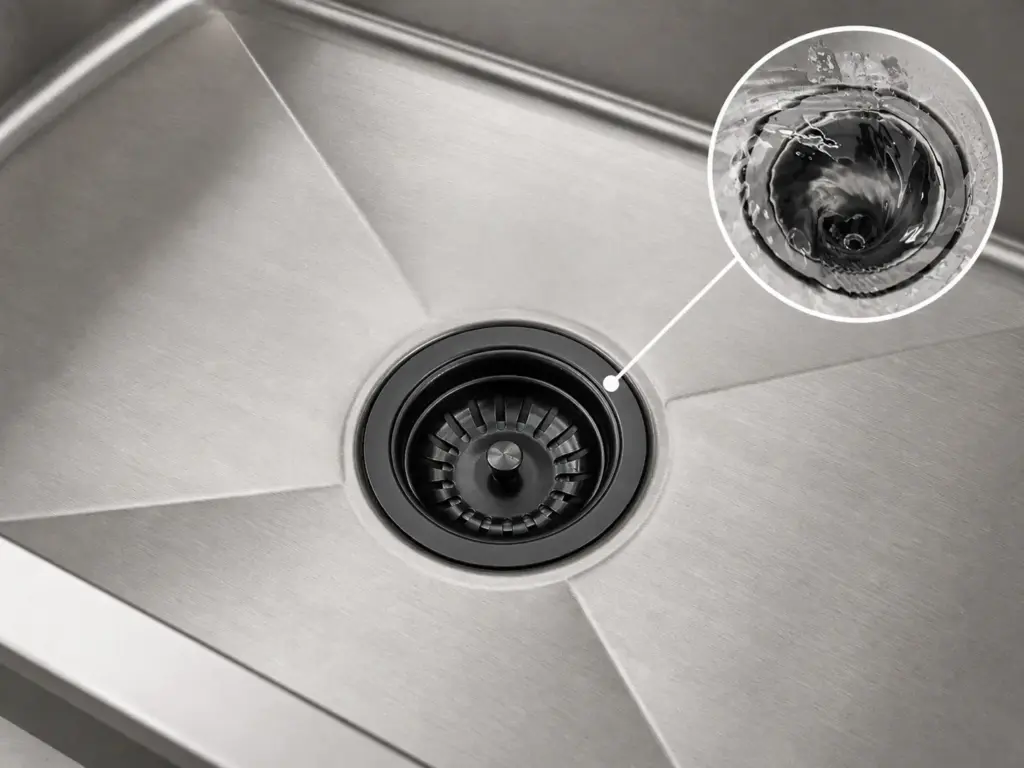
“Rear drain” or “center drain” is not enough for a custom project. The approved drawing should define the actual position.
Once the grid, accessories, plumbing or tooling are based on that location, changing the drain is no longer a small modification.
1. Drain Position Is an Engineering Dimension
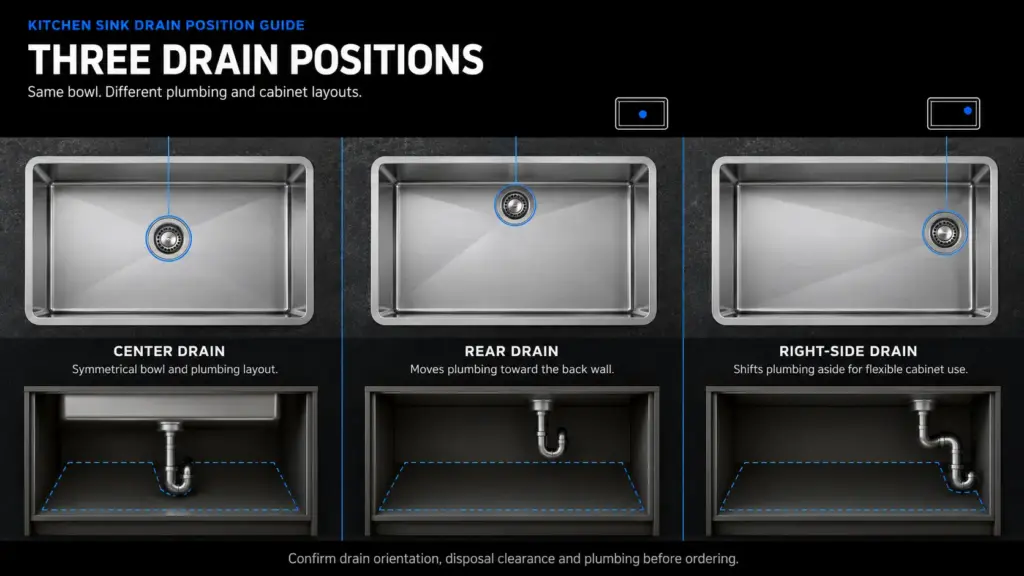
Buyers sometimes treat drain location as a cosmetic choice:
Center or rear?
But the drain connects the sink to several other parts of the kitchen.
It affects:
- bowl geometry
- plumbing
- cabinet
- disposal
- accessories
So for OEM and project orders, drain position should be treated like:
overall size
bowl depth
faucet-hole position
and frozen in the approved drawing.
2. “Rear Drain” Still Needs a Dimension
Consider a sink specified as:
Rear-center drain
That still leaves questions:
- how far from the rear bowl wall?
- exactly centered left-to-right?
- measured to drain-hole center or fitting edge?
- does the drain fitting clear the bowl radius?
- does it match the bottom grid?
For a custom program, the drawing should define the drain center from fixed reference edges.
3. Plumbing Is the First Constraint
Moving the drain changes where the waste connection sits below the sink.
That can affect:
- P-trap connection
- waste pipe routing
- existing plumbing
- disposal position
- cabinet layout
This is especially important for:
- replacement sinks
- cabinet suppliers
- apartment projects
- renovation programs
If the sink must fit an existing kitchen, the drain location may be more important than choosing the theoretically “best” position.
4. Rear Drain Can Improve Cabinet Usability — But Not Automatically
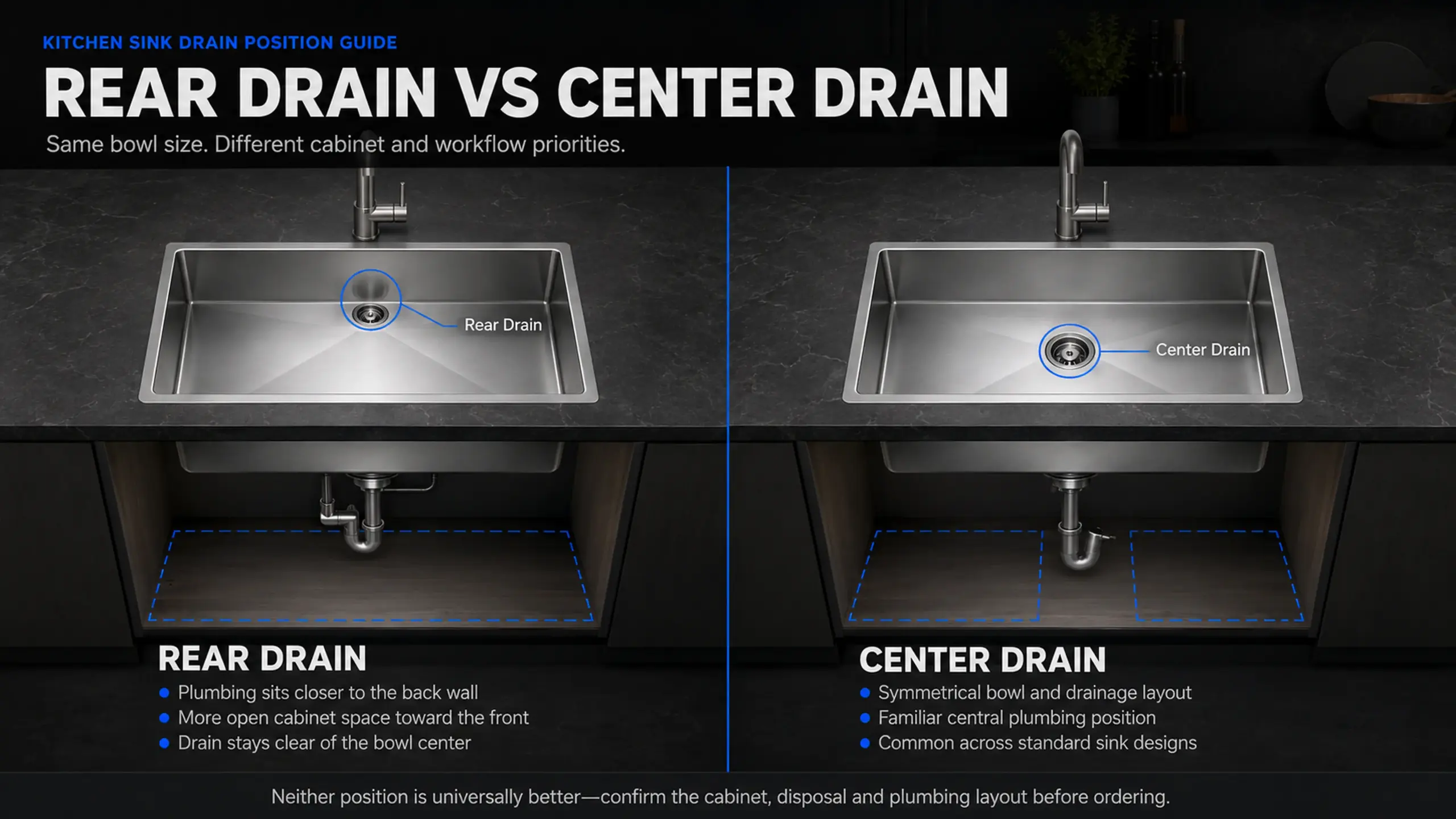
One reason buyers choose rear drains is to move plumbing toward the back of the cabinet.
That can leave more open space toward the front.
But whether this actually helps depends on:
- cabinet depth
- drain fitting
- disposal
- plumbing route
- sink depth
So:
rear drain = more cabinet storage
should not be treated as a universal rule.
The complete installation needs to be considered.
5. Drain Position Changes Usable Bowl Space
Inside the bowl, drain location can affect how the user works.
A centered drain occupies the central area.
A rear or offset drain can leave a larger uninterrupted section of the bowl bottom.
This can matter on:
- large single bowls
- workstation sinks
- prep sinks
- commercial applications
The choice should follow the intended product use, not only appearance.
6. Bottom Grid Geometry Depends on the Drain
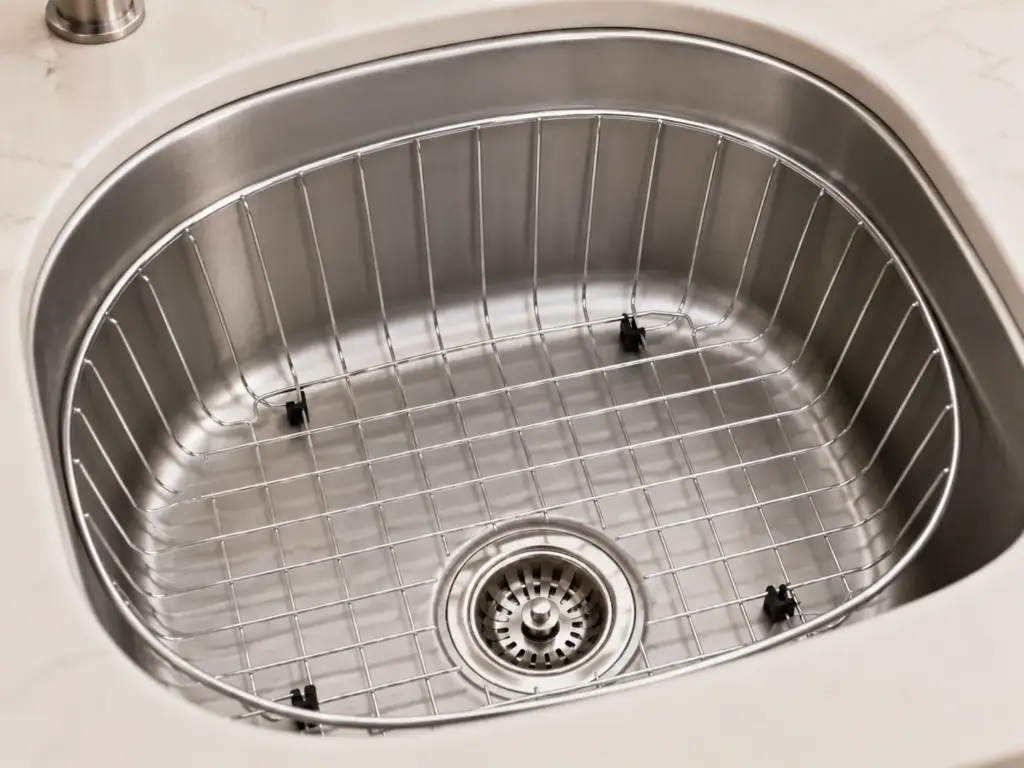
This is one of the easiest details to miss.
A bottom grid usually needs an opening or clearance around the drain.
If the drain changes from:
center
to:
rear offset
the existing grid may no longer work.
That can mean:
- new grid size
- new drain opening
- different feet position
- new accessory SKU
So changing the drain after accessory approval can create extra development work.
7. Workstation Sinks Make Drain Position More Important
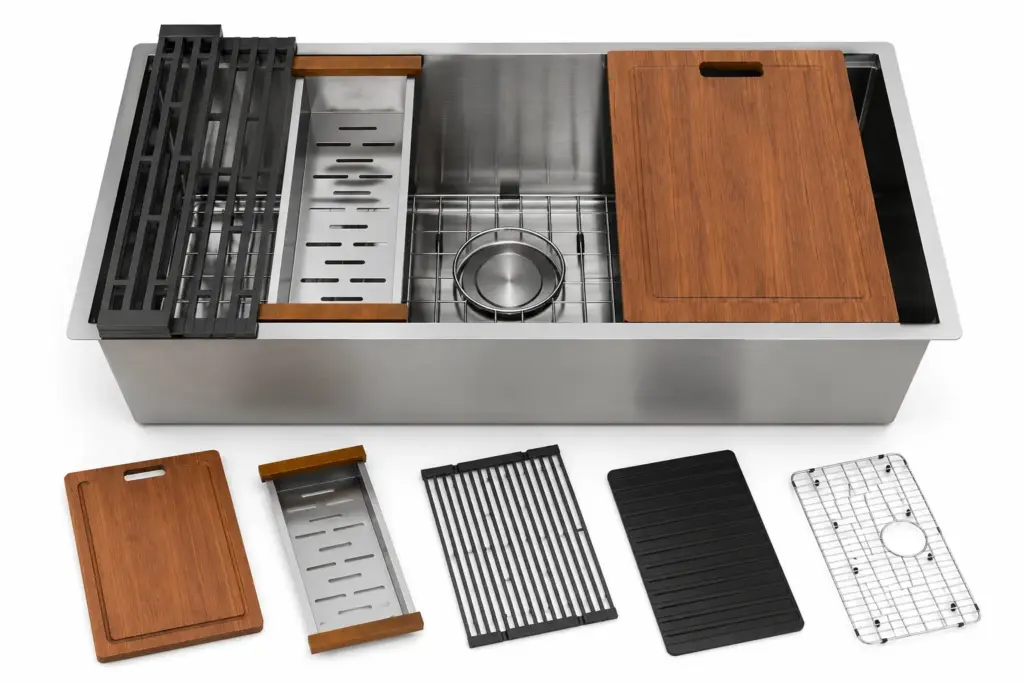
A workstation sink is designed as a system.
The drain may interact with:
- bottom grid
- colander
- cutting board workflow
- bowl usable area
- disposal
- under-sink storage
That is why the drain should be confirmed together with the rest of the workstation configuration.
See Workstation Kitchen Sinks for how the sink body and accessory system are treated together.
8. Handmade Sink Drain Position Is More Flexible — Before Production
Handmade fabrication generally allows more freedom to position a drain because the bowl is fabricated rather than fully defined by one deep-drawing mold.
Depending on the structure, buyers may request:
- center
- rear center
- rear left
- rear right
- other defined positions
But flexibility does not mean the position should remain open during production.
Once the drawing is approved, the drain should be dimensioned and controlled like any other critical feature.
9. Pressed Sink Drain Position Depends More on the Existing Geometry
Pressed / drawn sinks are mold-based.
The bowl bottom, slopes and forming geometry are already defined by the tooling.
A drain position may also be influenced by:
- bottom forming
- embossing
- mold geometry
- secondary punching
- existing accessory fit
So a buyer should not assume:
We can use this existing pressed mold and just move the drain anywhere.
Sometimes a secondary hole operation can be changed.
Sometimes the sink geometry makes the requested position impractical.
Matrix’s Factory Capabilities separates this clearly: handmade drain placement is more flexible, while pressed models need to be reviewed against the mold structure.
10. Drain Position and Bowl Slope Need to Work Together
The bowl bottom should guide water toward the drain.
So drain location should not be moved without considering the existing bottom geometry.
If the bowl was designed around one drain location, changing only the hole can create an awkward relationship between:
- slope
- low points
- drain flange
- residual water
This is especially relevant for pressed sinks where the bottom geometry is formed by the mold.
11. Drain Flange Size Also Matters
Freezing the center point is not enough if the drain component itself is still changing.
Confirm:
- drain-hole diameter
- drain fitting
- flange size
- basket / strainer type
- disposal compatibility where relevant
A larger drain flange can occupy more bowl-bottom area and affect grid clearance.
12. Faucet and Drain Positions Should Be Reviewed Together
For some top-mount or faucet-deck designs, both faucet and drain locations affect the overall layout.
The drawing should show:
- drain center
- faucet-hole center
- hole diameter
- relationship to bowl and rear edge
This reduces the chance that two separately confirmed components create a conflict later.
13. Installation Can Make a Small Drain Change Expensive
During early development, moving a drain may be simple.
After approval, the same change can affect:
- drawing
- sink body
- grid
- plumbing
- carton label
- specification sheet
- installation guide
- sample approval
For pressed products, tooling or fixtures may also be involved.
This is why engineering changes become more expensive later in the project.
14. Freeze It Before the Golden Sample
The preferred order is:
- define target drain position
- confirm drawing
- manufacture sample
- check drain and accessory fit
- approve golden sample
- release bulk production
Do not use the sample to discover a drain-location requirement that should have been defined in the RFQ.
15. How to Specify Drain Position in an RFQ
Instead of:
Rear drain
use something like:
Drain center: X mm from rear bowl wall and centered left-to-right.
Or define the center coordinates directly in the drawing.
A practical RFQ should include:
- drain position
- drain-hole diameter
- drain component
- grid requirement
- disposal requirement if applicable
- reference drawing
The Kitchen Sink RFQ Checklist includes drain position together with dimensions, installation and accessory requirements for this reason.
16. What Should Be Checked on the Sample?
Before approval, verify:
Position
Does the actual drain center match the drawing?
Drain Fit
Does the approved drain install correctly?
Water Flow
Does the bowl geometry direct water toward the drain as intended?
Grid
Does the bottom grid clear the drain?
Plumbing
Does the drain position work with the intended installation?
Workstation
Does the location preserve the intended usable bowl area?
Drain Position Decision Checklist
| Question | Confirm Before Production |
|---|---|
| Center / Rear / Offset? | Yes |
| Exact Center Dimension | Yes |
| Drain Hole Diameter | Yes |
| Drain Fitting | Yes |
| Garbage Disposal Requirement | If applicable |
| Bottom Grid | Fit confirmed |
| Bowl Slope | Reviewed |
| Cabinet / Plumbing | Reviewed |
| Workstation Accessories | Reviewed |
| Drawing Revision | Frozen |
Buyer Takeaway
Drain position looks like one small hole in the sink.
It is not.
It connects:
sink geometry → water flow → plumbing → cabinet → grid → accessories
So the right time to change the drain is during specification review.
Not after tooling.
Not after accessory approval.
And not after mass production has started.
Freeze the drain center in the drawing before the rest of the product begins depending on it.
FAQ
Can drain position be changed after the sample is approved?
Technically it may be possible on some products, but it can affect the drawing, grid, plumbing, accessories and production setup. It should be treated as an engineering change.
Is drain position easier to customize on handmade sinks?
Generally yes. Handmade fabrication offers more flexibility, while pressed sinks depend more heavily on existing mold and formed bottom geometry.
Can a pressed sink drain be moved without changing the mold?
Sometimes secondary hole processing allows some flexibility, but it depends on the sink geometry and tooling. It should be reviewed model by model.
Is a rear drain always better?
No. Rear drains can improve usable bowl or cabinet space in some applications, but plumbing, cabinet depth and product use should determine the position.
Why should the drain be shown in the RFQ?
Because it can affect manufacturing feasibility, accessories, plumbing and quotation scope.
Developing a Custom Sink?
Use the Kitchen Sink RFQ Checklist to define the drain together with bowl dimensions, installation, thickness and accessories.
For custom dimensions and drain layouts, see Custom Kitchen Sink Programs.
To understand how drain flexibility differs between handmade and pressed production, review Matrix Factory Capabilities.