Kitchen sink packaging should be specified before quotation, not added after the product price has already been agreed.
For B2B buyers, packing affects:
- product protection
- carton CBM
- freight
- warehouse handling
- private-label presentation
- damage risk
- final delivered cost
Quick Answer: What Packaging Requirements Should I Send to a Kitchen Sink Manufacturer?
A kitchen sink packaging RFQ should define at least:
- pcs per carton
- sink size and weight
- surface finish
- protective film requirement
- rim / corner protection
- internal foam or support structure
- accessory separation
- carton type
- private-label printing
- SKU / barcode / carton labels
- pallet requirement
- distribution route
The distribution route is especially important.
A carton designed for:
pallet + container + importer warehouse
may not be suitable for:
individual parcel / drop-ship delivery.
Do not ask only for “standard export packing.” Define how the sink will actually move from the factory to the final customer.
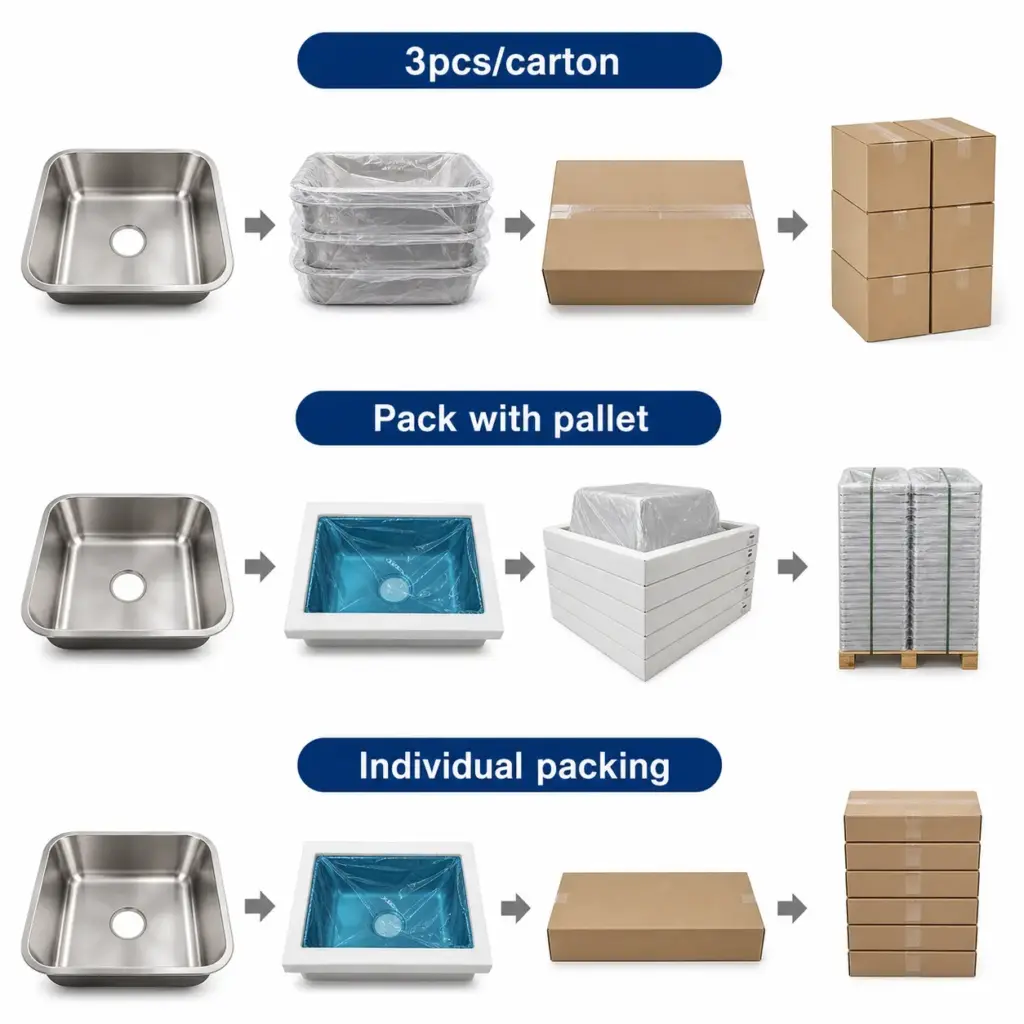
Why “Standard Export Packing” Is Too Vague
A quotation may simply state:
Export carton included.
But this does not tell the buyer:
- how many sinks are packed together
- what protects the rim
- whether accessories are separated
- how much internal movement is possible
- whether the carton is designed for parcel handling
- whether the carton is printed or plain
Two suppliers can both quote:
export packing
while providing very different protection and cost.
1. Start With Pcs Per Carton
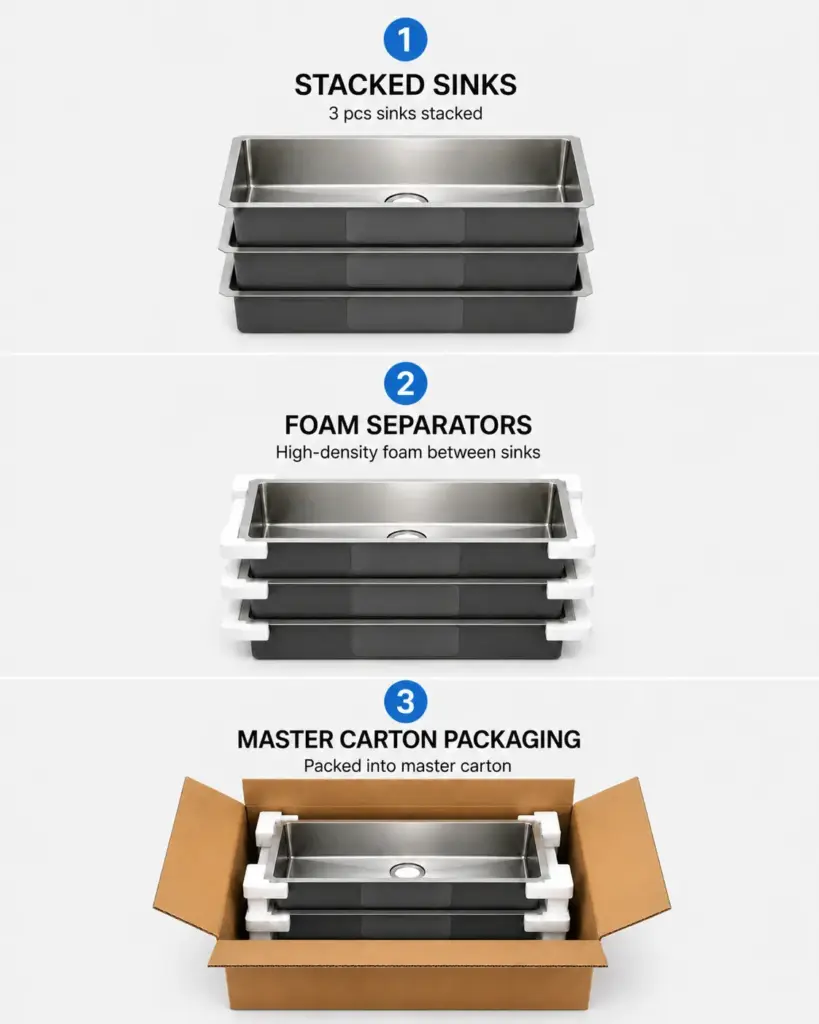
This is one of the first packaging decisions.
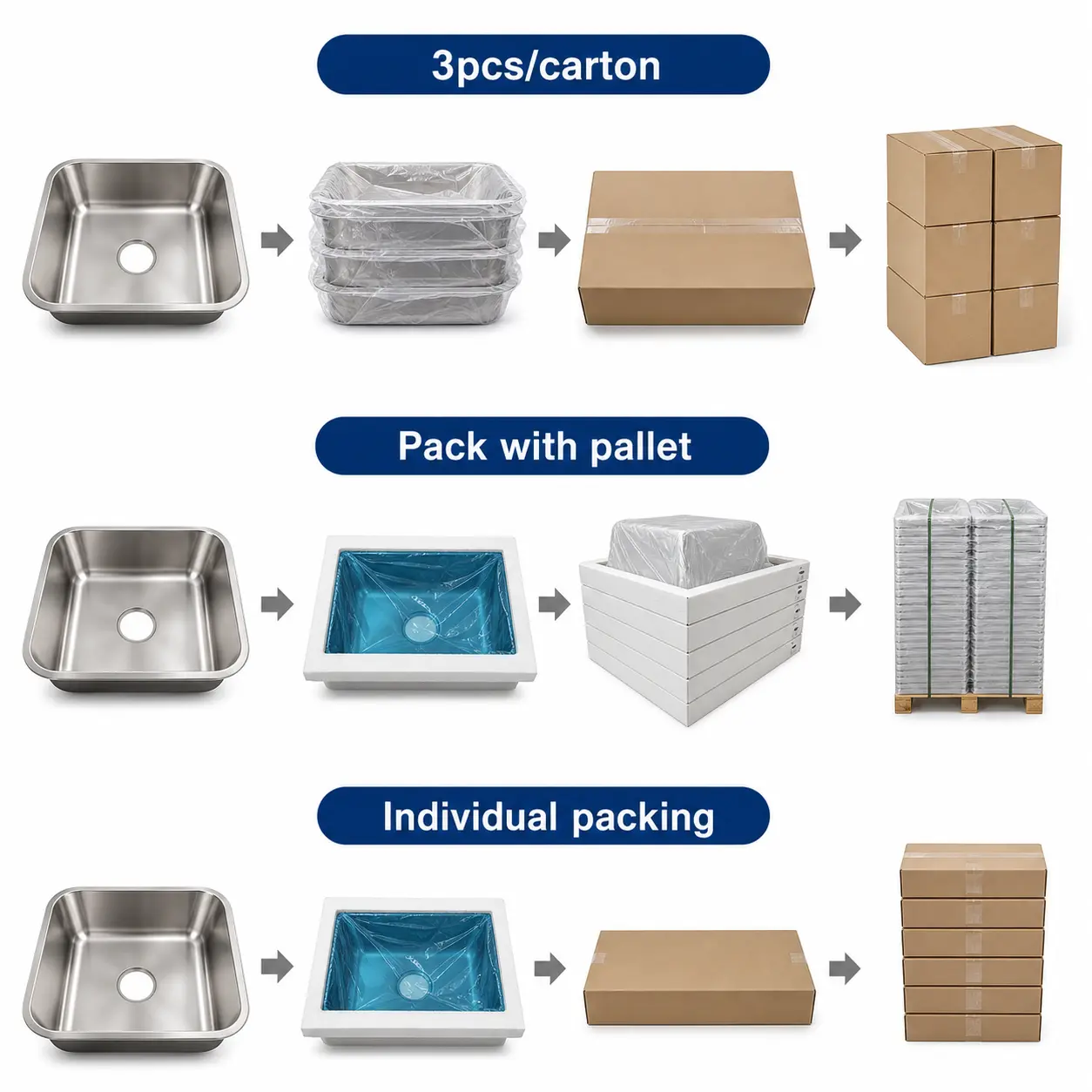
Typical options may include:
- 1 pc / carton
- 2 pcs / carton
- multiple pcs / master carton
The right choice depends on:
- sink size
- sink weight
- finish
- sales channel
- freight
- handling
For example, 1 pc / carton may provide stronger individual protection and simpler retail handling.
A multi-piece carton may improve packing efficiency for wholesale programs.
Neither is automatically better.
2. Tell the Supplier the Distribution Route
This is one of the most useful pieces of information a buyer can provide.
For example:
Container / Importer Warehouse
Factory → container → importer warehouse
Retail Distribution
Factory → importer → distribution center → retailer
E-Commerce / Drop-Ship
Factory / warehouse → parcel carrier → customer
These routes expose the carton to different risks.
Parcel distribution usually creates more:
- orientation changes
- individual handling
- edge impact
- corner impact
Packaging should therefore be reviewed against the actual route.
3. Define the Sink Finish
Finish affects packing sensitivity.
For example:
Brushed Stainless Steel
Main concerns may include:
- scratches
- rim deformation
- accessory contact
PVD / Colored Finish
Additional attention may be needed for:
- surface rubbing
- accessory abrasion
- protective-film movement
- foam contact marks
A packing quotation for a brushed sink should not automatically be reused for a decorative PVD SKU.
4. Define Surface Protection
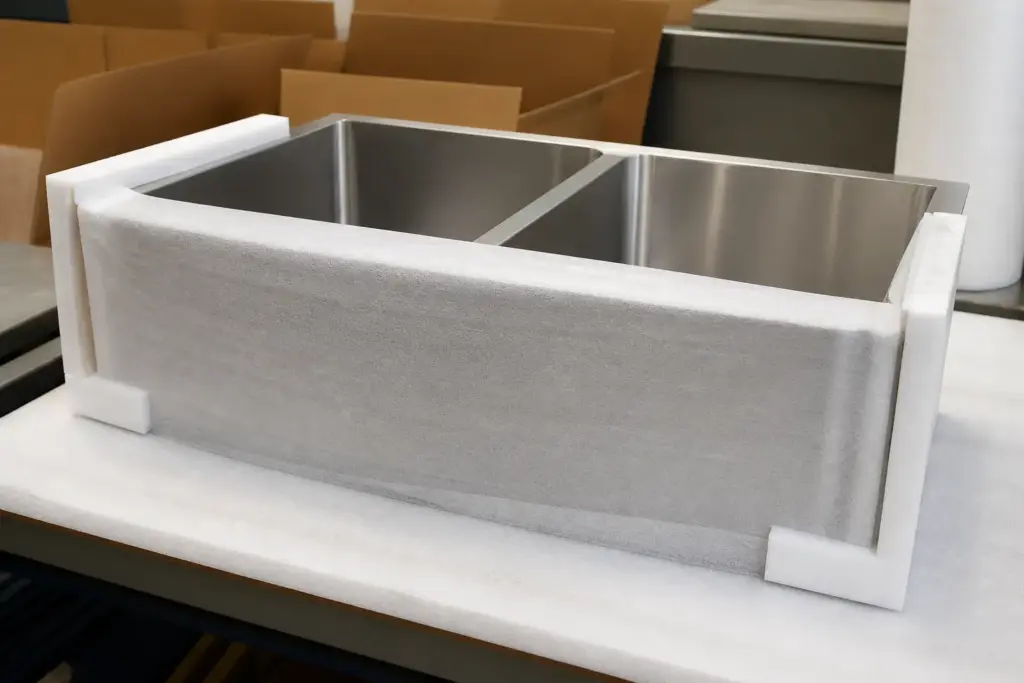
If protective film is required, state it.
But remember:
protective film protects the surface, not the structure.
It does not prevent:
- bent rim
- crushed corner
- apron deformation
Structural protection still needs:
- foam
- supports
- carton
- internal restraint
5. Rim Protection Should Be Considered Separately
The sink rim is particularly important because deformation can create installation claims.
For larger sinks, consider how the packing protects:
- front rim
- rear rim
- corners
- flange
The goal is not simply to add more foam.
The support needs to prevent the rim from carrying excessive impact or compression.
6. Corner Protection Matters
Corners can take concentrated impact during:
- handling
- pallet movement
- parcel delivery
This is especially important for:
- large handmade sinks
- apron-front sinks
- wide top-mount sinks
- workstation sinks
A carton can remain mostly intact while one sink corner inside is deformed.
So buyers should ask how corner loads are controlled.
7. Internal Movement Should Be Limited
One common packaging problem is excessive free space.
If the sink can move inside the carton, external impact can turn into internal impact.
The packaging should therefore:
restrain the product
rather than only:
surround the product.
This is particularly important for heavy sinks.
8. Accessories Must Be Specified in the Packing RFQ
A workstation sink may contain:
- drain
- grid
- cutting board
- colander
- roll-up rack
- clips
- soap dispenser
These items need their own packing logic.
Ask:
- where will each accessory be placed?
- will metal accessories touch the sink?
- are heavy components boxed separately?
- can anything move during transport?
9. Avoid Metal-to-Metal Contact
For example:
bottom grid directly against PVD bowl
can create rubbing during long-distance vibration.
Likewise:
- drains
- clips
- colanders
should not be able to repeatedly impact visible surfaces.
If the complete SKU includes several accessories, accessory separation should be part of the approved packing layout.
10. Cutting Boards Need Different Protection
Wood, bamboo or composite cutting boards have different transport risks from metal accessories.
Potential issues include:
- edge damage
- moisture
- rubbing
- pressure from heavy components
They should not simply be placed loose inside the bowl.
11. Define the Carton Type
At RFQ stage, buyers can specify whether they need:
- plain export carton
- branded carton
- retail carton
- master carton
- customer-supplied artwork
If the exact carton strength is not yet defined, do not invent a number.
Instead, tell the supplier:
- distribution route
- product weight
- pcs/carton
- pallet or parcel requirement
and then review the proposed carton structure.
12. Private-Label Cartons Need More Information
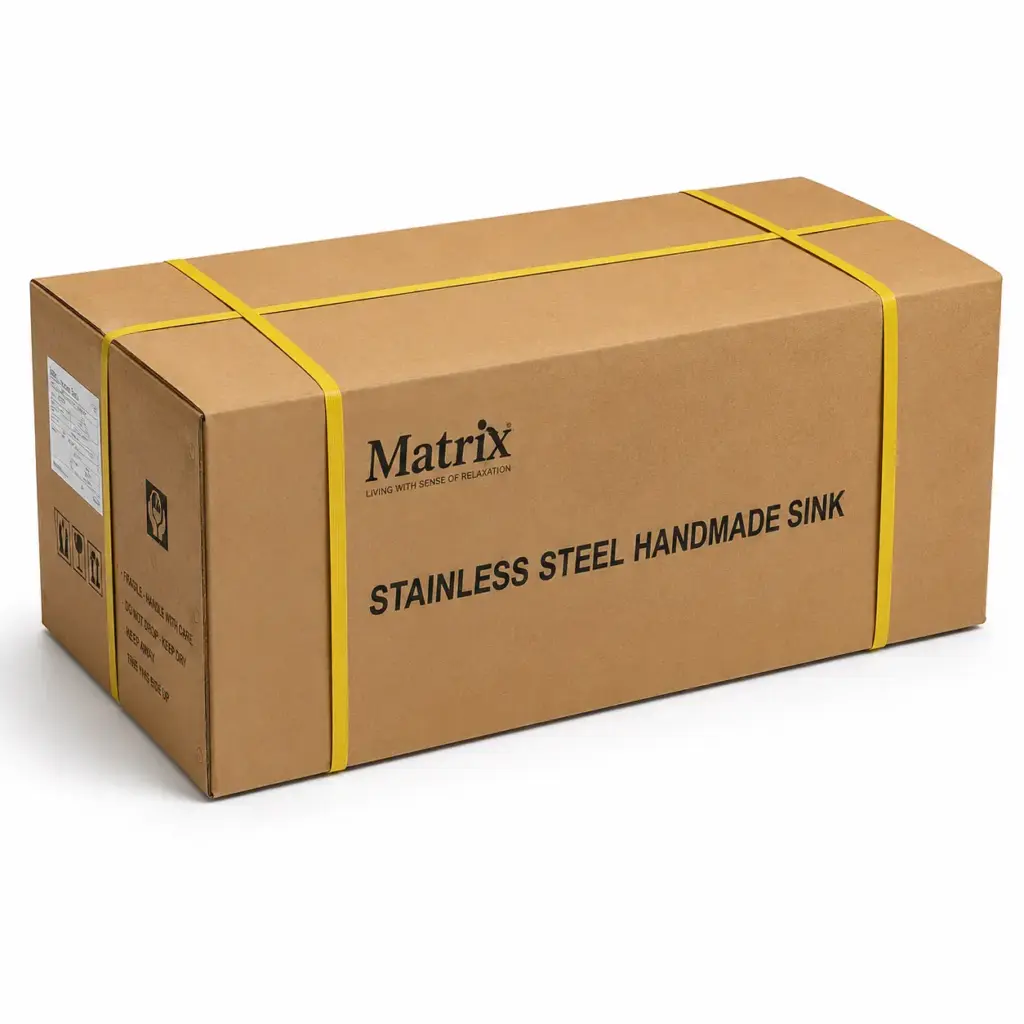
For private-label programs, define:
- brand logo
- product name
- model
- SKU
- barcode
- color / finish
- country information if required
- carton marks
- handling marks where applicable
Matrix’s Private Label Product Programs treats the carton and labeling as part of the final private-label SKU rather than a separate afterthought.
13. Barcode and SKU Errors Can Make Correct Goods Unusable
A sink may be manufactured correctly but arrive with:
- wrong barcode
- wrong SKU
- wrong finish label
- wrong carton model
That can create problems for:
- warehouse receiving
- retail
- ERP systems
- customer fulfillment
So label control belongs in the packaging specification.
14. Pallet Requirements Should Be Defined Early
If pallets are required, tell the supplier:
- pallet required / not required
- maximum pallet height if relevant
- warehouse handling requirement
- destination restrictions where applicable
Palletization affects:
- shipment CBM
- loading
- handling
- carton compression
It should not be added after the quotation if freight efficiency matters.
15. Carton Dimensions Affect Freight
Packaging is not only a protection issue.
It also affects:
CBM per sink.
A slightly oversized carton multiplied across hundreds or thousands of sinks can change:
- container utilization
- LCL volume
- delivered cost
This is why packaging optimization should consider both:
protection
and:
logistics efficiency.
16. Do Not Reduce Packaging Cost Without Checking the Consequence
Common cost reductions include:
- less foam
- thinner carton
- more sinks per carton
- removing corner protection
Each may reduce unit packing cost.
But the buyer should also consider:
- damage rate
- freight
- handling
- claims
- replacement cost
The lowest-cost packaging is not always the lowest-cost logistics solution.
17. Packaging Requirements Change by Sink Type
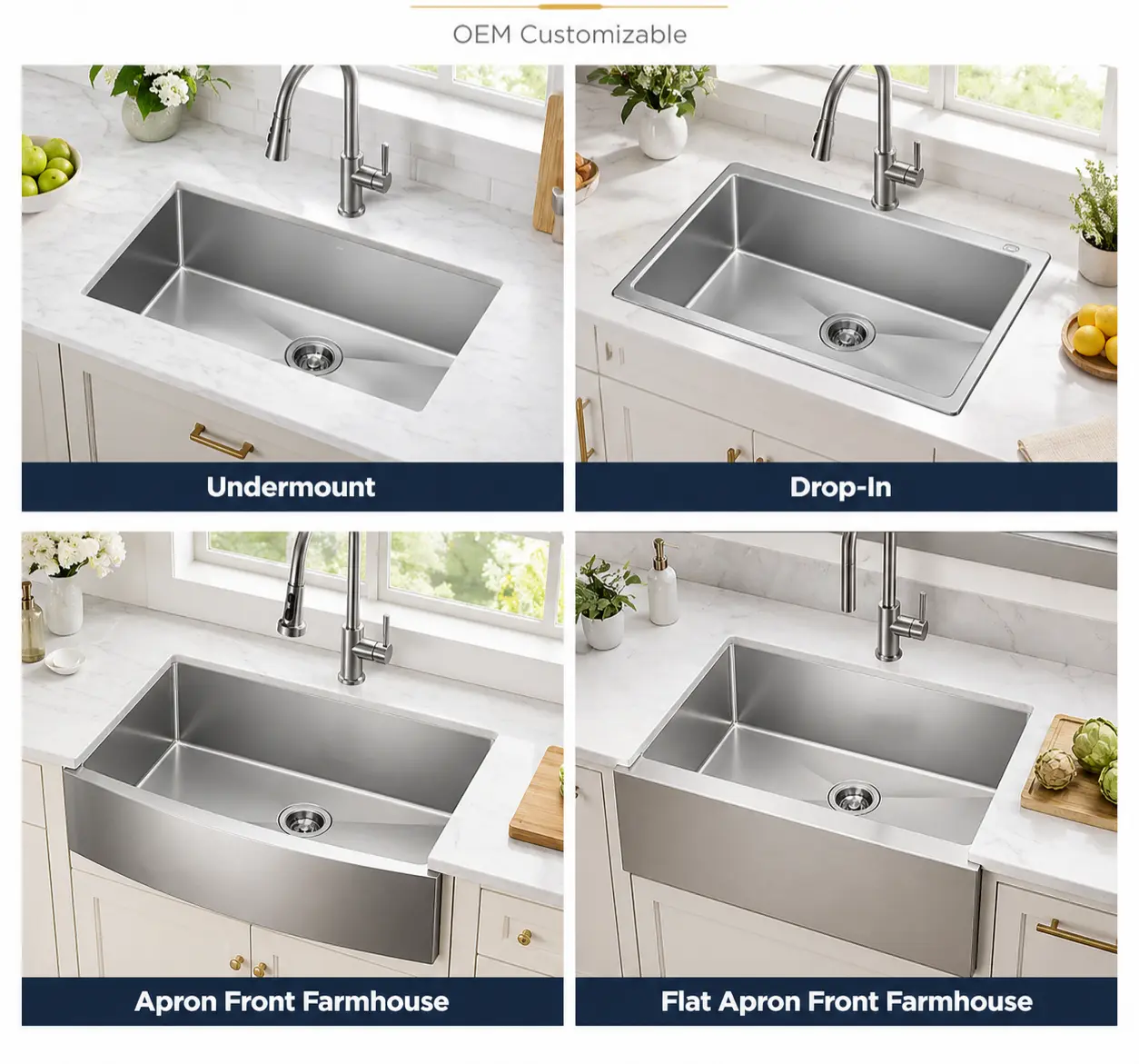
Standard Undermount Sink
Main concerns:
- rim
- surface
- bowl movement
Top-Mount Sink
Additional attention:
- visible rim
- corner protection
Apron-Front Sink
Additional attention:
- front apron
- apron corners
Workstation Sink
Additional attention:
- accessory separation
- complete-SKU organization
PVD Sink
Additional attention:
- surface rubbing
- finish protection
One standard packing layout should not automatically be used across every model.
18. Sample Approval Should Include Packing
Do not approve only:
sink body + accessories.
Also review:
- protective film
- foam
- accessory position
- carton
- labels
- barcode
If the bulk order will use a different packaging method from the sample, that difference should be clearly recorded.
19. Packing Should Be Frozen Before Mass Production
Before production release, confirm:
- pcs/carton
- internal layout
- protection
- accessory configuration
- carton artwork
- labels
- barcode
- pallet
This helps prevent a common situation:
product approved, packing still changing after production starts.
20. A Better Packaging RFQ Example
Instead of:
Good export packing required.
send something like:
Product: 30-inch workstation sink
Finish: Gunmetal PVD
Packing: 1 pc / carton
Distribution: Importer warehouse + parcel fulfillment
Surface Protection: Required
Rim / Corner Protection: Required
Accessories: Drain, grid, cutting board, colander, roll-up rack
Accessory Separation: No metal-to-metal contact with sink
Private Label: Customer logo carton + SKU barcode
Pallet: Required for import shipment
Now the manufacturer can quote the actual packing program instead of guessing.
Packaging RFQ Checklist
| Item | What Buyer Should Define |
|---|---|
| Pcs / Carton | 1 / 2 / Multi |
| Distribution Route | Container / Retail / Parcel |
| Finish | Brushed / PVD / Other |
| Surface Protection | Required / Review |
| Rim Protection | Requirement |
| Corner Protection | Requirement |
| Internal Restraint | Required |
| Accessories | Complete list |
| Accessory Separation | Defined |
| Carton | Plain / Printed |
| Logo | Artwork |
| SKU | Defined |
| Barcode | Defined |
| Pallet | Yes / No |
| Carton Dimensions | Review for logistics |
What Not to Put in the RFQ Without Evidence
Avoid copying random packaging requirements from another product.
For example:
Drop test from X meters
should not be inserted unless:
- the buyer requires that method
- the carrier requires it
- the test method is clearly defined
Formal packaging validation should follow the actual product weight, carton and distribution program.
How Packaging Connects to PSI
Before shipment, QC should compare the actual packing with the approved specification.
Check:
- carton
- foam
- accessory layout
- labels
- barcode
- pallet
Matrix’s Quality Control & Inspection explains how packaging can be controlled together with the product specification.
How Packaging Connects to the Initial RFQ
The earlier packaging is defined, the more accurate the quotation becomes.
The Kitchen Sink RFQ Checklist combines:
- product
- accessories
- private label
- packaging
- quantity
so buyers can compare suppliers on the same commercial scope.
Common Packaging RFQ Mistakes
“Standard export packing.”
Too vague.
“Use strong carton.”
What distribution route?
“Accessories included.”
Where and how are they packed?
“PVD finish, same packing as brushed.”
Not necessarily appropriate.
“Private-label carton.”
Artwork, barcode and SKU still need to be defined.
“We will decide packing after the PO.”
This can change both quotation and logistics cost.
Buyer Takeaway
A useful packaging RFQ should answer three questions:
What needs protection?
How will the product move?
What must the customer receive as the complete SKU?
Define:
Sink → Finish → Accessories → Internal Protection → Carton → Label → Distribution Route
before comparing supplier pricing.
“Export packing” is a description. A packing specification is a purchasing requirement.
Frequently Asked Questions
What packaging information should I send to a kitchen sink manufacturer?
Provide pcs per carton, finish, accessories, internal protection, carton requirement, labels and the intended distribution route.
Should packaging be included in the original RFQ?
Yes. Packing affects unit cost, CBM, freight and damage risk.
Should parcel-delivery sinks use different packaging?
They may need different protection because individual parcel handling can create more drops, impacts and orientation changes.
Should accessories be packed separately?
They should be restrained and prevented from damaging the sink. The exact layout depends on the accessory set.
Should private-label carton artwork be approved before production?
Yes, particularly SKU, barcode, finish and model information.
Is thicker foam always better?
No. Placement, product restraint and structural support are more important than foam thickness alone.
Can packaging affect container loading cost?
Yes. Carton dimensions and palletization directly affect shipping volume.
Preparing a Kitchen Sink RFQ?
Use the Kitchen Sink RFQ Checklist to define the sink, accessories, branding, packaging and quantity together.
For private-label cartons and SKU details, see Private Label Product Programs.