SUS316 is more corrosion-resistant than SUS304 — but that does not mean every kitchen sink should be made from 316.
For many normal residential and commercial kitchen applications, SUS304 already provides a strong balance of:
- corrosion resistance
- fabrication performance
- availability
- cost
SUS316 becomes more relevant when the sink will face a more aggressive environment, especially where chloride exposure is higher.
For buyers, the real question is not:
“Which stainless steel grade is better?”
It is:
“Does the application justify paying for the extra corrosion margin of SUS316?”
Quick Answer
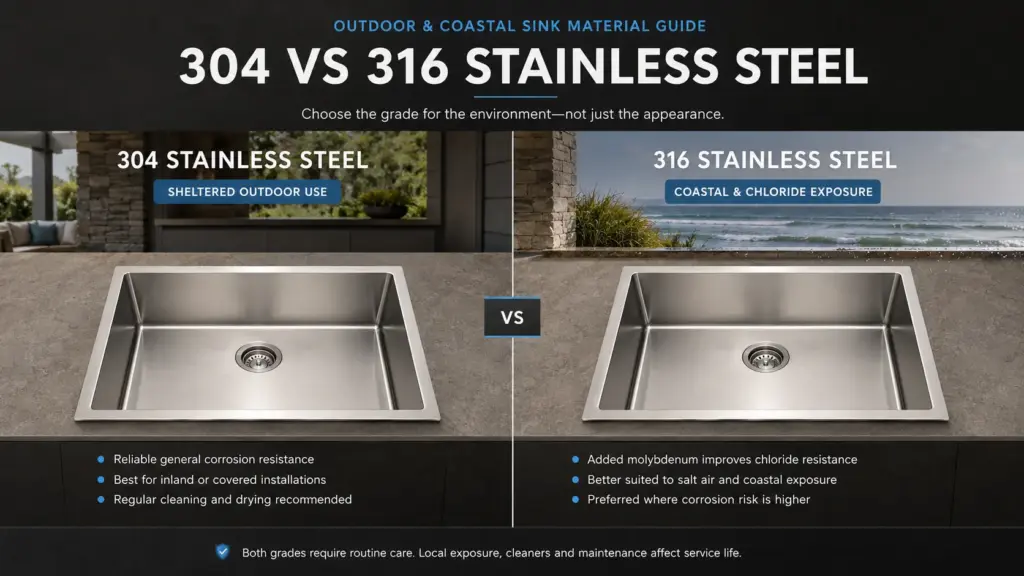
SUS316 usually makes more sense than SUS304 when the sink will be exposed to:
- coastal or marine environments
- higher chloride levels
- salt-heavy applications
- some laboratory or specialist-use environments
- more aggressive cleaning chemicals
- project specifications that explicitly require 316
SUS304 is still the normal choice for many:
- residential kitchens
- apartments
- hospitality projects
- standard commercial kitchens
- private-label retail sink programs
The practical decision is:
Application Environment
→ Chloride Exposure
→ Cleaning Conditions
→ Project Requirement
→ Cost Difference
SUS316 should solve a real corrosion-risk problem, not simply serve as a “premium” label.
1. What Is the Main Difference Between SUS304 and SUS316?
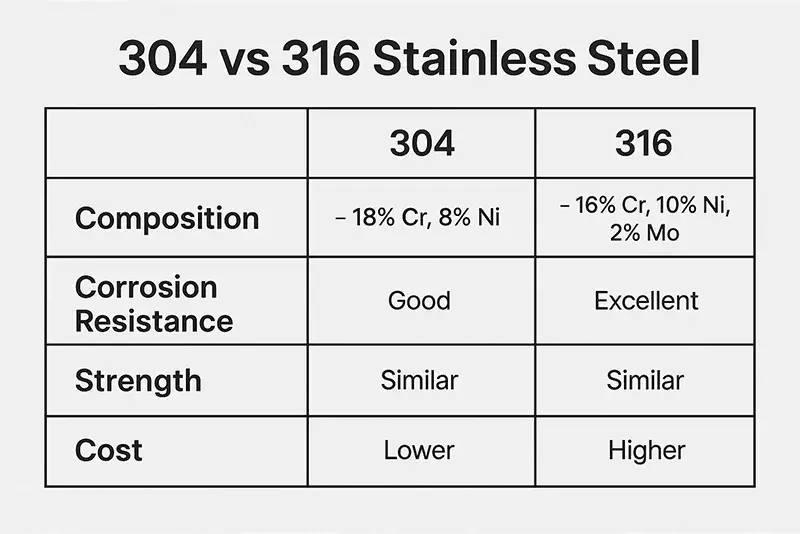
Both are austenitic stainless steels widely used for corrosion-resistant products.
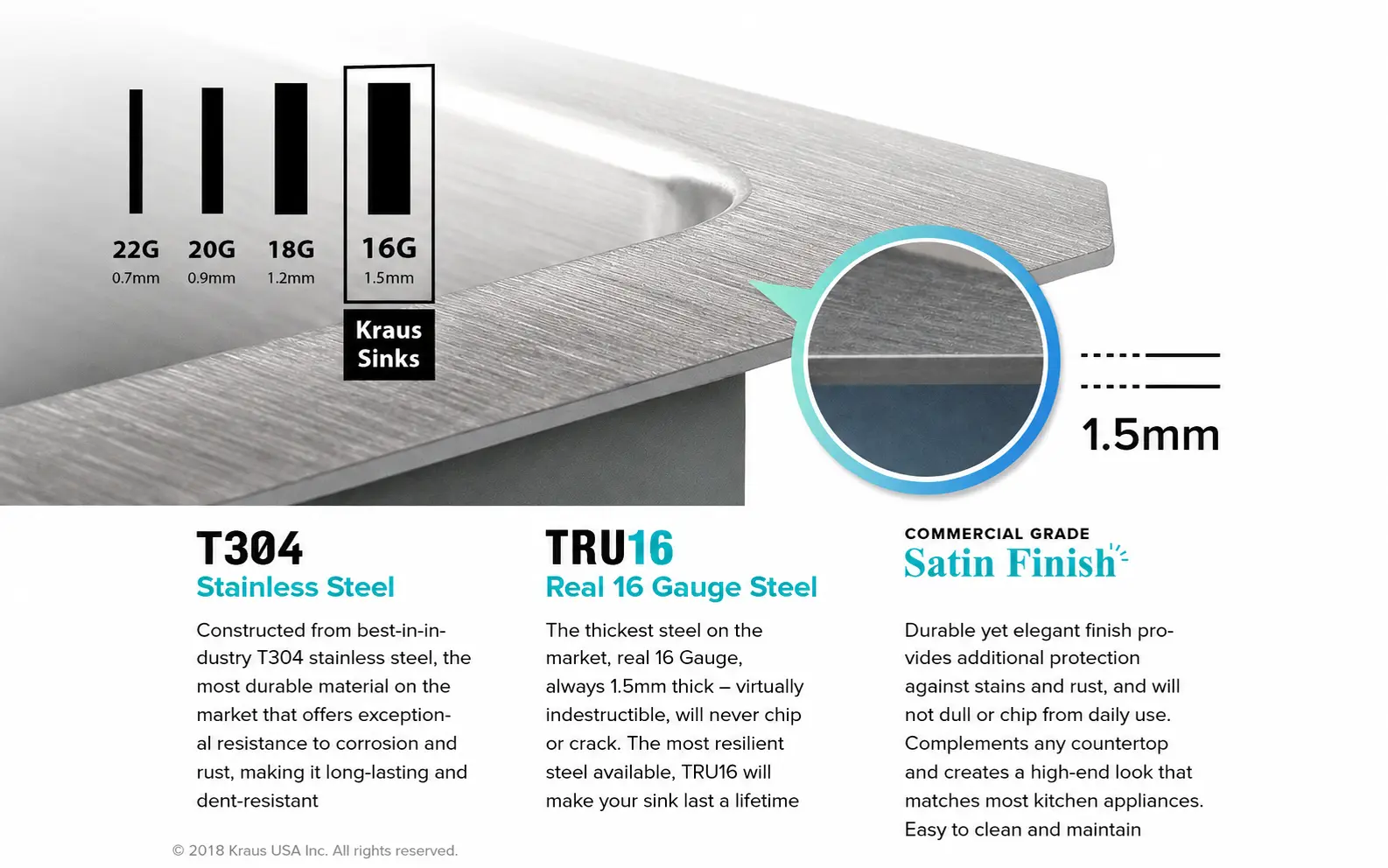
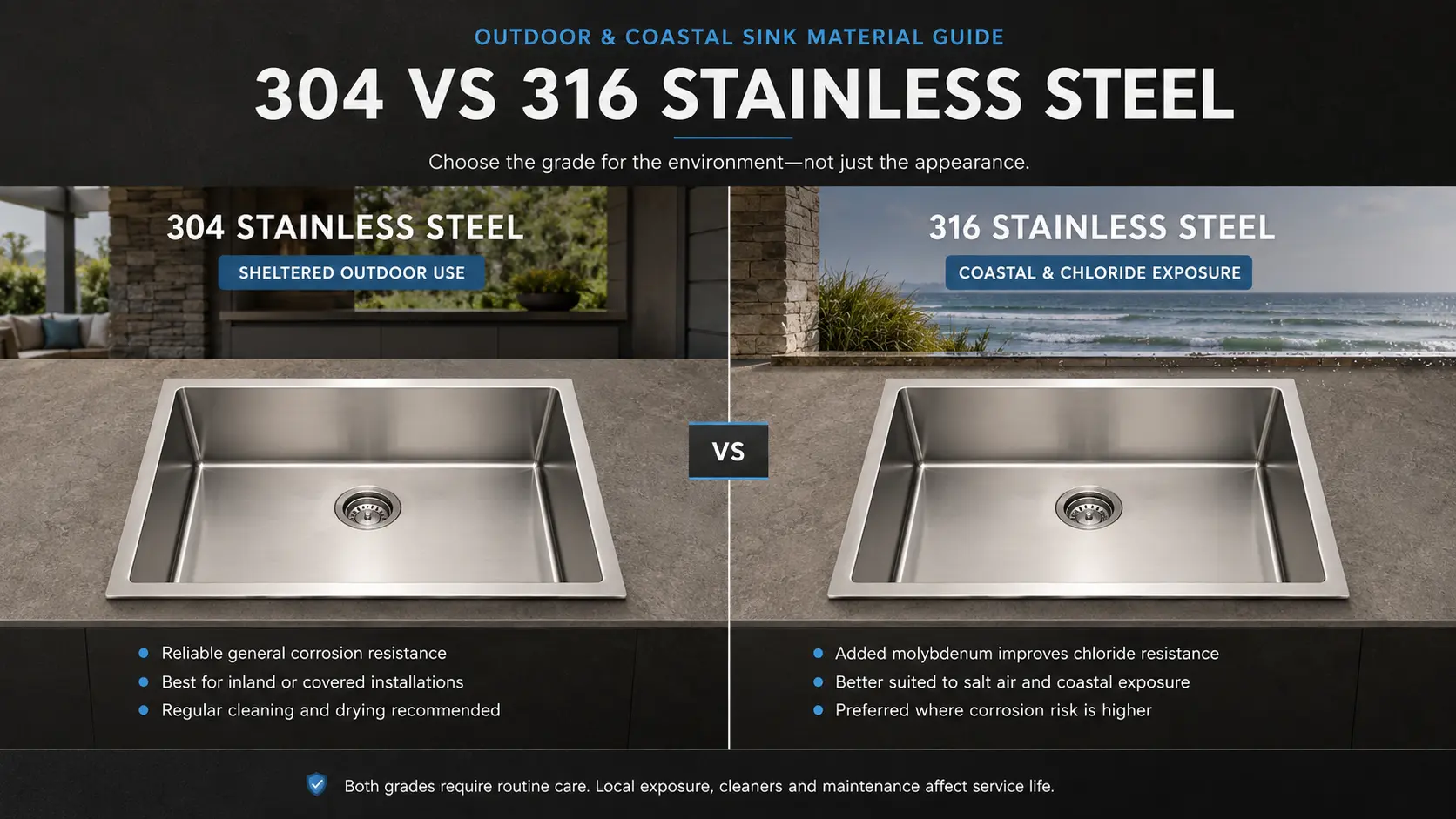
The key difference is that SUS316 contains molybdenum in addition to the chromium and nickel typically associated with this stainless steel family.
That additional alloying improves resistance to certain forms of localized corrosion, especially in chloride-containing environments.
For a sink buyer, the important takeaway is:
316 generally gives more corrosion margin where chloride exposure is more demanding.
2. Why SUS304 Is Still the Standard Choice for Many Kitchen Sinks
A normal kitchen environment usually includes:
- tap water
- food residue
- household detergent
- routine cleaning
- intermittent moisture
For these applications, SUS304 is widely used because it offers a good combination of:
- corrosion resistance
- formability
- weldability
- surface finishing
- commercial availability
So choosing 304 is not a “budget compromise” by default.
In many projects, it is simply the correct material for the application.
3. Coastal Environments Can Change the Decision
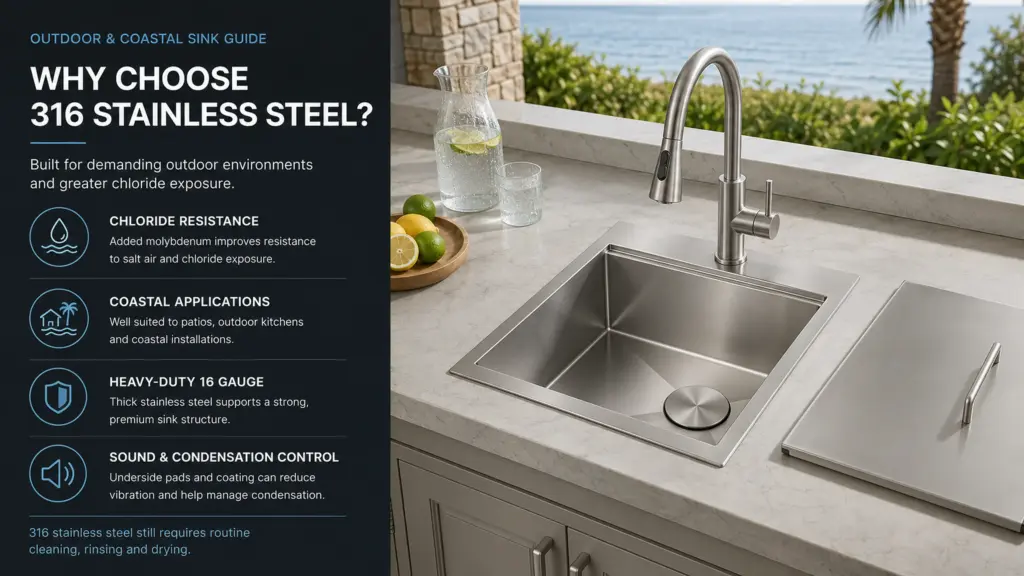
One of the clearest reasons to consider SUS316 is higher chloride exposure.
Coastal conditions can introduce:
- salt air
- salt deposits
- higher chloride contamination
This does not mean every sink near the sea automatically requires 316.
But as exposure becomes more aggressive or continuous, the extra corrosion resistance of 316 becomes more valuable.
This is especially relevant for:
- beachfront properties
- coastal villas
- marine-related projects
- outdoor kitchen areas near the sea
4. Salt-Heavy Applications Deserve More Attention
Salt is a chloride source.
If a sink will regularly handle:
- salty water
- seafood processing
- brine
- food production with high salt exposure
the material decision may deserve more scrutiny than a standard residential kitchen.
The exposure level, cleaning routine and contact time all matter.
A material grade should be selected around the real operating condition rather than the product category alone.
5. Outdoor Kitchen Sinks May Need a Different Material Review
An outdoor sink can face more than normal indoor use.
Depending on location, it may be exposed to:
- rain
- humidity
- salt air
- temperature changes
- outdoor cleaners
- longer periods of standing moisture
For a normal inland outdoor kitchen, SUS304 may still be suitable.
For a coastal or chemically demanding outdoor environment, SUS316 may offer useful additional corrosion resistance.
Matrix’s Outdoor Kitchen Sinks are a good example of why application environment should be part of the material specification rather than choosing stainless steel grade in isolation.
6. Laboratory or Specialist Projects Can Justify SUS316
Some non-residential projects involve:
- chemicals
- cleaning agents
- more aggressive environments
- project-specific material requirements
In these cases, SUS316 may be specified because the application needs additional corrosion resistance.
But the correct grade still depends on the actual chemical exposure.
316 is more resistant than 304, but it is not universally resistant to every chemical environment.
7. SUS316 Is Not Automatically Necessary for Every Commercial Kitchen
“Commercial use” alone does not automatically mean:
SUS316 required.
A restaurant kitchen may still operate well with SUS304 depending on:
- cleaning chemicals
- salt exposure
- maintenance
- operating environment
So buyer specifications should avoid the shortcut:
Residential = 304
Commercial = 316
The environment matters more than the label.
8. Cleaning Chemicals Can Matter as Much as the Location
Even high-grade stainless steel can perform poorly if exposed to unsuitable chemicals.
Repeated use of aggressive chloride-containing cleaners can increase corrosion risk.
So upgrading the steel grade while ignoring the cleaning environment is incomplete.
The correct review should include:
- cleaner type
- chloride content
- contact time
- rinsing
- surface condition
This is also why visible rust-like marks should not immediately be interpreted as proof that the sink was made from the wrong material.
See:
Why Can a SUS304 Stainless Steel Sink Develop Rust-Like Spots?
9. Material Grade and Surface Contamination Are Different Issues
A buyer may assume:
316 = cannot develop rust marks.
That is not correct.
Even SUS316 can show surface contamination if:
- carbon-steel particles
- grinding dust
- contaminated tools
- external iron
remain on the surface.
So:
higher alloy grade does not replace fabrication cleanliness and surface control.
10. Does SUS316 Look Different From SUS304?
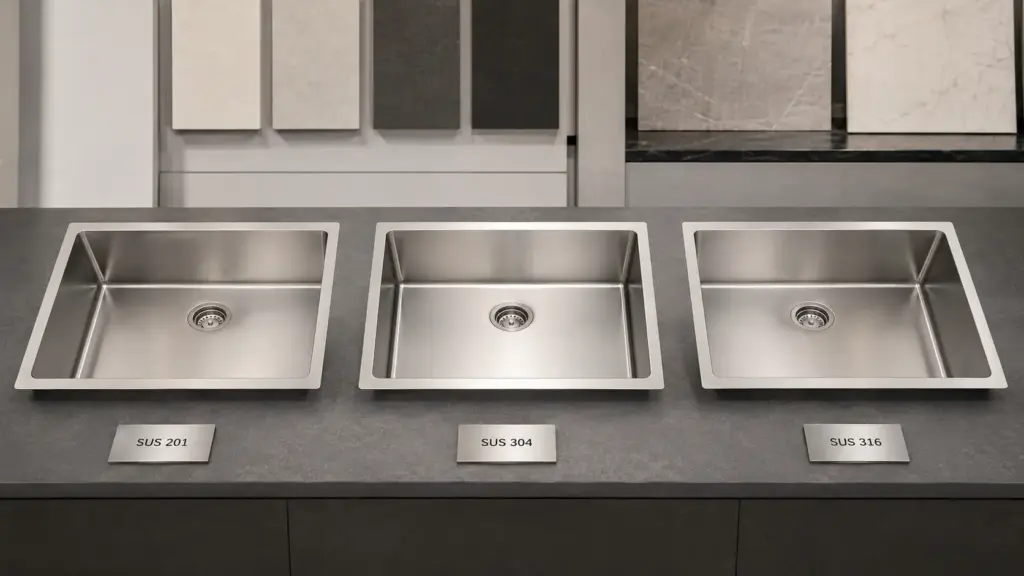
Not in a way that buyers should use for material identification.
A finished brushed SUS304 sink and a finished brushed SUS316 sink can look very similar.
Appearance cannot reliably confirm the alloy grade.
If the grade matters commercially, verify it through:
- material specification
- traceability
- supplier documentation
- XRF / PMI where required
For material-verification logic, see:
How Can Buyers Verify SUS304 Without Relying on a Magnet?
11. A Magnet Still Does Not Solve the 304 vs 316 Question
Magnetic response is not a reliable grade-identification method for finished sinks.
Fabrication can alter local magnetic behavior, especially after:
- pressing
- bending
- welding
So a buyer should not use:
magnetic = 304
non-magnetic = 316
as a sourcing rule.
The alloy should be verified by composition and traceability when necessary.
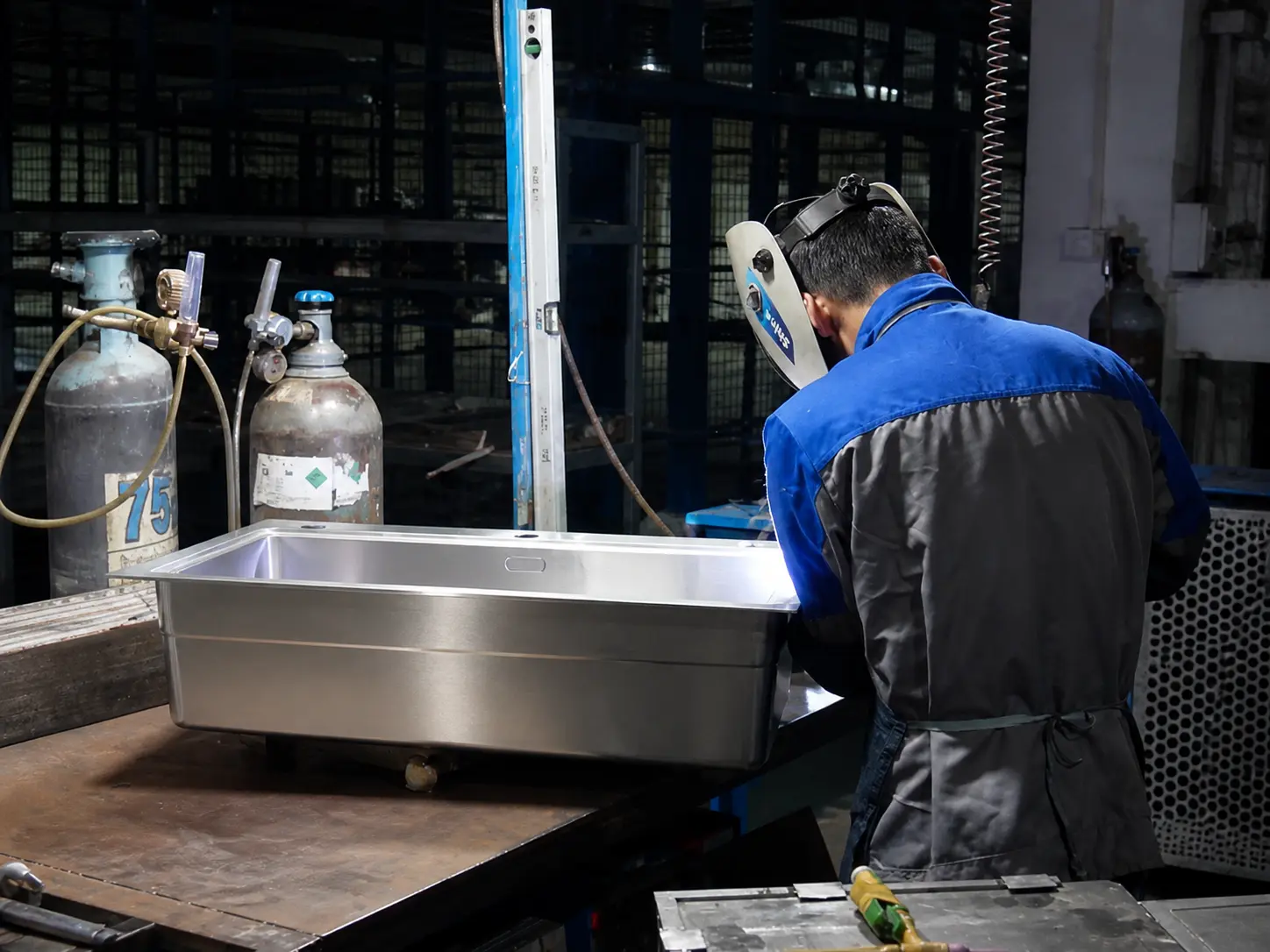
12. Does SUS316 Affect Sink Manufacturing?
Yes, material grade can affect:
- material cost
- sourcing
- fabrication behavior
- welding
- polishing
- production planning
But from the buyer’s perspective, the main commercial difference is usually:
higher material cost in exchange for greater corrosion resistance in demanding environments.
This is why 316 should be specified intentionally.
13. Cost Difference Matters More on Large or Heavy Sink Programs
The material premium becomes more visible when the product uses more stainless steel.
For example:
- deep handmade sinks
- large farmhouse sinks
- drainboard sinks
- commercial utility sinks
- heavy-gauge custom sinks
A small material-grade change can have a meaningful effect on unit cost.
That makes application-based selection especially important for OEM programs.
14. Handmade Custom Projects May Be More Likely to Consider SUS316
Custom handmade production is often used for:
- non-standard dimensions
- specialist projects
- small-to-medium custom programs
- heavier-gauge products
These are also the projects where buyers are more likely to specify unusual materials.
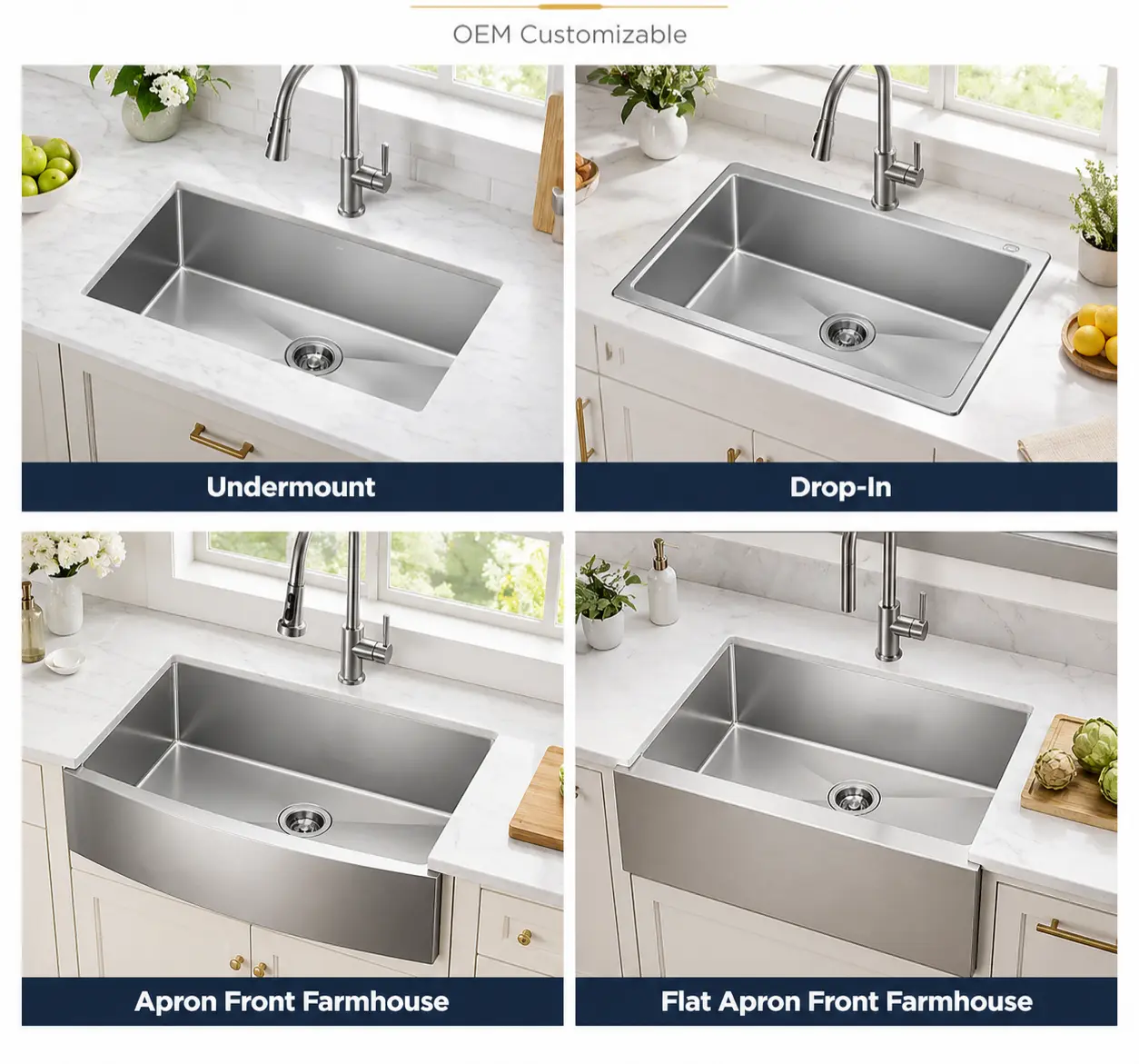
Matrix’s Handmade Kitchen Sinks and Custom Kitchen Sink Programs are relevant where material grade, thickness and project geometry need to be confirmed together.
15. Do Not Upgrade to SUS316 Without Checking the Whole Product
This is important for OEM sourcing.
A sink body may be SUS316 while:
- drain
- clips
- screws
- bottom grid
- accessories
use different materials.
If the project specifically requires higher corrosion resistance, the buyer should confirm whether the requirement applies to:
sink body only
or:
the complete wet-area component system.
16. A 316 Sink With Lower-Grade Accessories Can Still Create Claims
Imagine:
Sink Body
SUS316
Drain Component
Lower corrosion resistance
If rust or corrosion appears around the drain, the buyer may still receive a customer complaint even though the sink body itself meets the 316 specification.
This is why material requirements should follow the actual product interface.
17. When SUS304 Usually Makes More Sense
SUS304 is usually the practical choice when:
- the sink is used indoors
- water chemistry is normal
- chloride exposure is limited
- standard household or commercial cleaning is expected
- the project does not require 316
- cost competitiveness matters
This covers a large portion of normal kitchen sink programs.
18. When SUS316 Deserves Serious Consideration
Consider SUS316 more carefully when the project involves:
- coastal location
- marine exposure
- salt-heavy processing
- demanding outdoor use
- specialist chemical environment
- customer specification requiring 316
- high-value project where additional corrosion margin is commercially justified
SUS304 vs SUS316 Decision Table
| Application | Typical Starting Point |
|---|---|
| Standard residential kitchen | SUS304 |
| Apartment / housing project | SUS304 |
| Normal restaurant kitchen | SUS304 |
| Standard private-label retail sink | SUS304 |
| Inland outdoor kitchen | Review; often SUS304 |
| Coastal outdoor kitchen | Consider SUS316 |
| Beachfront / marine project | Consider SUS316 |
| Salt-heavy processing | Consider SUS316 |
| Specialist laboratory application | Review actual chemical exposure |
| Project specification requires 316 | SUS316 |
What Should Buyers Put in the RFQ?
Do not write only:
stainless steel sink.
Define:
- material grade
- thickness
- finish
- application
- installation type
- target market
- any special corrosion environment
For example:
SUS316 handmade sink for coastal outdoor installation
gives the manufacturer much more useful information than:
premium stainless steel sink.
Matrix’s Kitchen Sink RFQ Checklist can be used to structure these project requirements before quotation.
Should a Buyer Ask for 316 Just to Improve Product Positioning?
That depends on the market.
If 316 is part of a genuine:
- project requirement
- brand specification
- application advantage
then it can make sense.
If it is added only because:
higher grade sounds more premium
the buyer may be paying for corrosion resistance the end application does not actually need.
For OEM programs, the better approach is:
specify the material because the application requires it, not because the grade number is higher.
Common Misunderstandings
“316 is always better than 304.”
316 offers higher corrosion resistance in certain environments, but that does not make it the most economical or necessary choice for every sink.
“Commercial sinks should always use 316.”
No.
The actual environment and chemical exposure matter.
“304 rust spots mean I should switch every product to 316.”
No.
First identify whether the issue is alloy grade, contamination, cleaning or environment.
“316 stainless steel cannot rust.”
Incorrect.
It has stronger corrosion resistance, but it is not corrosion-proof.
“A magnet can tell whether a sink is 304 or 316.”
No.
Use material traceability or composition verification.
“If the bowl is 316, the entire sink system is 316.”
Not automatically.
Accessories and drain components should be confirmed separately.
Buyer Takeaway
Do not choose between SUS304 and SUS316 using:
Higher Grade = Better Product
Use:
Application
→ Chloride Exposure
→ Cleaning Environment
→ Project Requirement
→ Component Materials
→ Cost
The key distinction is:
SUS304 is the practical standard for many kitchen applications. SUS316 becomes valuable when the application genuinely needs additional chloride and corrosion resistance.
Frequently Asked Questions
Is SUS316 better than SUS304 for kitchen sinks?
It provides stronger corrosion resistance in some environments, especially chloride exposure, but it is not necessary for every kitchen.
Is SUS304 good enough for a normal kitchen sink?
For many normal indoor kitchen applications, SUS304 is a widely used and practical material choice.
Should coastal kitchen sinks use SUS316?
SUS316 deserves consideration where salt-air or chloride exposure is more demanding, especially for coastal outdoor applications.
Is SUS316 necessary for restaurant sinks?
Not automatically. Cleaning conditions, salt exposure and project requirements should be reviewed.
Can SUS316 still get rust-like marks?
Yes. Surface iron contamination or unsuitable environmental exposure can still create rust-like marks.
How can buyers verify SUS316?
Use material traceability and, where commercially necessary, composition testing such as XRF / PMI rather than appearance or magnet tests.
Developing a SUS304 or SUS316 Sink Program?
Matrix supports stainless steel sink programs with material grade, thickness, geometry and finish defined around the target application.
See Handmade Kitchen Sinks, Custom Kitchen Sink Programs and Outdoor Kitchen Sinks for application-specific product options.