Waterfall kitchen sinks can be worth it for buyers who regularly wash produce, want an integrated workstation and can obtain reliable installation support and replacement parts.
They are less suitable for buyers who want the simplest possible sink, have limited cabinet space, experience low water pressure or cannot confirm long-term access to cartridges, hoses, control valves and display components.
The most important point is that a waterfall sink is not just a sink.
It is a connected system that may include:
- A stainless steel sink bowl
- A wide waterfall outlet
- A main pull-down faucet
- A digital temperature display
- Water-mode controls
- A cup washer
- A filtered-water faucet
- A soap dispenser
- A remote drain control
- Workstation ledges
- Cutting boards, baskets and colanders
- Multiple hoses, valves and connectors
Each added function can improve the kitchen workflow. Each one also creates another compatibility, maintenance and after-sales requirement.
Quick Answer: Is a Waterfall Kitchen Sink Worth It?
| Buyer situation | Recommendation | Reason |
|---|---|---|
| Frequent cooking and produce washing | Often worth considering | Wide rinsing area and workstation accessories may improve prep |
| Large modern kitchen | Potentially suitable | More room for bowl, faucet deck and under-sink components |
| Small cabinet with crowded plumbing | Usually not the best choice | Hoses, controls, drain and accessories require space |
| Low or unstable water pressure | Test before buying | Waterfall and cup-washer performance may be disappointing |
| Hard-water area | Buy only with a cleaning plan | Wide outlets and small spray openings can collect scale |
| Rental or low-maintenance property | A standard sink may be safer | Simpler products are easier to service and replace |
| Design-led retail collection | Strong differentiation potential | Visually distinctive and easy to demonstrate |
| B2B private-label program | Suitable only after system validation | Parts, installation, packaging and after-sales must be controlled |
| Buyer without replacement-part access | Avoid | A small failed component can disable an advertised function |
The practical verdict is:
A good waterfall sink can improve workflow. A poorly planned one adds more parts without adding reliable value.
What Is a Waterfall Kitchen Sink?
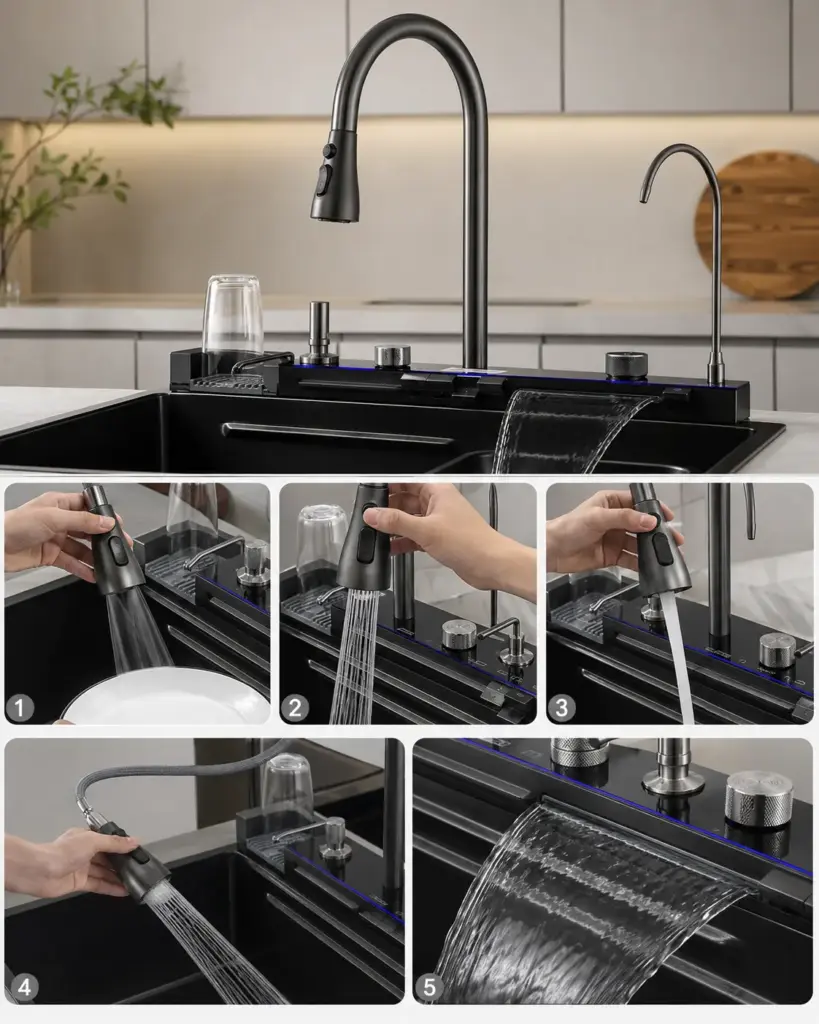
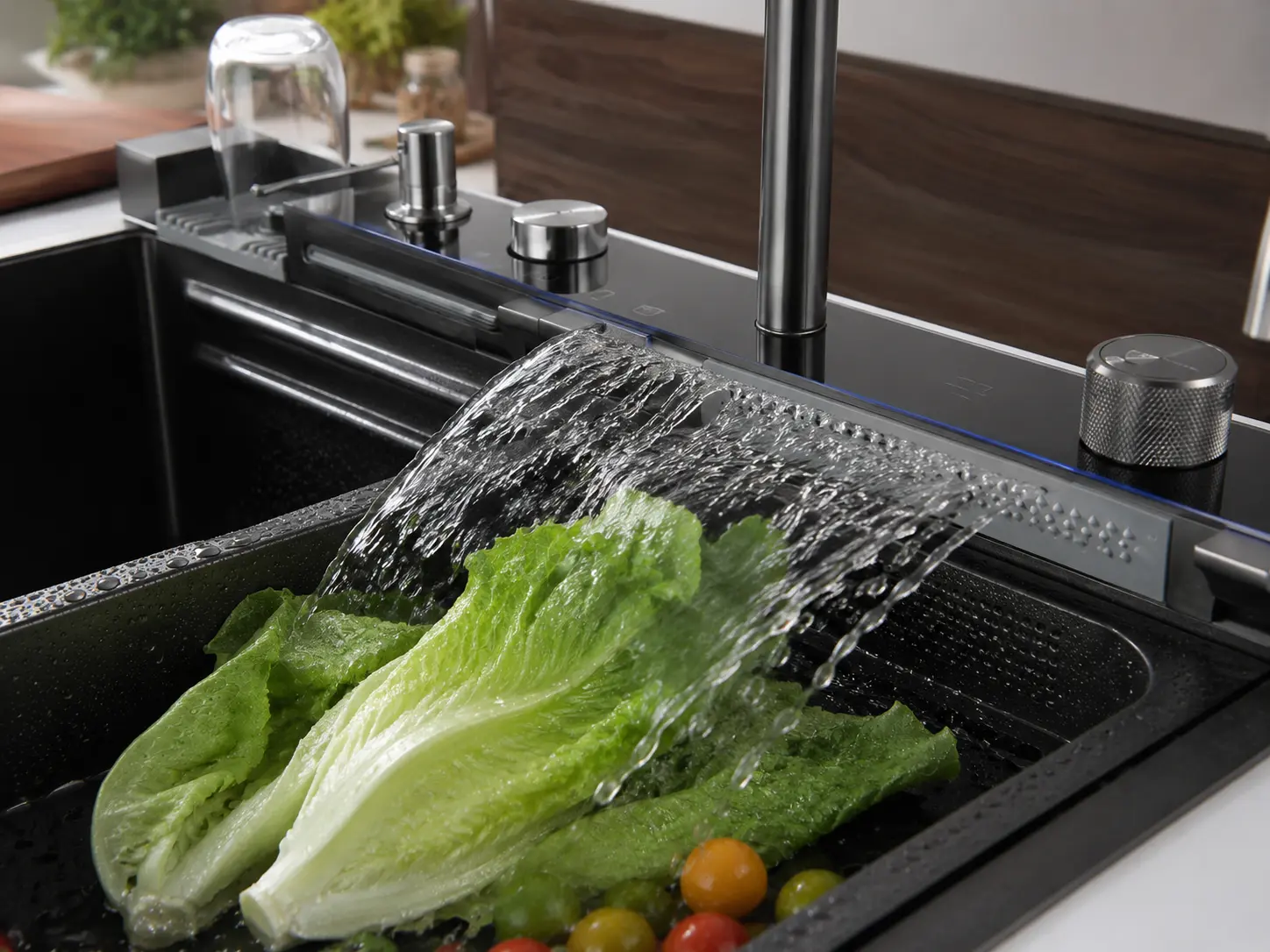
A waterfall kitchen sink is a multifunctional sink system with a wide water outlet that creates a sheet-like or rain-style flow over part of the bowl.
The term may describe several different configurations.
Waterfall Outlet Integrated into the Sink Deck
The wide outlet is built into or mounted on the sink’s rear deck. Water is controlled through a knob, lever, button or multi-function valve.
Waterfall Mode Integrated into the Faucet
Some products create a broad blade-style flow from the main faucet instead of using a separate outlet in the sink deck.
Multifunction or “Smart” Waterfall Sink
These models may combine:
- Waterfall flow
- Rainfall or shower flow
- Pull-down faucet
- Temperature display
- Cup washer
- Filtered-water outlet
- Soap dispenser
- Remote drain
- Workstation accessories
Not every waterfall sink includes every feature. Product names are not standardized, so buyers should compare the actual component list rather than the phrase “smart waterfall sink.”
A waterfall kitchen sink should also not be confused with a waterfall countertop, where the countertop material continues vertically down the side of an island.
Which Features Provide Real Everyday Value?
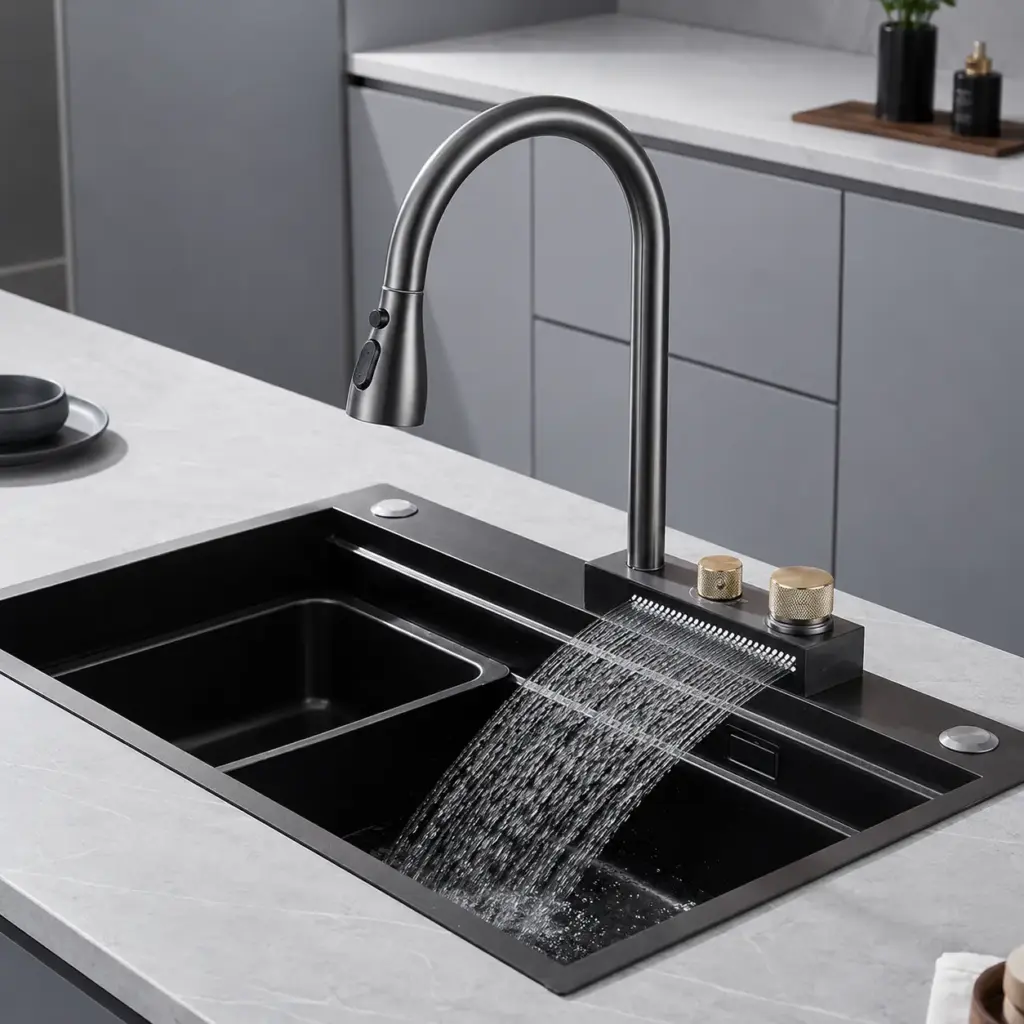
The value depends on how each feature fits the user’s daily routine.
1. Wide Waterfall or Rainfall Flow
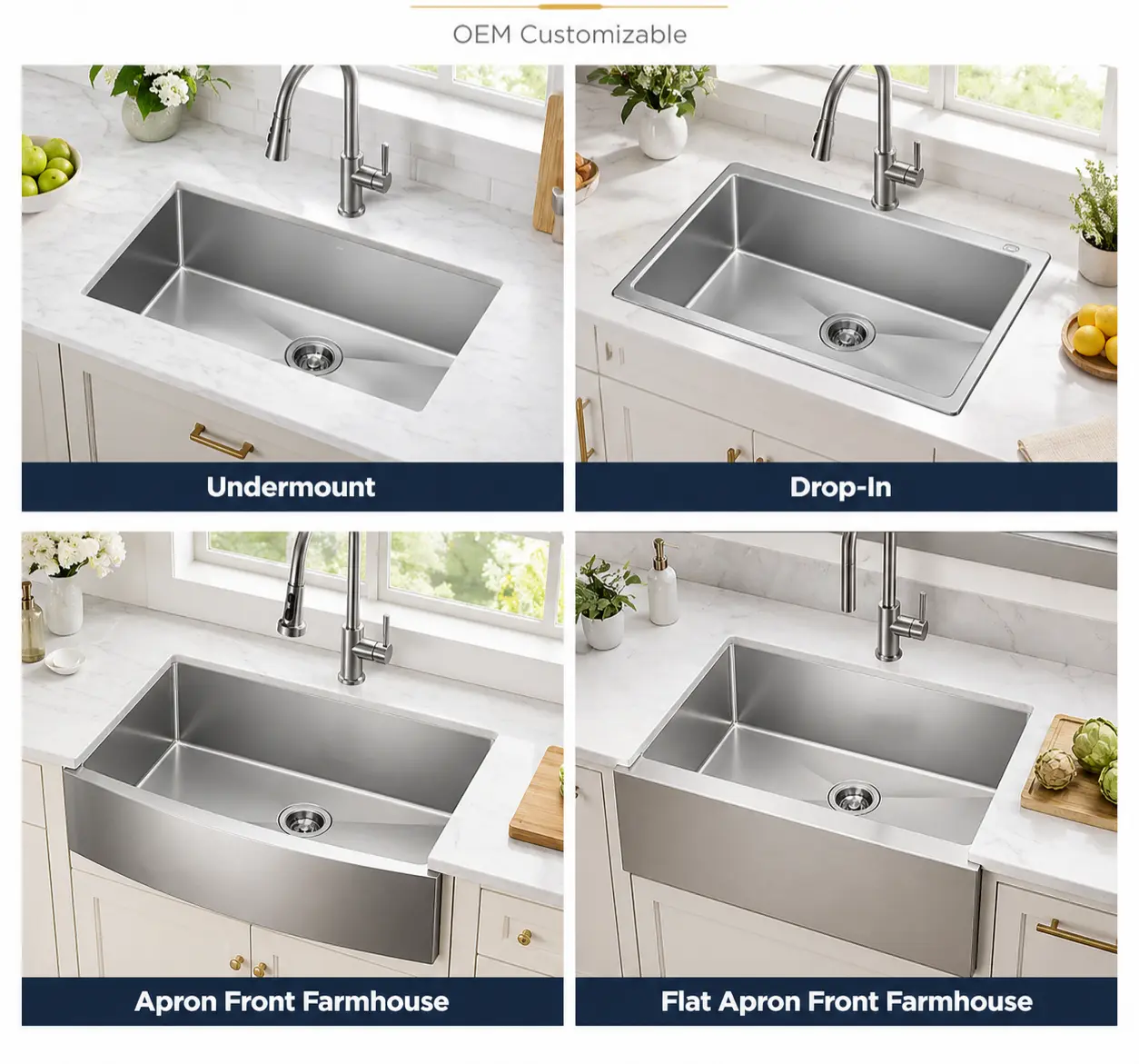
The waterfall outlet spreads water across a wider area than a conventional round faucet stream.
It may be useful for:
- Rinsing vegetables
- Washing fruit
- Rinsing removable baskets
- Wetting a larger surface quickly
- Creating a visible premium feature
However, a wider flow is not automatically a more powerful or more efficient flow.
Performance depends on:
- Available dynamic water pressure
- Flow rate
- Internal hose diameter
- Valve and connector restrictions
- Outlet width
- Outlet geometry
- Mineral buildup
- Water landing position
A visually impressive outlet can still perform poorly if the internal water path is too restrictive.
2. Pull-Down Main Faucet
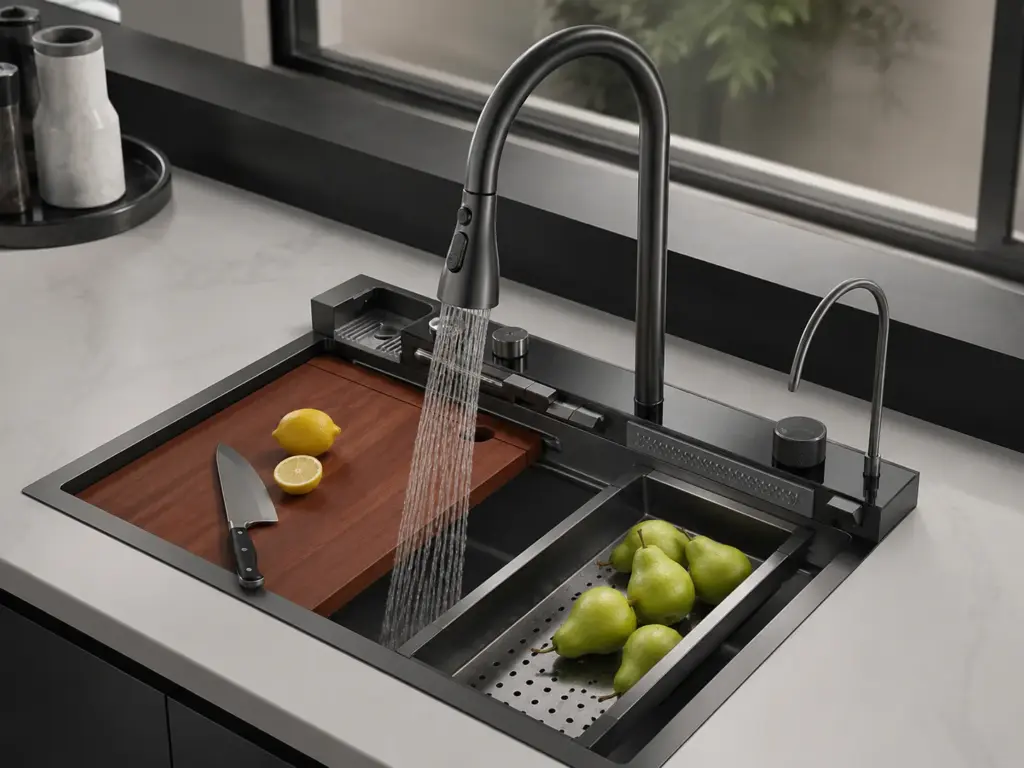
For many users, the pull-down faucet provides more daily value than the waterfall itself.
It allows water to be directed toward:
- Sink corners
- Large cookware
- Workstation accessories
- Drain covers
- Areas behind the bowl
- Containers outside the sink
Before buying, check whether the hose reaches the complete bowl and retracts without hitting the drain pipes, control valves or cabinet wall.
3. Digital Temperature Display
A digital display can show the approximate water temperature and, on some systems, the length of time water has been running.
Some displays use a small internal hydroelectric turbine and do not require a battery or external electrical connection. Other products may use a different power arrangement.
A display should not be confused with temperature control.
Unless the system contains a thermostatic mixing function, the display:
- Shows temperature
- Does not regulate temperature
- Does not prevent sudden supply-temperature changes
- Does not guarantee protection from scalding
B2B buyers should confirm what the display measures, how it is powered and what happens when the display module fails.
4. Cup Washer or Glass Rinser
A cup washer uses upward-facing water jets to rinse the inside of a glass or cup.
It can be useful for:
- Narrow glasses
- Coffee cups
- Baby bottles
- Blender cups
- Beverage preparation
Many systems connect the rinser through a branch or T-connection from a water-supply line. The exact configuration varies.
Buyer checks should include:
- Required pressure
- Shutoff response
- Spray containment
- Cup-size range
- Drainage around the platform
- Hose connection
- Access for cleaning
- Replacement nozzle and valve availability
A cup washer that continues dripping after release can waste water and create permanent wet areas on the sink deck.
5. Filtered-Water Faucet
A small secondary faucet may be included for drinking or filtered water.
The presence of a “pure water faucet” does not necessarily mean a filtration system is included.
Confirm:
- Whether the filter is included
- Compatible inlet connection
- Required operating pressure
- Filter location
- Cartridge availability
- Faucet material
- Whether filtered and normal water paths remain separate
This distinction must be clear in product descriptions and packaging.
6. Remote Drain Control
Some waterfall sinks allow the drain to be opened or closed using a knob or button on the sink deck.
This reduces the need to put a hand into dirty water.
Depending on the design, the control may use:
- A mechanical cable
- A rod linkage
- A rotary connection
- Another remote-operating mechanism
The system must remain accessible for adjustment and replacement. A remote drain that cannot be serviced easily can become less convenient than a standard basket strainer.
7. Workstation Accessories
Many waterfall sinks use integrated ledges for:
- Cutting boards
- Colanders
- Baskets
- Small bowls
- Roll-up drying racks
- Drain trays
These accessories can create genuine working space in a compact kitchen.
Their value depends on accurate fit. The outside sink size does not determine accessory compatibility.
Review the Matrix workstation sink accessory fit guide for the measurements that control ledge support, sliding clearance and replacement fit.
The Main Advantages of a Waterfall Kitchen Sink
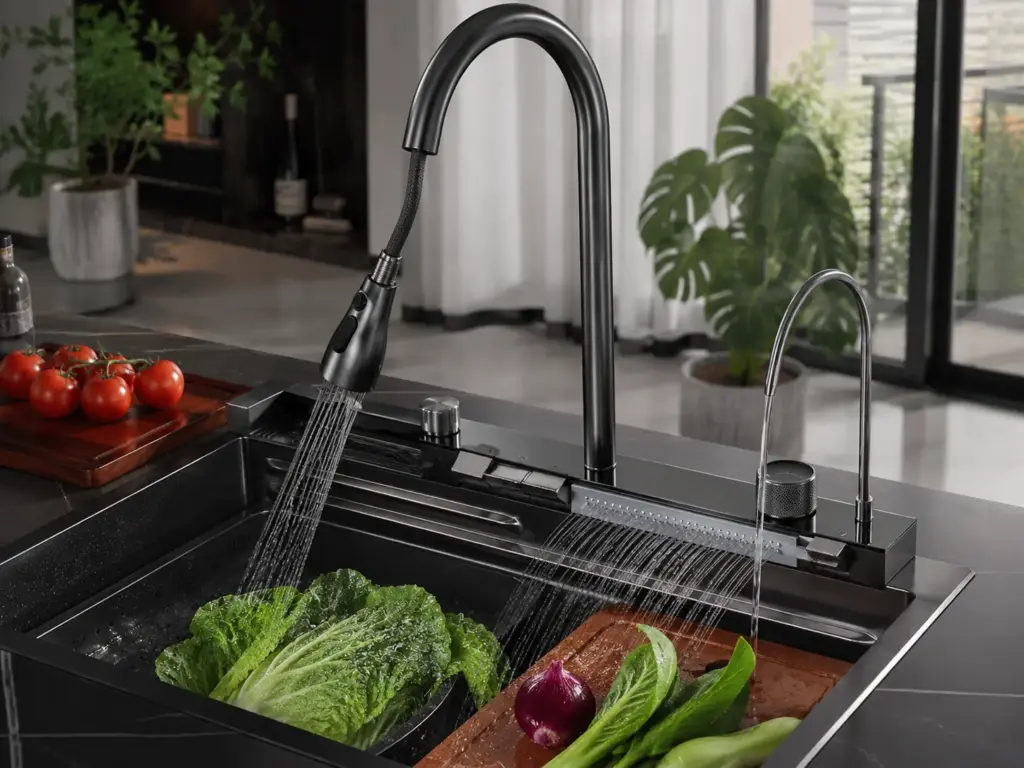
More Integrated Food Preparation
The combination of a large bowl, ledges, baskets and wide rinse function can keep washing and preparation inside one working zone.
Strong Showroom and Online Presentation
Moving water, digital displays and multiple controls are visually easy to demonstrate. This can help a retailer or private-label brand create a differentiated product presentation.
Reduced Countertop Clutter
Integrated dispensers, cutting boards, colanders and rinse functions may reduce the need for separate countertop accessories.
Multiple Water Modes
A focused stream, spray mode and wide waterfall flow can support different tasks better than one fixed outlet.
Premium Product Positioning
A complete sink-and-faucet set can support a higher-value product program when the engineering, finish, instructions and after-sales support match the visual promise.
The premium position should come from a reliable system—not from the number of visible buttons.
The Hidden Problems Buyers Should Understand
1. More Water Connections Mean More Potential Leak Points
A standard sink and faucet may need relatively few water connections.
A multifunction waterfall system can add connections for:
- Main faucet
- Waterfall outlet
- Display turbine
- Cup washer
- Filtered-water faucet
- Mode-control valve
- Hot and cold mixing
- Soap dispenser opening
- Remote drain mechanism
Every hose, gasket, adapter and threaded joint needs correct assembly.
This does not mean that a waterfall sink will leak. It means the system requires more installation control and a more complete leak test.
2. Water Pressure Can Change the Experience Completely
Waterfall outlets need sufficient flow to form a clean, even sheet.
If available pressure or flow is inadequate, the user may see:
- Uneven waterfall coverage
- Weak cup-washer jets
- Slow rinsing
- Poor spray switching
- Digital display instability on flow-powered models
- Long delays when changing modes
Excessive pressure can create different problems:
- Splashing
- Harsh cup-washer spray
- Noise
- Increased stress on connectors
- Difficult control
Do not rely on a factory demonstration connected to an unknown water supply. Test the sample under conditions that represent the target market.
3. Hard Water Can Block Small Outlets
Hard water leaves mineral deposits as droplets evaporate.
Scale can collect in:
- Waterfall outlet slots
- Rainfall spray openings
- Faucet aerators
- Cup-washer jets
- Control cartridges
- Drain-cover openings
- Display turbine water paths
A wide outlet may gradually produce an uneven sheet if one area becomes restricted.
Buyers in hard-water markets should confirm:
- Whether the outlet can be removed
- How it should be descaled
- Which cleaners are permitted
- Whether replacement outlet parts are available
- Whether the finish tolerates the approved cleaner
“Easy to clean” should be demonstrated through access and maintenance instructions, not assumed from appearance.
4. More Functions Take Up Cabinet Space
The visible sink may look organized while the cabinet below becomes crowded.
Under-sink space may need to accommodate:
- Deep sink bowl
- Main drain
- Remote drain parts
- Garbage disposal, if used
- Pull-down hose
- Faucet counterweight
- Hot and cold hoses
- Waterfall hoses
- Control valve body
- Display turbine or module
- Cup-washer supply
- Water filter
- Soap bottle
- Shutoff valves
- Waste pipes
These parts must not rub, kink or block one another.
The pull-down counterweight is especially easy to overlook. If it hits a drain pipe or hose bundle, the spray head may stop retracting correctly.
5. Replacement Parts May Be Difficult to Identify
A normal stainless steel bowl can remain usable for many years. The smaller components in a waterfall system may have shorter or different service lives.
Possible replacement parts include:
- Faucet cartridge
- Pull-down hose
- Spray head
- Mode switch
- Waterfall valve
- Waterfall outlet
- Display module
- Hydroelectric turbine
- Cup-washer valve
- Cup-washer nozzle
- Remote drain cable
- Drain stopper
- Flexible connectors
- Gaskets and seals
If these parts do not have model numbers, drawings or replacement SKUs, a minor fault can become a complete-product complaint.
The ability to purchase replacement parts is often more important than the number of included accessories.
6. Installation Instructions Are Often Incomplete
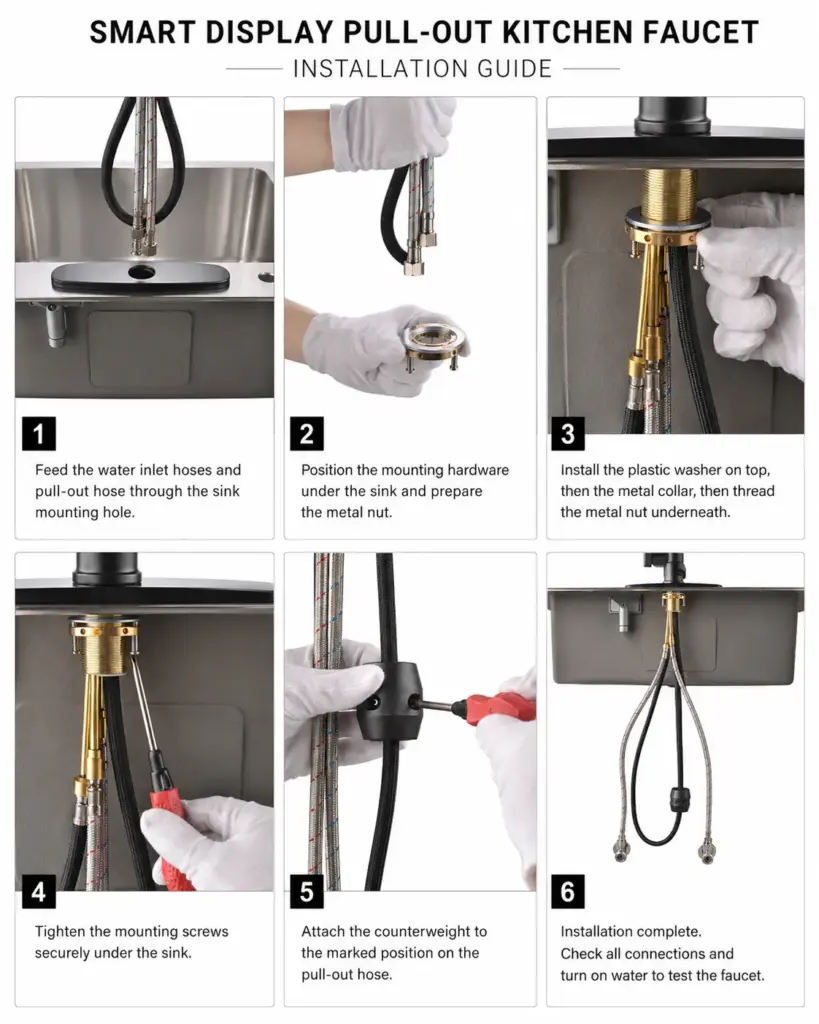
A photograph of assembled components is not a complete installation guide.
Good instructions should show:
- Sink cutout
- Installation type
- Faucet and accessory holes
- Hot and cold connections
- Waterfall supply route
- Cup-washer connection
- Display connection
- Drain assembly
- Remote drain connection
- Hose-routing area
- Pull-down counterweight clearance
- Parts list
- Leak-test procedure
- Troubleshooting steps
For sink-and-faucet sets, use the Matrix installation guide center to review why the complete system must be checked together.
7. The Waterfall Can Increase Splashing
A wide, gentle outlet can reduce concentrated impact when it is matched correctly. But an unsuitable water landing point can create more splash.
Splash behavior depends on:
- Outlet height
- Outlet angle
- Flow rate
- Sink depth
- Bowl width
- Drain-cover shape
- Accessory position
- Cookware below the stream
- Distance from the front edge
Water should land within a controlled area of the bowl—not on an accessory edge, raised drain cover or shallow front zone.
8. Cleaning Is More Complicated Than on a Basic Sink
A standard sink has fewer corners and components.
A waterfall system may require cleaning around:
- Controls
- Display edges
- Outlet slots
- Cup washer
- Accessory ledges
- Remote drain knob
- Secondary faucet
- Drain cover
- Hose connection points
This is particularly important for black, gunmetal or PVD finishes, where mineral deposits and unsuitable cleaners can be visually obvious.
For colored products, review the Matrix guide to black PVD sink durability and scratch claims.
9. Included Accessories May Interfere with One Another
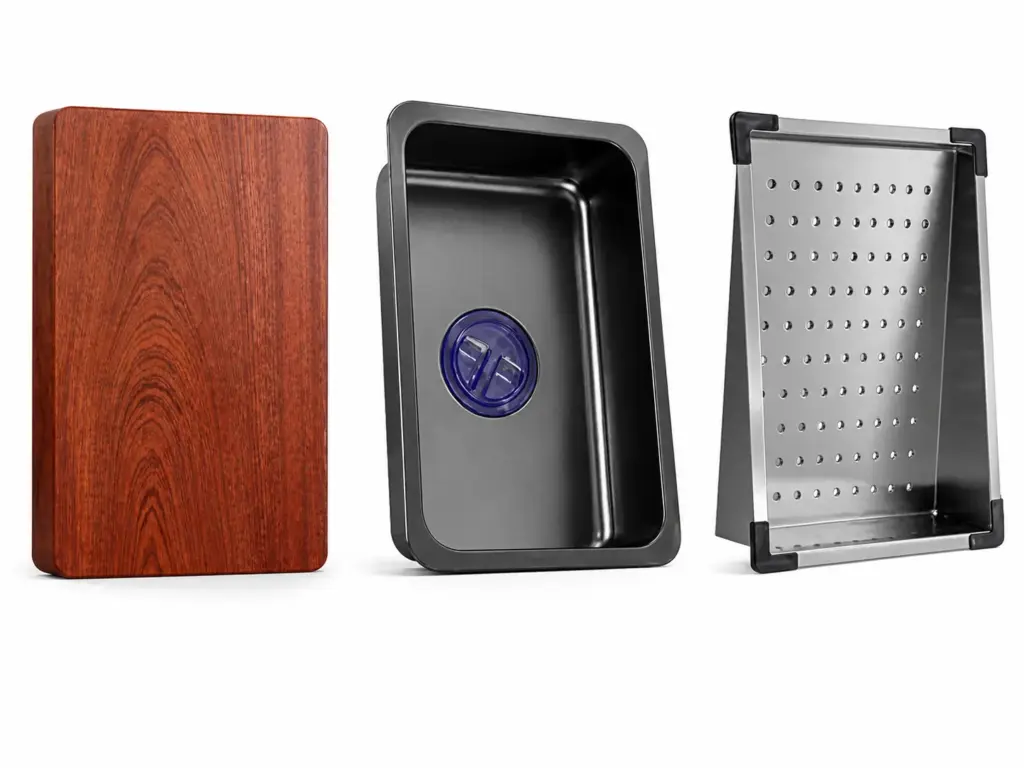
A product can include many accessories without allowing them to work together.
Possible conflicts include:
- Cutting board blocks waterfall flow.
- Colander prevents the main faucet from reaching part of the bowl.
- Drain basket covers the remote drain.
- Cup washer interferes with a tall glass or faucet handle.
- Accessory ledge limits spray-head movement.
- Drain cover prevents a bottom grid from sitting flat.
- Soap bottle collides with hoses below the deck.
A high accessory count is not useful if the complete workflow has not been tested.
10. Packaging Becomes a Product-Quality Issue
Waterfall sink sets contain many metal and finished components.
If they can move inside the carton, they may cause:
- Bowl scratches
- PVD damage
- Dented sink rims
- Broken display modules
- Bent hoses
- Damaged faucet finishes
- Missing small fittings
- Mixed left- and right-hand components
Each accessory should have a defined packing position and part-list reference.
Which Features Are Worth Paying For?
| Feature | Potential value | Main question before paying more |
| Pull-down faucet | High | Does it reach and retract correctly? |
| Accurate workstation ledges | High | Can replacement accessories be supplied? |
| Wide waterfall flow | Medium to high | Does it perform at actual site pressure? |
| Cup washer | Medium | Will it be used frequently and can it be serviced? |
| Digital temperature display | Medium | Is it readable, replaceable and correctly described? |
| Filtered-water faucet | Medium to high | Is the filter system included and supported? |
| Remote drain | Medium | Can the cable or mechanism be replaced? |
| Multiple decorative buttons | Low without proven function | Do they improve workflow or only appearance? |
| Large accessory package | Variable | Can the accessories fit, store and work together? |
| Black or Nano finish | Visual value | What process is used and how should it be maintained? |
The best upgrade is usually the function that solves a repeated daily task.
The least valuable upgrade is a feature that looks impressive during a short video but has no clear maintenance or replacement plan.
Who Should Buy a Waterfall Kitchen Sink?
A waterfall sink may suit:
- Households that prepare and wash fresh food frequently
- Buyers who want a workstation-style kitchen
- Users who will regularly use a cup washer
- Large single-bowl sink users
- Design-led kitchens
- Retailers able to provide product support
- Brands building coordinated sink-and-faucet sets
- Buyers with reliable installation and water pressure
Who Should Avoid One?
A standard sink may be more suitable when:
- Cabinet space is limited.
- Plumbing is already crowded.
- Water pressure is low or unstable.
- The local installer is unfamiliar with multifunction systems.
- Replacement parts cannot be obtained.
- The buyer wants minimal maintenance.
- Hard-water scaling is severe and regular descaling is unlikely.
- The sink is intended for a basic rental or low-service project.
- The product will be sold without installation support.
- Simplicity is more important than visual impact.
A standard high-quality sink with a reliable pull-down faucet can be more useful than an overloaded multifunction product.
Pre-Purchase Checklist for Homeowners
Before ordering, obtain the product drawing and answer the following questions.
Sink and Cabinet
- What is the exact outside sink size?
- What is the bowl size and depth?
- What minimum cabinet size is required?
- Is the sink top-mount, undermount or dual-mount?
- Is the cutout template supplied?
- Is there sufficient countertop support?
- Will the sink clear the cabinet frame?
Water Supply
- What operating pressure range is required?
- Are hot and cold connections included?
- Does the waterfall use mixed or cold water?
- How is the cup washer connected?
- Does the filtered-water faucet require a separate system?
- Can each function be isolated for service?
Display and Controls
- Is the display water-powered, battery-powered or externally powered?
- Does it only display temperature, or does it regulate it?
- What happens if it fails?
- Can the display or turbine be replaced separately?
- Are control valves accessible below the sink?
Drainage
- What drain-opening size is used?
- Is the supplied drain compatible with local waste plumbing?
- Is it garbage-disposal compatible?
- How does the remote drain operate?
- Can the remote-drain mechanism be replaced?
- Does the bowl drain completely?
Faucet and Accessories
- Does the faucet reach the complete bowl?
- Where does the water land?
- Does the pull-down hose retract freely?
- Do the accessories work while the waterfall is running?
- Are replacement boards and colanders available?
- Can every accessory be removed for cleaning?
Maintenance
- Can the waterfall outlet be removed?
- How should mineral scale be cleaned?
- Which cleaners are prohibited?
- Are cartridge, hose, display and valve part numbers available?
- Is there an exploded-parts diagram?
If these questions cannot be answered before purchase, installation and after-sales risks remain unclear.
B2B Buyer Checklist for Waterfall Sink Programs
A B2B buyer should approve the complete system rather than approving the stainless steel bowl and faucet separately.
1. Define the Product Configuration
The specification should state exactly which components are included:
- Sink bowl
- Main faucet
- Waterfall outlet
- Rainfall outlet
- Display
- Control valve
- Cup washer
- Filtered-water faucet
- Soap dispenser
- Drain
- Remote drain
- Water hoses
- Adapters
- Workstation accessories
- Installation hardware
- Spare parts
- Instructions
Do not use “full set” as the only component description.
2. Review the Interface Drawing
Confirm:
- Hole diameters
- Hole positions
- Deck thickness
- Faucet base clearance
- Control-body clearance
- Hose routes
- Thread standards
- Inlet sizes
- Drain dimensions
- Cup-washer connection
- Display connection
- Minimum cabinet size
A component may function correctly by itself and still be incompatible with the assembled sink.
3. Define Performance Conditions
Sample testing should use agreed conditions for:
- Available water pressure
- Flow rate
- Hot and cold supply
- Waterfall uniformity
- Spray switching
- Display startup
- Temperature reading
- Cup-washer operation
- Shutoff
- Hose retraction
- Drainage
- Leakage
Avoid a vague requirement such as “waterfall works normally.”
Define what should be observed and under which test conditions.
4. Run a Complete Assembly Test
Install the actual production components on the sample.
Check:
- Faucet stability
- Gasket seating
- Hose connection
- Valve operation
- Waterfall distribution
- Display response
- Cup-washer shutoff
- Remote drain operation
- Pull-down movement
- Accessory movement
- Drainage
- Under-sink clearance
- Leakage after repeated operation
Photographs of individual parts cannot replace an assembled functional test.
5. Test Low, Normal and High Supply Conditions
A product that performs well only under one factory condition may not work consistently across the target market.
Evaluate:
- Whether the waterfall remains even
- Whether the display activates
- Whether the cup washer functions
- Whether flow switching remains stable
- Whether splash becomes excessive
- Whether connectors remain dry
The pressure range should be based on the product design and target market, not copied from an unrelated model.
6. Establish a Replacement-Parts Program
Create part numbers for:
- Faucet cartridge
- Spray head
- Pull-down hose
- Mode selector
- Waterfall valve
- Waterfall outlet
- Display module
- Turbine
- Cup-washer assembly
- Remote drain cable
- Drain stopper
- Seals
- Adapters
Record which parts are shared across models and which are model-specific.
Without this information, a brand may be forced to replace a complete sink-and-faucet set because of one failed valve.
7. Check Product Claims
Claims requiring clarification include:
“304 Stainless Steel”
Define how the base material is specified and verified. Waterfall features do not prove the bowl’s steel grade.
“Nano Anti-Scratch”
“Nano” is not a complete finish specification. Identify the actual coating system, substrate and care limitations.
“No Electricity Required”
Confirm whether the display is water-powered and the flow conditions required for activation.
“Constant Temperature”
A display that shows temperature does not necessarily control temperature.
“High-Pressure Cup Washer”
Define the test pressure, spray result and shutoff behavior.
“Water-Saving”
A wide outlet is not automatically water-saving. Water consumption depends on measured flow rate and how long the function is used.
“Fits Any Kitchen”
Cabinet size, countertop, drain height, water connections and service space must still be checked.
8. Inspect Packaging as an Assembled Set
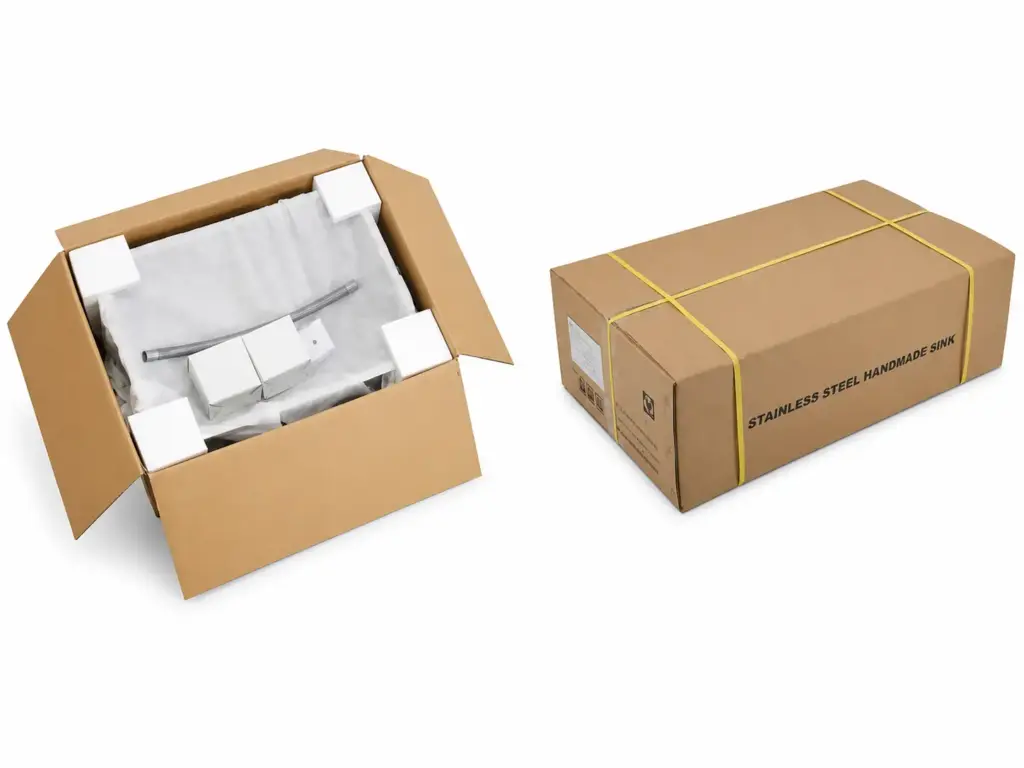
Perform an unpacking inspection after a representative shipping simulation.
Check for:
- Bowl scratches
- Finish rubbing
- Display damage
- Hose kinks
- Broken controls
- Missing fittings
- Mixed components
- Incorrect manuals
- Accessory movement
- Carton deformation
The carton should contain a visible part list so the distributor, installer and end user can identify missing components immediately.
Waterfall Sink Sample-Approval Table
| Control area | Approval requirement |
| Sink material | Defined grade and thickness |
| Bowl structure | Size, depth, drainage and flatness |
| Installation | Method, cutout and cabinet requirement |
| Waterfall outlet | Uniformity, landing position and removability |
| Main faucet | Reach, height, swivel and pull-down movement |
| Display | Power source, readability and replacement |
| Cup washer | Spray coverage, shutoff and connection |
| Filter faucet | Included function and inlet requirement |
| Control valve | Smooth switching and service access |
| Remote drain | Opening, closing and replacement access |
| Accessories | Fit, stability and simultaneous use |
| Finish | Master sample and cleaning expectations |
| Hoses and threads | Target-market compatibility |
| Leak test | Complete assembled system |
| Instructions | Component, plumbing and troubleshooting diagrams |
| Spare parts | SKU list and supply plan |
| Packaging | Separation, identification and movement control |
| Repeat orders | Approved sample and change control |
How Matrix Supports Sink-and-Faucet Programs

Matrix supplies kitchen sinks, faucets and matched accessories for brands, wholesalers, importers and project buyers.
For waterfall or multifunction sink directions, buyers can review the complete system, including:
- Sink size and bowl depth
- Faucet-hole layout
- Waterfall outlet position
- Spout reach
- Water landing point
- Pull-down hose clearance
- Display and control configuration
- Drain position
- Workstation ledges
- Accessory fit
- Finish matching
- Installation information
- Packaging
- Replacement-part planning
Buyers can explore Matrix smart digital display kitchen faucets, the complete kitchen sink, faucet and accessory product range and the Matrix installation guides.
For an OEM or private-label review, send the target market, sink dimensions, required functions, installation method, finish, accessory list, order quantity and packaging expectations through the Matrix custom kitchen sink program or contact the Matrix team.
Frequently Asked Questions
What is the main benefit of a waterfall kitchen sink?
The main benefit is a wider rinsing area combined with integrated food-preparation functions. Its value is greatest when the user regularly rinses produce and uses workstation accessories.
Does a waterfall sink need electricity?
Not always. Some digital displays use an internal hydroelectric turbine powered by water flow. Other models may use batteries or another power source. Check the exact product specification.
Does the digital display control water temperature?
Usually, a basic display only shows the measured temperature. It does not regulate temperature unless a separate thermostatic control system is included.
Do waterfall sinks need high water pressure?
They need a suitable combination of pressure and flow to create an even waterfall and operate other functions. The required range varies by model and should be confirmed before purchase.
Can a waterfall sink work with low water pressure?
It may function, but the waterfall can be weak or uneven, the cup washer may perform poorly and a flow-powered display may not activate reliably. Test the exact model under representative conditions.
Are waterfall kitchen sinks difficult to clean?
The bowl itself may be straightforward to clean, but outlets, spray holes, controls, ledges, cup washers and drain covers create additional cleaning points. Hard-water areas require more frequent descaling.
Can a garbage disposal be installed with a waterfall sink?
Possibly, if the drain opening, flange, bowl depth, cabinet space and wall-drain height are compatible. The additional hoses and controls below the sink must also clear the disposal body.
Are waterfall sinks available as undermount models?
Some are, while others are designed for top-mount or dual-mount installation. The wide rear deck and integrated components can affect mounting options. Follow the drawing for the exact model.
Are Nano waterfall sinks scratch-proof?
No. “Nano” does not make a working sink scratch-proof. The actual finish process, substrate, contact material, cleaning method and product use determine how marks appear.
What parts are most likely to need replacement?
Depending on the design, service parts may include the cartridge, spray head, pull-down hose, waterfall valve, display module, turbine, cup-washer valve, remote drain cable and seals.
Should a B2B buyer sell the sink and faucet as one SKU?
A complete SKU can simplify marketing, but the carton, instructions, spare parts and component compatibility must be controlled. If components are also sold separately, their exact model and finish compatibility should be documented.
Final Verdict
Waterfall kitchen sinks are worth considering when the wide rinse function, workstation accessories and integrated controls solve real daily needs.
They are not automatically better than a conventional stainless steel sink.
The right decision depends on five questions:
- Does the user need the functions?
- Will the system work with the available water pressure and cabinet space?
- Can it be installed and serviced locally?
- Are cleaning instructions and replacement parts available?
- Has the complete assembled system been tested?
For homeowners, buy a waterfall sink because its functions fit the way you cook—not because the product video looks impressive.
For brands, importers and wholesalers, do not treat it as a sink with extra accessories. Treat it as a complete water, drainage, control and after-sales system.
The bowl may last for years. The real product quality is determined by whether every connection, valve, hose, display and replacement part can last with it.