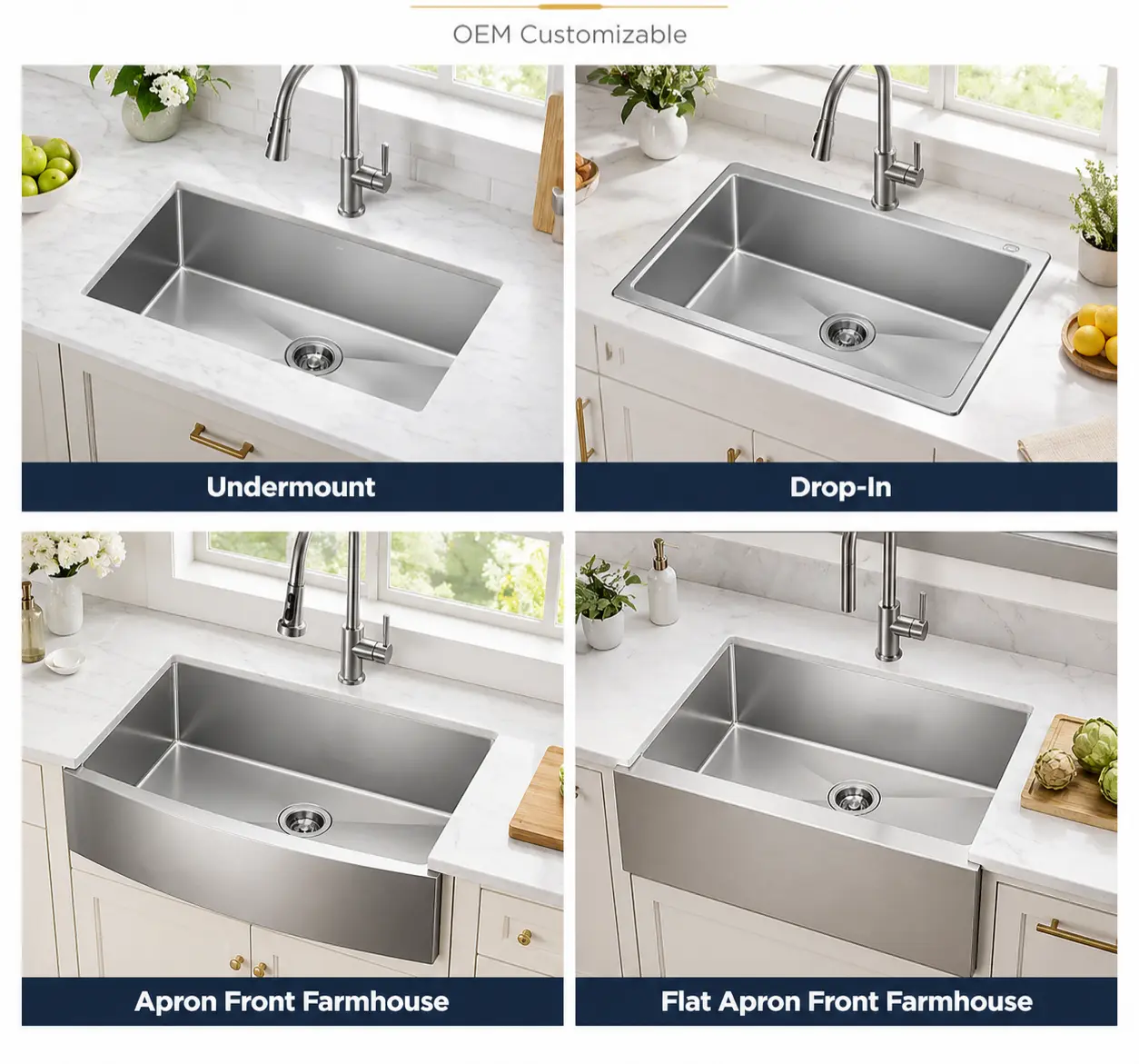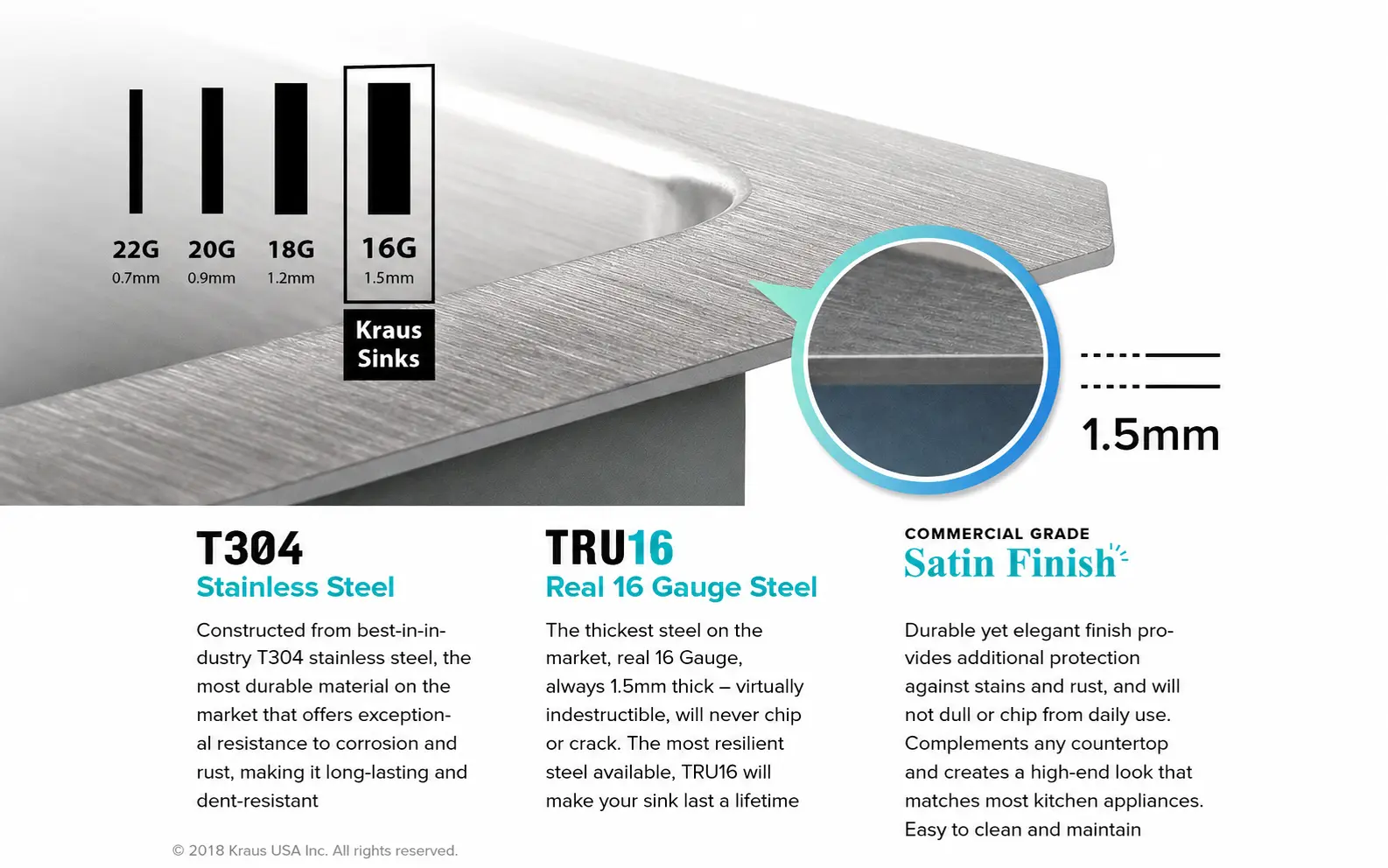
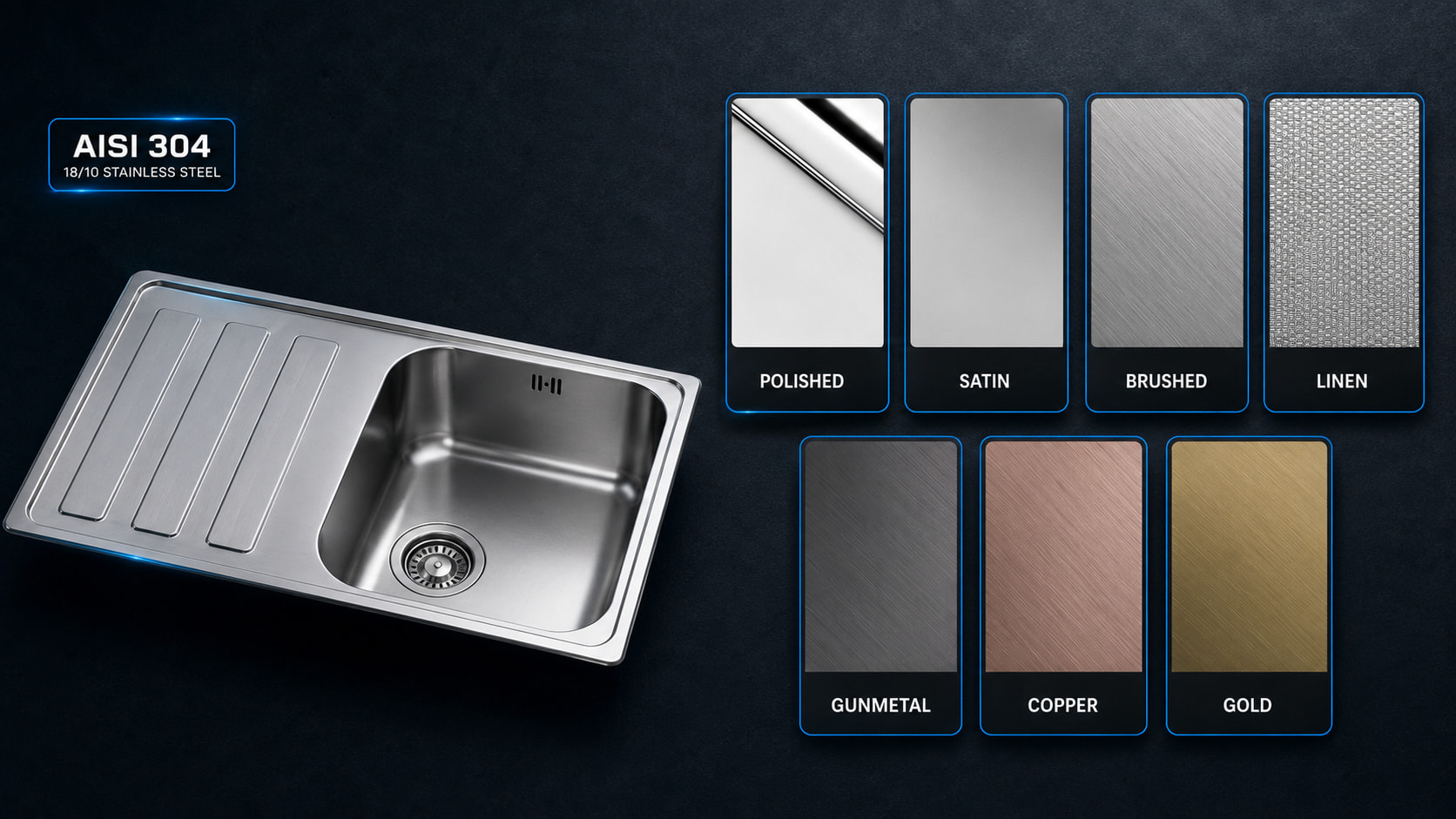
A stainless steel sink finish affects far more than its appearance. It changes how the sink reflects light, shows scratches, reveals water spots, responds to cleaning and looks after months of daily use.
The quick answer is:
- Brushed finish is usually the most practical choice for a frequently used kitchen.
- Satin finish provides a softer, more refined and lower-glare appearance.
- Polished finish creates the brightest and most decorative look but normally shows fingerprints, water marks and fine scratches more clearly.
The best sink finish is not necessarily the one that looks cleanest under showroom lighting. It is the one that still looks acceptable after repeated washing, drying, scratching and cleaning.
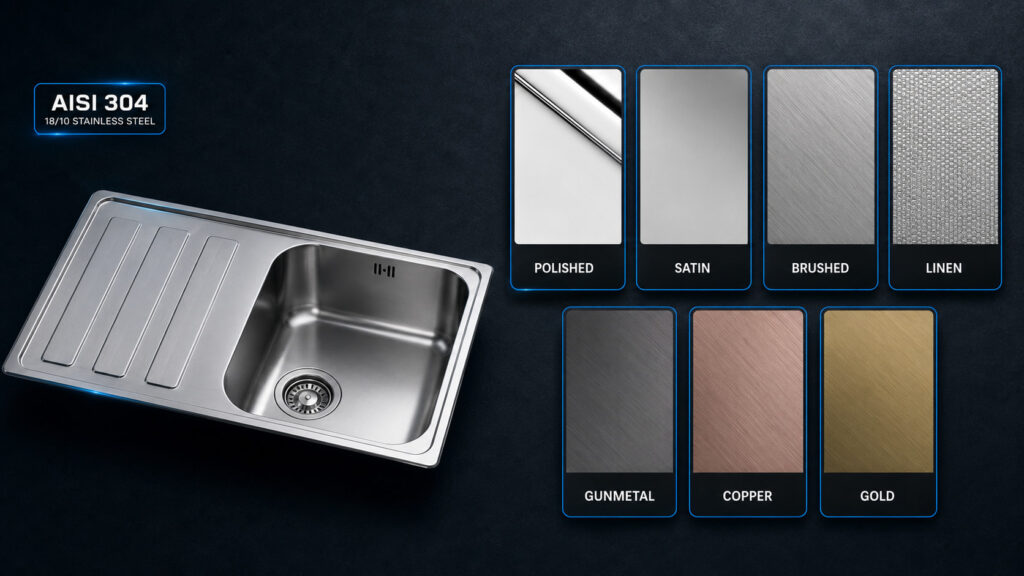
Brushed vs Satin vs Polished: Quick Comparison
| Feature | Brushed Finish | Satin Finish | Polished Finish |
|---|---|---|---|
| General appearance | Clearly directional and textured | Soft, smooth and low-glare | Bright and reflective |
| Grain visibility | Usually obvious | Usually finer and less obvious | Minimal or no visible grain |
| Reflection | Low to moderate | Soft and diffused | High |
| Fine scratch visibility | Usually lower | Moderate | Usually higher |
| Water spot visibility | Moderate | Low to moderate | High |
| Fingerprint visibility | Relatively low | Relatively low | High |
| Cleaning direction | Follow the grain | Follow any visible grain | Use soft, non-scratching motions |
| Local refinishing | Possible, but matching can be difficult | Requires careful blending | Difficult to restore without visible swirl or haze |
| Best application | High-use family kitchens and workstation sinks | Premium, minimalist and low-glare kitchens | Decorative, showroom or lower-use sinks |
| Main B2B risk | Inconsistent grain direction | Inconsistent interpretation of “satin” | Swirl marks, haze and visible handling marks |
First, Understand What a Sink Finish Is—and Is Not

A stainless steel finish describes the final condition of the visible metal surface. It does not automatically tell you the sink’s steel grade, thickness or manufacturing quality.
Finish should not be confused with:
- Stainless steel grade: such as 201, 304 or 316
- Material thickness: commonly expressed in gauge or millimeters
- Manufacturing method: such as handmade or pressed construction
- Surface coating: such as PVD color treatment
- Corrosion resistance: primarily affected by steel composition, environment, contamination and maintenance
A polished 201 stainless steel sink does not automatically have better corrosion resistance than a brushed 304 sink. In the same way, a brushed surface does not make thin steel stronger.
Finish, grade, thickness and construction must be evaluated separately.
For a broader product comparison, see the Matrix stainless steel kitchen sink range.
Why Brushed and Satin Are Often Confused
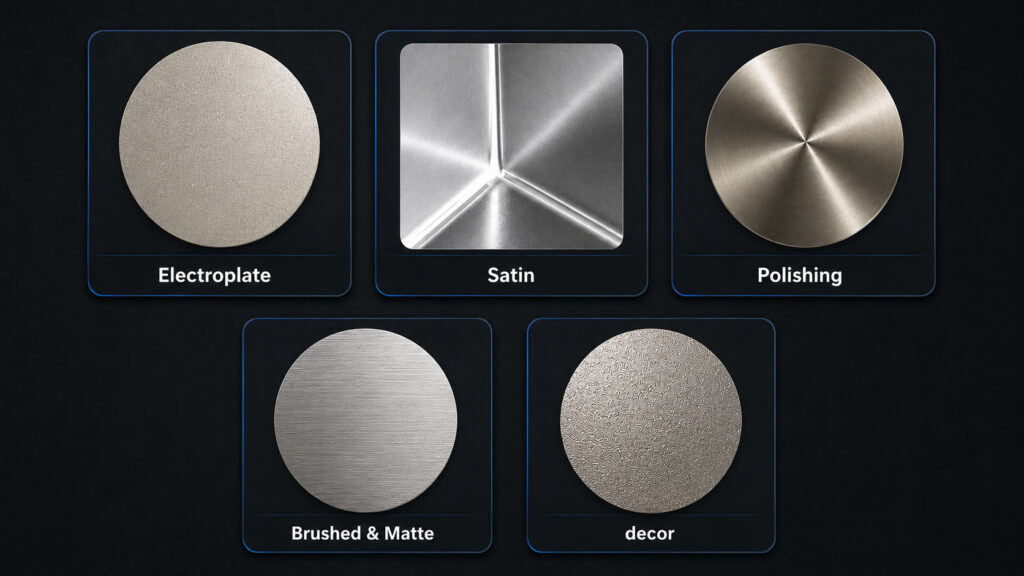
In technical surface-finish systems, brushed, satin-polished and bright-polished surfaces can be treated as different finish categories.
In the commercial sink market, however, the terminology is less controlled.
“Brushed” generally means that the surface has a visible directional grain produced by abrasive finishing.
“Satin” normally describes a finer, softer and more diffused finish. But some manufacturers use the following terms interchangeably:
- Satin
- Satin brushed
- Fine brushed
- Hairline
- Matte brushed
- Soft satin
- No. 4-style finish
These descriptions may indicate a general appearance, but they do not guarantee an identical result.
The actual surface can change according to:
- Abrasive type
- Abrasive grit sequence
- Belt speed and pressure
- Number of finishing passes
- Grain direction
- Base sheet condition
- Whether the sink is finished before or after forming
- Manual blending around welds and corners
- Final polishing or cleaning process
Therefore, a B2B buyer should never approve a sink finish from the finish name alone.
What Is a Brushed Stainless Steel Sink Finish?
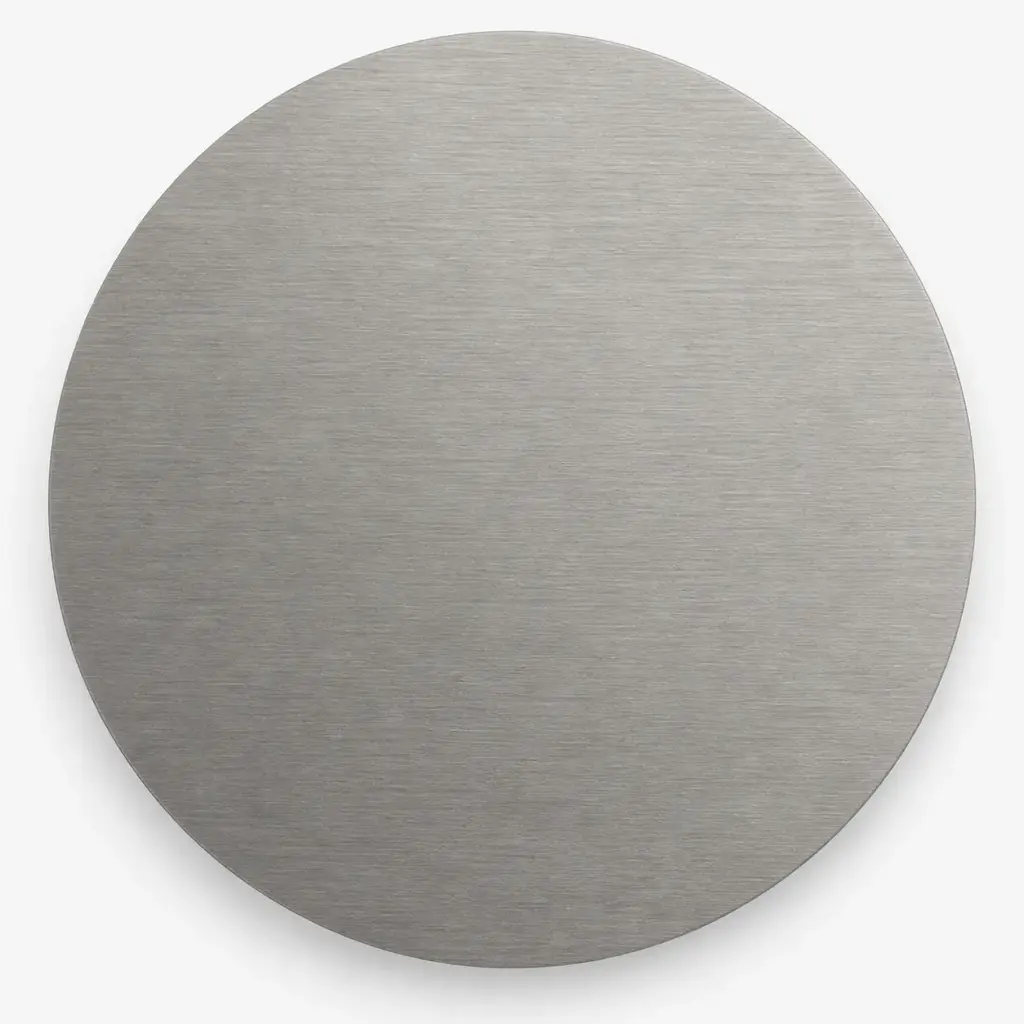
A brushed finish has fine, directional lines running across the stainless steel surface. These lines scatter light and reduce mirror-like reflection.
Brushed stainless steel is widely used for kitchen sinks because it balances appearance, maintenance and manufacturing practicality.
Advantages of a Brushed Sink
It hides normal wear relatively well.
Brushed stainless steel is not more scratch-proof than polished stainless steel. Instead, its directional pattern makes many fine scratches less visually obvious.
When scratches run in a similar direction to the original grain, they can blend into the surface. Cross-grain scratches may still be clearly visible.
It works well in high-use kitchens.
Family kitchens, rental properties, workstation sinks and food-preparation areas all experience regular contact with cookware, cutlery and sink accessories. A brushed finish usually ages more naturally in these environments.
It reduces glare.
The directional texture diffuses reflected light. This is useful in bright kitchens with strong ceiling lights, large windows or glossy countertops.
Minor refinishing may be possible.
A trained technician may be able to regrain a localized area. However, the new grain must match the original direction, line density and reflectivity. Otherwise, the repaired area can look brighter or rougher than the surrounding surface.
Disadvantages of a Brushed Sink
- Dirt and residue can collect more easily on an excessively coarse surface.
- Cross-grain scratches remain visible.
- Incorrect cleaning can create uneven shiny areas.
- Grain direction may look inconsistent around welded corners.
- A poorly finished sink may contain heavy belt lines or patchy reflection.
The objective is not to create the deepest possible grain. A good brushed finish should be uniform, controlled and suitable for regular cleaning.
What Is a Satin Stainless Steel Sink Finish?

A satin finish normally has a smoother, softer and more diffused appearance than a conventional brushed finish. Its grain may still be directional, but the lines are often finer and less visually dominant.
Satin is frequently chosen for premium or minimalist kitchens because it appears calm rather than industrial.
Advantages of a Satin Sink
It provides a soft, low-glare appearance.
Satin stainless steel does not reflect surrounding objects as sharply as polished steel. It works well with matte countertops, neutral cabinetry and understated kitchen designs.
It can make minor marks less distracting.
The diffused surface can reduce the contrast of light fingerprints, drying marks and very fine wear. Results depend on the exact satin treatment.
It feels more refined than a coarse brush.
A controlled satin finish can create a smoother visual transition across the sink bowl, rim and apron.
Disadvantages of a Satin Sink
The greatest problem is not performance. It is inconsistent terminology.
A supplier may describe a fine brushed sink as satin, while another may use satin for a much smoother, almost semi-polished surface. Buyers ordering by name may receive a finish that is darker, brighter, coarser or more reflective than expected.
Satin surfaces can also be difficult to repair locally. If an abrasive pad creates a visibly different grain, the repaired area may stand out under side lighting.
When Satin Is the Better Choice
Satin is particularly suitable when the buyer wants:
- A refined but non-reflective appearance
- Less obvious directional texture
- Lower glare in a bright kitchen
- A premium minimalist product position
- Visual compatibility with matte appliances or countertops
A physical approval sample is essential before placing repeat or high-volume orders.
What Is a Polished Stainless Steel Sink Finish?
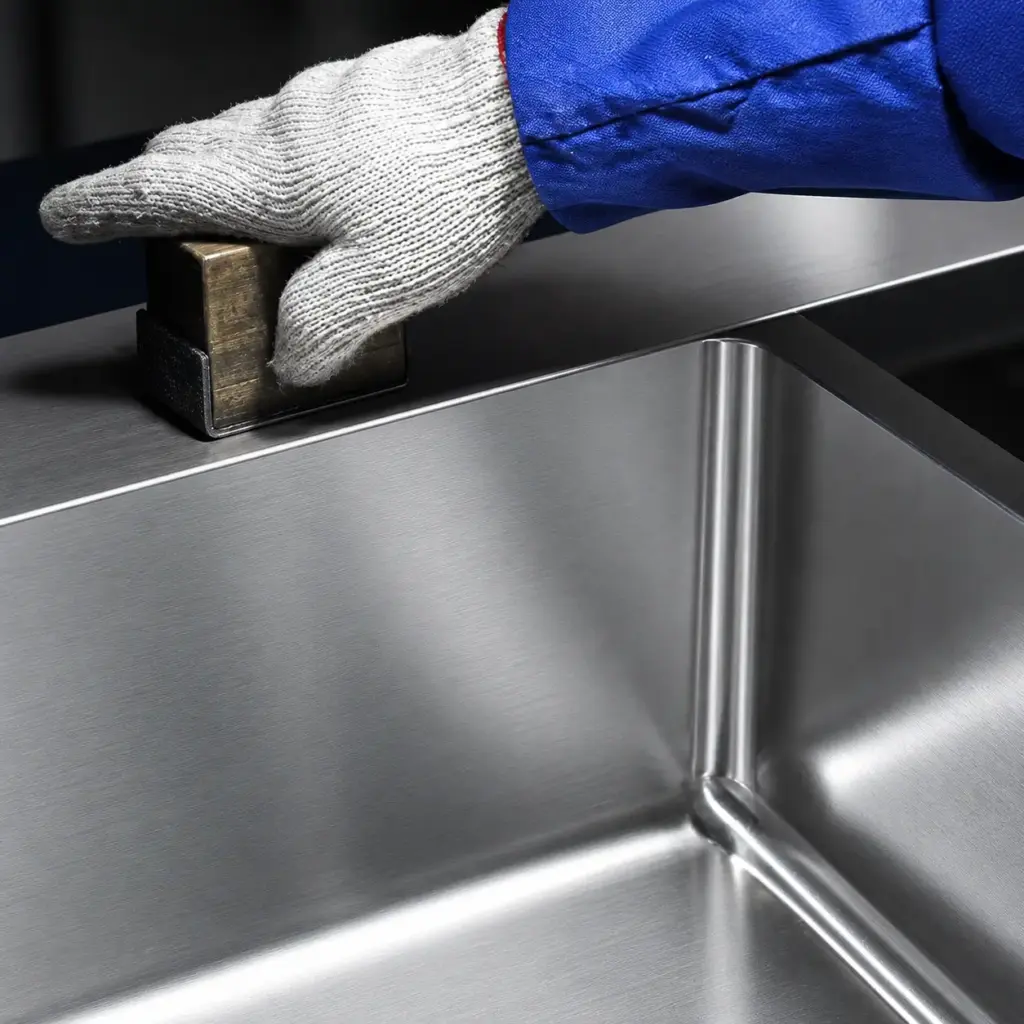
A polished sink has a smoother and more reflective surface. Depending on the polishing level, it may range from semi-bright to nearly mirror-like.
Polished stainless steel can look striking when new, especially in decorative kitchens, showrooms, bar areas and secondary preparation zones.
Advantages of a Polished Sink
It produces a bright, decorative appearance.
Polished stainless steel reflects more light and can make a compact space feel brighter.
A smooth surface may be easy to wipe.
Because the surface texture is less pronounced, residue has fewer deep finishing lines in which to remain. That does not mean the sink will always look clean: water spots and fingerprints can still be highly visible.
It suits design-led applications.
Polished sinks can complement glossy appliances, reflective fittings and decorative interiors.
Disadvantages of a Polished Sink
Fine scratches are easier to see.
A scratch interrupts the uniform reflection of the polished surface. Even a shallow mark can become obvious under strong or angled light.
Water spots and fingerprints have greater visual contrast.
The sink may require more frequent drying to preserve its intended appearance.
Local repair is difficult.
Polishing one small area can create swirl marks, haze or a different reflection level. Restoring the original appearance may require refinishing a much larger area.
Manufacturing and handling marks are more visible.
Packaging friction, polishing swirls, cloth marks and uneven buffing may all become noticeable on a highly reflective surface.
For a main kitchen sink exposed to heavy cookware, a polished finish is usually an aesthetic choice rather than the most forgiving practical choice.
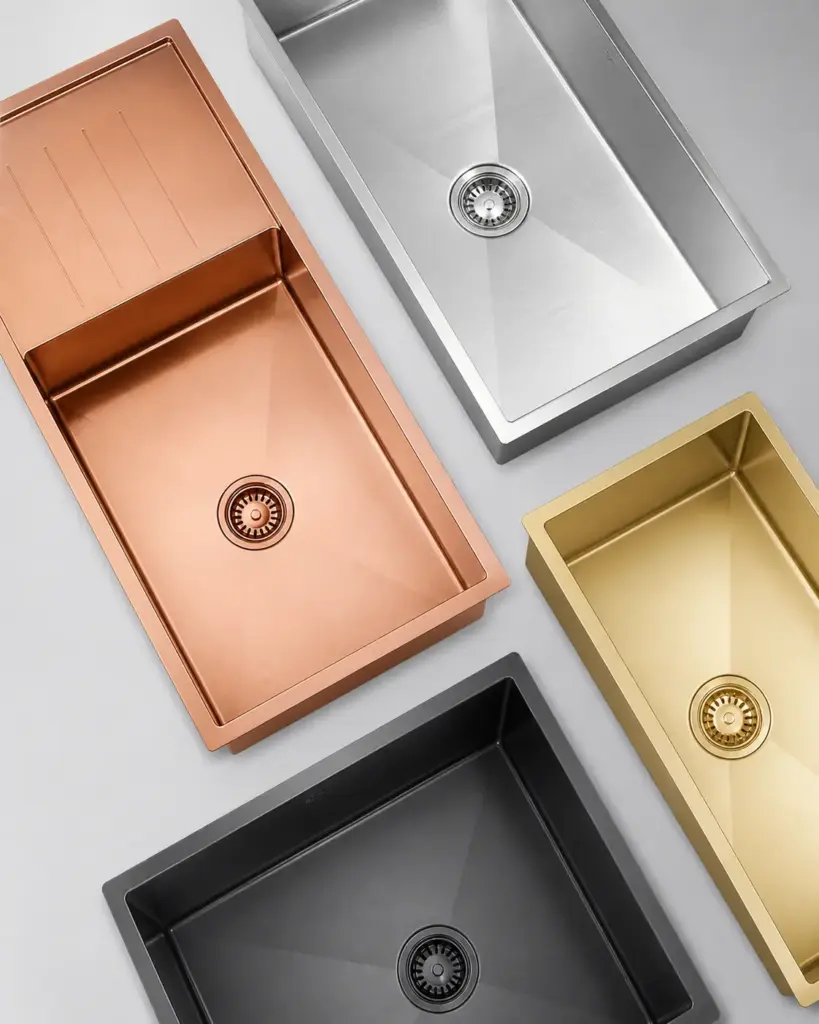
Which Finish Looks Best After One Year?
This is a more useful question than asking which finish looks best when new.
A new polished sink can look cleaner and more dramatic in a showroom. After months of washing pans, moving bottom grids and rinsing mineral-rich water, its appearance may require more maintenance.
A brushed sink may look less dramatic on the first day, but normal wear often integrates more naturally with the original grain.
A satin sink can provide a middle ground, provided the finish is fine, uniform and correctly maintained.
In typical daily use:
- Brushed finishes tend to disguise normal wear most effectively.
- Satin finishes maintain a calm appearance but can show uneven refinishing.
- Polished finishes preserve their intended appearance only with more careful use and drying.
No stainless steel sink remains permanently scratch-free. The practical objective is to choose a finish that makes expected wear visually acceptable.
Does a Brushed Finish Resist Scratches Better?
Not necessarily.
Surface finish changes the visibility of scratches more than the physical scratch resistance of the steel.
Scratch behavior also depends on:
- Steel hardness and manufacturing condition
- Contact material
- Weight and sharpness of the object
- Direction of movement
- Presence of abrasive particles
- Use of sink grids or accessories
- Cleaning tools and chemicals
A brushed sink can still be scratched by knives, cast-iron cookware, ceramic bases, metal fragments or abrasive cleaning pads.
The difference is that fine scratches running with the grain are often less noticeable on a brushed surface. The same scratch on a polished surface may strongly disrupt the reflection.
Are Smoother Finishes More Hygienic?
A smoother surface generally gives residue fewer irregularities in which to collect and may be easier to rinse. But finish alone does not determine whether a kitchen sink is hygienic.
Daily hygiene also depends on:
- Bowl drainage
- Corner design
- Residual food and grease
- Cleaning frequency
- Drain and strainer condition
- Water hardness
- Cleaning product compatibility
- Drying and ventilation
An extremely coarse brushed surface may retain more visible residue than a fine satin surface. Conversely, a polished sink can appear dirty quickly because dried water minerals are easy to see.
For most residential sinks, a uniform, properly finished surface combined with correct cleaning is more important than choosing the brightest possible polish.
The Four-Surface Test: How to Compare Sink Finish Samples
Online photographs are not sufficient for approving a stainless steel finish. Camera exposure, image editing, viewing angle and lighting can change the apparent brightness and grain.
Use this four-stage test instead.
1. View the Sample Dry
Inspect the sink in normal room lighting. Check whether the surface is brighter, darker, coarser or more reflective than expected.
2. Inspect It Under Side Lighting
Move a light source across the surface at a low angle. Side lighting reveals:
- Cross-grain scratches
- Belt lines
- Polishing haze
- Swirl marks
- Uneven reflection
- Weld-blending differences
- Local over-polishing
A finish that looks uniform from directly above may appear patchy under angled light.
3. Wet and Dry the Surface
Water changes the apparent depth and reflection of stainless steel. Wet part of the sample, wipe it with a soft cloth and allow it to dry naturally.
Observe how clearly it shows:
- Water spots
- Wipe marks
- Drying lines
- Residual haze
This is particularly important for markets with hard water.
4. Touch and Clean the Surface
Touch the sample with clean fingers and wipe it using the intended cleaning method. Compare fingerprint visibility and confirm whether cleaning changes the grain or sheen.
For commercial approval, test all samples under the same lighting, orientation and cleaning conditions.
How Finish Changes on Handmade and Pressed Sinks
The manufacturing process can affect how the same finish appears.
Handmade Stainless Steel Sinks
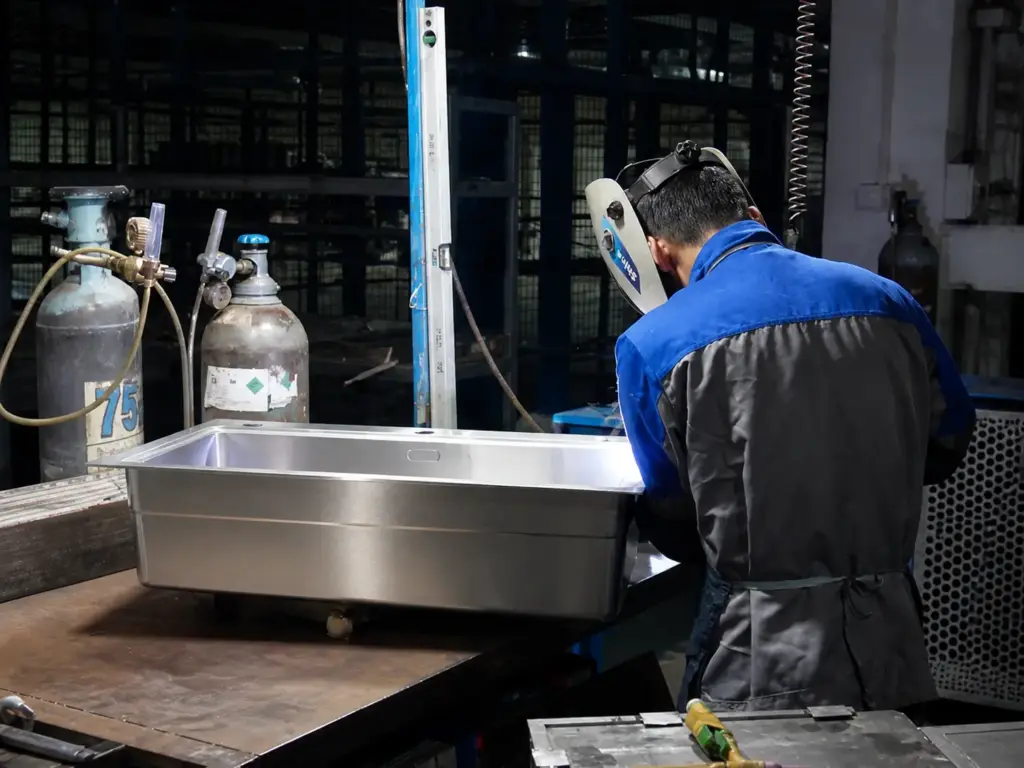
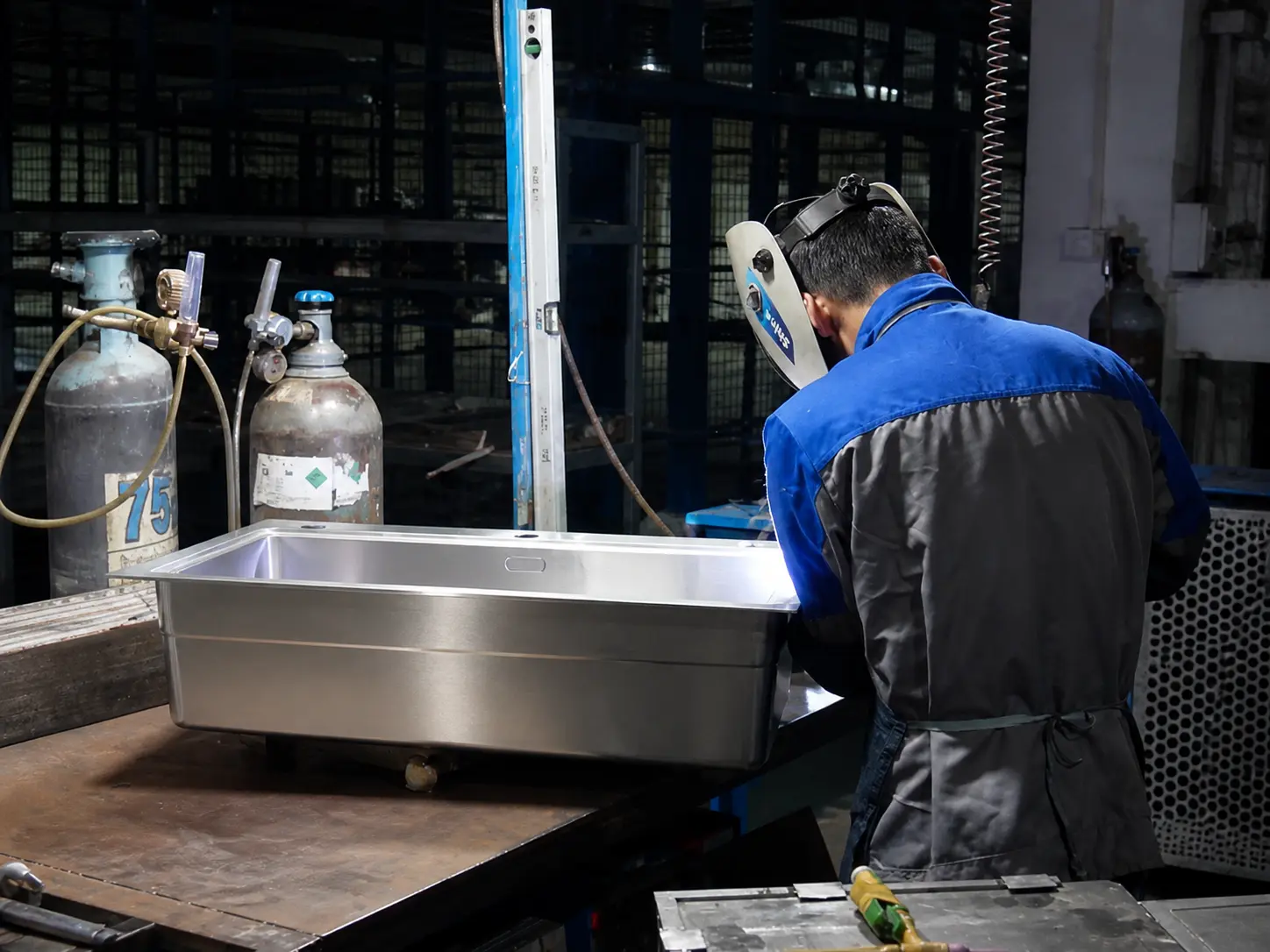
A handmade kitchen sink is assembled from cut, bent and welded stainless steel components.
Finish control should include:
- Consistent grain direction across panels
- Smooth transition around welded corners
- Uniform appearance on the bottom and sidewalls
- Controlled blending around the drain opening
- Consistent finish on the rim and apron
- No excessively bright areas caused by over-grinding
Handmade sinks can show finish differences where welded sections have been ground and blended. Good workmanship minimizes these transitions without making the surface unnaturally coarse.
Pressed Stainless Steel Sinks
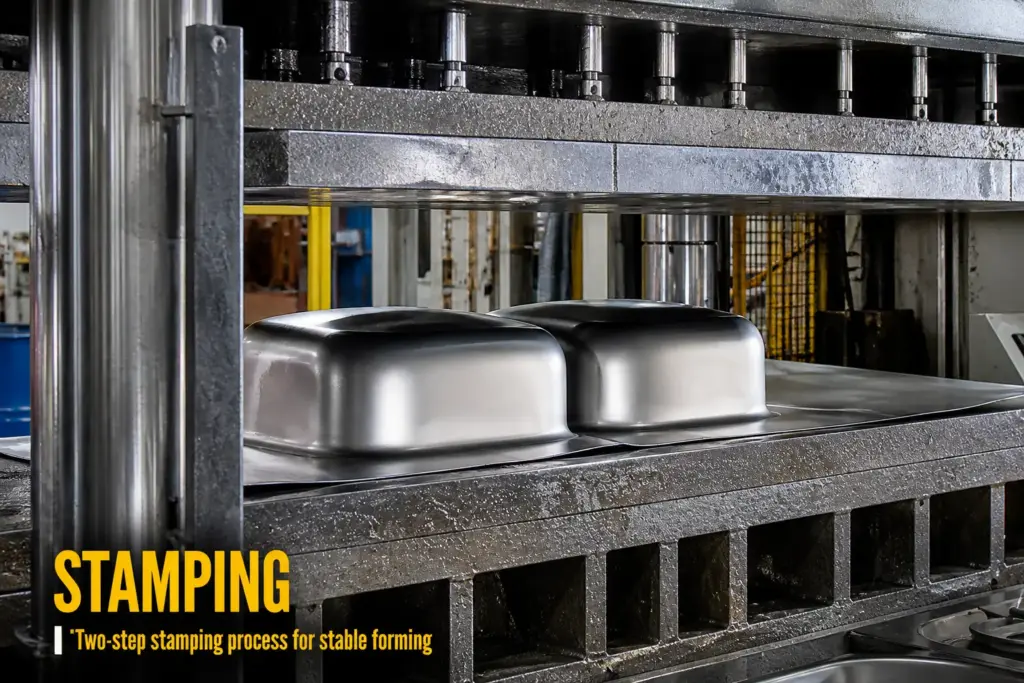
A pressed kitchen sink is formed from stainless steel sheet through drawing or pressing.
During forming, the material stretches differently across the bottom, corners and sidewalls. This can change the way the surface reflects light.
Quality control should therefore evaluate the finish after forming—not only the original flat sheet.
Inspect for:
- Uneven reflection between the bowl bottom and walls
- Forming or tooling marks
- Over-polished corners
- Finish variation around curves
- Surface lines caused by drawing
- Inconsistent appearance between production batches
A finish that works well on flat stainless steel may not look identical after deep drawing.
How Finish Affects PVD and Colored Stainless Steel Sinks
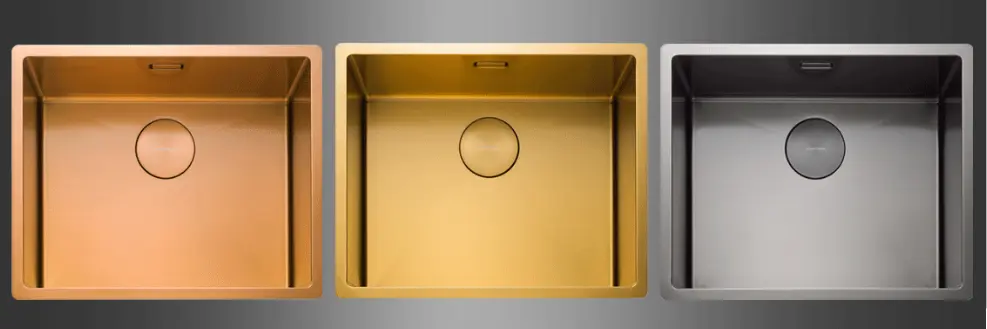
A PVD color is applied over a prepared stainless steel substrate. The condition of that underlying surface affects how the final color appears.
The same PVD color can look different on:
- Brushed stainless steel
- Fine satin stainless steel
- Polished stainless steel
- Embossed or textured stainless steel
A brushed substrate creates a directional color effect. A satin substrate produces a softer appearance. A polished substrate makes the color brighter and more reflective.
This means the base finish must be included in the color specification. Approving only a color name—such as gunmetal, gold or black—is not enough.
For example, two sinks described as “gunmetal PVD” may appear noticeably different if one has a coarse brushed substrate and the other has a fine satin substrate.
Buyers evaluating colored products can review the Matrix PVD colored stainless steel sink range and the guide to black PVD sink durability and scratch resistance.
Which Finish Should You Choose?
Choose Brushed If:
- The sink will be used heavily every day.
- The household frequently washes large cookware.
- The product is a workstation or utility-style sink.
- Easy visual maintenance is more important than high reflection.
- The sink is intended for broad retail or project use.
- You want normal fine wear to blend into the surface.
Brushed is generally the safest all-purpose finish for a main kitchen sink.
Choose Satin If:
- You prefer a softer, more refined appearance.
- The kitchen uses matte or low-glare materials.
- A coarse directional grain would look too industrial.
- The product targets a premium minimalist market.
- You can approve a physical sample before production.
Satin can be an excellent choice, but only after confirming what the supplier means by “satin.”
Choose Polished If:
- Reflection is an intentional design feature.
- The sink is used mainly for display, beverages or light preparation.
- The owner accepts more frequent drying and cleaning.
- The sink will not be exposed regularly to heavy cookware.
- The project requires a bright decorative surface.
Polished finishes can be visually impressive, but they are less forgiving in high-use environments.
Finish Recommendations by Application
| Application | Recommended Starting Point | Reason |
| Main family kitchen | Brushed | Hides everyday wear more effectively |
| Workstation sink | Brushed | Better visual tolerance around accessories |
| Rental or multi-family project | Brushed | Practical maintenance and broad acceptance |
| Premium minimalist kitchen | Fine satin | Soft, controlled and low-glare |
| Showroom display | Satin or polished | Stronger visual presentation |
| Bar or secondary sink | Satin or polished | Usually lighter use |
| Commercial-style home kitchen | Brushed | Matches functional design language |
| Colored PVD sink | Approved substrate sample | Base finish changes the apparent color |
| Private-label retail program | Brushed or satin | Easier positioning for mainstream buyers |
| Decorative limited collection | Polished or specialty satin | Stronger differentiation, with higher QC demands |
Common Finish Myths
Myth 1: Brushed Stainless Steel Does Not Scratch
It does scratch. The grain simply makes some scratches less noticeable.
Myth 2: Satin Is Always Smoother Than Brushed
It often is, but the commercial terms overlap. The physical sample is more reliable than the name.
Myth 3: Polished Stainless Steel Is Higher Quality
Polished describes appearance, not overall sink quality. Steel grade, material thickness, forming, welding, drainage and dimensional control must still be evaluated.
Myth 4: A Rougher Grain Hides Every Defect
An excessively coarse grain can look inconsistent, retain residue and make local refinishing more difficult.
Myth 5: Finish Determines Corrosion Resistance
Finish condition can affect cleanability and contaminant retention, but corrosion resistance depends primarily on steel grade, environmental exposure, surface contamination and maintenance.
Myth 6: All PVD Sinks with the Same Color Name Look the Same
The substrate finish, lighting, coating process and batch conditions can all change the perceived color.
How B2B Buyers Should Specify a Sink Finish
Writing only “304 stainless steel sink, satin finish” leaves too much room for interpretation.
A more complete finish specification should include:
- Stainless steel grade
- Nominal material thickness
- Handmade or pressed construction
- Finish description
- Approved physical reference sample
- Grain direction for each visible surface
- Target reflectivity or gloss range, if required
- Surface roughness reference, if technically necessary
- Acceptable visual variation
- Weld and corner blending requirements
- Treatment of the rim, apron and drain area
- Protective film requirements
- Packaging contact restrictions
- Inspection lighting and viewing conditions
- Repeat-order sample control
Example of an Incomplete Specification
304 stainless steel sink with satin finish.
This identifies the grade and a general finish category, but it does not define the actual appearance.
Example of a Better Commercial Specification
304 stainless steel sink with a fine directional satin finish matching the buyer-approved physical sample. Grain direction must remain consistent across visible bowl surfaces. Welds, corners, rim and drain area must be blended without obvious bright patches, cross-scratches or polishing haze. Production batches must remain within the approved visual range when inspected under consistent diffuse and angled lighting.
If numerical roughness or gloss limits are needed, they should be agreed with the manufacturer together with the measurement method. A number without a defined method or reference sample may still produce disputes.
Stainless Steel Sink Finish QC Checklist
Before shipment, inspect the sink after removing any removable surface residue but before discarding its protective packaging.
Overall Appearance
- Does the production sink match the approved sample?
- Is the brightness consistent across the bowl?
- Is the finish uniform under both diffuse and angled light?
- Are there unexplained dark or bright areas?
Grain Control
- Does the grain run in the approved direction?
- Are there cross-grain scratches?
- Do adjacent panels have conflicting grain directions?
- Are the grain lines excessively coarse or uneven?
Corners and Welds
- Have welded areas been blended consistently?
- Are the corners noticeably brighter than the sidewalls?
- Are grinding lines visible around the welds?
- Is the transition between surfaces visually acceptable?
Rim, Apron and Drain Area
- Does the rim match the bowl finish?
- Is the apron uniform from left to right?
- Are there circular polishing marks around the drain?
- Has edge finishing created shiny strips?
Polished Surfaces
- Are there swirl marks or haze?
- Is the reflection distorted by uneven polishing?
- Are cloth marks or packaging abrasions visible?
- Does the gloss vary across the sink?
Packaging Protection
- Does the protective film cover the required visible surfaces?
- Can accessories move and rub against the bowl during transport?
- Are metal components isolated from the sink surface?
- Does the packaging leave adhesive residue or pressure marks?
Do not approve the finish using compressed phone photographs alone. A photograph can conceal grain, reflection and subtle batch variation.
A Practical Buyer Decision Checklist
Before choosing a finish, ask:
- Will this be the main kitchen sink or a secondary sink?
- How frequently will heavy cookware contact the bowl?
- Is the user willing to dry the sink after use?
- Does the kitchen have strong direct or angled lighting?
- Is low glare more important than brightness?
- Should scratches blend into the surface or remain visually obvious?
- Will the sink use bottom grids or sliding workstation accessories?
- Is the finish suitable for the expected retail price and customer profile?
- Can future repeat orders match the original appearance?
- Has a physical sample been approved?
For homeowners, the most practical choice is usually brushed stainless steel. For architects and designers, satin may offer a more controlled visual result. For importers and private-label buyers, repeatability is often more important than the finish name itself.
How Matrix Supports Finish Selection
Matrix supplies stainless steel kitchen sinks for distributors, wholesalers, kitchen brands, project buyers and private-label programs.
Depending on the product structure and market position, buyers can evaluate:
- Brushed and satin surface directions
- Handmade and pressed sink construction
- Visible finish transitions
- PVD substrate options
- Rim and apron appearance
- Accessory contact areas
- Protective packaging requirements
- Sample-based production standards
For custom collections, finish selection should begin with the intended customer, kitchen environment and maintenance expectation—not with a finish name alone.
Buyers developing their own sizes, bowl configurations, accessories or surface requirements can review the Matrix custom kitchen sink program or contact the Matrix team to discuss product positioning and sample requirements.
Frequently Asked Questions
Is brushed or satin better for a kitchen sink?
Brushed is generally better for a heavily used kitchen because its directional grain hides normal fine wear more effectively. Satin is suitable when a softer, lower-glare and more refined appearance is preferred. Because suppliers may use the two terms differently, compare physical samples before deciding.
Is polished stainless steel harder to maintain?
Polished stainless steel is smooth, but it usually shows water spots, fingerprints, wipe marks and fine scratches more clearly. It may need more frequent drying to maintain its reflective appearance.
Does a brushed sink scratch less than a polished sink?
Not necessarily. A brushed surface mainly makes certain scratches less visible. It does not make the stainless steel scratch-proof.
Can scratches be removed from a brushed stainless steel sink?
Some light scratches can be blended by refinishing in the direction of the grain. However, local refinishing may create a different texture or brightness. Deep scratches may not be removable without changing the surrounding finish.
Can a polished sink be refinished?
It can be refinished, but restoring a uniform reflective surface is difficult. Local polishing may leave swirl marks, haze or a visibly different reflection level.
Is satin the same as matte stainless steel?
Not always. Satin normally refers to a smooth, diffused finish, while matte is a broader visual description. Supplier terminology varies, so the actual sample should determine the specification.
Which finish hides water spots best?
Fine brushed and satin finishes usually make water spots less obvious than highly polished surfaces. Water hardness, cleaning habits and lighting also affect visibility.
Which finish is best for a workstation sink?
A brushed finish is normally the most practical. Workstation accessories can leave contact marks, and directional brushing helps reduce their visual contrast. Correctly fitted accessories and protective feet are still important.
Which finish is best for a PVD sink?
There is no single best substrate finish. Brushed PVD appears directional and practical, satin PVD appears softer, and polished PVD appears brighter. The substrate and color should be approved as one combined finish.
How should a commercial buyer approve a sink finish?
Use a labeled physical sample, define the grain direction and visible surfaces, agree on acceptable variation, and inspect production under consistent lighting. The approved sample should remain available for repeat-order comparison.
Final Verdict
For most working kitchens, brushed stainless steel is the most practical and forgiving choice. It reduces glare and allows normal fine wear to blend more naturally into the surface.
Satin stainless steel is the refined alternative. It offers a softer, quieter appearance, but buyers must confirm the actual finish because the term “satin” is not used consistently.
Polished stainless steel is the decorative option. It delivers the strongest reflection but also reveals fingerprints, water spots, handling marks and fine scratches more clearly.
For an individual homeowner, the decision should be based on use and maintenance expectations. For a B2B buyer, the finish name is only the beginning. The real specification is the combination of an approved sample, grain direction, reflectivity, surface consistency, manufacturing method and repeat-order control.