Not every dimension on a kitchen sink drawing carries the same quality risk.
For buyers, product managers and QC teams, the important step is to identify which dimensions can cause the sink to fail installation, plumbing, accessory fit or customer use if they move outside the approved range.
Quick Answer: Which Kitchen Sink Dimensions Are Critical for QC?
The most critical kitchen sink dimensions are usually the ones connected to another component or installation condition.
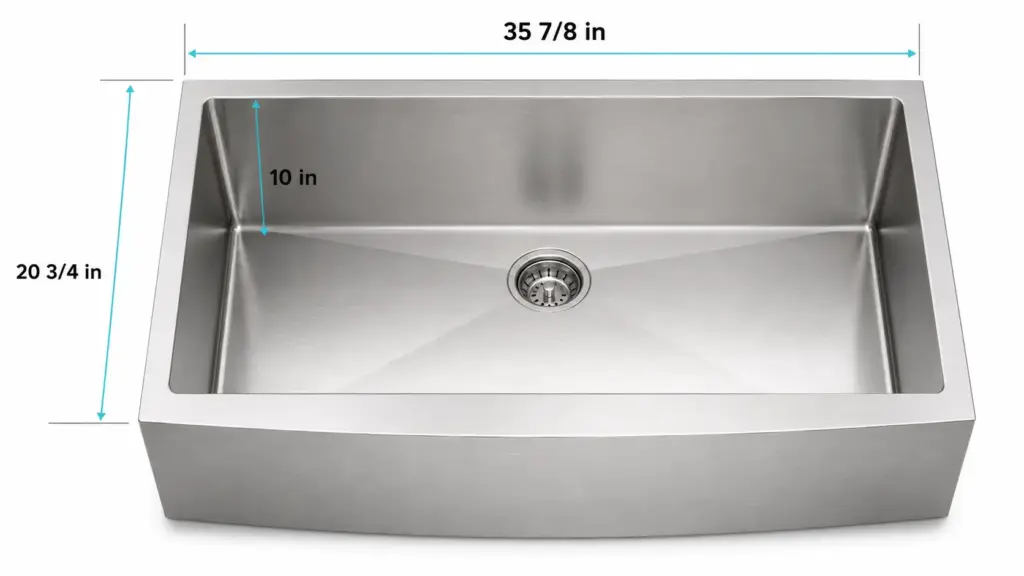
Typical CTQ dimensions include:
- overall sink length and width
- countertop interface / flange dimensions
- rim flatness
- bowl opening dimensions
- bowl depth
- drain-hole size and position
- faucet-hole size and position
- workstation ledge width and height
- apron-front dimensions
- divider position on double bowls
- dimensions that control accessory fit
But not every sink needs the same CTQ list.
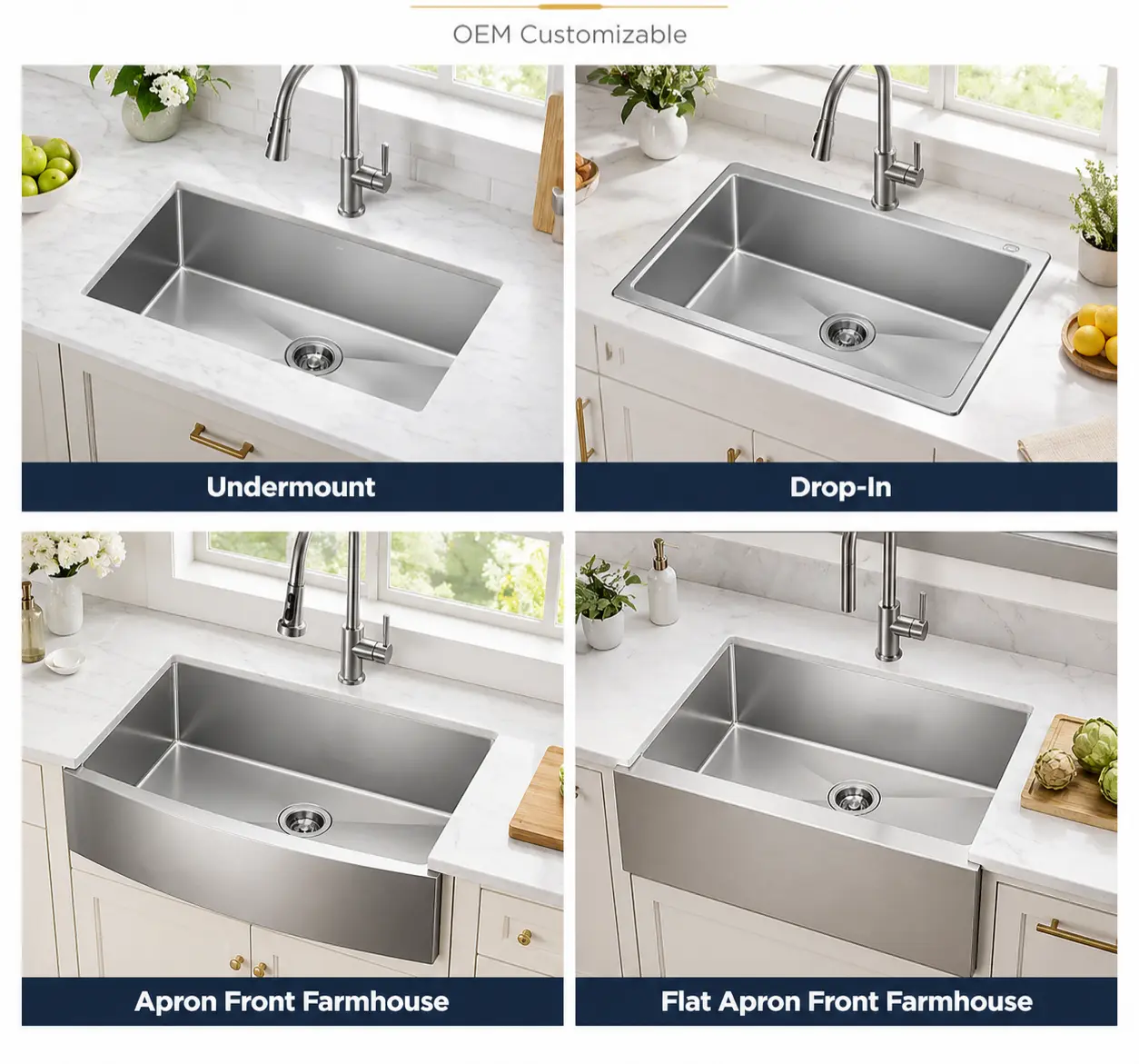
An undermount replacement sink may make flange geometry critical.
A workstation sink may make ledge dimensions critical.
A pressed sink may require more attention to formed geometry and repeatability.
A dimension becomes Critical-to-Quality when an out-of-spec result changes fit, installation, function or an important customer-visible interface.
What Does CTQ Mean for a Kitchen Sink?
CTQ means Critical-to-Quality.
It does not mean:
every dimension on the drawing must be treated as equally critical.
A useful CTQ system asks:
If this dimension changes, what happens?
If the answer is:
- the sink no longer fits the countertop
- the drain no longer aligns
- the cutting board falls through the ledge
- the rim does not sit correctly
- the faucet cannot be installed
- the replacement sink no longer fits the existing opening
then that dimension deserves tighter control and clearer inspection.
1. Overall Length and Width
Overall dimensions are obvious inspection points, but their importance depends on the installation.
For example:
Top-Mount Sink
Overall size affects:
- countertop coverage
- cutout relationship
- cabinet fit
- visual alignment
Undermount Sink
Overall dimensions interact with:
- countertop opening
- flange width
- mounting area
- cabinet clearance
For standard wholesale products, overall size helps maintain SKU consistency.
For project or replacement sinks, it can become installation-critical.
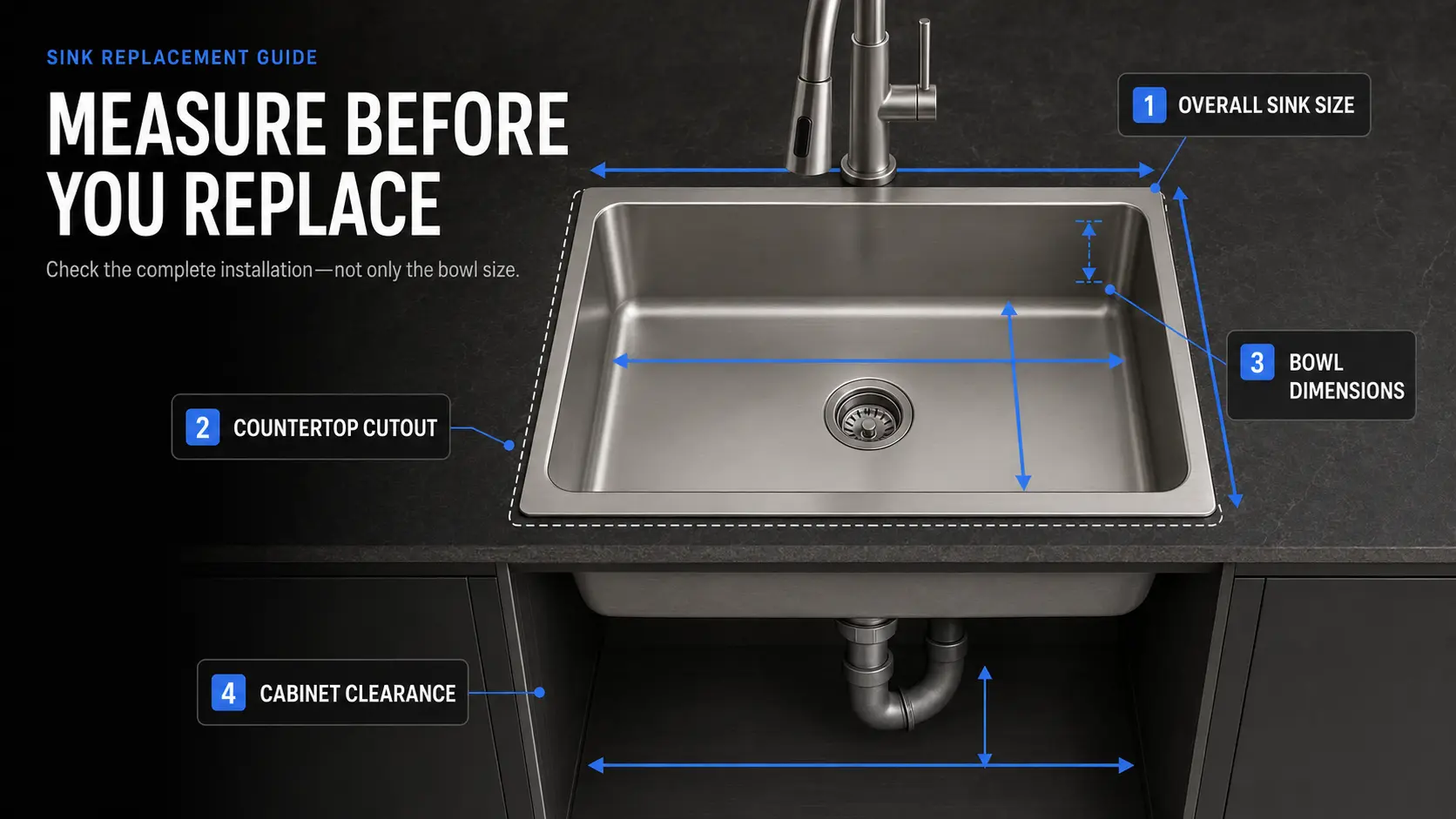
2. Countertop Interface Is Often More Important Than Nominal Sink Size
A buyer may describe a product as:
30-inch undermount sink
but installation does not happen according to the nominal marketing size.
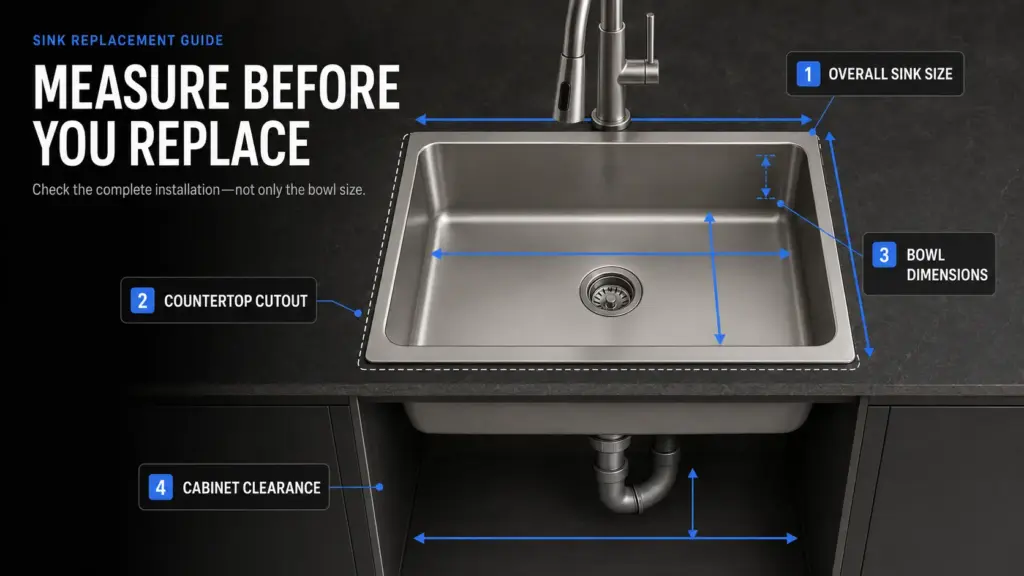
The actual installation depends on dimensions such as:
- bowl opening
- outer flange
- countertop cutout
- reveal
- mounting edge
This is especially important for custom and replacement projects.
A sink can have the correct nominal width and still fail installation if the flange does not match the available countertop area.
Matrix’s Kitchen Sink Installation Guides show why countertop opening, rim width and mounting method should be reviewed together rather than separately.
3. Rim Flatness Is a CTQ Even Though It Is Not a Simple Length Dimension
This is easy to miss.
A sink can pass:
overall length
overall width
bowl depth
and still create an installation claim because the rim is distorted.
Rim flatness affects:
- countertop contact
- top-mount appearance
- undermount alignment
- sealing
- installation pressure
This is particularly important for:
- handmade sinks
- large workstation sinks
- wide top-mount rims
- products with welding or heavy polishing around the upper structure
So QC should not treat dimensional inspection as only a caliper exercise.
4. Bowl Dimensions Matter When They Control Usable Space or Fit
Bowl length and width affect:
- usable capacity
- cabinet clearance
- accessory design
- product positioning
They become especially important when another component depends on them.
Examples:
- bottom grid
- colander
- sink rack
- divider
- replacement countertop opening
For a basic sink, a small bowl variation may not create the same risk as a flange variation.
For a workstation sink, it may affect several accessories at once.
5. Bowl Depth Is More Than a Product Feature
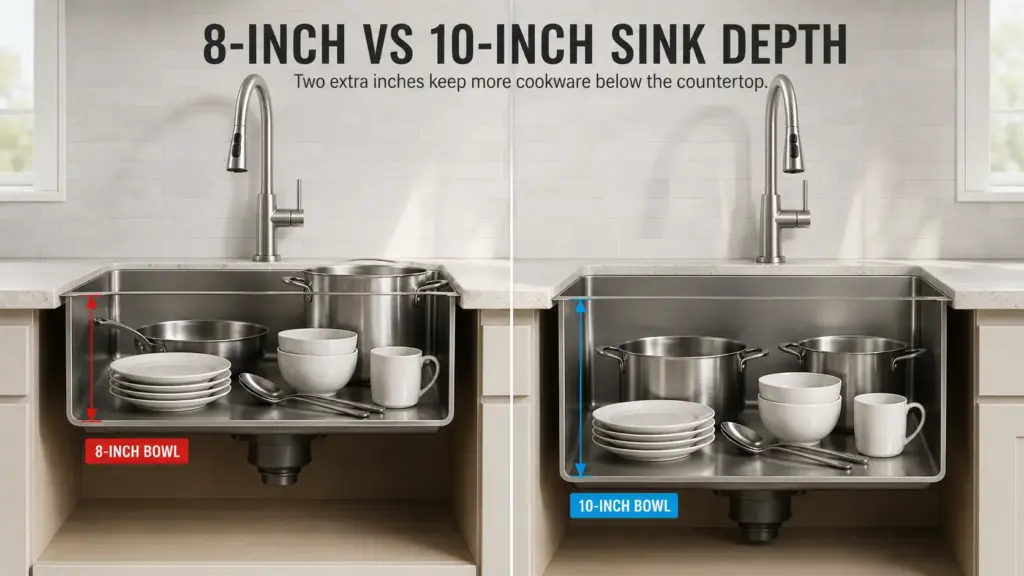
Depth affects:
- usable volume
- under-sink clearance
- drain height
- disposal clearance
- forming difficulty
- cabinet compatibility
For pressed sinks, deeper bowls also increase forming demand.
For handmade sinks, bowl depth affects fabrication geometry and welding structure.
So bowl depth can be both:
functional CTQ
and:
manufacturing CTQ.
6. Drain Position Is a Functional CTQ
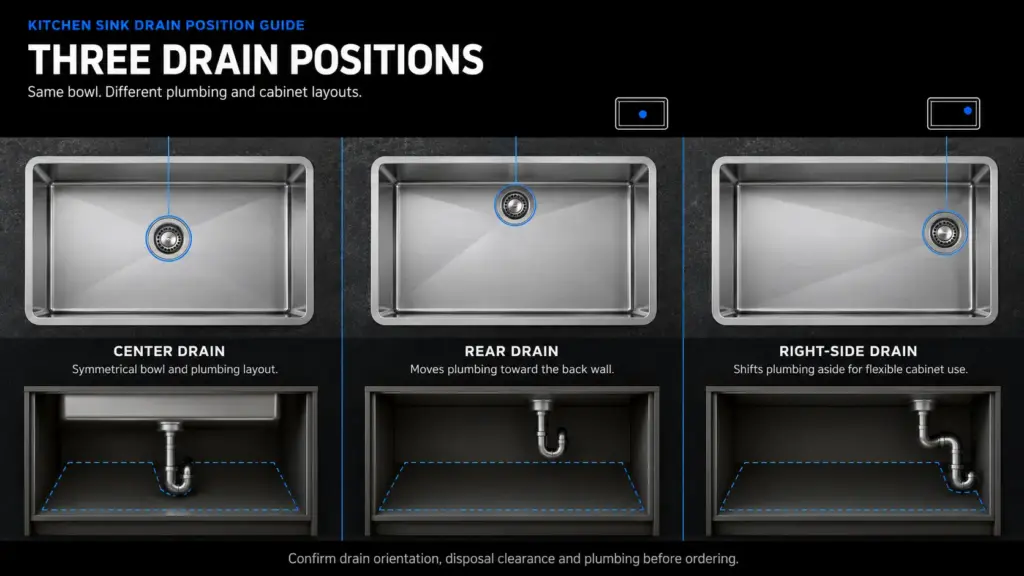
Drain position affects:
- plumbing
- garbage disposal
- bottom grid
- workstation usable area
- under-sink storage
For custom projects, writing only:
rear drain
may not be enough.
The drawing should define the actual drain center from fixed references.
A drain position that moves by a small amount may still look acceptable visually but create a completely different plumbing or accessory result.
7. Drain-Hole Diameter Is Also Critical
The drain center can be correct while the drain component still does not fit.
The drawing should also define:
- drain-hole diameter
- drain type where relevant
- relationship to the bottom geometry
This is particularly important when the buyer is supplying its own:
- strainer
- disposal flange
- drain kit
8. Faucet Holes Become CTQ When the Sink Includes a Faucet Deck
For sink models with faucet holes, inspect:
- hole diameter
- center position
- spacing
- relationship to bowl and rear edge
A faucet hole that is only a few millimeters out of position may create:
- faucet base interference
- countertop conflict
- accessory collision
- poor visual alignment
This is a good example of why dimensional importance should follow function rather than size alone.
9. Workstation Ledge Dimensions Are High-Risk CTQs
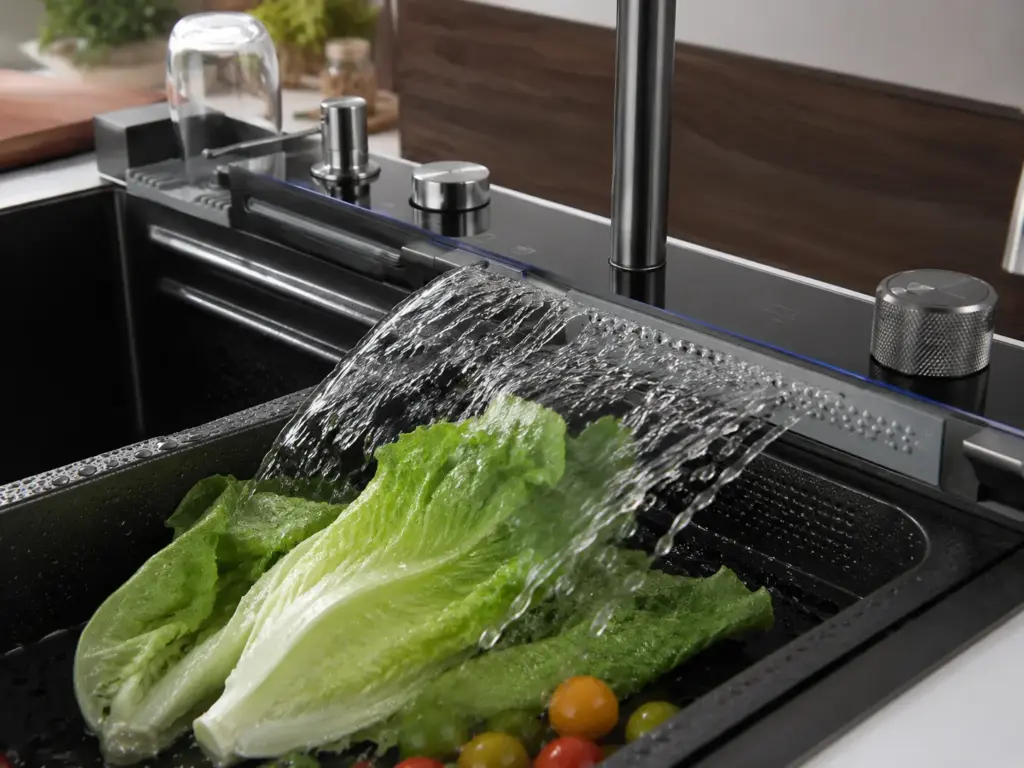
For workstation sinks, ledge geometry controls the entire accessory system.
Important dimensions can include:
- ledge width
- ledge height
- distance between support surfaces
- usable ledge length
- front-to-back alignment
These affect:
- cutting board stability
- colander movement
- roll-up rack support
- accessory interchangeability
A sink body can pass basic dimensional inspection and still fail the workstation program if the ledge is wrong.
For workstation sinks, accessory fit is part of dimensional quality.
10. Bottom Grid Fit Creates Its Own CTQ Dimensions
A bottom grid depends on:
- bowl dimensions
- corner radius
- drain position
- grid clearance
If the bowl changes while the grid does not, the final SKU may fail even though both parts individually meet their own drawings.
This is why QC should identify interface dimensions between components.
11. Apron-Front Sinks Have Different CTQs
For an apron-front / farmhouse sink, additional critical dimensions may include:
- apron width
- apron height
- apron projection
- cabinet-front opening
- support position
- upper rim relationship
These dimensions affect both:
cabinet fabrication
and:
countertop installation.
A generic sink QC checklist is therefore not enough for every product type.
12. Double-Bowl Sinks Need Divider Control
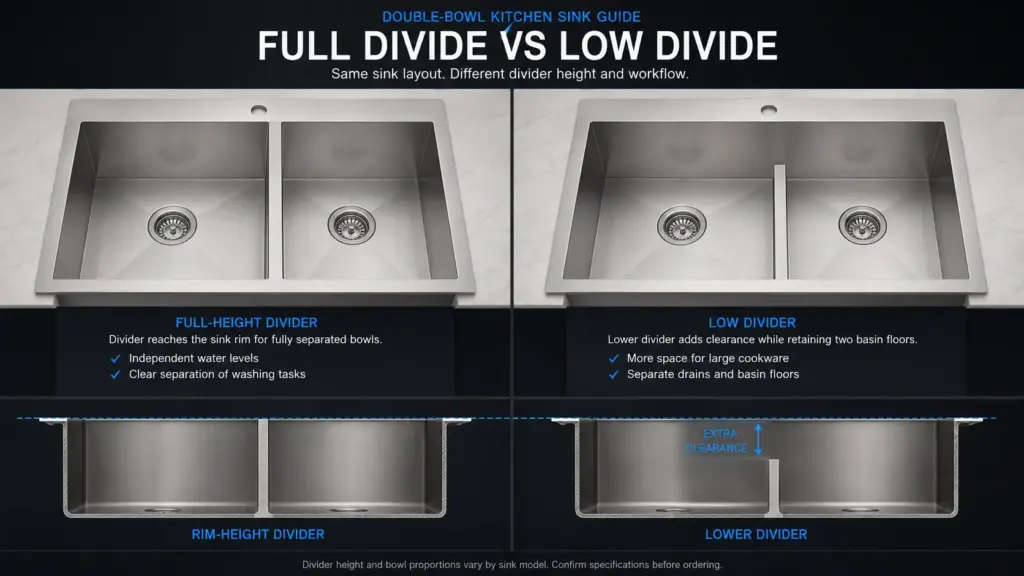
Double-bowl sinks introduce another functional interface:
the divider.
Depending on the product, buyers may need to control:
- divider position
- divider height
- bowl width on each side
- drain position in each bowl
A small divider shift can make a 50/50 sink behave more like an uneven configuration even if overall size remains correct.
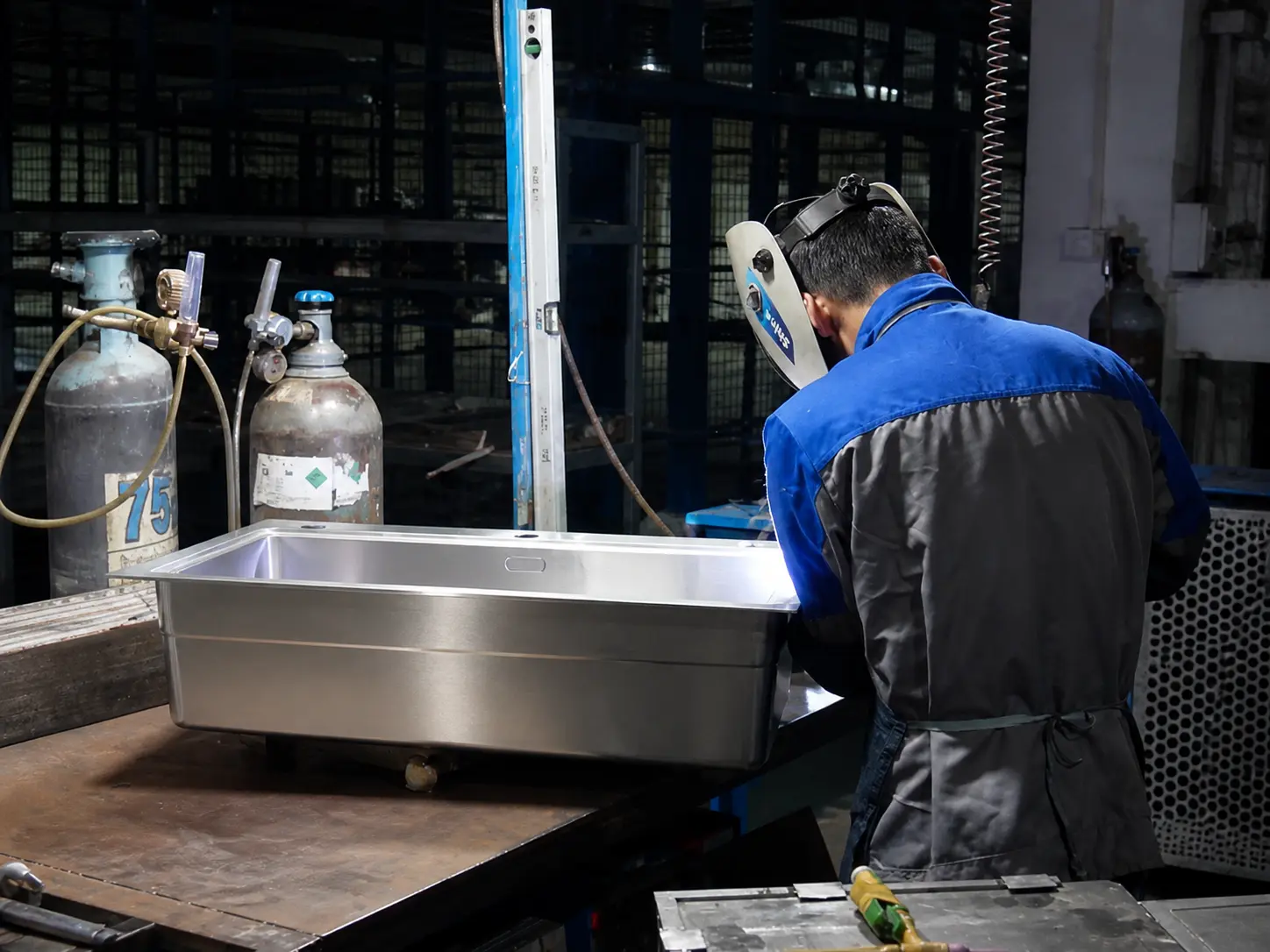
13. Pressed and Handmade Sinks Do Not Need Identical CTQ Lists
Handmade Sink
Typical higher-risk CTQs include:
- overall dimensions
- bowl dimensions
- depth
- rim flatness
- flange
- drain position
- workstation ledge
- welded structure
Pressed / Drawn Sink
Typical higher-risk CTQs include:
- overall formed geometry
- bowl depth
- rim profile
- drain position
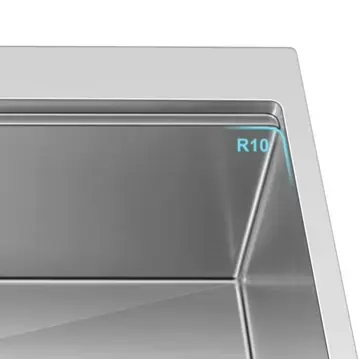
- formed radius
- mold-dependent dimensions
- thickness at critical formed locations where specified
The manufacturing route changes what is most likely to vary.
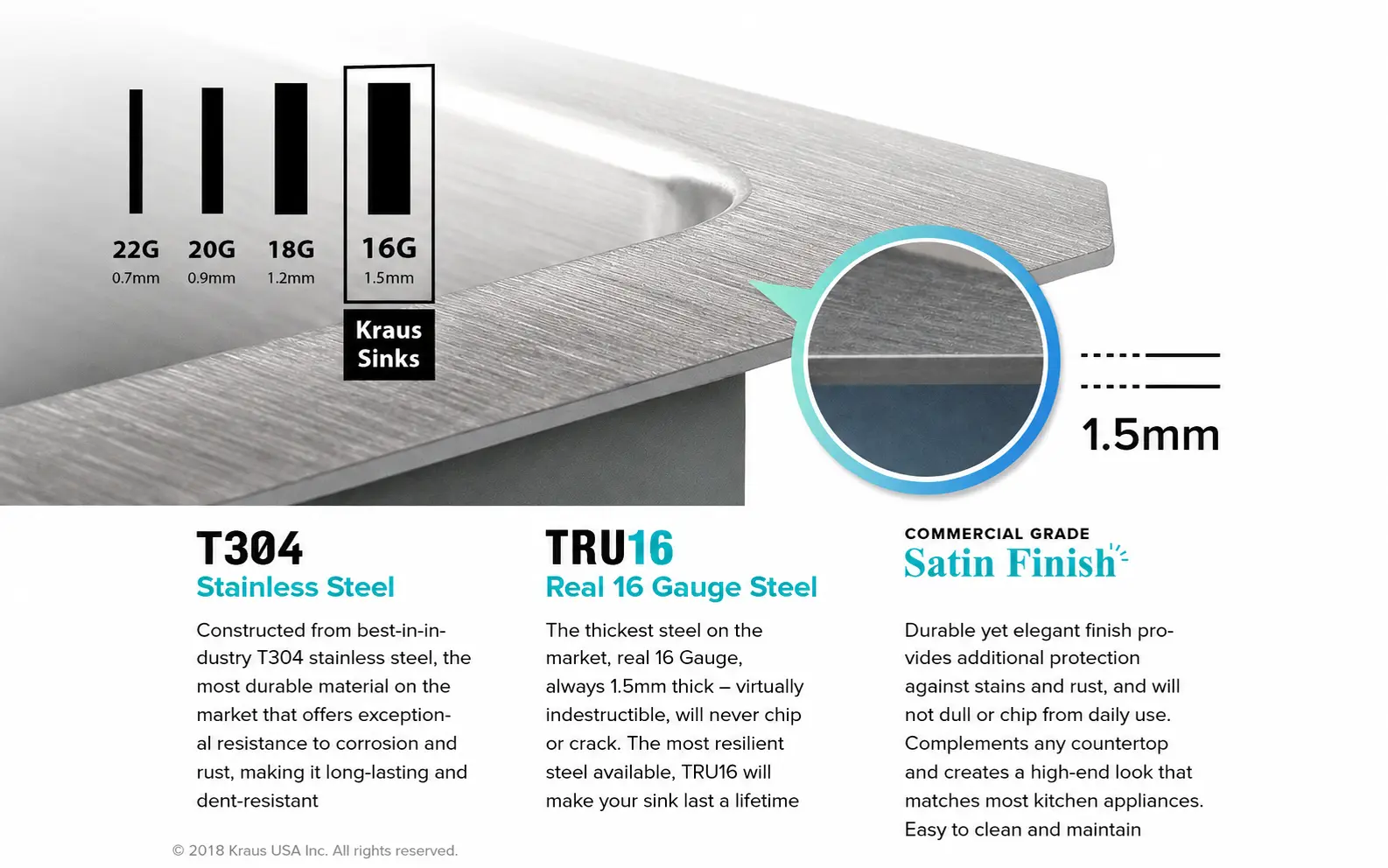
For more detail on the two production paths, see Stainless Steel Sink Manufacturing.
A Better Way to Classify Sink Dimensions
Instead of treating every dimension equally, group them by consequence.
A. Installation-Critical
Examples:
- overall dimensions
- flange width
- countertop interface
- rim flatness
- apron dimensions
B. Function-Critical
Examples:
- bowl depth
- drain position
- faucet holes
- divider position
C. Accessory-Critical
Examples:
- workstation ledge
- bowl opening
- bottom grid clearance
- drain-to-grid relationship
D. Appearance-Critical
Examples:
- symmetry
- visible alignment
- apron position
- certain rim relationships
E. Manufacturing Reference
Some dimensions are important for process control but do not directly affect the customer unless they move significantly.
These can still be inspected without being treated as the highest-risk CTQ.
How Buyers Should Build a CTQ List
Start with the approved drawing.
Then ask five questions for each dimension:
- Does it affect countertop fit?
- Does it affect plumbing?
- Does it affect another component?
- Does it affect installation?
- Would the end customer notice or be unable to use the sink if it changed?
If the answer is yes to one or more, consider whether it should be marked as CTQ.
Example: Custom Undermount Workstation Sink
Suppose the specification is:
32 × 19 in
Undermount
Rear drain
Workstation style
Cutting board + colander + grid
A practical CTQ list could include:
| CTQ | Why It Matters |
|---|---|
| Overall Size | Cabinet / countertop relationship |
| Bowl Opening | Countertop reveal and usable bowl |
| Outer Flange | Mounting area |
| Rim Flatness | Installation |
| Bowl Depth | Cabinet / drain clearance |
| Drain Position | Plumbing + grid |
| Drain Diameter | Drain fit |
| Ledge Width | Accessory support |
| Ledge Height | Accessory fit |
| Bowl Radius | Grid / accessory fit |
Notice that this list is driven by the product system, not by a generic factory checklist.
CTQ Dimensions Should Be Shown on the Drawing
Once the important dimensions are identified, they should be controlled in the latest approved drawing or linked inspection specification.
Do not rely on:
- email instructions
- WhatsApp messages
- verbal confirmation
- “same as sample”
for installation-critical dimensions.
The drawing should remain the measurable reference.
CTQ Does Not Mean “Use the Tightest Possible Tolerance”
This is important.
Identifying a dimension as critical does not mean giving it an unnecessarily tight tolerance.
A tolerance should reflect:
- function
- manufacturing process
- installation need
- measurement method
- agreed product requirement
Over-tight tolerances can increase:
- rejection
- manufacturing cost
- inspection complexity
without improving the actual product.
The next step is therefore to define tolerances according to function, not simply label everything ±1 mm.
How QC Should Inspect CTQ Dimensions
For each CTQ, define:
- drawing reference
- target dimension
- tolerance
- measurement method
- measurement location
- inspection stage where relevant
For example:
| CTQ | Reference | Inspection Method |
|---|---|---|
| Overall Width | Drawing | Tape / caliper as appropriate |
| Bowl Depth | Drawing | Depth measurement |
| Drain Position | Drawing datum | Center-position measurement |
| Rim Flatness | Approved requirement | Flatness check |
| Ledge Width | Drawing | Caliper / gauge |
| Drain Hole | Drawing | Diameter measurement |
There is no useful PASS result without a defined reference.
Matrix’s Quality Control & Inspection uses approved drawings, specifications, samples and accessory requirements as the basis for inspection.
What Should Buyers Put in the RFQ?
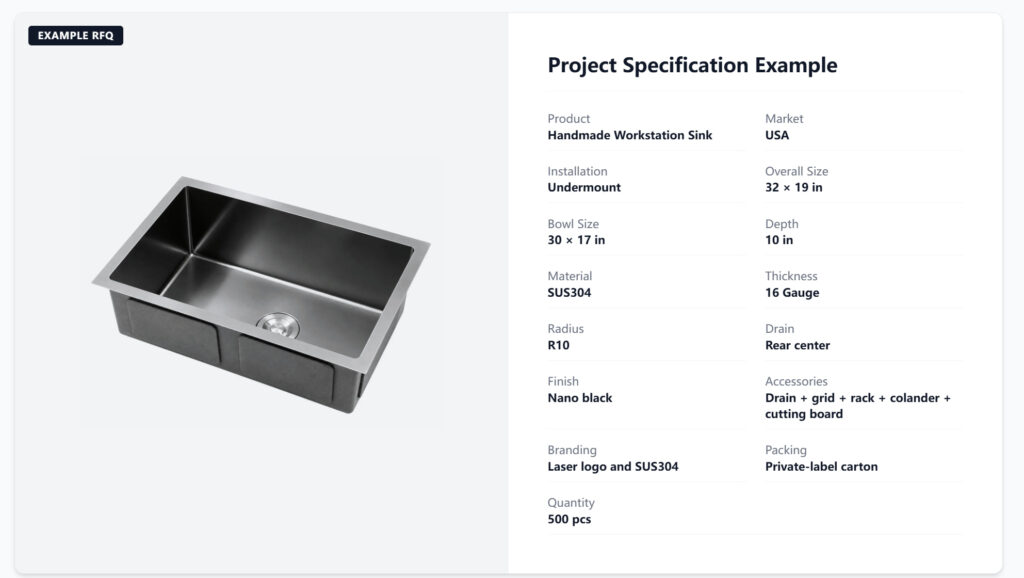
You do not need to create a full CTQ plan before asking for a quotation.
But specification-sensitive projects should provide:
- installation method
- overall dimensions
- bowl dimensions
- depth
- drain position
- radius
- faucet holes
- workstation ledge
- reference drawing if available
This allows the supplier to identify which interfaces require tighter development control.
The Kitchen Sink RFQ Checklist can be used to structure these inputs before quotation.
Buyer Takeaway
Do not ask QC to:
“Check all dimensions.”
Ask:
Which dimensions can make this sink fail if they move?
For most sink programs, critical dimensions fall into four groups:
Installation → Function → Accessories → Customer-Visible Geometry
The purpose of CTQ control is not to measure more.
It is to measure the dimensions that carry the most product risk.
Frequently Asked Questions
Which kitchen sink dimensions are most important for QC?
Overall size, countertop interface, rim flatness, bowl depth, drain position and accessory-interface dimensions are common CTQs. The exact list depends on the product and installation.
Are all drawing dimensions critical?
No. Some dimensions carry more risk because they affect fit, installation or function.
Is bowl depth a CTQ?
Often yes, especially where cabinet clearance, drain height, disposal or product positioning depends on it.
Is rim flatness a dimension?
It is a geometric condition rather than a simple linear dimension, but it can be installation-critical and should be included in QC where relevant.
What dimensions are critical on a workstation sink?
Ledge width and height, bowl dimensions, drain position and dimensions controlling grid, cutting board and colander fit are particularly important.
Should CTQ dimensions have tighter tolerances?
Not automatically. Tolerance should follow the functional requirement and manufacturing process.
Should CTQs be written into the production drawing?
Yes, either directly on the drawing or through a clearly linked controlled inspection specification.
Developing a Specification-Sensitive Sink?
Use Matrix’s Custom Kitchen Sink Programs to review installation, dimensions, production method and accessory interfaces before sample development.
For quotation preparation, start with the Kitchen Sink RFQ Checklist.