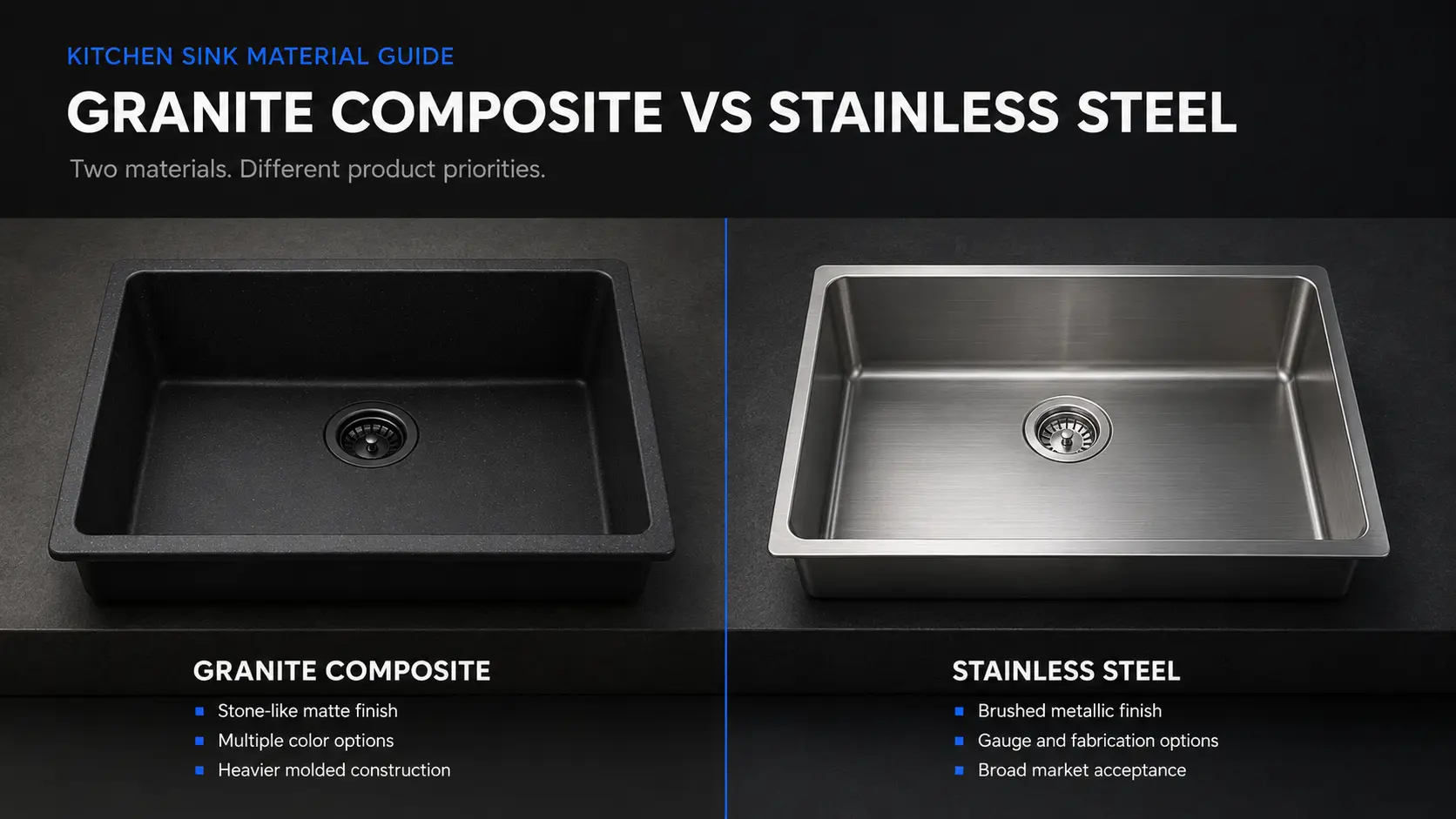
Neither material is better for every kitchen. Stainless steel is usually the more forgiving choice for heavy cookware, frequent use, lower installation weight and workstation designs.
Granite composite is often better when quietness, matte color and a stone-like appearance matter most. The right choice depends on how you cook, your water quality, cleaning habits, installation and which type of visible aging you can accept.
Quick Decision
Choose stainless steel if you want:
- Better tolerance of heavy impact without cracking
- Lower weight and easier handling
- More sizes, bowl layouts and workstation configurations
- A practical option for rentals, renovations and high-use kitchens
- A surface that may scratch visibly but usually remains functional
Choose granite composite if you want:
- A matte, stone-like sink in black, white, grey, beige or another color
- Lower perceived noise without relying mainly on pads and undercoating
- A rigid, solid feel
- Minor daily marks to be less obvious on the right color and texture
- A sink that visually coordinates with the countertop, faucet and drain
The most useful question is not “Which material is stronger?” It is:
Would you rather manage visible scratches and water spots, or manage mineral haze, color expectations, heavier installation and a small risk of chips or cracks?
Granite Composite vs Stainless Steel: At a Glance
| Decision Factor | Stainless Steel | Granite Composite |
|---|---|---|
| Basic structure | Stainless steel sheet, pressed or fabricated | Mineral particles bound in a molded resin system |
| Appearance | Metallic, brushed, satin or colored finish | Matte, stone-like and available in multiple molded colors |
| Fine scratches | Usually more visible | Often less obvious, but abrasion and metal transfer still occur |
| Heavy impact | May scratch or dent | Rigid body may chip or crack under severe impact |
| Heat | Metal body generally offers a wider practical margin | Heat-resistant, not universally heat-proof; formulation and test limits matter |
| Hard water | Shows spots, film and dull areas | Dark colors can show pale or chalky mineral deposits |
| Noise | Controlled by steel thickness, bowl shape, pads, coating and installation | Greater mass normally reduces vibration and perceived noise |
| Weight | Usually lighter | Usually heavier and more demanding to handle and support |
| Installation | Broad installation options and easier handling | Requires careful cutout, support and impact protection |
| Product flexibility | Very broad, especially for handmade and workstation designs | Mold-dependent; strong for color-led residential collections |
| Typical visible aging | Fine scratches, scuffs, water marks and occasional dents | Mineral haze, metal marks, localized abrasion and possible edge chips |
| Hard-to-reverse damage | Deep dent or severe surface damage | Structural crack, chip or permanent surface/color damage |
These are typical tendencies—not universal guarantees. A good product in either material can outperform a poorly designed or poorly installed product in the other.
First Separate Three Different Questions
Many comparisons become misleading because they mix three issues together.
1. Material Behavior
How stainless steel or a mineral-resin composite responds to impact, heat, chemicals and daily wear.
2. Product Quality
How well the specific sink was formed, molded, cured, finished, inspected and packed.
3. User and Installation Conditions
Water hardness, cleaning chemicals, cookware, cabinet support, countertop cutout and installation method.
A white haze on a black composite sink may be a removable mineral deposit rather than poor pigment. A rust-colored mark on stainless steel may be transferred iron rather than corrosion of the sink body. A crack can be caused by impact, transport or poor support rather than the material category alone.
Professional diagnosis starts with the symptom and operating conditions—not with a conclusion about the material.
What Is a Stainless Steel Kitchen Sink?
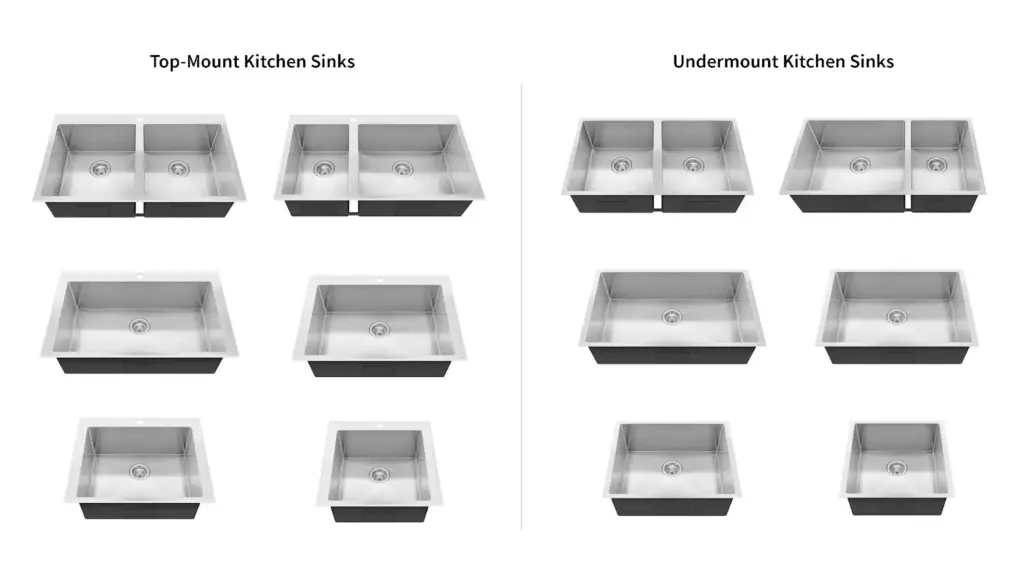
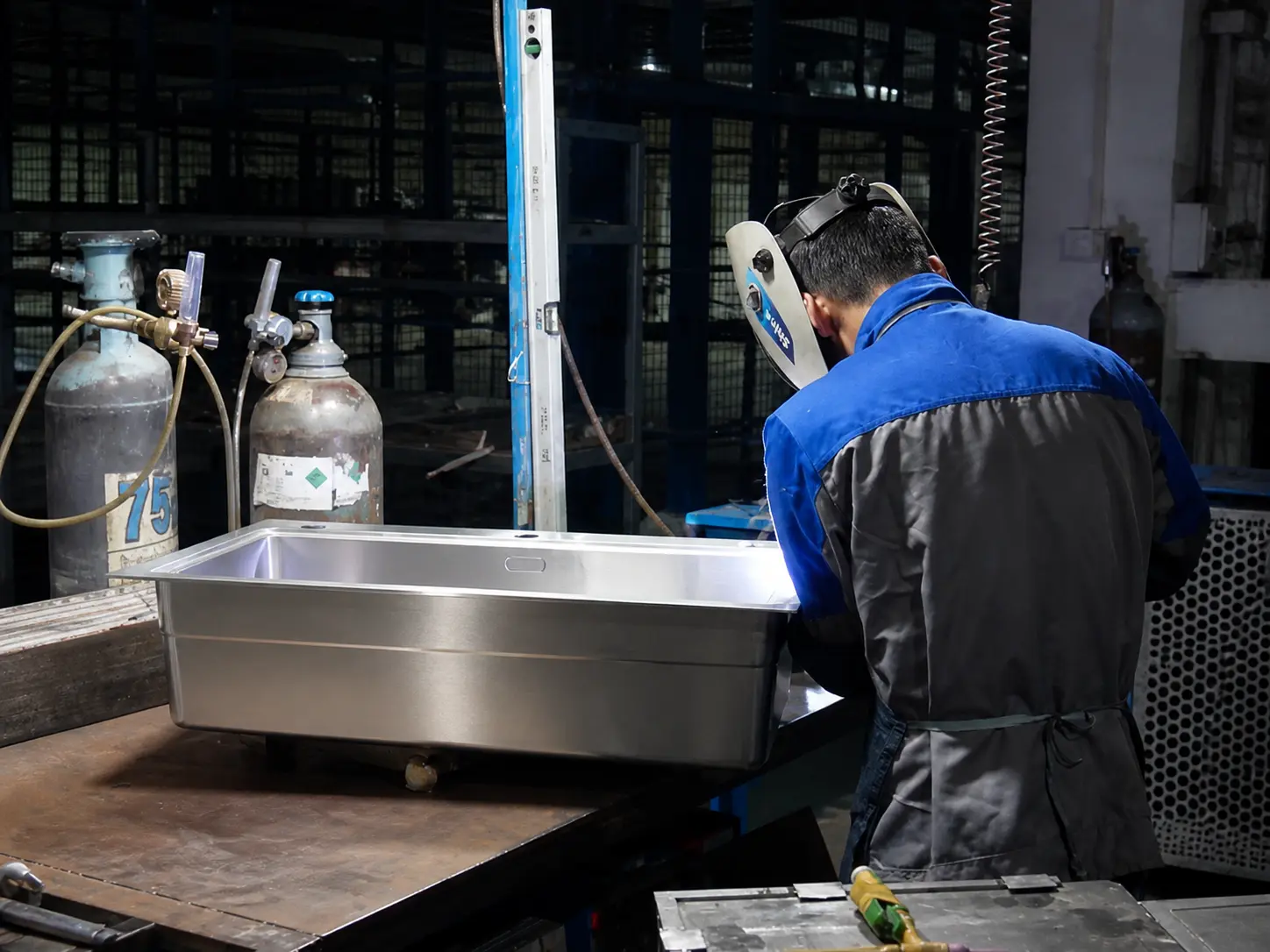
A stainless steel sink is produced from stainless steel sheet by pressing, drawing, cutting, bending, welding and finishing, depending on the model.
Common constructions include:
- Pressed or drawn sinks
- Handmade sinks
- Undermount sinks
- Top-mount sinks
- Apron-front sinks
- Workstation sinks
- Drainboard and commercial sinks
Material grade matters, but grade alone does not define quality. A professional stainless steel sink evaluation should also include:
- Actual steel thickness
- Thickness distribution after forming
- Bowl geometry and bottom slope
- Rim flatness
- Weld and corner finishing
- Surface grain direction and consistency
- Drain position and forming
- Sound-deadening pads and undercoating
- Accessory fit
- Packaging protection
A Commonly Missed Detail: Forming Can Change Thickness
For a pressed sink, the original sheet thickness and the thickness at the deepest or most stretched part of the finished bowl may not be identical. Forming can reduce thickness in highly stretched areas.
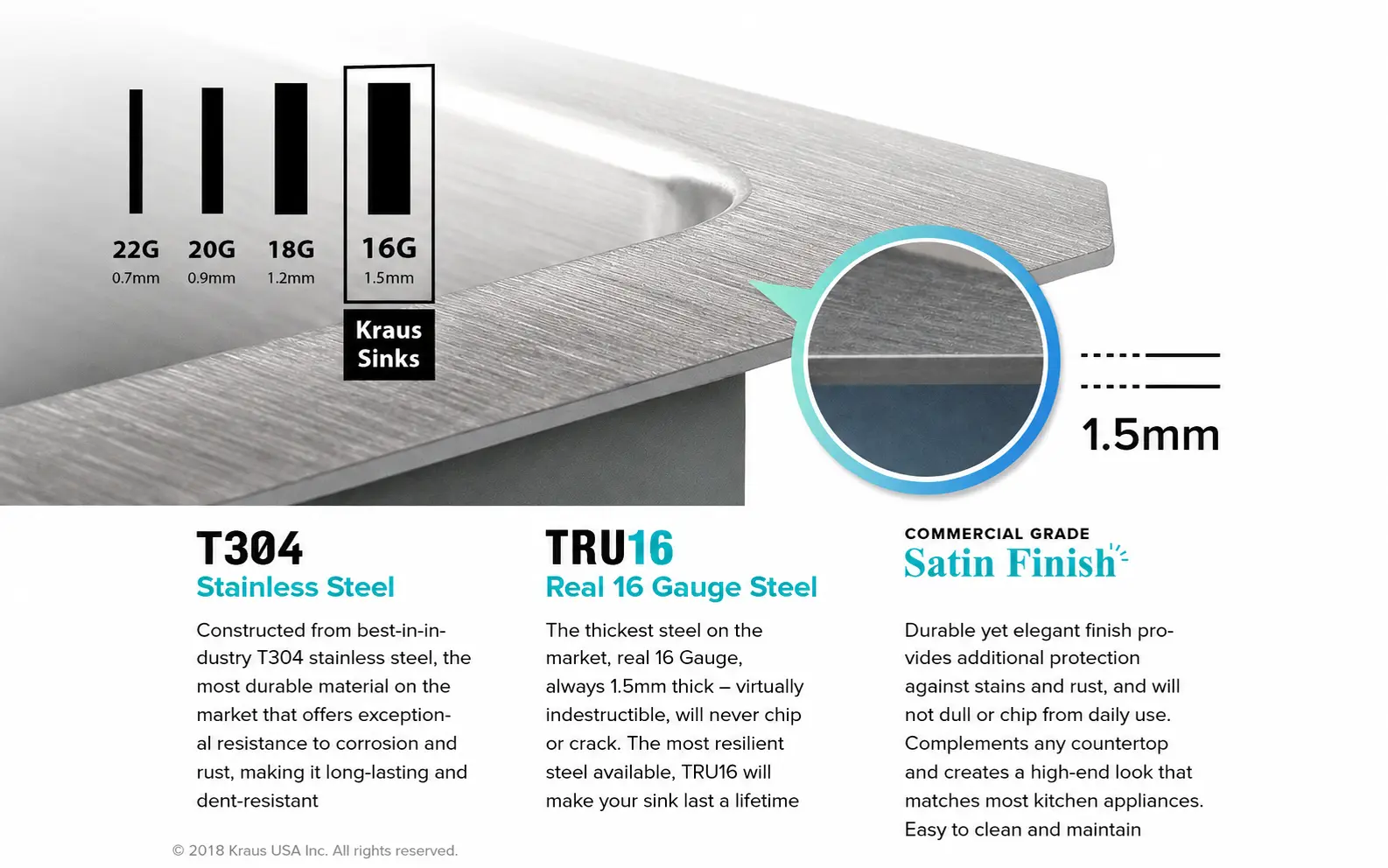
This does not automatically make a pressed sink poor quality. It means professional buyers should define where and how thickness is measured instead of relying only on a nominal gauge claim.
A thicker sink may feel more substantial and resist deformation better, but it is not automatically more scratch-resistant. Scratching happens at the surface; gauge describes sheet thickness.
Explore Matrix stainless steel kitchen sinks for handmade, pressed, undermount, top-mount and workstation programs.
What Is a Granite Composite Sink?
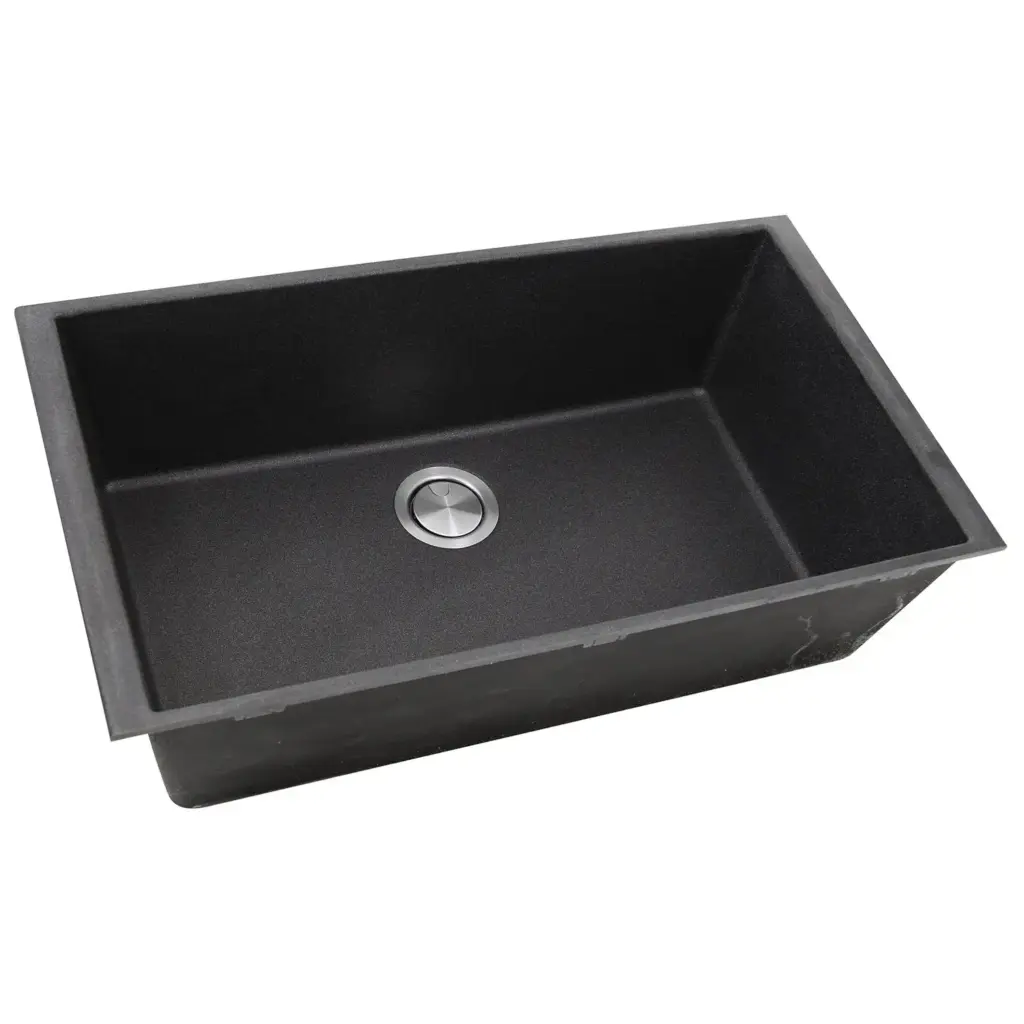
A granite composite sink is a molded product made from mineral particles—commonly granite, quartz or a related mineral blend—held together by a resin binder and colored with pigments.
It is not a sink carved from one solid block of natural granite.
“Granite composite” is a category, not one universal recipe. Performance can change with:
- Mineral type and purity
- Particle-size distribution
- Mineral-to-resin balance
- Resin chemistry
- Mixing uniformity
- Pigment dispersion
- Molding pressure and temperature
- Curing conditions
- Wall and rim design
- Surface texture
Why the Stone Percentage Is Not Enough
A high mineral percentage may support hardness and a stone-like feel, but percentage alone does not prove:
- Uniform particle distribution
- Complete binding
- Good curing
- Low internal stress
- Color consistency
- Strong drain and rim areas
- Resistance to household chemicals
Two sinks with a similar advertised mineral percentage can perform differently because their formulation, molding and curing are different.
A professional composite evaluation should therefore include the finished product—not only the recipe claim.
Explore Matrix granite composite sinks for residential, retail, showroom and project programs.
Which Sink Is More Durable?
“Durable” has no useful meaning until the failure type is defined.
| Event | Stainless Steel Response | Granite Composite Response |
| Light daily contact | Fine scratches or scuffs may appear | Often remains visually uniform, depending on color and texture |
| Heavy pan dropped into bowl | May scratch or dent | May resist the impact, but a severe event can chip or crack the rigid body |
| Sharp object dragged across surface | Can change or cut across the grain | Can leave abrasion, a scratch or metal-transfer mark |
| Extreme localized heat | Metal body is generally tolerant, but finish and accessories may be affected | Resin system may be affected if exposure exceeds the model’s tested conditions |
| Poor undermount support | Rim distortion or separation may occur | Stress may concentrate at the rim or body and contribute to cracking |
| Shipping impact | Rim or bowl may dent | Corner, rim or drain area may chip or crack |
Practical Verdict
Stainless steel is generally more forgiving when impacts are unpredictable. It often shows damage earlier as a visible scratch or dent, but that damage may remain cosmetic.
Granite composite can maintain a uniform appearance well during normal use, but its rigid structure makes correct handling, support and packaging more important.
Scratches: Hardness Is Not the Same as Scratch Visibility
Composite is commonly described as more scratch-resistant. That can be directionally true, but three different issues should be separated:
- Actual cutting or abrasion of the surface
- Material transferred from cookware onto the sink
- How visible the mark appears against the finish
Stainless Steel Scratches
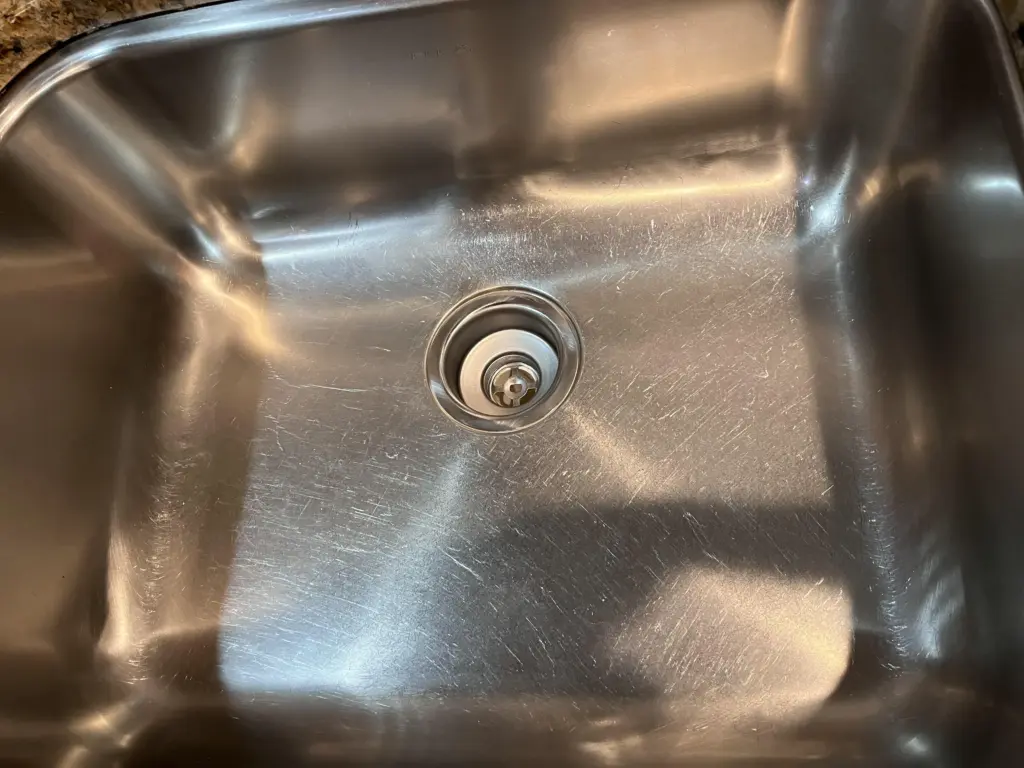
Fine scratches are common on new stainless steel sinks because utensils and cookware change the original factory grain.
Scratch visibility depends on:
- Brushed, satin or polished finish
- Grain direction
- Lighting angle
- Contrast between old and new marks
- Cleaning tools
- Whether a bottom grid is used correctly
Brushed and satin finishes usually hide daily wear better than reflective finishes. Over time, fine marks can blend into a more uniform use pattern.
Deep scratches across the grain are harder to disguise and should not be confused with normal fine use marks.
Granite Composite Marks

Composite surfaces often hide fine daily marks, but they can still show:
- Metal transfer from pans
- Abrasion in high-contact areas
- Slightly polished patches on a matte surface
- Scratches from hard or sharp objects
- Chips after concentrated impact
A grey line from a pan is not automatically a scratch. Clean a small area using the approved care method before diagnosing permanent damage.
Practical Verdict
Choose composite if visible fine scratches would strongly reduce your satisfaction. Choose stainless steel if you can accept cosmetic patina in exchange for a more impact-forgiving body.
Heat Resistance: Ask for Conditions, Not Adjectives
“Heat-resistant” is incomplete unless the claim defines:
- Temperature
- Contact time
- Dry or wet surface
- Number of cycles
- Test location
- Cooling method
- Pass/fail criteria
Stainless Steel and Heat
The stainless steel body generally provides a wider practical heat margin because it does not depend on a resin binder.
However, excessive heat can still affect:
- PVD, nano or other colored finishes
- Sealants
- Rubber feet and grids
- Drain components
- Adjacent countertop materials
- Undercoating beneath the bowl
Granite Composite and Heat
Composite sinks are normally designed for kitchen temperatures, but they are not unlimited heat-proof stone. Performance depends on the actual mineral-resin formulation.
Possible problems after excessive or sudden heat exposure include:
- Surface change
- Discoloration
- Resin damage
- Local warping
- Stress around the drain or rim
- Thermal cracking
Practical Verdict
Stainless steel is the safer starting point when users frequently handle extremely hot cookware. With either material, use a rack or trivet and avoid placing a very hot pan directly onto a dry sink surface.
Hard Water, Stains and White Haze
Neither material prevents mineral deposits. They reveal them differently.
Stainless Steel in Hard Water
Hard water often leaves:
- Water spots
- Cloudy film
- Chalky drain rings
- Dull areas where droplets repeatedly dry
These deposits may look severe under directional lighting even when they remain on the surface.
Dark Granite Composite in Hard Water
Black, dark grey and brown composite sinks can show:
- White haze
- Pale rings
- Chalky faucet and drain areas
- Light film on the bowl walls
This does not automatically mean the color is fading.
Light Granite Composite
White and light-colored composite sinks may hide pale mineral deposits better but can show:
- Dark food residue
- Metal-transfer marks
- Tea or coffee deposits
- Local discoloration after incorrect chemical use
Diagnose Before Treating
| Appearance | Possible Cause | First Check |
| White haze on a dark sink | Hard-water minerals, soap film or surface damage | Clean a small hidden area using the approved care method |
| Grey line on composite | Metal transfer or abrasion | Check whether gentle approved cleaning removes it |
| Brown mark on stainless | Food residue, iron contamination or corrosion | Identify whether the mark is on or in the surface |
| Dull stainless patch | Mineral film or inconsistent abrasion | Inspect under different lighting after mild cleaning |
| Permanent color change | Chemical, heat or surface damage | Stop aggressive cleaning and request technical review |
Do not escalate immediately to stronger acids, bleach or abrasive pads. A more aggressive cleaner can turn a removable deposit into permanent surface damage.
Which Sink Is Easier to Clean?
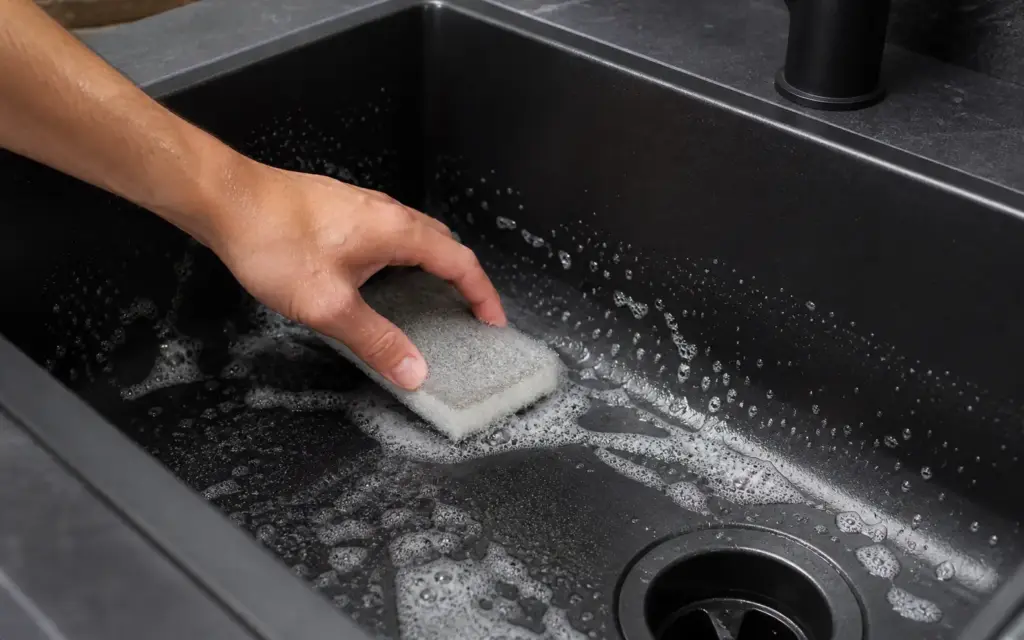
Both can be easy to maintain when the user understands the surface.
Routine Stainless Steel Care
- Wash with warm water, mild detergent and a soft cloth or sponge.
- Follow the grain on a directional finish.
- Rinse away food and cleaner residue.
- Dry the surface when water spots matter.
Avoid:
- Carbon-steel wool
- Metal brushes
- Random aggressive scrubbing across the grain
- Prolonged chloride or bleach exposure
- Leaving concentrated salt or cleaner in the bowl
Routine Granite Composite Care
- Use mild detergent and a soft sponge.
- Rinse away soap, food and mineral residue.
- Dry dark colors when pale deposits are visible.
- Use only care products approved for the specific formulation.
Avoid:
- Assuming one cleaning recipe is safe for every composite sink
- Long exposure to strong chemicals
- Extreme abrasive cleaning
- Repeated use of an unverified “restorer” that changes the surface sheen
- Treating every pale mark as faded pigment
Practical Verdict
Stainless steel care is more standardized, but it shows water spots and fine scratches. Composite can look visually calm between cleanings, but product-specific care instructions matter more.
Which Sink Is Quieter?
Granite composite normally has a natural acoustic advantage because its mass and molded structure reduce vibration.
Stainless steel noise depends on the whole system:
- Actual thickness
- Bowl area and geometry
- Sound-pad coverage and adhesion
- Undercoating
- Cabinet construction
- Mounting method
- Contact with cookware or a bottom grid
A well-designed stainless steel sink with correctly positioned pads and undercoating can be much quieter than a thin, untreated bowl.
Practical Verdict
Choose composite when low perceived noise is a primary material requirement. Choose stainless steel when its other benefits matter more, then evaluate the actual soundproofing system instead of gauge alone.
Weight, Installation and Countertop Risk
Stainless steel is normally easier to lift, transport and position. Composite is heavier and more rigid.
For composite installations, check:
- Cabinet strength
- Countertop cutout accuracy
- Undermount support method
- Rim contact and flatness
- Clip or bracket placement
- Drain alignment
- Handling during unpacking
- Protection against impact before installation
For stainless steel installations, check:
- Rim flatness
- Clip accessibility
- Support and sealing
- Bowl and plumbing clearance
- Protection from rim bending
- Undermount reveal and cutout fit
Sealant is not automatically a structural support system. Follow the model drawing, countertop requirements and approved installation method.
Practical Verdict
Stainless steel is generally easier for replacements, renovations and volume installation. Composite performs well when support, handling and cutout accuracy are planned before delivery.
Hygiene and Food-Contact Claims
Both materials can provide cleanable kitchen surfaces when correctly manufactured, undamaged and maintained.
Do not assume that either material is automatically “antibacterial.” Such a claim requires a defined test method, test organism, contact time and verified result.
Practical hygiene depends on:
- Surface condition
- Drain and corner design
- Residue removal
- Cleaning frequency
- Cracks, chips or deep damage
- Access around accessories and bottom grids
A smooth, intact and correctly cleaned surface matters more than an unsupported marketing label.
Design and Product Flexibility
Stainless Steel Strengths
Stainless steel supports a wide range of:
- Standard pressed models
- Custom handmade sizes
- Deep bowls
- Workstation ledges
- Apron fronts
- Drainboards
- Commercial configurations
- RV, bar, laundry and outdoor applications
Handmade fabrication is especially useful when a buyer needs custom dimensions, a special drain position or an accessory system.
Granite Composite Strengths
Composite is strong for:
- Matte black, white, grey, beige and brown collections
- Color-matched faucet and drain sets
- Molded drainboards
- Rounded or designer shapes
- Showroom-focused products
- Residential collections where the sink should look integrated with the countertop
Composite customization usually depends more heavily on available molds, formulation and production volume.
Which Sink Offers Better Long-Term Value?
Purchase price is only one part of value.
Include:
- Installation cost
- Countertop and cabinet changes
- Packaging and shipping risk
- Cleaning expectations
- Common return reasons
- Replacement accessory availability
- Ability to replace the model later
- Batch color or finish consistency
- Repeat-order specification control
Stainless steel usually offers broader model and price coverage. Composite can deliver stronger visual differentiation and showroom value but needs closer control of color, handling and packaging.
The better value is the sink whose normal aging matches the customer’s expectations. A surface sold as “perfect forever” creates complaints even when it is functioning normally.
Choose by Kitchen and User Type
| Kitchen or User | Better Starting Point | Reason |
| Busy family with heavy cookware | Stainless steel | More forgiving under unpredictable impact |
| Matte black, grey or beige kitchen | Granite composite | Molded color and stone-like appearance |
| Hard-water home | Either, with the right color and care plan | Stainless shows spots; dark composite shows pale mineral haze |
| Rental or multi-unit project | Stainless steel | Lower weight, broad availability and easier replacement planning |
| Quiet open-plan kitchen | Granite composite | Greater mass normally reduces perceived noise |
| Small kitchen needing prep space | Stainless workstation sink | Broad range of ledges and fitted accessories |
| User highly sensitive to fine scratches | Granite composite | Texture and color may hide minor daily marks better |
| Home using heavy cast-iron pans | Stainless steel | Lower risk of structural cracking after severe impact |
| Showroom or color-focused retail line | Granite composite | Strong visual differentiation and faucet matching |
| Custom size or unusual bowl layout | Stainless steel | Handmade fabrication provides greater dimensional flexibility |
Normal Aging or Product Defect?
| Observation | Often Normal or Maintenance-Related | May Require Product Review |
| Fine stainless scratches following use direction | Yes | Review if deep, present before use or inconsistent with the approved finish |
| Stainless water spots | Yes | Review if the surface is pitted or permanently damaged |
| Removable white haze on dark composite | Yes | Review if approved cleaning does not change it and the surface texture or color has altered |
| Grey cookware transfer on composite | Often | Review if it is a deep scratch or chip |
| Small stainless dent after a heavy object is dropped | Impact-related | Review if present before installation or linked to packaging damage |
| Composite crack | No | Investigate impact, shipping, installation stress, support and material or production causes |
| Composite edge chip | Usually impact-related | Investigate whether it occurred during production, packing, transport or installation |
| Batch color difference | Depends on approved tolerance and lighting | Review against the physical master sample and agreed measurement method |
Do not classify a complaint from one photograph alone. Ask for lighting conditions, cleaning history, installation details, use history and close-up images.
How to Judge Stainless Steel Sink Quality

Before buying or approving a sample, check:
- Material grade and agreed verification method
- Actual thickness at defined measurement locations
- Overall and bowl dimensions
- Rim flatness
- Welded corners and grinding on handmade sinks
- Surface grain direction and consistency
- Drain position and hole geometry
- Bottom slope and drainage behavior
- Sound-pad adhesion and undercoating coverage
- Accessory fit
- Surface, rim and corner protection in the carton
Do not approve a stainless steel sink using only “304” and “16 gauge.”
How to Judge Granite Composite Sink Quality
Before buying or approving a sample, check:
- Material formulation information appropriate to the project
- Surface texture, density and consistency
- Color under warm, cool and daylight conditions
- Overall dimensions and rim flatness
- Wall, corner and drain-area structure
- Faucet-hole or knock-out locations
- Drain and accessory compatibility
- Installation support requirements
- Declared heat, impact and chemical limitations
- Care instructions
- Carton support around the rim, corners and drain area
- Repeat-order color reference
Do not approve a composite sink only because it feels heavy or contains an advertised percentage of mineral.
B2B Sample Testing: Define the Conditions
For importers, private-label brands and project buyers, “passed the test” is not useful unless the test is reproducible.
Every performance requirement should define:
- Sample model and production stage
- Equipment or test setup
- Temperature, load, height or chemical concentration
- Exposure time
- Number of cycles
- Conditioning before inspection
- Lighting and viewing distance for appearance
- Pass/fail criteria
- Photo and record requirements
Stainless Steel Sample Checks
- Material verification using the agreed method
- Thickness at defined points
- Dimension and rim-flatness inspection
- Drain position and drainage test
- Surface comparison with the approved finish sample
- Sound-pad and undercoating inspection
- Accessory-fit test
- Carton and surface-protection review
Granite Composite Sample Checks
- Dimension and flatness inspection
- Physical color comparison with the approved master sample
- Surface-texture inspection under defined lighting
- Drain and rim-area inspection
- Heat-cycle test under supplier-declared conditions
- Impact test with defined object, mass, height and location
- Chemical spot test with defined concentration and exposure time
- Packaging and handling review
There is no responsible universal pass limit for every formulation, color and model. Set the acceptance criteria before the purchase order rather than after a complaint.
B2B Program Risks
Stainless Steel Program Risks
- Consumers treat normal fine scratching as a manufacturing defect
- Finish direction or gloss varies between orders
- Nominal gauge is confused with finished-bowl thickness
- Rims bend during transport
- Bottom grids or accessories do not match the model
- Material and finish changes are not recorded by SKU
Granite Composite Program Risks
- Screen images do not match the physical color
- Batch color differs from the first sample
- Dark colors receive hard-water haze complaints
- Heavy products are under-protected in the carton
- Rim, corner or drain damage occurs during handling
- Care instructions do not match the actual formulation
- Faucet, drain and sink colors are approved only from digital images
Recommended Approval Process
- Define the target customer and sales channel.
- Approve the exact model specification.
- Review the cutout, cabinet and installation method.
- Approve a physical material, finish or color sample.
- Define repeatable performance checks and acceptance criteria.
- Test drain, faucet and accessory compatibility.
- Approve the care guide and claim wording.
- Review the packaging method.
- Retain a golden sample and signed specification revision.
- Reconfirm changes before repeat production.
Which Material Should a Brand or Distributor Choose?
Choose stainless steel when the product program needs:
- Broad size coverage
- Workstation and accessory options
- Custom bowl layouts
- Replacement-friendly models
- Apartment or project supply
- Lower handling weight
- Commercial or utility applications
Choose granite composite when the product program needs:
- Strong color differentiation
- Matte, stone-like positioning
- Showroom impact
- Coordinated sink-and-faucet sets
- Quieter residential products
- A collection that looks different from standard metallic sinks
A complete collection can use both. Stainless steel can cover volume, workstation and project applications, while composite creates color-led options for showrooms and residential retail.
Common Myths
Granite Composite Never Stains
False. Mineral deposits, soap film, food residue, metal transfer and chemical damage can all change its appearance. Not every mark is permanent pigment damage.
Granite Composite Is Scratch-Proof
False. It may hide fine wear better than reflective stainless steel, but abrasion, scratching, metal transfer and impact damage remain possible.
Stainless Steel Cannot Rust
False. Stainless steel is corrosion-resistant, not immune to all environments. Iron contamination can create rust-colored marks, while prolonged chloride exposure can damage the passive surface.
Thicker Stainless Steel Is More Scratch-Resistant
False. Thickness affects weight, rigidity and deformation. Scratch visibility depends more directly on the surface finish, grain and contact conditions.
Composite Is Always More Premium
False. Formulation, molding, curing, color control, installation and packaging determine whether a composite sink performs like a premium product.
Stainless Steel Is Always Noisy
False. Noise depends on thickness, bowl geometry, sound pads, undercoating, cabinet and installation.
Final Decision Checklist
Before choosing, answer these questions:
- Will heavy cookware be dropped or moved frequently?
- Are visible fine scratches or possible chips more concerning?
- Is the local water hard?
- Will the user rinse and dry the sink regularly?
- Is a specific molded color essential?
- Is low perceived noise a priority?
- Can the cabinet and installer support a heavier sink?
- Is a workstation or custom configuration required?
- Are replacement accessories available?
- Do the product’s tested limits match the marketing claims?
- Does the care guide match actual household habits?
- For B2B orders, can the same finish or color be repeated?
Choose stainless steel if you prioritize impact tolerance, configuration flexibility, lower weight and easier replacement.
Choose granite composite if you prioritize quietness, molded color, a matte stone-like appearance and low visibility of fine daily marks.
Frequently Asked Questions
Is granite composite better than stainless steel?
Not universally. Granite composite is usually quieter and offers more color choices. Stainless steel is lighter, more impact-forgiving and available in more configurations. The better material depends on the kitchen, water quality, installation and expected wear.
Do granite composite sinks crack easily?
A properly manufactured, transported, supported and installed composite sink should not crack during normal use. Severe impact, shipping damage, poor support, installation stress or extreme thermal exposure can increase the risk.
Do stainless steel sinks scratch easily?
Fine scratches can appear during normal use, especially on a new or reflective surface. Brushed and satin finishes generally make daily wear less obvious. A visible fine scratch does not automatically indicate poor steel quality.
Do black composite sinks turn white?
White haze is often caused by hard-water minerals, soap residue or cleaning-product buildup. It does not automatically mean the pigment is fading. Test the approved cleaning method on a small area before diagnosing permanent damage.
Which sink is better for hard water?
Both can work. Stainless steel tends to show water spots, while dark composite tends to show pale mineral deposits. The right surface color and regular rinsing and drying matter more than a simple material label.
Which sink is better for hot pans?
Stainless steel generally offers a wider practical heat margin. Composite is heat-resistant but not universally heat-proof. Extremely hot cookware should not be placed directly on a dry sink surface without checking the product’s limits.
Which material is better for a workstation sink?
Stainless steel offers broader workstation configurations, including ledges, bottom grids, cutting boards, colanders and roll-up racks. Composite workstation systems are also possible, but molded-ledge and accessory compatibility must be checked by model.
Which sink is better for a rental property?
Stainless steel is often the more practical starting point because it is lighter, broadly available and forgiving under impact. Users should still be informed that fine scratches and water spots are normal possibilities.
Are granite composite sinks harder to install?
They usually require more careful handling because they are heavier and more rigid. Cabinet support, cutout accuracy, mounting and impact protection should be reviewed before installation.
Which sink lasts longer?
Both can last for many years when correctly manufactured, installed and maintained. Stainless steel tends to accumulate cosmetic scratches or dents. Composite may retain a uniform matte appearance but is harder to restore if it develops a structural chip or crack.
Is granite composite the same as a natural granite sink?
No. Granite composite is molded from mineral particles and a resin binder. It is not normally carved from one piece of natural granite.
Is an 80% stone composite automatically better than a lower percentage?
Not automatically. Percentage does not show particle distribution, resin performance, molding quality, curing, color consistency or strength around the rim and drain. Evaluate the finished sink and defined test results.
Compare Stainless Steel and Granite Composite Programs with Matrix

Matrix supplies stainless steel and granite composite sinks for brands, wholesalers, showrooms and project buyers. Because Matrix supports both materials, selection can be based on the target market rather than a one-material sales claim.
Matrix can help buyers compare:
- Product positioning
- Sink size and bowl layout
- Installation method
- Material and surface expectations
- Color and faucet matching
- Drain and accessory configuration
- Sample and test requirements
- Packaging protection
- Repeat-order control
Contact the Matrix team to request a stainless steel sample, granite composite color sample or side-by-side product-program review.