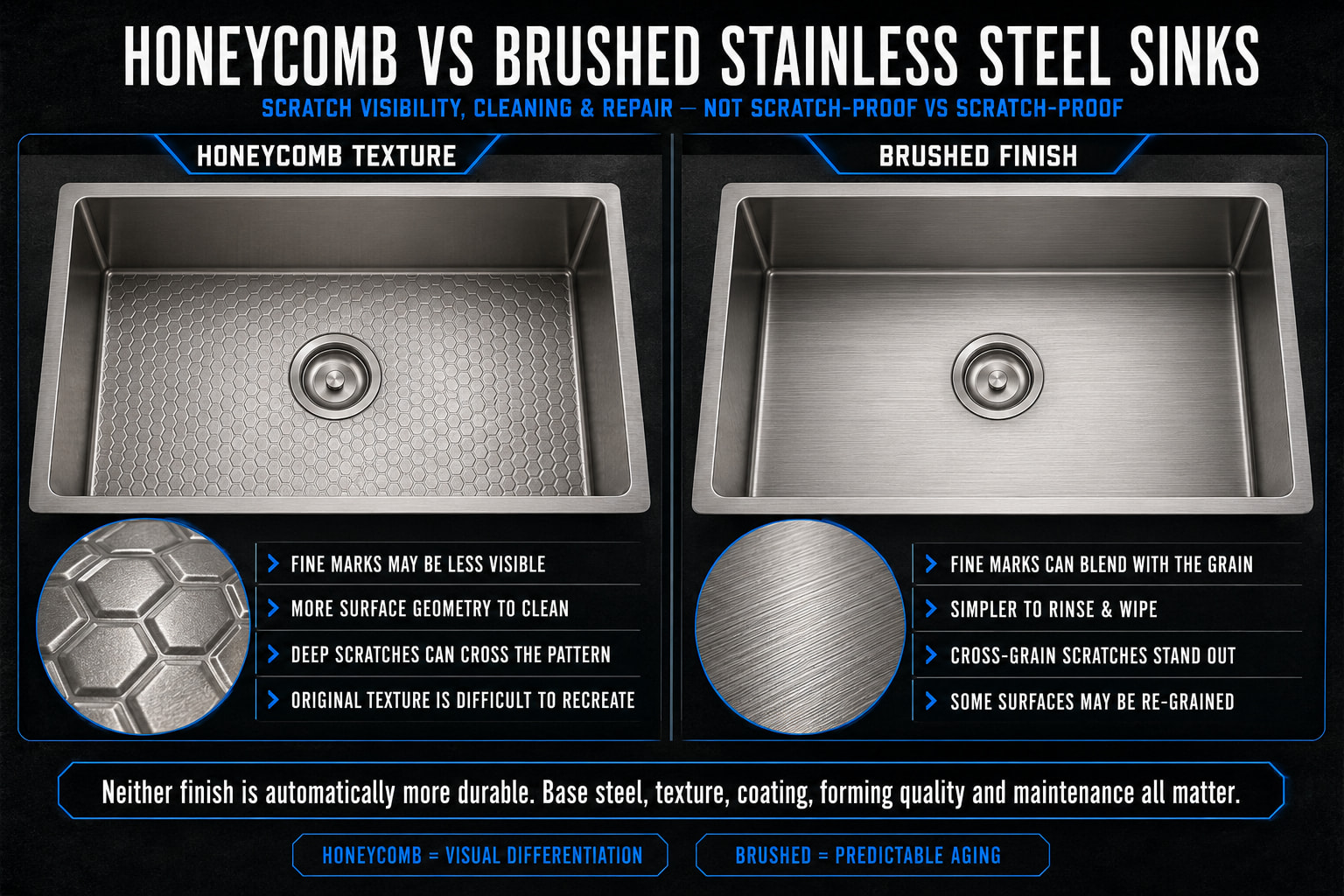
Honeycomb stainless steel sinks are often marketed as scratch-resistant, stain-resistant and easier to clean than conventional brushed sinks.
The textured pattern can make everyday marks less visible and reduce broad contact between cookware and the sink bottom. But it does not make stainless steel scratch-proof.
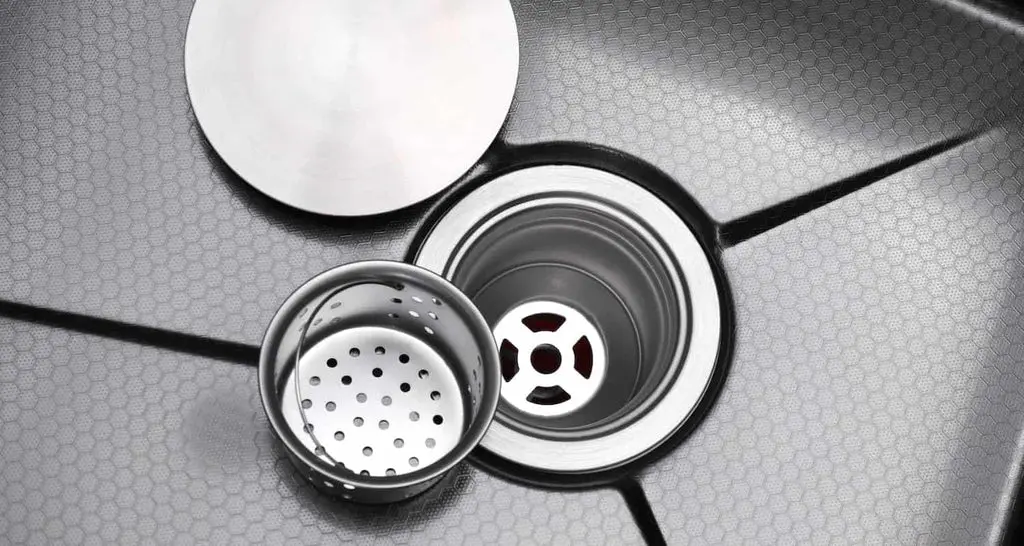
In some products, “honeycomb” describes only an embossed stainless steel pattern. In others, the pattern is combined with a transparent, nano, black or colored coating.
That difference changes how the sink should be cleaned, how scratches appear and whether the surface can be repaired.
The practical answer is:
Choose honeycomb for visual differentiation and reduced scratch visibility. Choose brushed stainless steel for simpler cleaning, more predictable aging and better repairability.
Neither surface is automatically more durable. The result depends on the base stainless steel, texture, coating, forming quality and maintenance instructions.
Quick Comparison
| Factor | Honeycomb stainless steel | Brushed stainless steel |
|---|---|---|
| Scratch-proof | No | No |
| Fine scratch visibility | Often lower because of the pattern | Usually blends with the grain over time |
| Deep scratch visibility | Can be obvious, especially on colored coatings | Visible but usually lower contrast on silver steel |
| Cleaning | May require brushing inside the texture | Generally easier to wipe |
| Water spots | Pattern may disguise some marks but can hold deposits | Visible when water dries; easier to wipe |
| Coating risk | Possible, depending on product | Usually bare stainless steel |
| Surface repair | Difficult to reproduce the original pattern | Sometimes possible to regrain |
| Batch consistency | Pattern, color and embossing must be controlled | Grain direction and gloss must be controlled |
| Best for | Design-led and differentiated sink programs | Practical, broad-market and high-use kitchens |
First: What Does “Honeycomb Sink” Actually Mean?
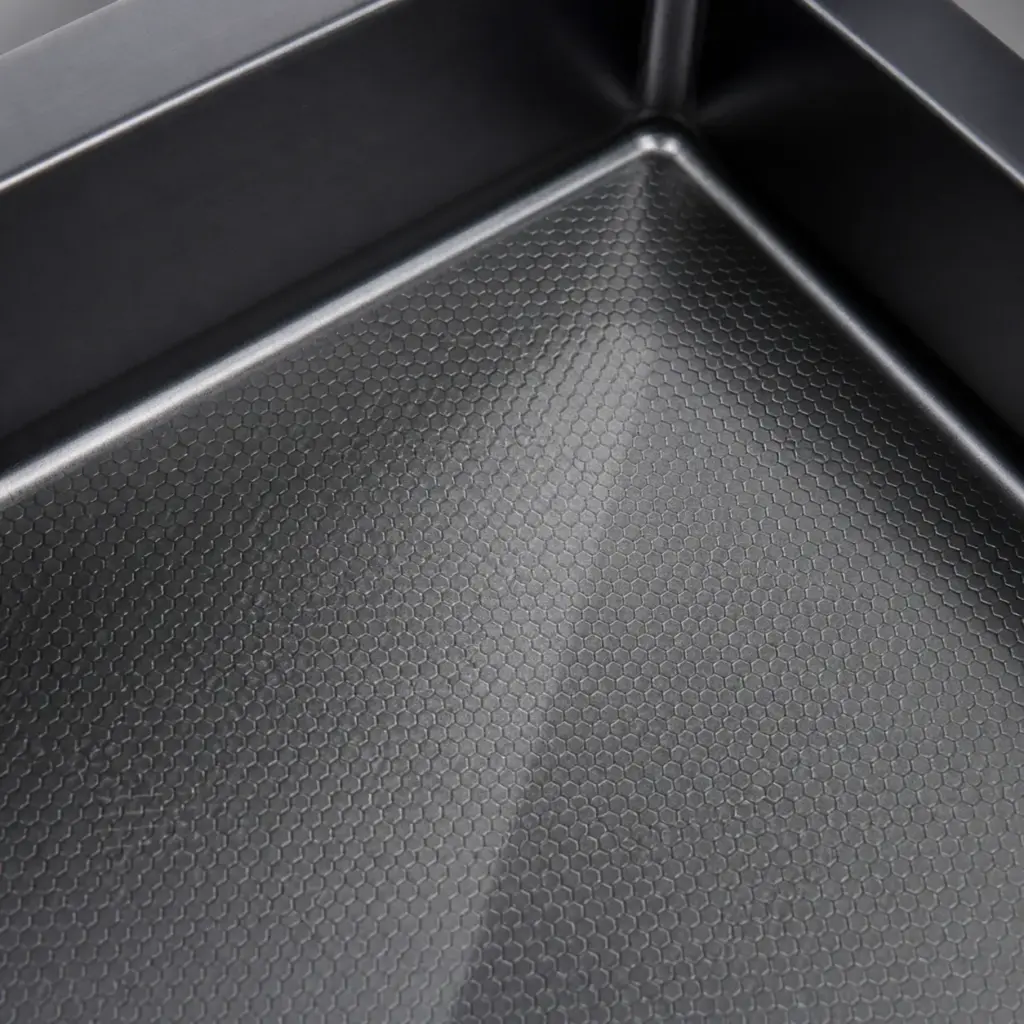
A honeycomb sink is not a separate stainless steel grade.
The term normally describes a hexagonal or geometric texture on the sink surface. The base material may still be SUS304, SUS201 or another stainless steel grade.
At least four different products may be sold under the same honeycomb name.
1. Bare embossed stainless steel
The honeycomb pattern is physically formed into the stainless steel.
There may be no additional colored or transparent top coating. The raised and recessed pattern is part of the metal geometry.
The pattern itself cannot peel away, but the stainless steel can still scratch, dent, stain or collect deposits.
2. Embossed stainless steel with a transparent coating
The texture is formed in the steel and then covered with a clear protective or water-repellent layer.
The coating may change water beading, oil release and cleaning behavior. Its long-term performance depends on the actual coating system.
3. Embossed stainless steel with a colored coating
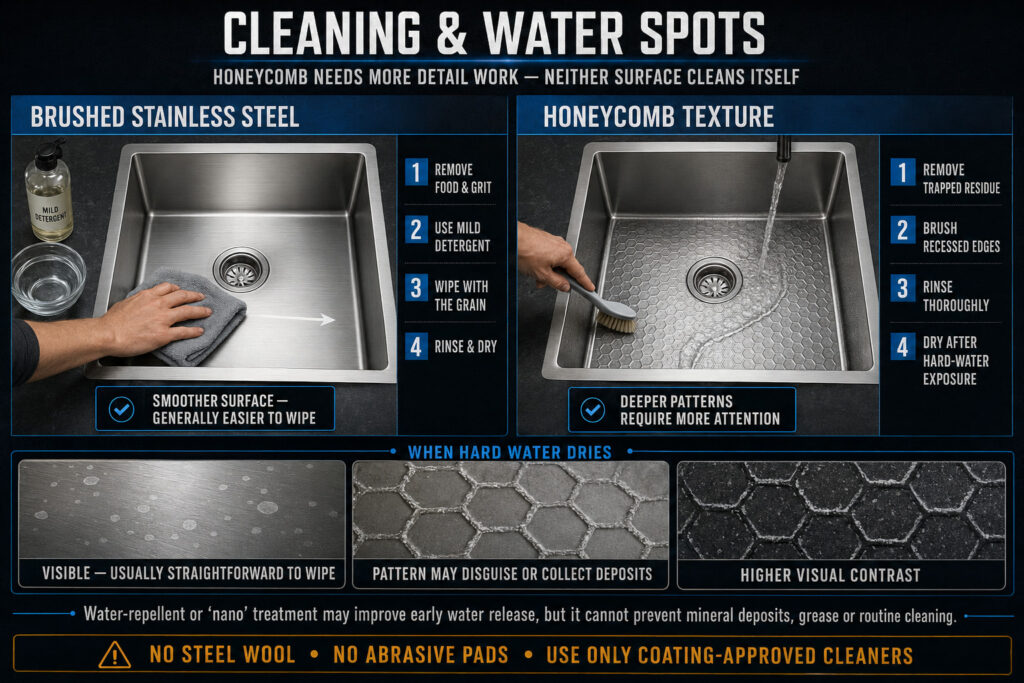
The honeycomb structure is combined with a black, grey, gunmetal, gold or other decorative finish.
This creates stronger visual differentiation, but a deep scratch may penetrate the color and expose bright stainless steel underneath.
4. Honeycomb bottom panel or sink cover
Some multifunctional sinks use a honeycomb-patterned panel only at the bottom of the bowl. The sidewalls, ledges and rim may use a different finish.
The panel may be:
- Permanently integrated
- Removable
- Part of a sink cover system
- Made from a different thickness or finish
Before comparing two products, confirm whether “honeycomb” refers to the complete bowl, the bottom only or a removable component.
The Three-Layer Test
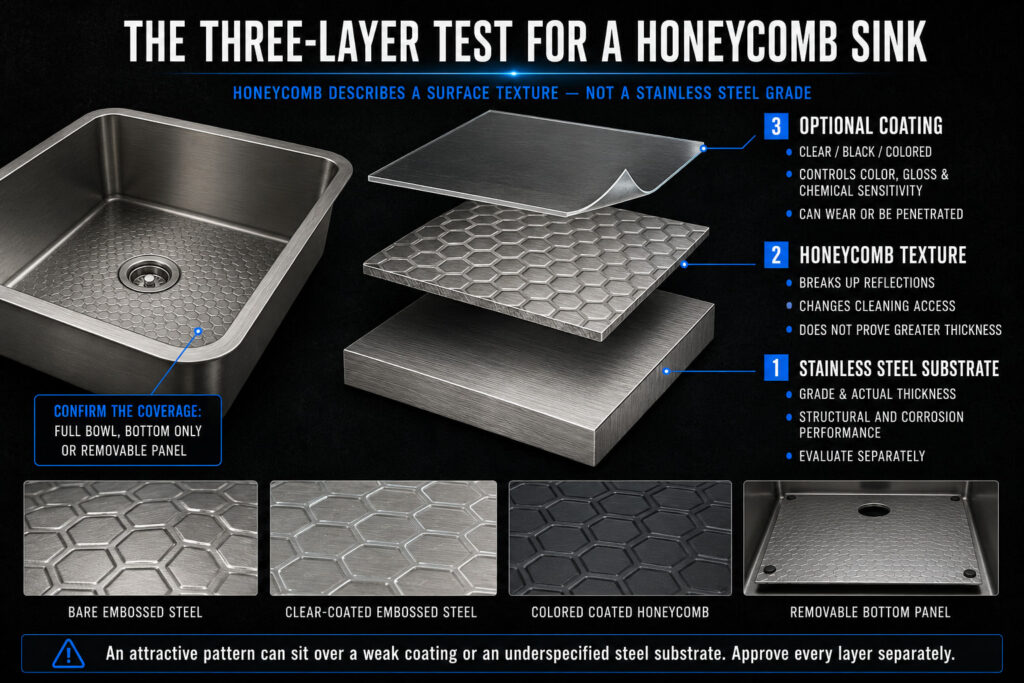
The most reliable way to evaluate a honeycomb sink is to separate it into three layers.
Layer 1: Stainless steel substrate
This determines much of the sink’s:
- Corrosion resistance
- Structural strength
- Formability
- Dent resistance
- Welding behavior
- Long-term metal integrity
The substrate should be evaluated by grade, actual thickness, manufacturing method and forming quality.
Layer 2: Honeycomb texture
This affects:
- Scratch visibility
- Cookware contact
- Light reflection
- Cleaning access
- Surface appearance
- Local stiffness
- Water and residue behavior
The texture may be shallow and open or deep and sharply defined. These designs do not clean or age in the same way.
Layer 3: Optional surface coating
This affects:
- Color
- Gloss
- Water beading
- Oil release
- Chemical sensitivity
- Abrasion behavior
- Repair method
A sink can have an excellent stainless steel base but a poorly controlled decorative coating. It can also have an attractive honeycomb texture over a thinner or lower-grade substrate.
Evaluate all three layers separately.
Do Honeycomb Sinks Really Resist Scratches?
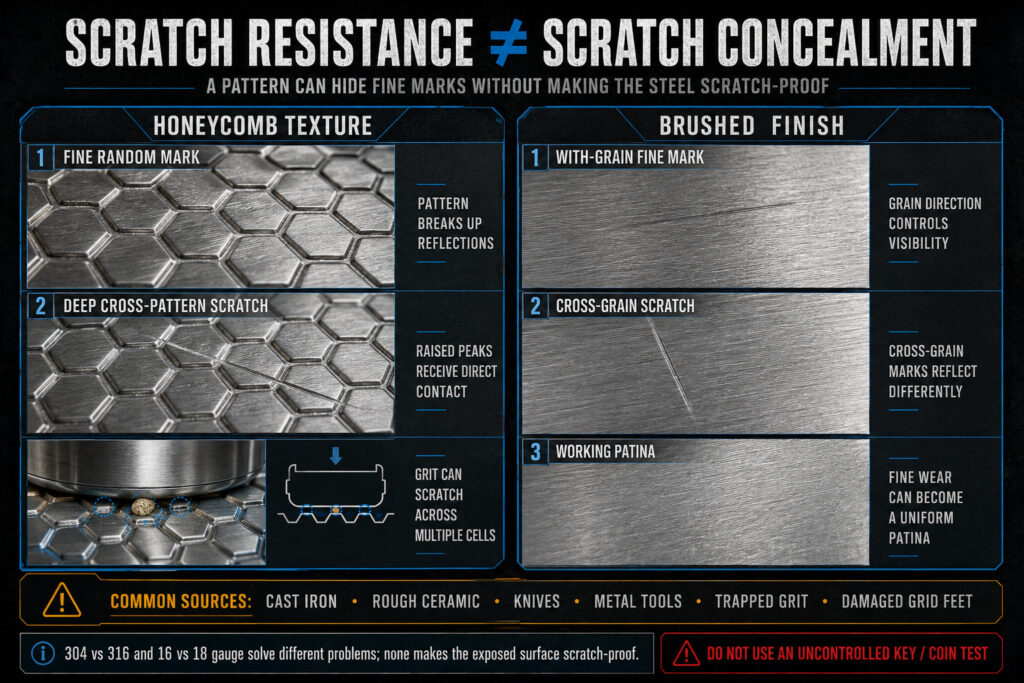
Honeycomb patterns may reduce the visibility of some scratches, but “scratch-resistant” requires qualification.
How the pattern can help
A textured surface breaks up reflections. Fine random marks may be less noticeable because they do not appear across one continuous flat plane.
Raised areas may also reduce broad contact between the entire base of a pan and the sink surface.
This can help disguise:
- Fine utensil marks
- Light scuffing
- Minor sliding wear
- Early surface aging
- Random reflections from small scratches
Why the surface can still scratch
The raised points of the pattern receive direct contact from cookware.
If sand, ceramic particles, metal fragments or food grit become trapped between a pan and the sink, dragging the pan can create a scratch across multiple raised sections.
Common scratch sources include:
- Cast-iron cookware
- Rough ceramic bases
- Knives
- Metal tools
- Unprotected bottom grids
- Trapped sand or grit
- Sliding heavy pans
- Abrasive cleaning pads
A deep scratch can cross the honeycomb pattern instead of following it, making the damage easier to see.
Scratch resistance vs scratch concealment
These are not the same.
- Scratch resistance means the surface is physically more difficult to mark under defined conditions.
- Scratch concealment means the pattern makes an existing mark less visible.
Without a controlled comparison test, buyers should not assume that reduced visibility proves higher physical scratch resistance.
How Brushed Stainless Steel Handles Scratches
A brushed sink has fine directional lines created during surface finishing.
New scratches are usually most visible when they:
- Run across the grain
- Are deeper than the original brushing
- Reflect light at a different angle
- Contain transferred metal or mineral residue
Fine scratches running in the same direction as the grain tend to blend more easily.
As a brushed sink ages, many small marks can develop into a more uniform working patina. The sink may no longer look factory-new, but the wear often becomes less visually dominant.
This predictable aging is one reason brushed stainless steel remains common in residential, project and utility kitchens.
Does 304 or 316 Stainless Steel Scratch Less?
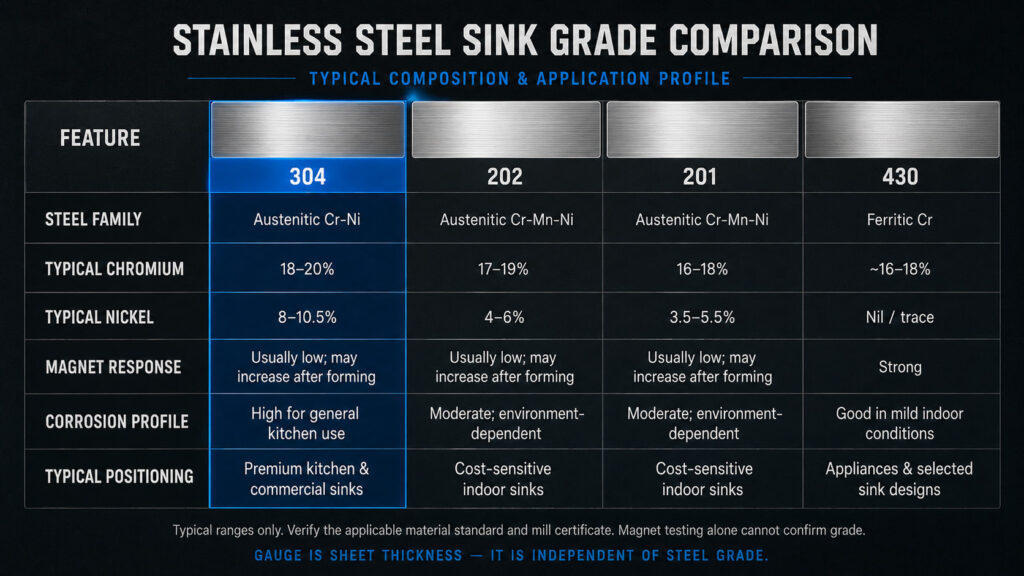
Not in a way buyers should use as the main finish decision.
SUS304 and SUS316 are selected mainly for corrosion performance and environmental suitability. They do not make a kitchen sink scratch-proof.
Similarly:
- 16-gauge steel is not automatically scratch-resistant.
- 18-gauge steel is not automatically easier to scratch.
- A thicker sink may resist denting and flexing better, but the exposed surface can still be marked.
- A premium alloy does not correct a weak coating or poor texture.
Material grade, gauge and surface finish solve different problems.
Which Surface Is Easier to Clean?
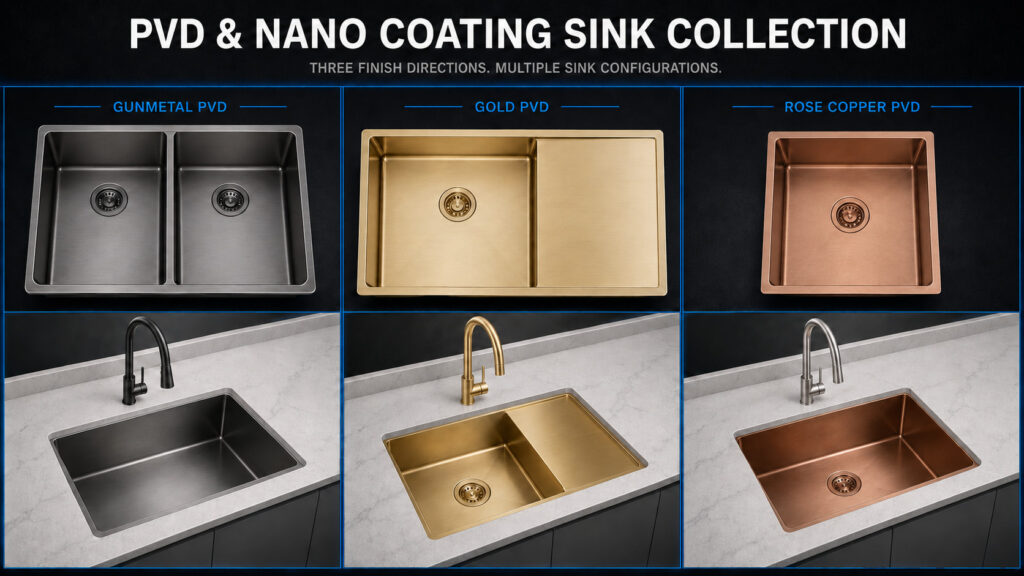
For routine cleaning, a conventional brushed surface is usually simpler.
Cleaning a brushed sink
A relatively smooth brushed bowl is easy to rinse and wipe.
Routine care normally involves:
- Removing food and grit
- Washing with warm water and mild detergent
- Using a soft cloth or non-scratching sponge
- Wiping in the direction of the grain
- Rinsing thoroughly
- Drying when water spots are a concern
The directional grain makes the correct cleaning direction easy to identify.
Cleaning a honeycomb sink
A shallow, open honeycomb pattern can still be practical to clean, but residue may settle around the recessed edges.
Cleaning may require:
- A soft nylon brush
- More attention around pattern transitions
- Thorough rinsing
- Removal of residue from recessed sections
- Drying after hard-water exposure
- Separate cleaning beneath a removable bottom panel
A deep or sharply embossed pattern may take longer to clean than a smooth brushed surface.
Does Honeycomb Texture Trap Food and Grease?
It can, depending on the pattern.
A broad, shallow texture is less likely to retain residue than narrow, deep recesses.
Potential collection points include:
- Pattern corners
- Drain transitions
- Welded edges
- Workstation ledges
- Bottom panel joints
- Grid feet
- Areas where the coating is uneven
The honeycomb structure is not inherently unhygienic, but it creates more surface geometry that must be cleaned.
For heavy-use kitchens, buyers should evaluate cleanability with actual food residue rather than judging only a dry display sample.
Do Nano-Coated Honeycomb Sinks Clean Themselves?
No.
A water- or oil-repellent coating may make some residue easier to rinse during the early life of the product. It may also cause water to form beads rather than a continuous film.
However, it cannot prevent all:
- Hard-water deposits
- Soap residue
- Grease
- Food particles
- Fingerprints
- Water spots
- Abrasive damage
The word “nano” does not identify the exact coating chemistry, thickness, adhesion or service life.
Buyers should ask:
- What is the coating process?
- Is the coating clear or colored?
- Which parts of the sink are coated?
- Which cleaners are permitted?
- Which abrasion test was used?
- What change in appearance is considered normal?
- Can the finish be repaired?
A generic “nano honeycomb” description is not a complete product specification.
Water Spots: Which Surface Performs Better?
Neither surface can prevent minerals from remaining when hard water evaporates.
On brushed stainless steel
Mineral deposits may appear as white spots or cloudy areas. The relatively smooth surface is usually straightforward to clean and dry.
On honeycomb stainless steel
The pattern may break up the visual outline of water spots, making some deposits less obvious from a distance.
However, minerals can also collect along recessed lines. If the sink is not rinsed and dried, the pattern may become outlined by limescale.
On dark honeycomb coatings
White mineral deposits can create strong contrast against black or gunmetal surfaces.
A cloudy white mark is not automatically a failed coating. Clean it with the approved method before diagnosing surface damage.
Long-Term Durability
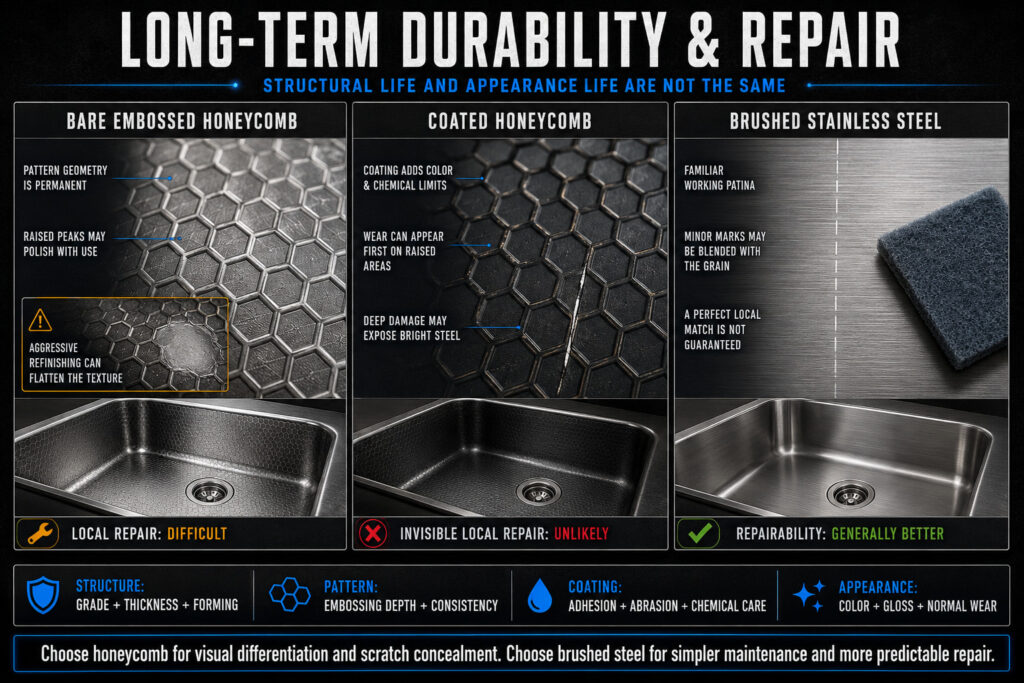
Durability should be evaluated in separate categories.
Structural durability
This depends mainly on:
- Stainless steel grade
- Actual material thickness
- Bowl structure
- Welding or forming quality
- Rim support
- Drain-area forming
- Installation
- Sound-pad and undercoating quality
Honeycomb texture does not prove that the complete sink is thicker or structurally stronger.
Embossing may add some local stiffness to a broad sheet, but it should not replace thickness and structural inspection.
Pattern durability
If the pattern is physically embossed into the steel, the geometry is permanent unless the sink is severely worn or deformed.
However, raised peaks may become polished or flattened in appearance through repeated cookware contact.
Coating durability
If a clear or colored coating is applied, the surface becomes a multilayer system.
Possible long-term changes include:
- Loss of water repellency
- Gloss change
- Wear on raised areas
- Color fading or variation
- Fine abrasion
- Local peeling or adhesion failure
- Bright metal exposure after a deep scratch
Coating performance cannot be determined from the honeycomb pattern alone.
Appearance durability
A surface can remain structurally sound while its appearance changes.
This is especially important for black and colored sinks. A shallow scratch may not affect use, but the contrast can create a customer complaint.
Which Surface Is Easier to Repair?
Brushed stainless steel
Minor surface marks may sometimes be blended into the grain using a manufacturer-approved method.
Professional refinishing can recreate a directional brushed appearance, although a perfect local match is not guaranteed.
Any abrasive repair should:
- Follow the original grain
- Use uncontaminated tools
- Avoid carbon-steel particles
- Be tested in an inconspicuous area
- Treat the complete visible area when necessary
Bare honeycomb stainless steel
The pattern cannot easily be recreated with an ordinary abrasive pad.
Aggressive polishing may flatten the raised texture or create a smooth patch that looks different under light.
Coated honeycomb stainless steel
Do not use metal polish or abrasive refinishing unless specifically approved.
An abrasive may remove:
- The transparent top layer
- The colored coating
- The gloss level
- The honeycomb peak finish
Once a colored coating is penetrated, local invisible repair may not be realistic.
The Scratch Test Buyers Should Not Use
Do not test a sink by dragging a key, knife or coin across the display sample.
This test is uncontrolled because:
- Force is inconsistent
- Contact angle varies
- Tool hardness varies
- The result cannot be compared between samples
- It intentionally damages the product
- It does not represent normal cleaning or cookware use
A serious comparison requires an agreed test method, load, contact material, number of cycles and viewing condition.
“Key test passed” is not a professional scratch-resistance specification.
How Lighting Changes the Comparison
Surface appearance changes significantly with lighting.
Inspect both finishes under:
- Diffused daylight
- Warm showroom lighting
- Cool LED lighting
- Direct side lighting
- Normal standing distance
Direct side lighting reveals:
- Brushing inconsistency
- Flattened honeycomb areas
- Coating streaks
- Fine scratches
- Gloss variation
- Dents and low spots
Catalog images can conceal these differences through exposure, angle and image processing.
B2B buyers should approve a physical sample under defined lighting rather than relying only on photographs.
Honeycomb and Sink Drainage
Honeycomb texture does not automatically improve bottom drainage.
Drainage still depends on:
- Overall bottom slope
- Local flatness
- Drain recess
- Drain flange height
- Sink installation level
- Position of the drain
Water may remain inside recessed patterns because of surface tension even when bulk drainage is acceptable.
A large puddle is a geometry problem. Small droplets in the texture are a surface-behavior issue.
Do not use honeycomb pattern claims as a substitute for an actual water test.
Does a Bottom Grid Still Help?
A bottom grid can reduce direct contact between cookware and either sink finish.
However, the grid must be correctly matched.
Check:
- Grid dimensions
- Bowl radius
- Drain opening position
- Rubber feet
- Edge clearance
- Movement during use
- Grid coating or polishing
- Cleaning access
Damaged or missing rubber feet can allow the metal grid to rub against the sink.
For model-specific requirements, see Matrix sink bottom grids.
Who Should Choose a Honeycomb Sink?
A honeycomb sink may be a good choice when:
- Visual differentiation is important
- Fine scratch concealment is a priority
- The user accepts textured-surface cleaning
- A modern multifunctional design is preferred
- The actual coating and care instructions are known
- A physical sample has been reviewed
- Replacement expectations are realistic
It can be particularly useful for retail and showroom programs that need a stronger visual difference from standard brushed sinks.
Who Should Choose Brushed Stainless Steel?
A brushed sink is usually the safer choice when:
- Easy routine cleaning is the priority
- The sink will receive heavy daily use
- Predictable long-term aging matters
- The buyer wants broad market acceptance
- Simple care instructions are important
- Local refinishing may be required
- Repeat-order finish control is needed
- The product is intended for rental or project supply
A brushed sink will scratch, but its aging behavior is familiar and easier to explain to buyers.
Consumer Buying Checklist
Before choosing between the two surfaces, ask:
- Is the honeycomb pattern embossed or printed?
- Is the surface bare stainless steel or coated?
- What is the base stainless steel grade?
- What is the actual sink thickness?
- Does the pattern cover the bowl or only the bottom?
- Is the bottom panel removable?
- What cleaners are approved?
- Are abrasive sponges prohibited?
- How will a deep scratch look?
- Can the surface be repaired?
- Does the drain area clean easily?
- Does water remain in the recessed pattern?
- Is a bottom grid included?
- Are replacement panels or accessories available?
If the supplier cannot explain the surface construction, do not rely on the term “honeycomb.”
B2B Specification Checklist
For wholesalers, kitchen brands and project buyers, “honeycomb 304 sink” is not a sufficient specification.
Base material
- Stainless steel grade
- Sheet thickness before forming
- Representative finished thickness
- Handmade or pressed construction
- Weld and drain-area treatment
Texture
- Pattern drawing
- Hexagon size
- Embossing depth
- Raised and recessed geometry
- Pattern coverage
- Pattern alignment
- Transition at corners and drain
- Permanent or removable structure
Coating
- Bare, transparent or colored
- Actual finish process
- Color and gloss target
- Coating coverage
- Approved cleaner list
- Chemical limitations
- Abrasion expectations
- Repair guidance
Visual inspection
- Agreed physical reference sample
- Viewing distance
- Lighting condition
- Pattern consistency
- Gloss consistency
- Brushing direction on untextured areas
- Acceptable surface marks
- Color tolerance
Functional testing
- Water-drainage test
- Water-spot cleaning test
- Oil and food-residue cleaning test
- Appropriate scratch or abrasion test
- Chemical-resistance test
- Hot-and-cold exposure test
- Coating adhesion evaluation where applicable
- Bottom grid contact test
Packaging
- Protective film compatibility
- No adhesive residue
- Separate accessory packaging
- Grid feet protected
- No metal-to-finish contact
- Edge and corner protection
- Finished-side identification
- Care card included
The approved appearance should be recorded for repeat orders. Pattern depth, gloss and color can vary if tooling, sheet, forming pressure or coating conditions change.
Claims B2B Buyers Should Rewrite
Avoid:
“100% scratch-proof honeycomb surface.”
Use:
“Embossed honeycomb texture designed to reduce the visibility of normal surface marks. The sink can still be scratched by abrasive tools, grit and heavy cookware.”
Avoid:
“Permanent self-cleaning nano technology.”
Use:
“Selected surface treatment may improve routine water and oil release when maintained according to the care instructions.”
Avoid:
“Honeycomb makes the steel thicker.”
Use:
“Honeycomb embossing changes the surface geometry. Base material thickness should be specified and measured separately.”
Avoid:
“Never shows water spots.”
Use:
“Textured appearance may reduce the visibility of some marks, but mineral deposits can remain when water dries.”
Accurate claims reduce returns and build more durable product trust than absolute promises.
Frequently Asked Questions
Are honeycomb stainless steel sinks really scratch-proof?
No. The texture may conceal fine marks and reduce broad cookware contact, but sharp objects, grit and heavy pans can still scratch the surface.
Does the honeycomb coating peel?
The embossed metal pattern itself cannot peel. A clear, black or colored coating applied over the pattern may wear, scratch or lose adhesion depending on the process and use.
Are honeycomb sinks harder to clean?
They can require more attention because residue may collect in the recessed pattern. A shallow open texture is generally easier to clean than a deep, narrow one.
Do brushed stainless steel sinks scratch easily?
All working stainless steel sinks develop marks. A brushed finish helps many fine scratches blend with the existing grain, especially as the surface develops a uniform patina.
Which finish hides scratches better?
A honeycomb pattern can visually break up random marks. Brushed stainless steel allows fine marks to blend into its directional grain. Deep scratches remain visible on both.
Which finish is more durable?
There is no universal winner. Bare brushed stainless steel has a simple, repairable surface system. Honeycomb may conceal wear better, but a coated version adds a layer that must also remain intact.
Can I use steel wool on either sink?
No. Steel wool can scratch the surface and leave carbon-steel particles that later rust. Use the approved non-scratching cleaning tools.
Can I polish scratches out of a honeycomb sink?
Usually not without changing the pattern or coating. Aggressive polishing can flatten the texture or expose the base metal.
Can a brushed sink be refinished?
Some brushed stainless steel surfaces can be professionally regrained. Local repair may still remain visible if the new grain does not match the original finish.
Does honeycomb prevent water spots?
No. It may change how spots appear, but minerals remain when water evaporates. Rinsing and drying remain the most reliable prevention.
Is a black honeycomb sink less durable than a silver one?
Not necessarily, but damage can be more visible. A deep scratch through a black coating may expose bright silver steel and create strong contrast.
Does honeycomb texture improve drainage?
Not by itself. Bottom slope, flatness, drain recess and installation level determine bulk drainage.
Final Verdict
Honeycomb stainless steel sinks can provide real visual differentiation and may make fine everyday marks less noticeable.
But the honeycomb pattern should not be treated as proof that the sink is:
- Scratch-proof
- Self-cleaning
- Stain-proof
- Thicker
- Better draining
- More corrosion-resistant
A brushed stainless steel sink offers a simpler surface, easier routine cleaning and more predictable long-term aging. It will develop scratches, but many marks blend into the grain and specialist refinishing may be possible.
A honeycomb sink is the better choice when the buyer values texture, modern appearance and scratch concealment—and understands the cleaning and repair limitations.
A brushed sink is the better choice when easy maintenance, broad market acceptance and practical long-term service matter more than visual novelty.
Matrix supplies stainless steel kitchen sinks with brushed, satin, selected PVD, nano and honeycomb surface directions for wholesale, project and private-label programs.
For colored honeycomb options, buyers should also review the Matrix guide to PVD and colored stainless steel sinks.
To compare substrate, pattern, coating, accessories and sample requirements for a specific market, contact the Matrix team before approving the final specification.