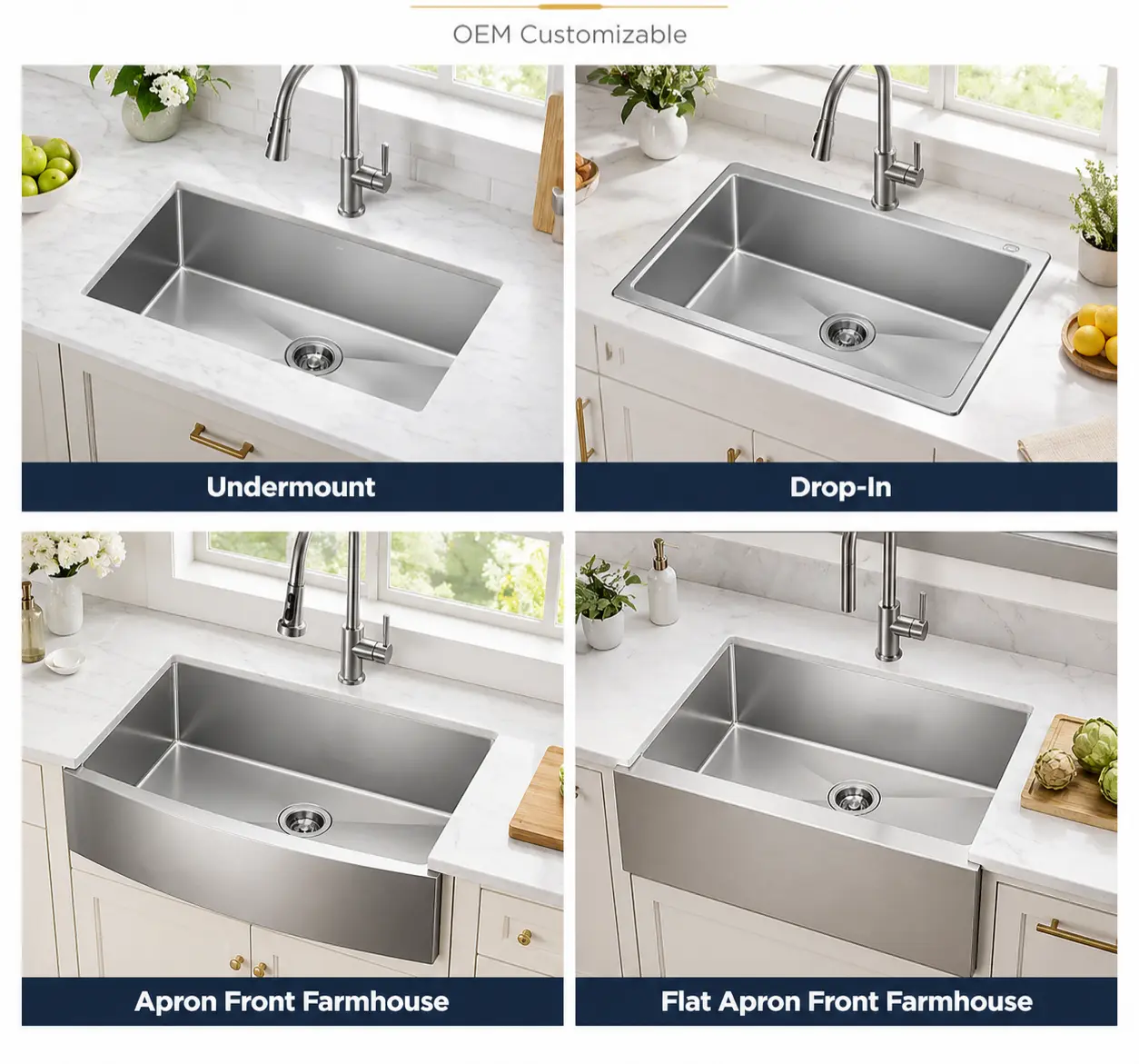
Quick Answer
For a stainless steel sink RFQ, specify four things clearly:
- Material grade — for example, SUS304
- Actual thickness in millimeters — not gauge alone
- What the thickness refers to — starting sheet, bowl body, rim, or minimum finished thickness
- Where finished thickness should be measured — especially for pressed / drawn sinks
For a handmade sink, different structural parts should be listed separately if they use different thicknesses.
For a pressed sink, the starting sheet thickness and finished thickness are not automatically the same because deep drawing stretches the stainless steel.
A clearer RFQ is:
SUS304, pressed / drawn, 1.2 mm starting sheet thickness. Finished thickness at critical formed areas to be reviewed during sample approval.
not simply:
18 Gauge SUS304.
Why “16 Gauge” or “18 Gauge” Is Not Enough
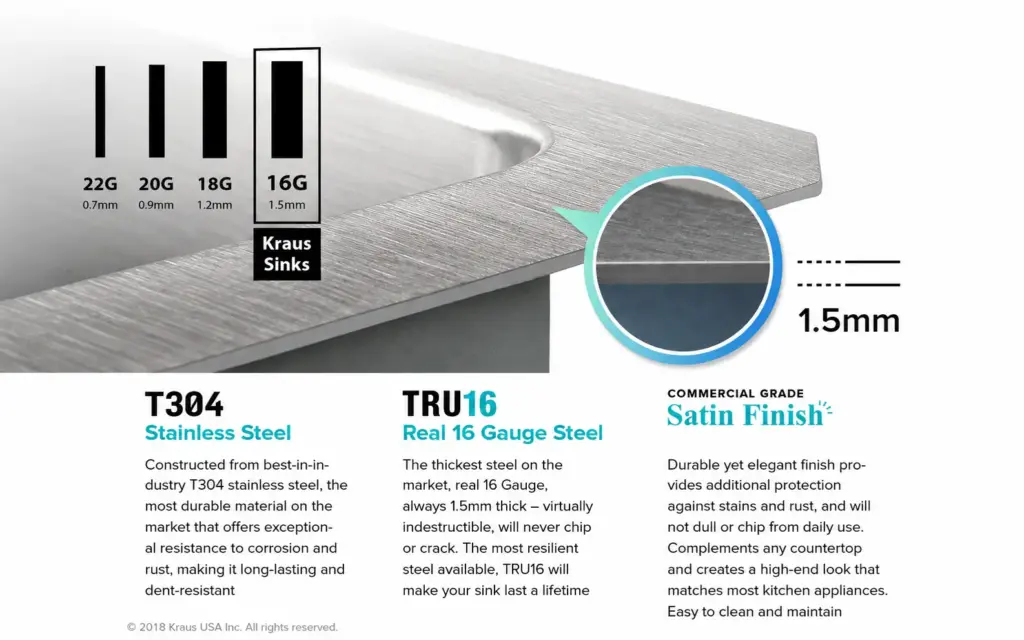
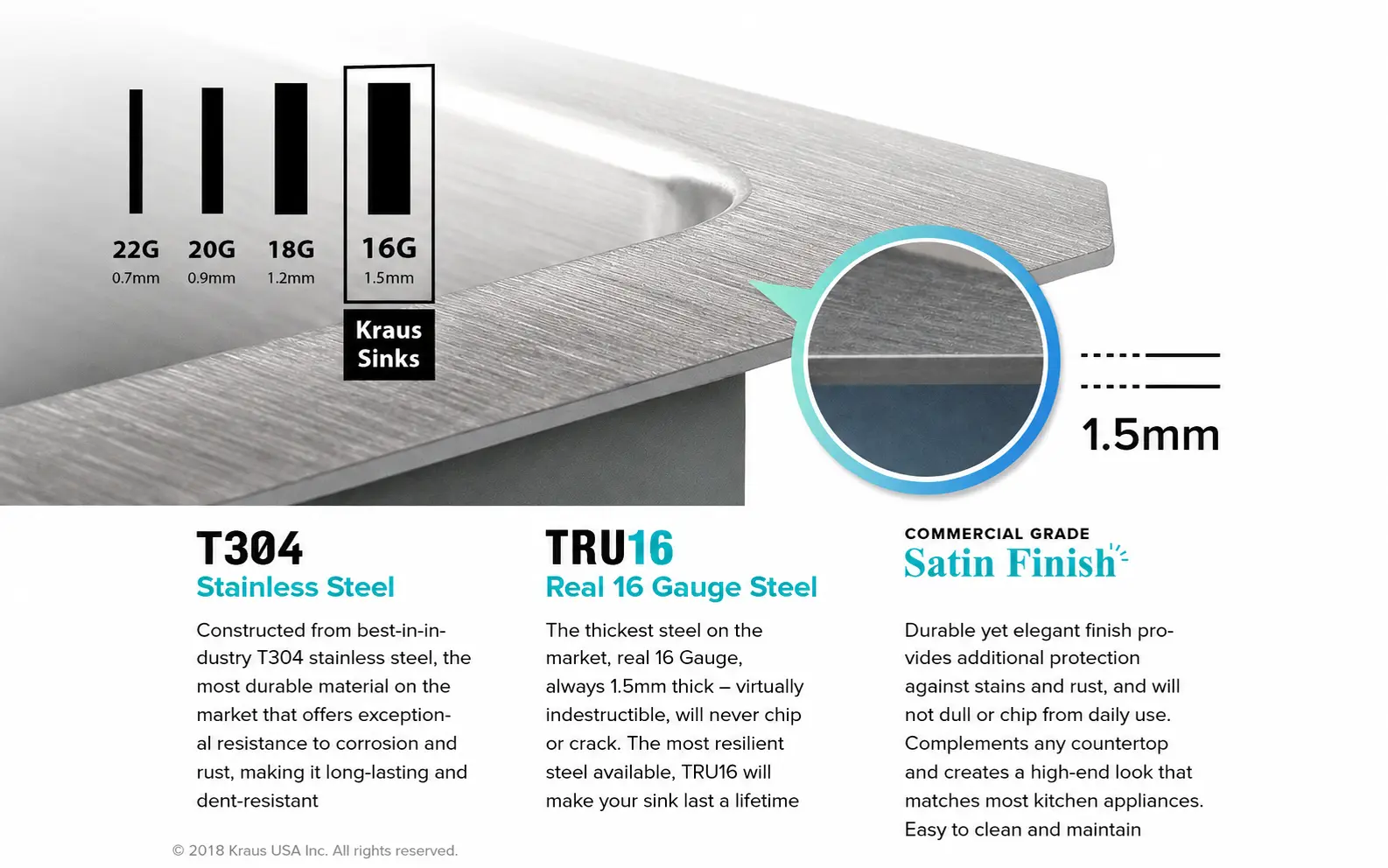
Gauge describes a nominal thickness category.
It does not tell the manufacturer:
- whether the value refers to incoming sheet or finished sink
- whether the rim and bowl use the same thickness
- whether thinning after forming is acceptable
- where thickness should be measured
- what minimum value must be maintained
This is why two suppliers can both quote an “18-gauge sink” while supplying products with different actual thickness profiles.
Handmade Sink: Specify Each Structural Thickness
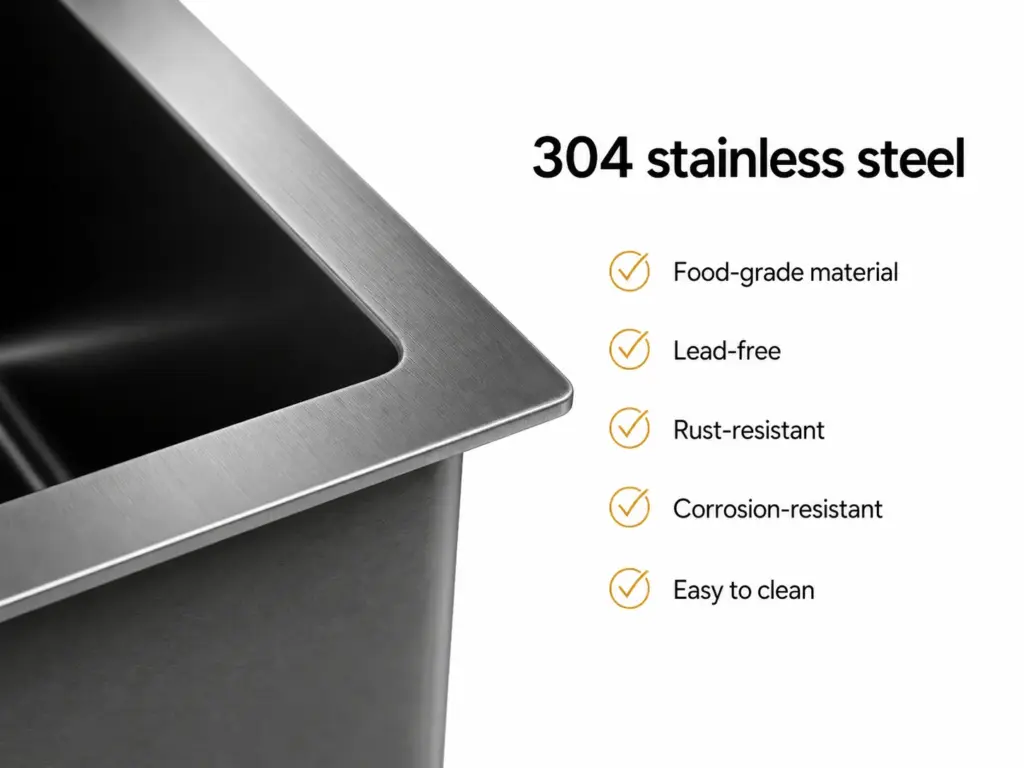
Handmade sinks are cut, bent, welded and polished rather than deep drawn.
Because of that, their thickness specification is generally easier to define.
However, one handmade sink may still use more than one material thickness.
For example:
| Component | Specification |
|---|---|
| Material | SUS304 |
| Bowl Body | 0.8 mm |
| Upper Rim / Plate | 3.0 mm |
| Production | Handmade |
| Installation | Top Mount |
This should not be shortened to:
SUS304, 3.0 mm sink
because the bowl itself is not 3.0 mm.
For custom handmade projects, define the thickness of every structural part that affects cost or performance.
See Matrix’s Handmade Kitchen Sink manufacturing options for the types of dimensions and structures that can be customized.
Pressed Sink: Separate Starting Thickness from Finished Thickness
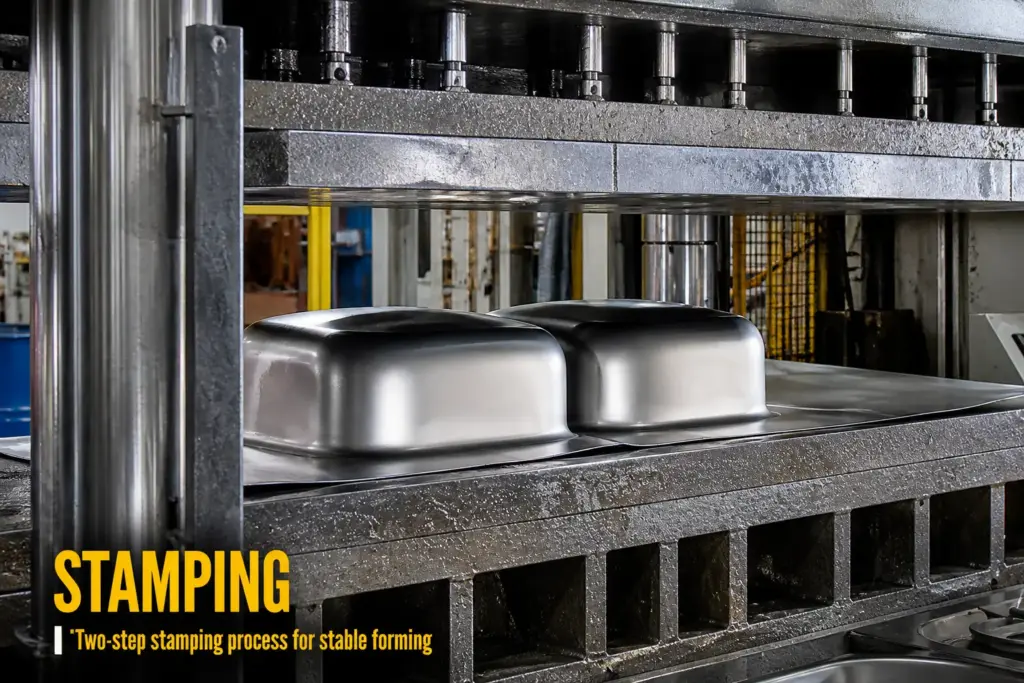
Pressed / drawn sinks are different.
A stainless steel sheet is drawn into the mold under pressure. During forming, the material stretches and redistributes.
That means one finished sink can contain:
- relatively thicker areas near the flange
- thinner sidewalls
- thinner lower-radius areas
- different thickness around heavily formed sections
So this specification:
1.0 mm pressed sink
is still incomplete.
The buyer should ask:
Is 1.0 mm the starting sheet thickness or the minimum finished thickness?
Starting Sheet Thickness
The stainless steel thickness before drawing.
Example:
SUS304, 1.0 mm starting sheet
Finished Thickness
The thickness measured on the sink after forming.
The value can vary by location.
If minimum finished thickness matters to your program, both the acceptance value and measurement locations should be agreed before sample approval.
See the Stainless Steel Sink Manufacturing Process for how handmade and pressed production differ.
Where Should a Pressed Sink Be Measured?
One reading does not represent the entire sink.
For a pressed sink, useful measurement locations may include:
- flange / rim
- upper sidewall
- middle sidewall
- lower sidewall
- lower corner radius
- bowl bottom
- drain-forming area
The exact map depends on the sink geometry.
A deeper bowl or tighter forming radius can produce a different thickness distribution from a shallower sink.
If thickness is a critical acceptance requirement, include the measurement map in the sample approval record.
Do Not Measure Only at the Flange
This is one of the easiest ways to misunderstand a pressed sink specification.
The flange is usually one of the least severely formed parts of the sink.
A supplier showing:
1.0 mm at the flange
does not prove:
minimum finished thickness = 1.0 mm throughout the bowl.
For pressed products, the critical areas are normally the locations affected most by drawing.
Weight Does Not Prove Minimum Thickness
A heavier sink is not automatically thicker at every point.
Sink weight is affected by:
- overall dimensions
- bowl dimensions
- bowl depth
- flange width
- corner radius
- reinforcement
- sound pads
- undercoating
- accessory structure
For example, a larger sink can weigh more while still having a thinner lower sidewall.
The useful distinction is:
Weight measures the whole product. Thickness measures a specific location.
If minimum thickness matters, measure thickness directly.
Gauge vs Millimeters: Which Should Be Used in an RFQ?
For international sourcing, use millimeters as the primary technical specification.
For example:
SUS304, 1.2 mm
is clearer than:
18 Gauge
Gauge can still be shown as a market reference:
SUS304, nominal 1.2 mm, commonly marketed as 18 gauge.
This reduces interpretation differences between suppliers.
A Better Handmade Sink RFQ Example
Instead of:
16 Gauge handmade sink
use:
Material: SUS304
Production: Handmade
Bowl Body: 1.2 mm
Upper Rim: 1.2 mm
Overall Size: 800 × 500 mm
Bowl Depth: 220 mm
Installation: Undermount
Finish: Brushed
If the structure uses different thicknesses:
Bowl Body: 0.8 mm
Upper Plate: 3.0 mm
state both separately.
A Better Pressed Sink RFQ Example
Instead of:
SUS304, 18 Gauge pressed sink
use:
Material: SUS304
Production: Pressed / Drawn
Starting Sheet: 1.2 mm
Finished Thickness: Critical formed areas to be reviewed during sample approval
Measurement Points: Flange, sidewall, lower radius and bowl bottom
Acceptance Reference: Approved drawing / sample
If your project requires a minimum finished thickness, replace the general wording with the actual agreed requirement.
What Should Be Frozen at Sample Approval?
For thickness-sensitive products, record:
- material grade
- starting sheet thickness
- structural thicknesses
- finished thickness requirement where applicable
- measurement locations
- actual sample readings
- drawing revision
- production method
Do not leave repeat production dependent on:
“Same as last order.”
The approved drawing and inspection record should carry the requirement forward.
Common Thickness RFQ Mistakes
| RFQ Wording | Problem | Better Specification |
|---|---|---|
| SUS304 sink | No thickness | Add actual mm |
| 18 Gauge | Gauge interpretation | Add mm |
| 1.2 mm pressed sink | Starting or finished unclear | Define thickness stage |
| Heavy-duty sink | Not measurable | Define actual thickness |
| Minimum 1.0 mm | No measurement point | Define locations |
| Same as sample | Weak repeat-order reference | Record drawing + measurements |
| 3.0 mm handmade sink | May describe only rim | Separate rim and bowl |
Buyer Checklist Before Sending the RFQ
Confirm:
- handmade or pressed / drawn
- SUS grade
- actual thickness in mm
- gauge if commercially required
- starting vs finished thickness
- rim and bowl thickness separately if different
- finished measurement locations if critical
- overall dimensions
- bowl depth
- installation type
- quantity
For the full product specification, use the Matrix Kitchen Sink RFQ Checklist.
FAQ
Does deep drawing make a pressed sink thinner?
Yes, some areas can become thinner because stainless steel stretches during drawing. The amount and location of thinning depend on bowl depth, geometry, radius and forming conditions.
Is the rim thickness the same as bowl thickness?
Not necessarily. This is particularly important for pressed sinks and handmade sinks using reinforced upper structures.
Is sink weight enough to confirm 16 gauge or 18 gauge?
No. Weight is affected by the complete product geometry and additional materials. Actual steel thickness should be measured directly.
Should thickness be specified in gauge or millimeters?
Millimeters are preferable as the primary manufacturing specification. Gauge can be added as a commercial or market reference.
What should buyers ask a supplier about a pressed sink thickness?
Ask whether the quoted value is starting sheet thickness or finished thickness, and where finished thickness will be measured.
Need to Quote a Sink Program?
Use the Kitchen Sink RFQ Checklist to define dimensions, material, thickness, finish, accessories, packaging and quantity before requesting pricing.
For custom dimensions or structures, review Custom Kitchen Sink Programs.