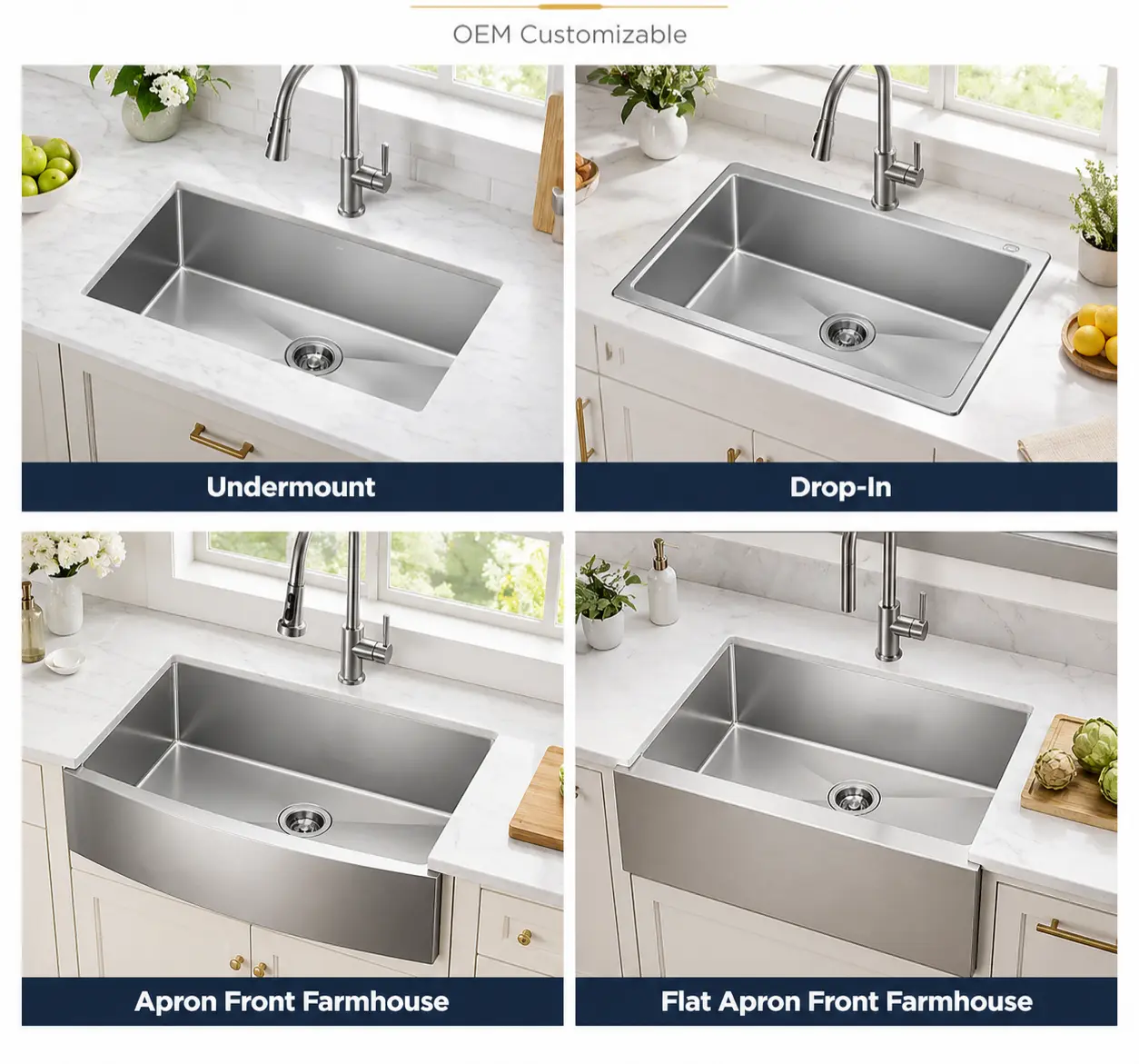
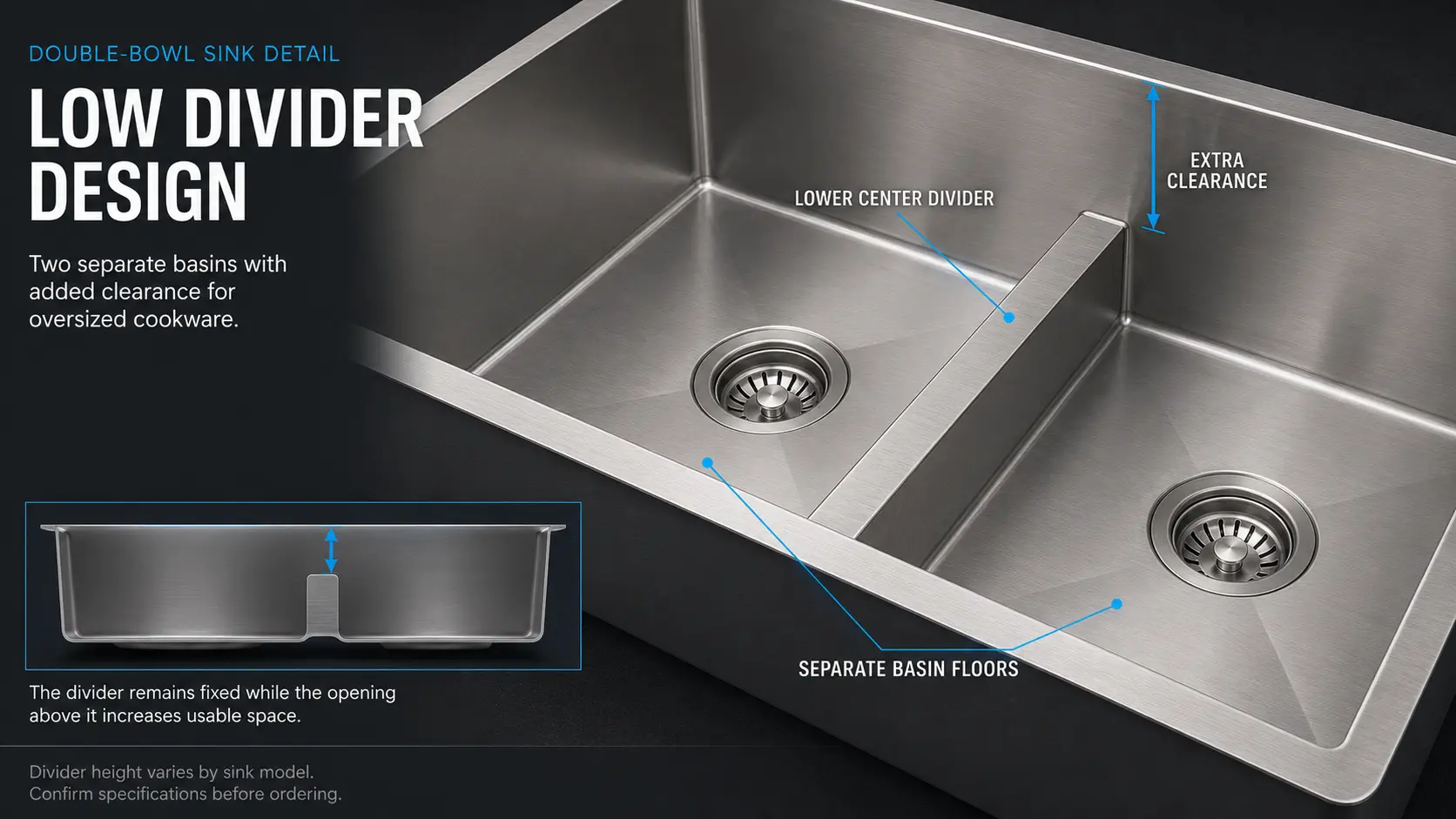
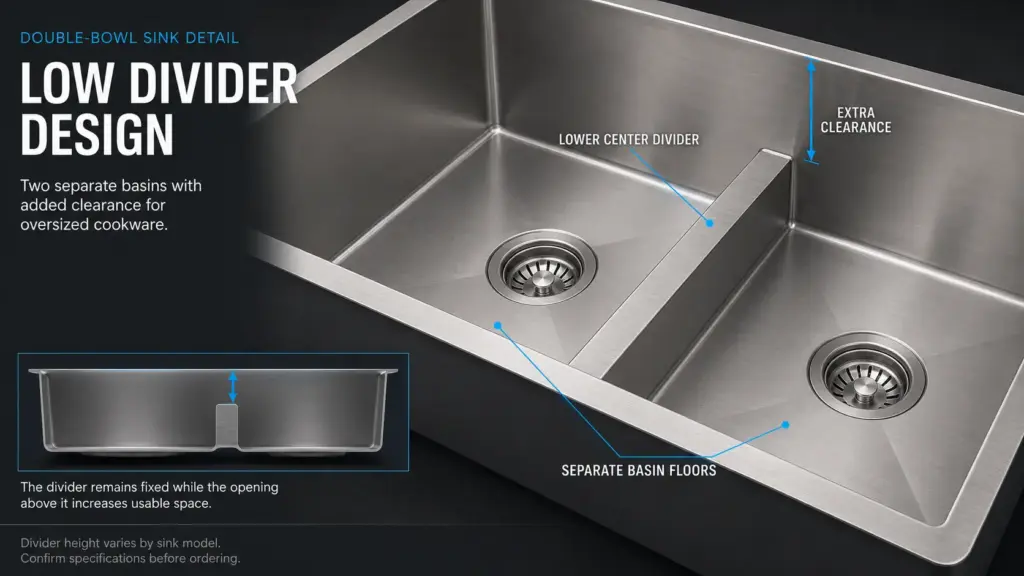
A low-divide kitchen sink has two bowls separated by a center divider that stops below the sink rim. It preserves separate washing and rinsing zones while allowing pans, trays and other long items to extend across both bowls.
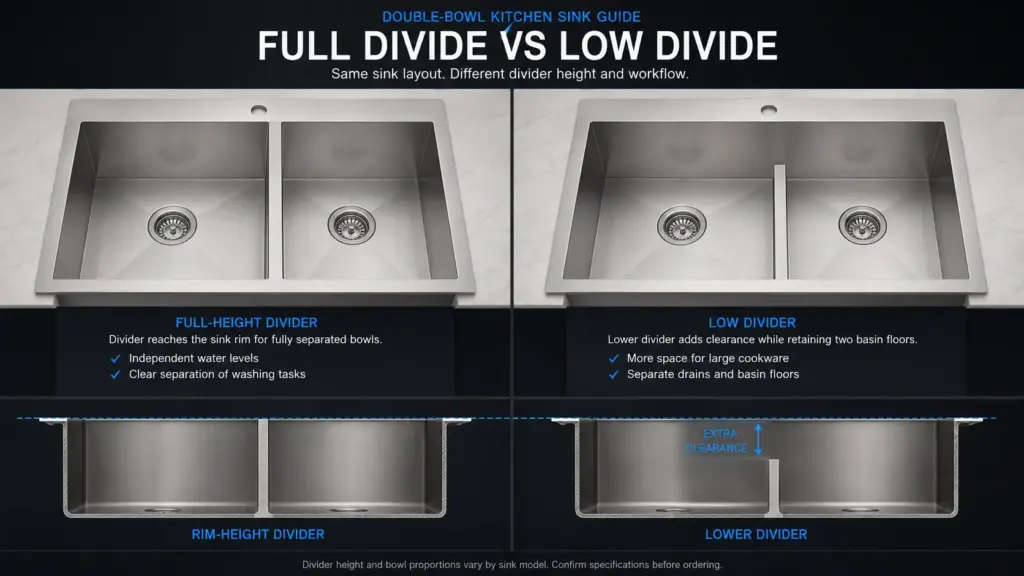
The concept sounds like the perfect compromise between a single bowl and a conventional double bowl. Sometimes it is. But its performance depends less on the label “low divide” and more on four measurable details:
- Divider height;
- Usable internal bowl dimensions;
- Bowl ratio;
- Drain and accessory layout.
A 60/40 low-divide sink can be highly practical when these details work together. The same nominal configuration can be frustrating when the divider is too high, the small bowl is too narrow or the drains consume too much cabinet space.
The Short Answer: Who Should Choose a Low-Divide Sink?
A low-divide sink is a strong choice when you want:
- Two zones for washing, rinsing or food preparation;
- More clearance for baking sheets and long cookware;
- A larger main bowl without losing a secondary bowl;
- A bridge between traditional double-bowl and modern single-bowl designs.
It may not be the best choice when you want:
- One completely open basin;
- Maximum independent soaking depth in both bowls;
- The simplest possible drain and disposal layout;
- Universal bottom grids and replacement accessories;
- A compact sink where dividing the available width creates two undersized bowls.
The correct question is therefore not simply, “Is a low-divide sink better?”
The better question is:
Does the divider height, bowl ratio and usable internal space match the way the sink will actually be used?
What Is a Low-Divide Kitchen Sink?
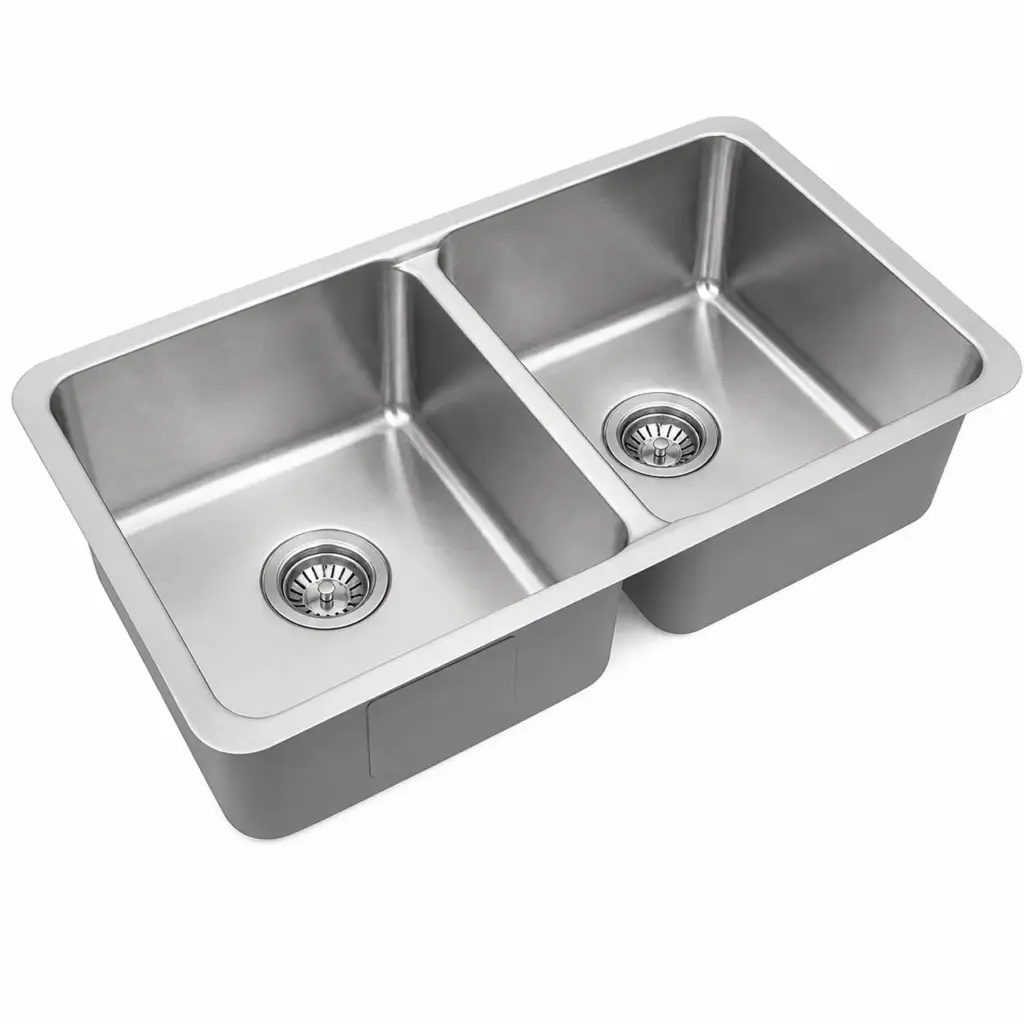
A conventional double-bowl sink has a center divider that rises close to the sink rim. Each bowl functions as a relatively independent basin.
A low-divide sink lowers that center wall. The bowls remain separate below the divider, but larger items can rest or extend across both sides more easily.
This creates three possible operating zones:
- The left bowl below the divider;
- The right bowl below the divider;
- The combined area above the divider.
That last zone is the main advantage. A long tray may not fit flat inside either bowl, but it can extend across the lowered center wall during rinsing or cleaning.
However, the sink does not become a true single bowl. The two bowl floors, drains and lower washing areas remain separate.
Low Divide vs Full Divide vs Single Bowl
| Design | Main advantage | Main limitation | Best suited for |
|---|---|---|---|
| Low-divide double bowl | Two work zones with better clearance for large items | Reduced independent fill depth | Flexible washing and preparation |
| Full-divider double bowl | Strong separation and deeper independent filling | Large cookware is restricted by the divider | Traditional wash-and-rinse routines |
| Single bowl | Maximum uninterrupted bowl space | No built-in separation | Large cookware, baking sheets and simple plumbing |
A low divide is most useful for someone who values separation but finds a full-height divider restrictive.
If separation is not important, a single bowl may still provide more usable space and simpler plumbing.
Divider Height Matters More Than the Name
“Low divide” is not a universal dimension.
Two sinks can both use that description while having noticeably different divider heights. One may place the divider only a few inches above the bowl floor. Another may lower it only slightly below the rim.
The specification should record divider height in two ways:
- From the bowl floor to the top of the divider;
- From the sink rim down to the top of the divider.
Both measurements matter.
Why measure from the bowl floor?
This measurement determines how much water one side can hold before water crosses into the other bowl.
Why measure from the sink rim?
This measurement shows how much clearance the divider provides for trays, pans and long cookware.
A divider can provide good cookware clearance but insufficient water depth. It can also hold plenty of water while remaining too high to solve the main problem of a conventional double bowl.
The Hidden Measurement: Independent Fill Depth
The full bowl depth is not the independent fill depth of a low-divide sink.
Consider a sink with:
- 9-inch bowl depth;
- 4-inch divider height measured from the bowl floor.
Although the bowl is 9 inches deep, one side can hold water independently only to approximately the top of the 4-inch divider. Above that level, water can cross into the other bowl.
Conceptually:
Independent fill depth ≈ vertical distance from the bowl floor to the top of the divider.
If a bottom grid raises dishes 3/4 inch above the bowl floor, the practical wash depth above the grid becomes smaller:
Practical depth above grid ≈ divider height − grid elevation.
Using the same example:
- Divider height: 4 inches;
- Grid elevation: 3/4 inch;
- Practical depth above grid: approximately 3 1/4 inches.
This does not make the sink unusable. Many users do not fill a bowl deeply. But buyers who regularly soak cookware should evaluate divider height before choosing a low-divide design.
Bowl Ratio Does Not Always Equal Usable Capacity
Labels such as 50/50, 60/40 and 70/30 describe the approximate relationship between the two bowls. They should not be treated as exact volume calculations.
Usable capacity is also affected by:
- Internal bowl length;
- Internal bowl width;
- Bowl depth;
- Divider thickness;
- Corner radius;
- Sloped bowl walls;
- Drain position;
- Workstation ledges;
- Installation flange.
For example, two different 60/40 sinks can provide different usable space if one has a thicker divider, larger corner radii or a shallower secondary bowl.
For product comparison, use the internal dimensions shown on the current technical drawing. Do not compare bowl ratios using the marketing label alone.
50/50 Low-Divide Sinks
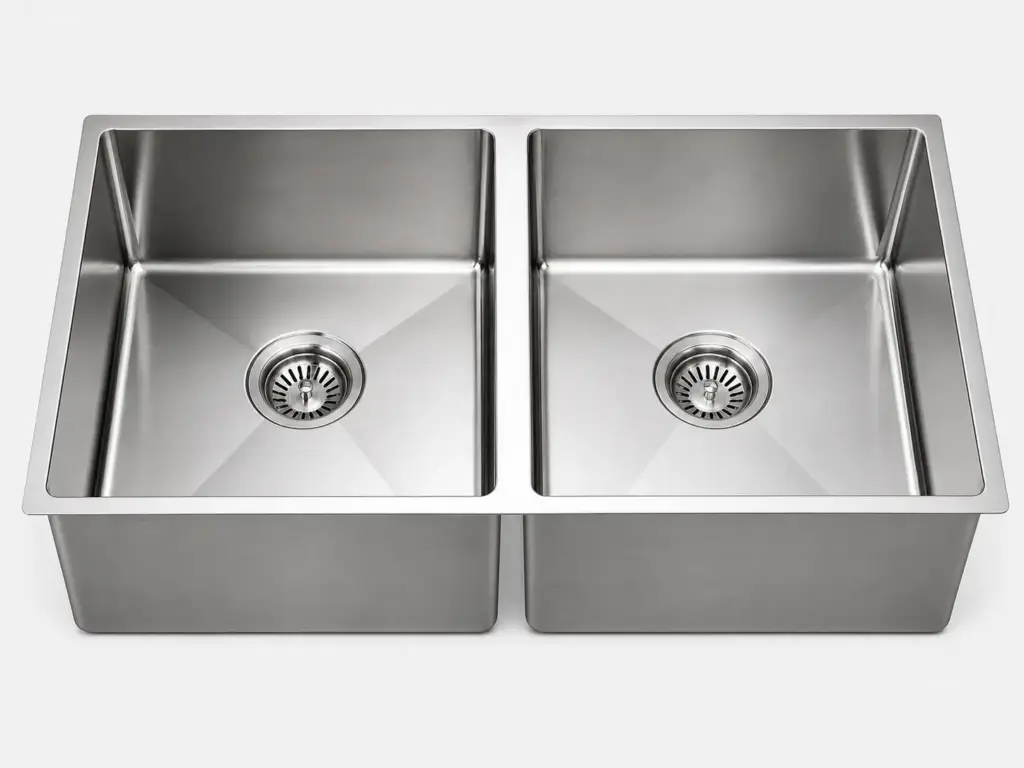
A 50/50 sink has two bowls of approximately equal size.
Where it works well
A 50/50 layout is useful when both bowls perform similar tasks. One side can be used for washing while the other is used for rinsing, draining or holding dishes.
It also provides:
- A balanced appearance;
- Similar reach into either bowl;
- Fewer left/right orientation concerns;
- Potentially simpler grid and accessory planning;
- A familiar layout for traditional double-bowl users.
Where it can fail
The main risk is that dividing the sink equally leaves neither bowl large enough.
In a compact sink, two equal bowls may both be too narrow for large cookware. Lowering the divider improves top clearance, but it does not increase the internal width of either bowl.
Best applications
- Traditional residential kitchens;
- Apartment and rental projects;
- Retail replacement programs;
- Markets where users prefer equal washing and rinsing zones;
- Product collections that favor symmetry.
60/40 Low-Divide Sinks
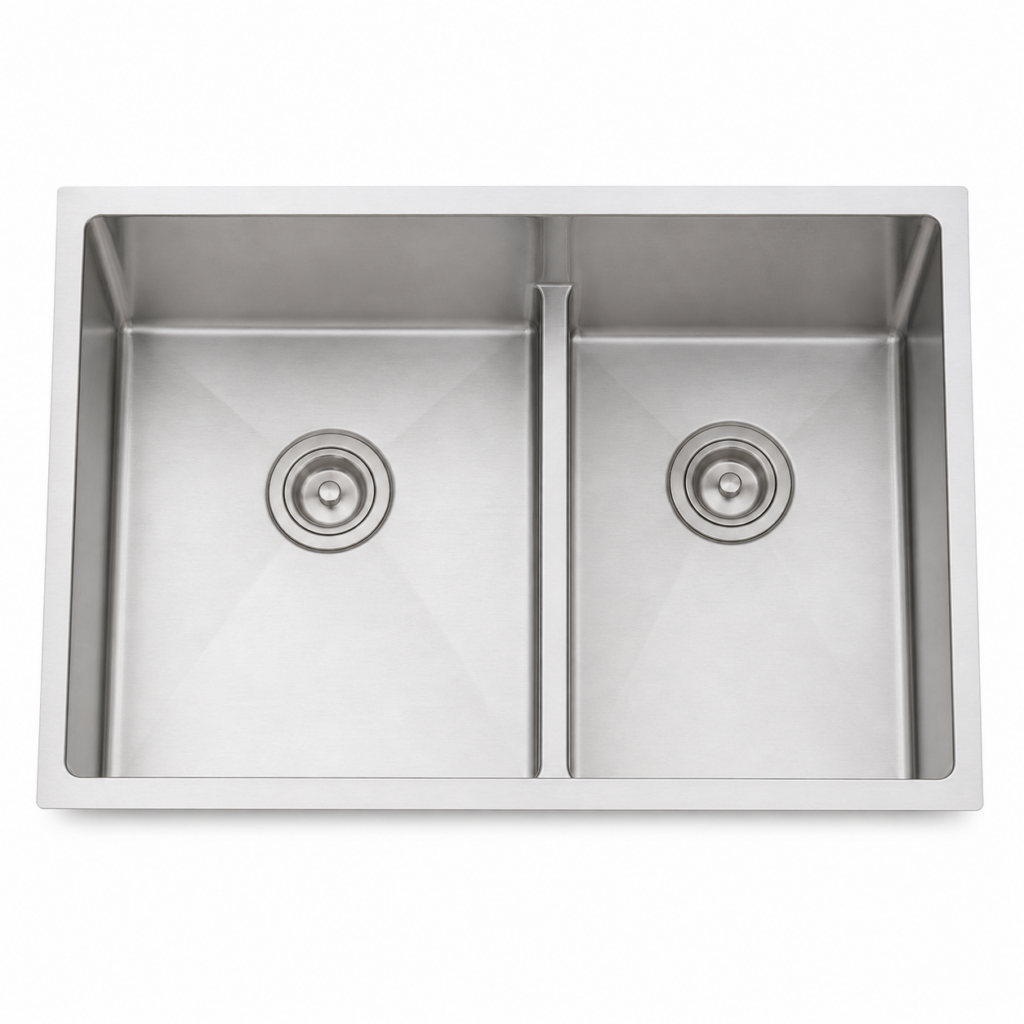
A 60/40 sink has one larger main bowl and one smaller secondary bowl.
This configuration often provides a useful balance, but only when the smaller bowl remains functional.
Where it works well
The larger bowl can handle:
- Pots and pans;
- Stacked dishes;
- Food preparation;
- Larger bottom grids;
- More general washing tasks.
The smaller bowl can support:
- Rinsing;
- Vegetable preparation;
- A garbage disposal;
- Utensil separation;
- Draining smaller items.
The low divider allows longer cookware to bridge both sides when necessary.
Where it can fail
The secondary bowl may be too narrow for meaningful use. This is especially likely when the overall sink is small.
Other risks include:
- Separate left and right grid sizes;
- Fixed large-bowl orientation;
- More complicated drain planning;
- Reduced reversibility;
- A small bowl that becomes an expensive accessory holder rather than a useful basin.
Best applications
- Mid-to-premium residential collections;
- Users who want a larger primary washing area;
- Modern replacement programs;
- Kitchens that combine washing, rinsing and preparation;
- Distributors seeking an alternative between equal double bowls and single bowls.
70/30 Low-Divide Sinks
A 70/30 sink gives most of the available width to one primary bowl and retains a compact secondary bowl.
Where it works well
The larger side feels closer to a single-bowl sink and may accommodate more cookware. The small side can be assigned a specific secondary function.
This layout can work well when the small bowl is used for:
- A garbage disposal;
- Produce rinsing;
- Utensils;
- Draining;
- Limited food preparation.
Where it can fail
A secondary bowl without a defined purpose quickly becomes wasted space.
The small bowl may also create challenges with:
- Bottom-grid availability;
- Drain access;
- Disposal clearance;
- Colander fit;
- Cleaning reach;
- Replacement accessories.
A 70/30 configuration is most successful when the overall sink is wide enough to keep the smaller bowl functional.
Best applications
- Larger sink cabinets;
- Premium kitchen collections;
- Buyers who primarily want a large main bowl;
- Markets moving toward single bowls but retaining some demand for separation.
Which Bowl Ratio Is Best?
There is no universally best bowl ratio.
Use the following decision guide:
| User requirement | More suitable starting point |
| Equal washing and rinsing zones | 50/50 |
| Large main bowl plus useful secondary bowl | 60/40 |
| Single-bowl feel with a compact secondary function | 70/30 |
| Maximum uninterrupted space | Single bowl |
| Maximum independent soaking depth | Full-divider double bowl |
| Large cookware plus task separation | Low-divide 60/40 or 70/30 |
The overall sink size can change the answer. A 60/40 split in a wide sink may provide two useful bowls, while the same ratio in a smaller sink may produce an impractically narrow secondary bowl.
Six Product Measurements to Confirm
Before selecting or sourcing a low-divide sink, confirm these six measurements.
1. Usable internal bowl width
Measure inside the bowl rather than across the outer rim.
2. Usable internal bowl length
Confirm whether the largest cookware fits inside the main bowl or must bridge the divider.
3. Bowl depth
Check both bowls. Offset designs do not always use equal depths.
4. Divider height
Record the height from the bowl floor and the distance below the rim.
5. Divider thickness
A thick divider can reduce usable bowl width and affect the available space for accessories.
6. Drain position
Confirm the drain location separately for each bowl.
Does the Small Bowl Go on the Left or Right?
There is no universal correct orientation.
The decision should consider:
- Dishwasher location;
- Garbage disposal position;
- Main food-preparation area;
- Faucet position;
- Drain and P-trap layout;
- Under-sink waste bins;
- Water-filtration equipment;
- Local user preference.
Do not assume that an offset bowl is reversible.
A model may appear symmetrical from above but still have:
- Fixed faucet holes;
- Different bowl depths;
- Specific drain positions;
- Asymmetrical flanges;
- Model-specific workstation ledges;
- Left- and right-specific accessories.
For wholesale and project orders, the orientation should be written into the model number, drawing, carton label and purchase order.
Drain Layout Can Decide Whether the Sink Works
A low-divide sink usually has two drains. The sink may be practical above the countertop but difficult to install if the drain layout is not coordinated with the cabinet.
Confirm:
- Distance between drain centers;
- Rear, center or offset drain position;
- Garbage disposal dimensions;
- P-trap routing;
- Dishwasher connection;
- Water-filter location;
- Pull-out waste-bin clearance;
- Cabinet depth;
- Available height below each bowl.
A deep bowl combined with a garbage disposal can lower the waste connection significantly. The bowl ratio should therefore be reviewed together with plumbing, not as an isolated design choice.
Does a Low Divide Cause More Splashing?
Not automatically.
Splashing is more directly affected by:
- Faucet height;
- Spout reach;
- Water pressure;
- Aerator flow pattern;
- Water landing point;
- Bowl depth;
- Drain position;
- Bowl-bottom geometry.
However, water can cross between bowls sooner because the divider is lower. A strong spray directed toward the divider may also send water into the other bowl.
The sink and faucet should therefore be evaluated as a system, particularly when they will be sold together in one retail package.
What About Workstation Accessories?
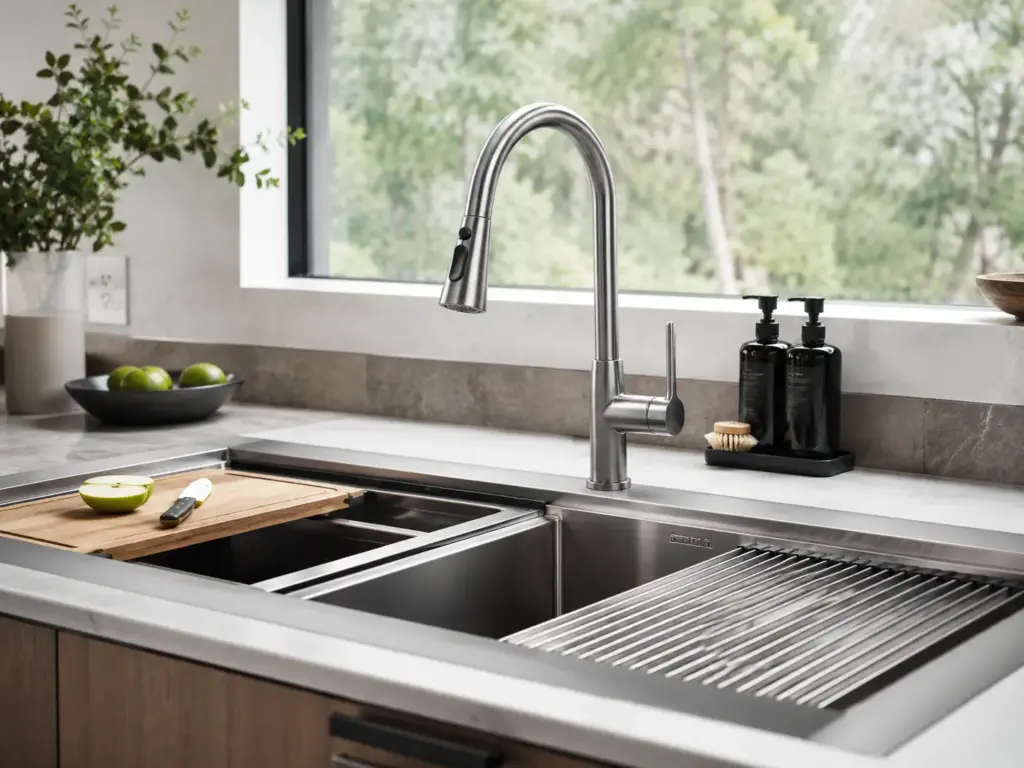
Adding a low divider to a workstation sink increases accessory complexity.
The following dimensions must work together:
- Workstation ledge width;
- Bowl opening;
- Divider position;
- Cutting-board length;
- Colander width;
- Roll-up rack span;
- Bottom-grid size;
- Accessory clearance.
An accessory that fits the larger bowl may not fit the smaller bowl. A cutting board may also collide with the divider or lose support when moved between working positions.
For B2B product programs, each accessory should be approved against the exact sink model. “Fits a 33-inch sink” is not a sufficient specification.
Stainless Steel vs Granite Composite Low-Divide Sinks
The low-divider concept is available in more than one material, but the manufacturing and product-development implications differ.
Stainless steel
Stainless steel low-divide sinks may be handmade or pressed/drawn.
Advantages can include:
- Lower product weight;
- Flexible handmade dimensions;
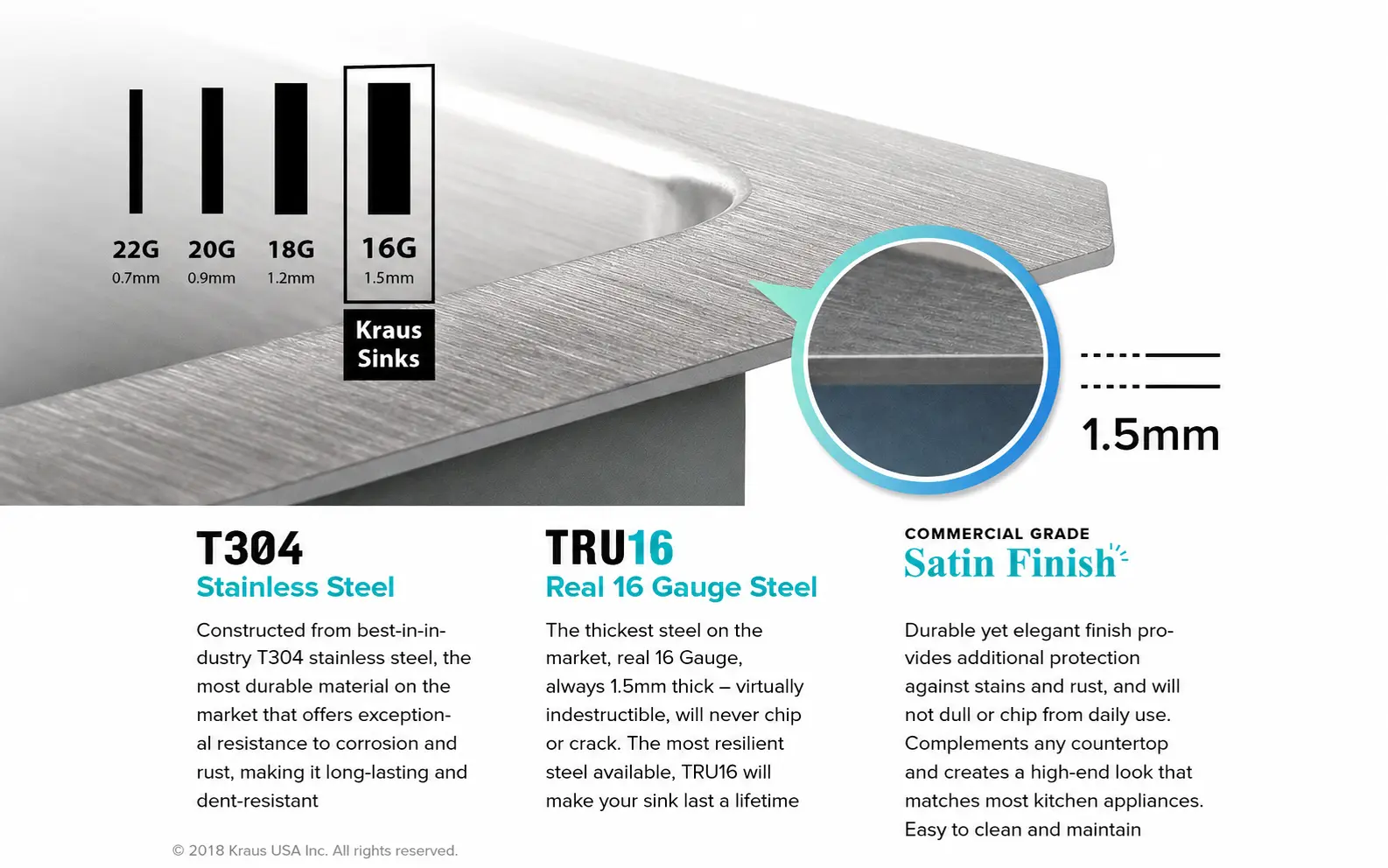
- Different gauge options;
- Easier integration with workstation designs;
- Brushed, satin, black or selected colored finishes.
Important checks include:
- Divider alignment;
- Rim flatness;
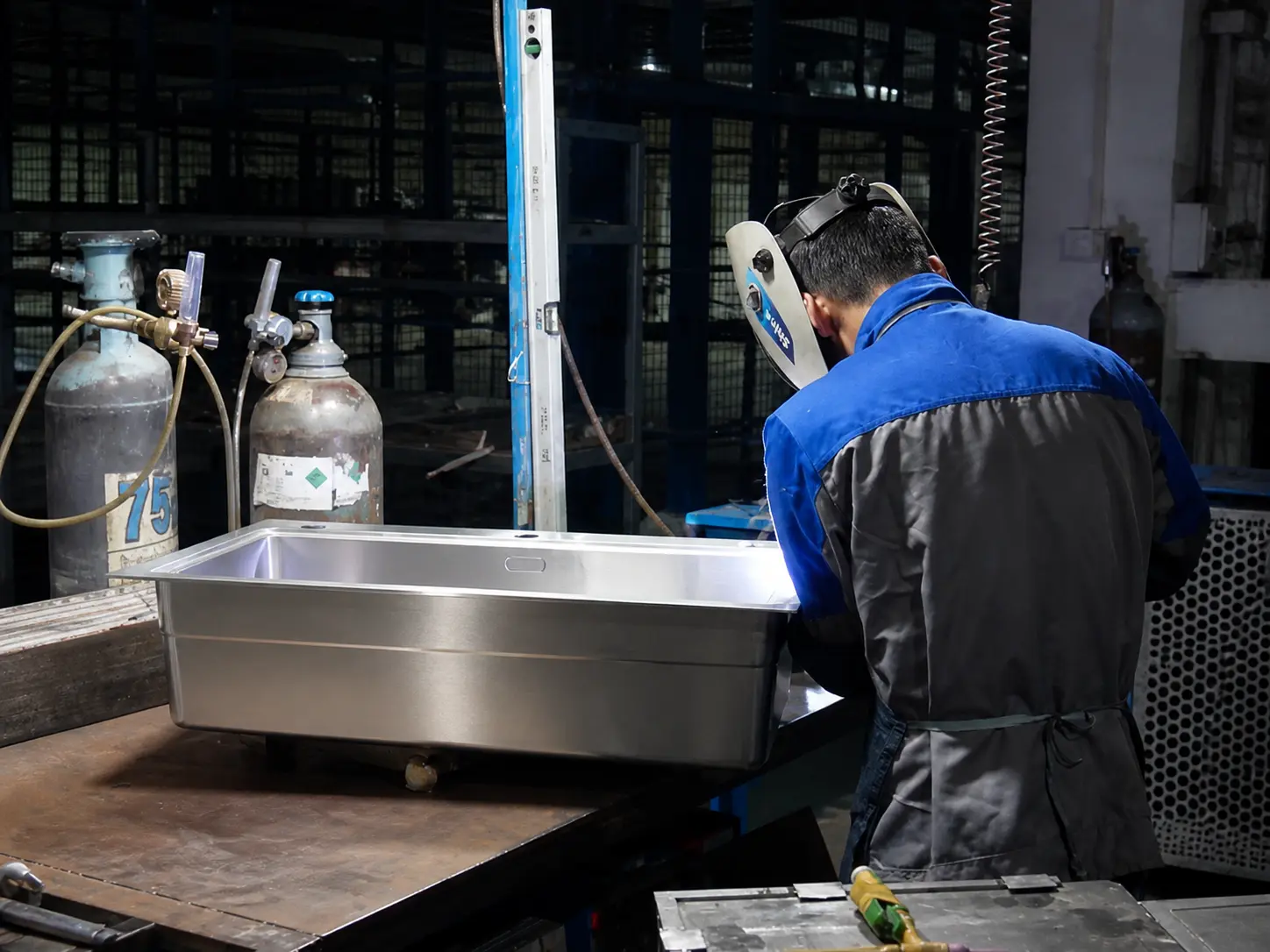
- Welding and polishing on handmade models;
- Formed thickness on pressed models;
- Surface consistency;
- Sound pads and undercoating;
- Packaging protection.
Granite composite
Granite composite low-divide sinks are generally mold-dependent.
Advantages can include:
- Color throughout the product body;
- A heavier, solid feel;
- Molded bowl and divider transitions;
- Coordinated color collections.
Important checks include:
- Mold availability;
- Product weight;
- Color consistency;
- Surface care requirements;
- Hard-water visibility;
- Impact protection in packaging;
- Countertop and cabinet support.
The divider decision remains the same in both materials: its height must balance cookware clearance against independent bowl capacity.
Handmade vs Pressed Stainless Steel Low Divides
Handmade construction
Handmade fabrication offers greater flexibility for:
- Custom bowl ratios;
- Custom divider height;
- Deep bowls;
- Workstation ledges;
- Drain positions;
- Smaller OEM development programs.
The critical control points are:
- Divider alignment;
- Weld continuity;
- Grinding and polishing;
- Corner consistency;
- Bowl dimensions;
- Rim flatness.
Learn more about Matrix handmade kitchen sinks.
Pressed or drawn construction
Pressed low-divide sinks are formed using tooling. They are well suited to:
- Standardized bowl geometry;
- Stable-volume production;
- Retail replacement programs;
- Apartment projects;
- Cost-controlled product lines.
Changes to bowl ratio or divider height may require mold modification or new tooling. An existing mold can therefore be more practical for early market testing.
Explore Matrix pressed and drawn kitchen sinks.
Common Mistakes When Choosing a Low-Divide Sink
Mistake 1: Choosing by ratio alone
A 60/40 label does not confirm usable bowl dimensions.
Mistake 2: Ignoring divider height
Bowl depth does not tell you how deeply one side can be filled.
Mistake 3: Forgetting the bottom grid
A raised grid reduces the practical washing depth above the grid.
Mistake 4: Assuming the sink is reversible
Faucet holes, drains, bowl depths and accessories may fix the orientation.
Mistake 5: Choosing a small secondary bowl without a purpose
The second bowl should solve a defined workflow problem.
Mistake 6: Reviewing the sink without the plumbing
Two bowls, two drains and a disposal can consume significant cabinet space.
Mistake 7: Treating accessories as universal
Bottom grids, colanders and cutting boards are normally model-specific.
Low-Divide Sink Specification Checklist
For a retail, wholesale, private-label or project order, confirm:
- Overall sink dimensions;
- Minimum cabinet width;
- Installation method;
- Material;
- Manufacturing method;
- Left bowl internal dimensions;
- Right bowl internal dimensions;
- Bowl depths;
- Bowl ratio;
- Divider height from the bowl floor;
- Divider distance below the rim;
- Divider thickness;
- Corner radii;
- Left/right orientation;
- Drain-hole dimensions;
- Drain positions;
- Faucet holes;
- Garbage disposal clearance;
- Workstation ledge dimensions;
- Bottom-grid sizes;
- Accessory list;
- Surface finish;
- Packaging method;
- Model and carton labels.
Quality-Control Points for B2B Buyers
A low-divide sink requires several checks beyond general appearance.
Dimensional checks
- Overall length and width;
- Individual bowl dimensions;
- Bowl depth;
- Divider height at multiple points;
- Divider alignment;
- Drain location;
- Faucet-hole position;
- Rim dimensions.
Construction checks
For handmade sinks:
- Divider welds;
- Corner grinding;
- Polishing consistency;
- Bowl alignment;
- Rim flatness.
For pressed sinks:
- Formed bowl geometry;
- Divider consistency;
- Finished thickness;
- Rim profile;
- Tooling marks.
Functional checks
- Drain fit;
- Water retention below the divider;
- Bottom-grid fit;
- Workstation accessory stability;
- Mounting hardware;
- Countertop compatibility.
Packaging checks
- Rim protection;
- Divider protection;
- Surface separation;
- Accessory isolation;
- Orientation labels;
- SKU accuracy.
How Low-Divide Sinks Fit a Product Collection
A low-divide model should usually complement rather than replace standard single- and double-bowl sinks.
A practical collection might include:
- One large single-bowl model;
- One standard 50/50 full-divider model;
- One 60/40 low-divider model;
- One workstation model;
- One top-mount replacement model.
This gives distributors and brands distinct solutions for different workflows without creating unnecessary SKU overlap.
A low-divider model is especially valuable when the product team can explain its benefit visually. Product photography should show:
- A tray extending across both bowls;
- Separate washing and rinsing zones;
- The actual divider height;
- Left and right bowl dimensions;
- Drain and accessory layout.
Avoid marketing it only as “the best of both worlds.” That statement is too broad. The product should show exactly what problem the lower divider solves.
Frequently Asked Questions
Is a low-divide sink better than a regular double sink?
It is better for handling large cookware while retaining two working zones. A full-divider sink is better when deeper independent filling and stronger separation are more important.
Is a low-divide sink better than a single bowl?
Not always. A single bowl provides more uninterrupted space and simpler plumbing. A low divide is better when the user still wants separate washing, rinsing or preparation zones.
Can one bowl hold water independently?
Yes, but only up to approximately the top of the divider. Above that level, water can cross into the other bowl.
What is the best divider height?
There is no universal best height. A lower divider improves clearance but reduces independent fill depth. The correct height depends on bowl depth, bottom-grid elevation and user workflow.
Is 60/40 better than 50/50?
A 60/40 layout provides a larger main bowl. A 50/50 layout provides two balanced bowls. The better option depends on internal dimensions and the intended use of the secondary bowl.
Can a low-divide sink use a garbage disposal?
Usually, if the drain size, bowl depth, cabinet space and plumbing layout are compatible. Disposal position should be confirmed before installation.
Can a low-divide sink be undermounted?
Yes. Low-divide sinks can be designed for undermount, top-mount, dual-mount or selected apron-front applications. The actual installation options depend on the rim design.
Can divider height be customized?
Handmade stainless steel sinks generally offer more flexibility. Pressed stainless steel and granite composite models are more dependent on existing tooling.
Final Verdict
A low-divide kitchen sink is not automatically better than a full-divider or single-bowl sink. Its value comes from a specific compromise:
It sacrifices some independent water depth to provide better clearance across two bowls.
Choose 50/50 when both bowls need to perform similar tasks. Choose 60/40 when a larger main bowl and a functional secondary bowl are required. Choose 70/30 when the main priority is a near-single-bowl experience with a compact secondary function.
Whatever ratio you choose, verify the internal bowl dimensions, divider height, drain layout and accessories on the technical drawing. Those details determine how the sink performs—not the ratio printed in the product name.
Develop Low-Divide Kitchen Sinks with Matrix
Matrix supports double-bowl kitchen sink programs for brands, importers, wholesalers, distributors and project buyers.
Available options may include:
- Handmade and pressed/drawn stainless steel construction;
- 50/50, 60/40, 70/30 and reviewed custom bowl layouts;
- Full-divider and low-divider designs;
- Undermount and top-mount configurations;
- Custom drain and faucet-hole positions;
- Matched bottom grids and workstation accessories;
- OEM labels and packaging;
- Drawing and sample review.
To review a low-divider sink program, send Matrix your target overall size, internal bowl dimensions, divider height, installation type, drain layout, material, finish and estimated order quantity through our custom kitchen sink program or contact page.