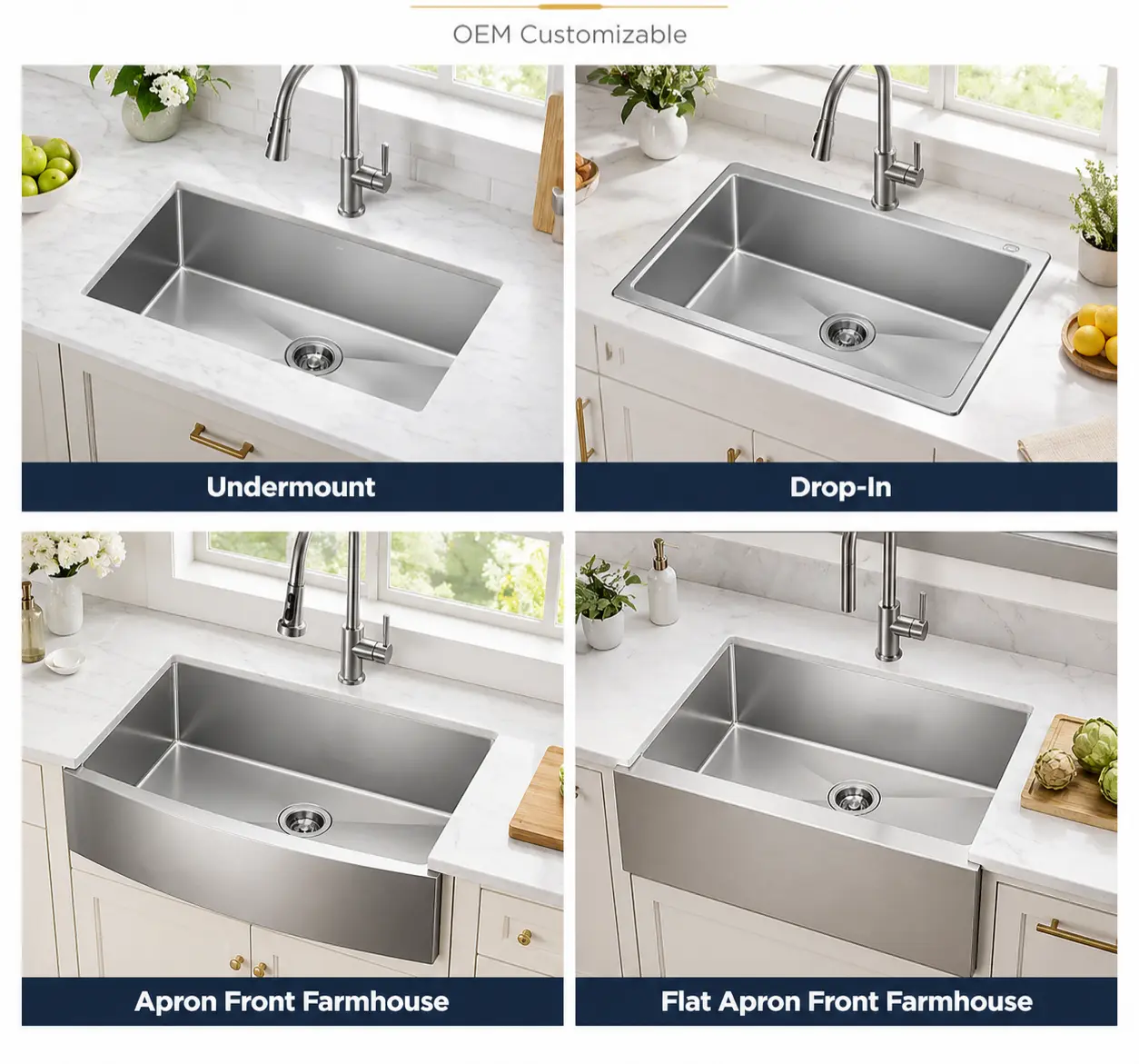
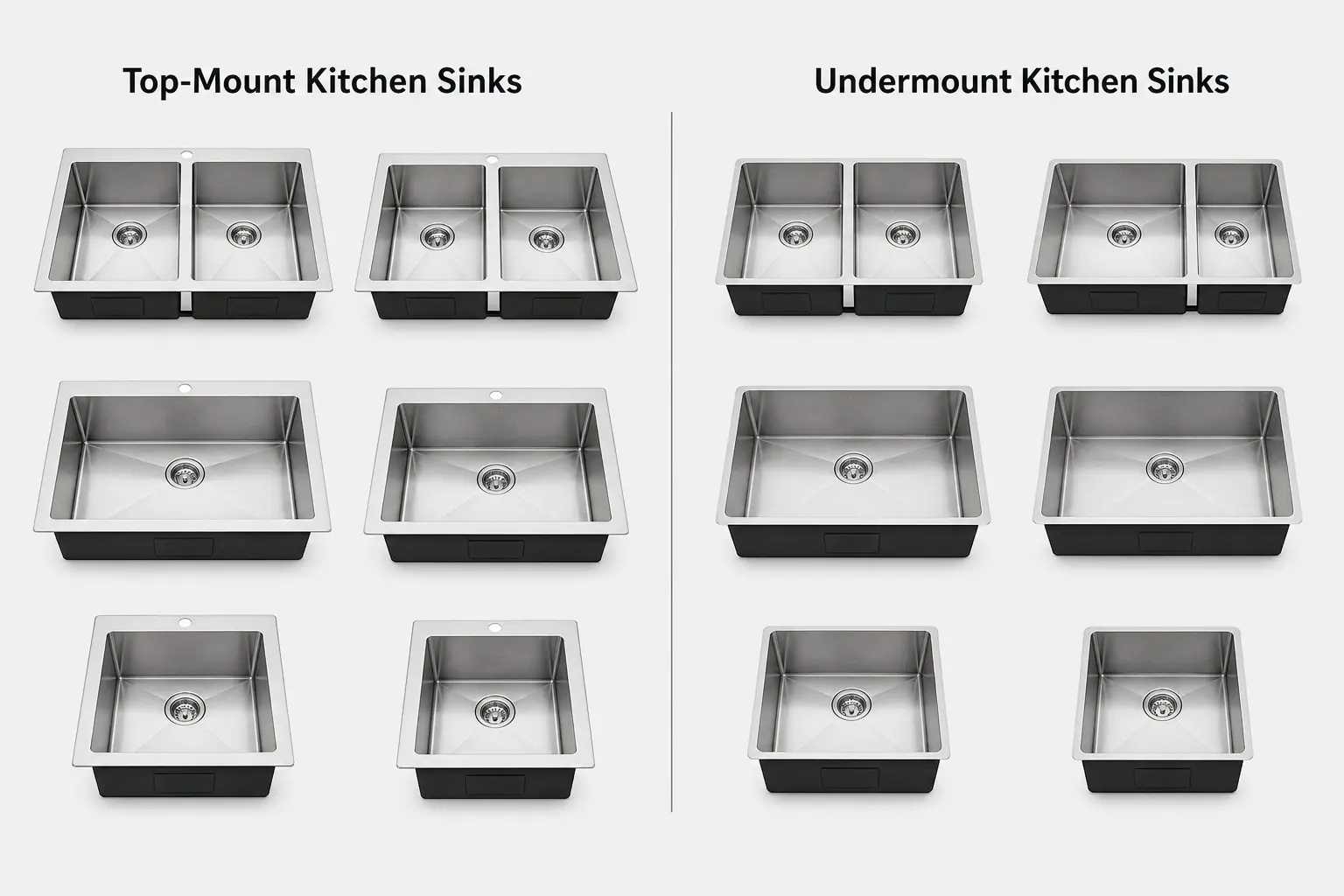
The sink itself is not always what sets the MOQ.
A stainless steel sink may be technically possible to manufacture in a small quantity, while the complete OEM program still requires a higher order volume.
Why?
Because a kitchen sink order can include:
- sink body
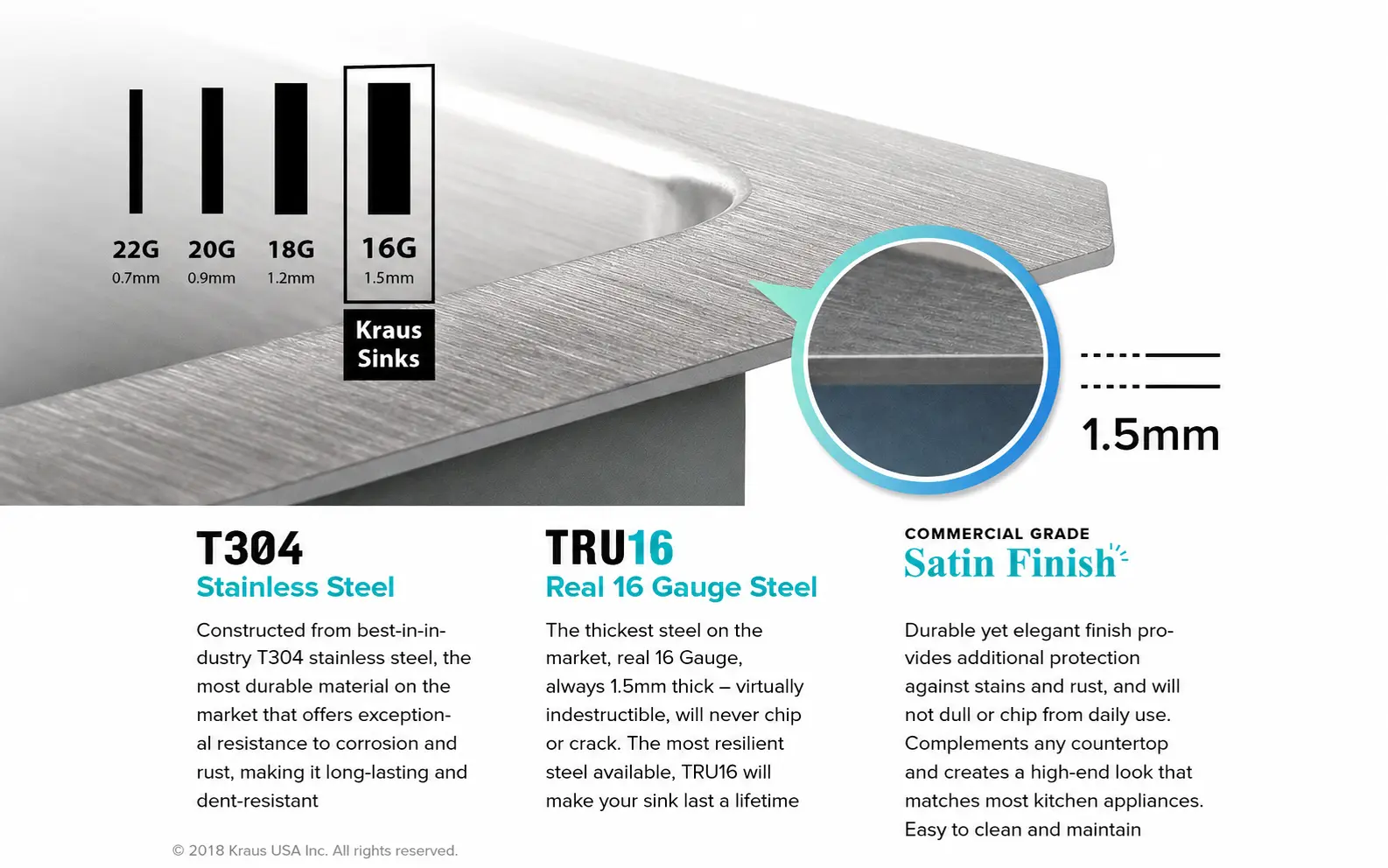
- stainless steel material
- forming or welding setup
- surface finish
- drain
- bottom grid
- cutting board
- colander
- logo
- label
- carton
- foam
- PVD components
Each part has its own production economics.
So the real MOQ is often controlled by:
the least flexible component or process in the program.
For buyers, this means:
Sink MOQ is not one fixed factory number. It is the result of the complete product configuration.
Quick Answer
Kitchen sink MOQ is mainly affected by:
- production route — handmade or pressed
- existing mold vs new tooling
- material purchasing requirement
- surface finish
- custom accessories
- packaging
- branding
- component supplier MOQ
- number of SKUs
- total project volume
A useful way to think about it is:
Sink Body MOQ
+
Component MOQ
+
Finish Batch Requirement
+
Packaging MOQ
+
Production Setup
The highest constraint often becomes the practical MOQ.
The minimum quantity for manufacturing a sink body and the minimum quantity for supplying a complete private-label SKU are not necessarily the same.
1. Handmade and Pressed Sinks Have Different MOQ Logic
The first question is:
How is the sink manufactured?
Matrix supplies both Handmade Kitchen Sinks and Pressed Kitchen Sinks, and the MOQ logic is different for each production route.
Handmade Sinks
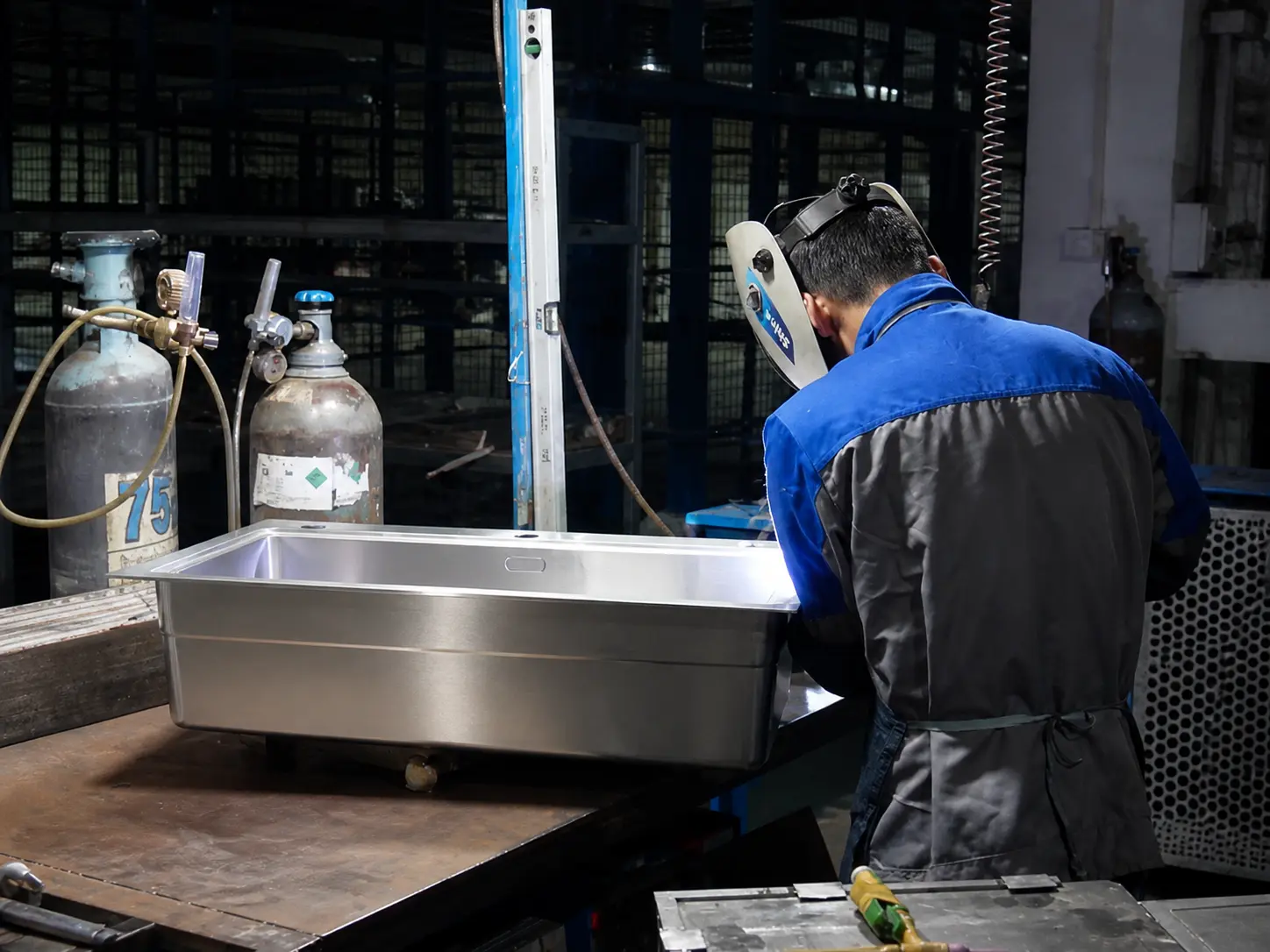
Handmade sinks are fabricated through processes such as:
- cutting
- bending
- welding
- grinding
- polishing
- brushing
They do not depend on a complete deep-drawing mold for every bowl geometry.
This generally makes handmade production more practical for:
- custom dimensions
- lower-volume projects
- new product trials
- non-standard bowl configurations
Pressed Sinks
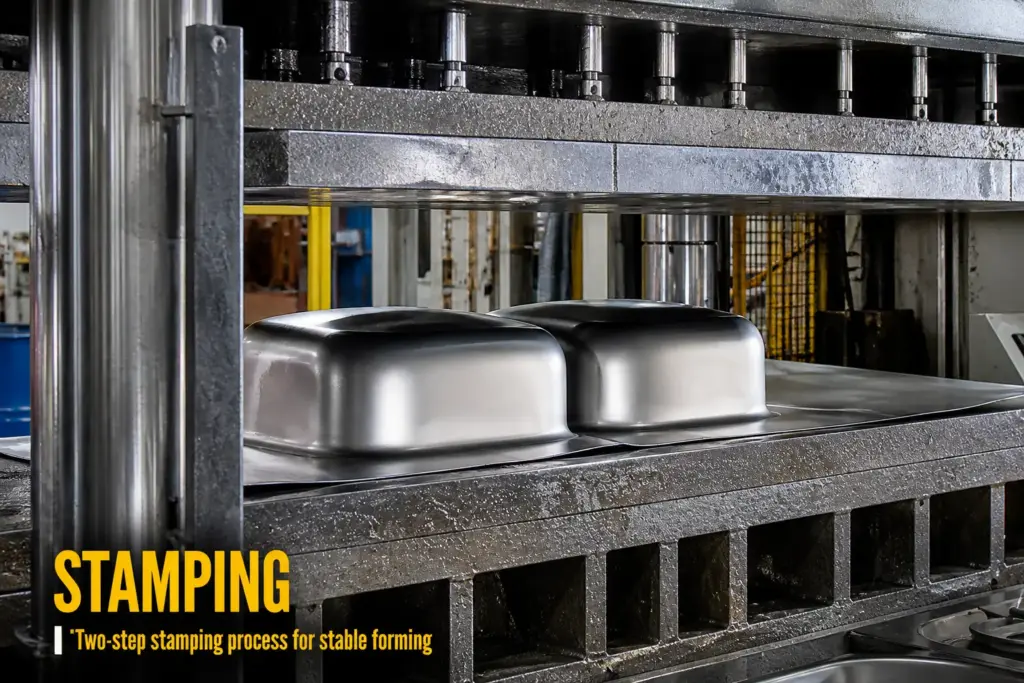
Pressed sinks depend more strongly on:
- existing tooling
- forming setup
- production batch
- trimming and punching
- mold geometry
This normally favors larger and more standardized production programs.
The important distinction is:
Handmade production can reduce tooling dependency, but it does not remove every MOQ constraint.
2. Existing Mold Can Lower the Entry Barrier
For a pressed sink, one of the first commercial questions is:
Does an existing mold already match the target product?
If yes, the buyer may avoid:
- new mold development
- tooling lead time
- tooling investment
This can make a lower-volume trial more practical.
Matrix’s Factory Capabilities includes existing pressed-sink tooling as part of the available production capability.
But:
existing mold does not automatically mean “no MOQ.”
The factory still needs to consider production setup, material, finishing, accessories and packing.
3. New Tooling Changes the Economics
If a buyer requires a new pressed sink geometry, the project may need new tooling.
Now the commercial question changes from:
“How many pieces can the factory make?”
to:
“Does the expected volume justify creating and setting up the tooling?”
For example, a project requiring:
- unique bowl geometry
- custom radius
- special rim
- proprietary workstation structure
may technically be possible.
But a very small quantity may not make commercial sense for a tooling-based program.
This is why MOQ and tooling should be discussed together rather than separately.
4. Stainless Steel Material Can Create a Batch Requirement
The sink body starts with raw material.
The factory may need to purchase stainless steel according to:
- grade
- thickness
- sheet size
- surface condition
A standard material such as:
SUS304 / common thickness
is generally easier to source than an unusual combination.
A custom requirement such as:
- unusual thickness
- SUS316
- special sheet dimension
- special surface condition
may increase the required material purchasing quantity.
So even if the factory only needs material for 50 sinks, the upstream steel supplier may require a larger purchase batch.
5. Surface Finish Can Set the MOQ
This is one of the most important points.
A standard brushed or satin stainless steel finish may be easier to accommodate in a small program.
But special finishes can have their own batch requirements.
Examples include:
- PVD black
- gunmetal
- gold
- special nano coating
- other outsourced surface treatments
If the finishing process requires a minimum production batch, then:
finish MOQ may become the product MOQ.
The sink body itself may not be the constraint.
6. PVD MOQ Is Especially Easy to Misunderstand
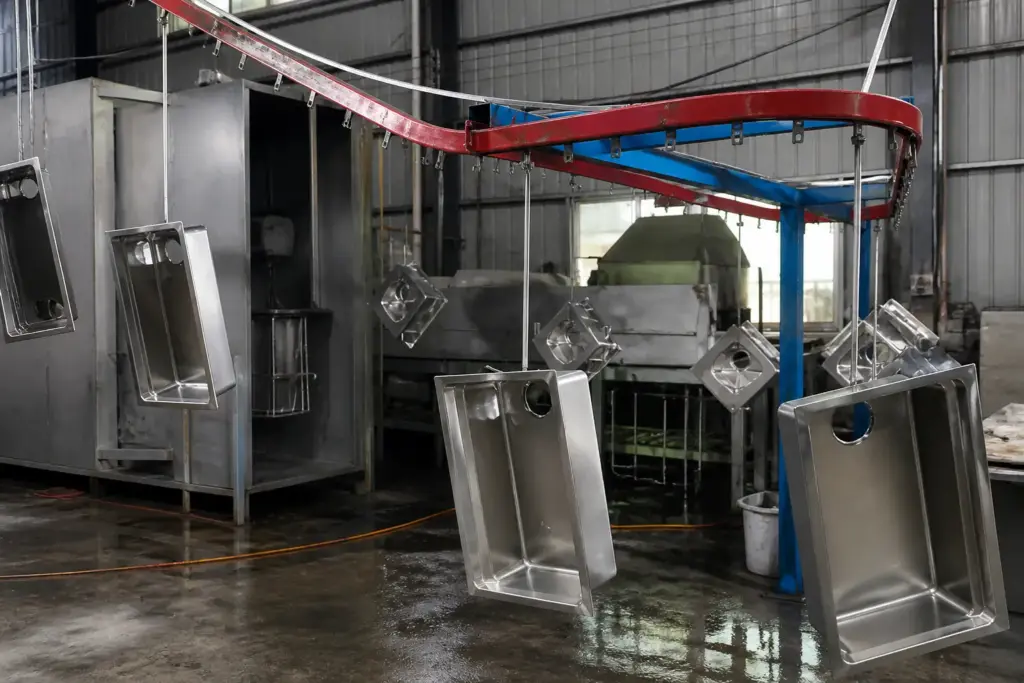
Sink Body
Factory can manufacture:
80 pcs
PVD Processing
Finishing partner requires:
a larger practical batch
The Buyer may ask:
“If you can make 80 sinks, why can’t you make 80 finished sinks at the same price?”
Because:
manufacturing capacity and finishing economics are two different questions.
For colored sink programs, finish batch requirements should therefore be confirmed early rather than after the sink body has already been quoted.
7. Accessories Can Set a Higher MOQ Than the Sink
This is extremely common in workstation sink programs.
A workstation sink may include:
- cutting board
- colander
- bottom grid
- roll-up rack
- drain
- soap dispenser
The sink body may support a relatively small production quantity.
But one accessory supplier may require a higher order quantity.
For example:
Sink Body
→ relatively flexible
Custom Cutting Board
→ supplier batch requirement
Custom Colander
→ different MOQ
Custom Color Drain
→ another MOQ
The highest requirement can determine the practical program quantity.
Matrix’s Workstation Kitchen Sinks show why accessory configuration should be considered together with the sink rather than treated as an afterthought.
8. Standard Accessories Usually Give More Flexibility
If the Buyer uses an existing:
- drain
- bottom grid
- rack
- cutting board
that already matches the sink, the project can often avoid some new component setup.
By contrast, a fully custom accessory may require:
- new size
- new tooling
- new packaging
- new supplier setup
So:
customization increases MOQ most when it creates a new supply-chain item, not simply when it changes the sink drawing.
9. Packaging Can Become the Real MOQ
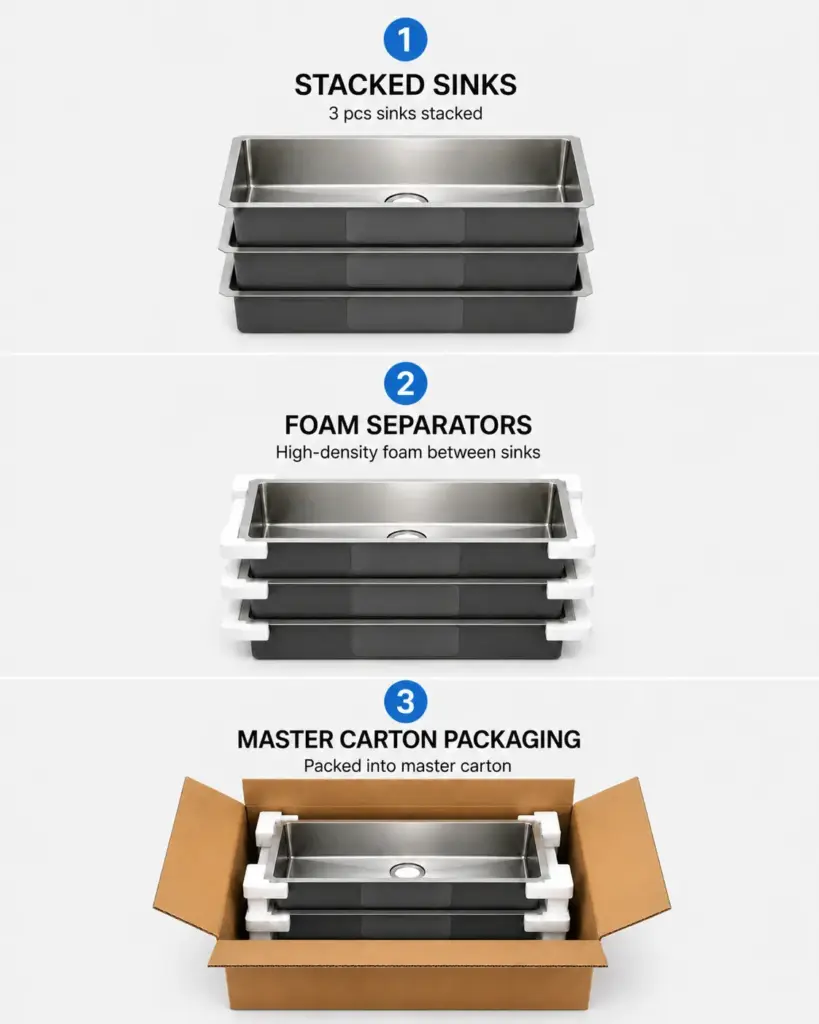
This is another common private-label issue.
A buyer may only want:
100 sinks
but also request:
- custom color carton
- full printed artwork
- custom foam
- private-label instruction manual
- barcode
- labels
The carton supplier may have its own production minimum.
For example, printing:
100 custom cartons
may be technically possible but commercially inefficient compared with a normal carton batch.
That means the Buyer has several options:
Option A
Increase order quantity.
Option B
Use a standard carton for the trial order.
Option C
Produce a larger carton batch and hold remaining cartons for repeat orders.
The correct choice depends on the project.
10. Logo MOQ and Sink MOQ Are Not Always the Same
A logo can be added through different methods depending on the product and requirement.
Possible approaches may include:
- laser marking
- label
- printed packaging
- branded accessory
Each has different setup economics.
So the question:
“Can you add our logo?”
should be separated from:
“Can you manufacture this quantity of sinks?”
The sink MOQ and branding MOQ may be different.
11. Mixed Models Can Reduce or Increase the Practical MOQ
Suppose a Buyer wants:
300 pcs total
but divided into:
- 50 pcs Model A
- 50 pcs Model B
- 50 pcs Model C
- 50 pcs Model D
- 50 pcs Model E
- 50 pcs Model F
The total order is 300 pcs.
But production does not behave like one 300-piece SKU.
Each model may require:
- separate setup
- separate QC reference
- separate carton
- different accessories
So:
Total PO quantity and per-SKU production quantity are different commercial variables.
12. One SKU Is Usually Easier Than Six Small SKUs
For the same total quantity:
Program A
300 pcs × 1 SKU
is usually simpler than:
Program B
50 pcs × 6 SKUs
because Program B creates more:
- setup
- material planning
- accessory planning
- QC references
- labels
- packaging
- warehouse handling
This is why buyers should give both:
total annual/project volume
and:
quantity per SKU.
13. Trial MOQ and Repeat-Order MOQ Can Be Different
A factory may accept a smaller quantity during product development because the goal is to:
- validate the market
- confirm the specification
- build the first approved sample
- establish the program
But that does not automatically mean the same economics apply forever.
Likewise, repeat orders may become easier if:
- tooling already exists
- packaging has already been produced
- accessory supply is stable
- finish references are approved
So MOQ should be understood in the context of:
development stage + repeat-order plan.
Matrix’s Private-Label Product Programs are structured around sample approval and repeat-order product definition rather than treating every order as an isolated purchase.
14. Annual Volume Can Matter More Than the First PO
This is particularly important for OEM projects.
Consider:
Project A
First order:
100 pcs
Expected annual demand:
2,000 pcs
Project B
One-time order:
100 pcs
No repeat plan.
Those two projects may deserve different commercial evaluation even though the first PO quantity is identical.
Why?
Because tooling, packaging and component setup can be spread over repeat business in Project A.
This is why buyers should share realistic:
- initial quantity
- annual volume
- expected repeat frequency
when evaluating custom programs.
15. A Lower MOQ Can Increase Unit Cost
MOQ and price are connected.
A smaller batch may increase cost because:
- setup is divided across fewer units
- material purchasing is less efficient
- special finishing is less efficient
- accessories are purchased in small batches
- custom cartons become more expensive per piece
- handling cost per unit rises
So:
low MOQ does not necessarily mean low total risk or low unit cost.
16. The Lowest MOQ Is Not Automatically the Best Supplier Offer
Buyer A receives:
MOQ 50 pcs
Buyer B receives:
MOQ 300 pcs
It is tempting to assume the first supplier is more flexible.
But the Buyer still needs to compare:
- unit price
- tooling
- packaging
- specification
- accessories
- QC
- repeat-order capability
A very low MOQ may simply mean the supplier is using:
- existing products
- generic accessories
- generic packaging
That may be perfect for one project.
It may be unsuitable for another.
17. MOQ Should Be Evaluated Together With Customization
A useful rule is:
The more components that become unique to the Buyer, the more likely one of them will create a minimum batch requirement.
For example:
Low Customization
- existing sink
- standard brushed finish
- standard drain
- neutral carton
Usually easier.
Higher Customization
- custom bowl size
- special finish
- custom grid
- branded drain
- printed carton
More supply-chain constraints become involved.
18. What Actually Sets the Final MOQ?
A simplified project may look like this:
| Item | Practical Constraint |
|---|---|
| Handmade Sink Body | Relatively flexible |
| SUS304 Material | Material purchasing batch |
| Standard Brushed Finish | Relatively flexible |
| Custom Cutting Board | Accessory supplier MOQ |
| Custom PVD Drain | Finish / supplier MOQ |
| Printed Carton | Packaging supplier MOQ |
If the cutting board has the highest minimum requirement, then:
the cutting board may effectively determine the MOQ of the entire sink program.
This is why the factory cannot always answer:
“What is your MOQ?”
with one universal number.
19. Handmade MOQ vs Pressed MOQ
A useful starting comparison is:
| Factor | Handmade | Pressed |
|---|---|---|
| New Bowl Geometry | More flexible | Tooling-dependent |
| Existing Model | Flexible | Efficient with existing mold |
| Very Low Volume | More practical in many cases | Less attractive for new tooling |
| Large Standard Volume | Possible | Strong advantage |
| Custom Radius / Size | Flexible | Mold-dependent |
| Tooling Investment | Lower dependence | Important |
| Accessory MOQ | Can still apply | Can still apply |
| Packaging MOQ | Can still apply | Can still apply |
| Finish MOQ | Can still apply | Can still apply |
The key point is:
production route changes the sink-body economics, but accessories, finishes and packaging can affect both routes.
20. What Should Buyers Send Before Asking for MOQ?
To receive a meaningful MOQ rather than a generic answer, provide:
- sink type
- dimensions
- handmade or pressed preference if known
- material
- thickness
- finish
- accessories
- logo requirement
- packaging requirement
- initial quantity
- estimated annual volume
- target market
Matrix’s Kitchen Sink RFQ Checklist can be used to structure these requirements before quotation.
A Better Way to Ask for MOQ
Instead of:
“What is your MOQ?”
a stronger RFQ question is:
“What is the practical MOQ for this exact configuration, and which component or process is driving it?”
That question produces much more useful information.
It reveals whether the constraint comes from:
- sink production
- tooling
- material
- finish
- accessory
- packaging
and gives the buyer something that can actually be optimized.
How Can MOQ Sometimes Be Reduced?
MOQ can sometimes be reduced by simplifying the first order.
For example:
Use Existing Mold
instead of developing a new pressed geometry.
Use Standard Finish
instead of a special PVD color.
Use Existing Accessories
instead of developing a custom cutting board.
Use Neutral Carton
instead of full private-label printing.
Combine Future Requirements
where the same material or component can be shared.
This does not mean every MOQ can be negotiated away.
It means:
identify which constraint is creating the MOQ before trying to reduce it.
Common Misunderstandings
“MOQ is decided only by factory capacity.”
No.
Capacity determines how much a factory can produce. MOQ is influenced by whether producing a small batch is commercially and operationally practical.
“Handmade sinks have no MOQ.”
No.
Handmade production may be more flexible, but materials, accessories, finishes and cartons can still create minimum quantities.
“Existing mold means there is no MOQ.”
No.
It removes one tooling constraint, but other production and supply-chain constraints remain.
“The supplier can simply order fewer accessories.”
Not always.
The accessory supplier may have its own MOQ.
“If I pay more, any MOQ can be reduced.”
Not necessarily.
Some constraints are driven by process batch size or upstream supplier requirements rather than sink-factory margin alone.
“MOQ should be the same for every sink model.”
No.
Different configurations can involve completely different supply chains.
Buyer Takeaway
Do not treat kitchen sink MOQ as:
one fixed factory policy.
Think of it as:
Sink Body
→ Tooling
→ Material
→ Finish
→ Accessories
→ Branding
→ Packaging
The practical MOQ is often controlled by whichever part of that chain is least flexible.
The key distinction is:
The factory may be able to manufacture a small quantity of sinks without being able to economically produce the complete private-label SKU in the same quantity.
Frequently Asked Questions
What is a normal MOQ for kitchen sinks?
There is no single universal MOQ. It depends on production route, tooling, finish, accessories, packaging and supplier requirements.
Do handmade sinks have lower MOQ than pressed sinks?
Handmade production is often more practical for lower-volume custom geometry because it is less dependent on forming tooling, but other MOQ constraints still apply.
Why does custom packaging increase MOQ?
Printed cartons and custom protective materials may have their own supplier production minimums.
Why does PVD increase kitchen sink MOQ?
Special surface treatment may require a practical processing batch, and matching accessories can create additional supplier requirements.
Can existing sink molds reduce MOQ?
Existing tooling can reduce the entry barrier for pressed sinks, but material, finish, accessories and packaging still affect the final MOQ.
Why does adding a cutting board change the MOQ?
A custom cutting board may have its own material, machining or supplier batch requirement.
Can a trial order have a lower MOQ?
Sometimes. A simpler initial configuration or existing components may make a trial order more practical, depending on the program.
Evaluating MOQ for an OEM Sink Program?
Matrix supports both Handmade Kitchen Sinks and Pressed Kitchen Sinks for different volume and customization requirements.