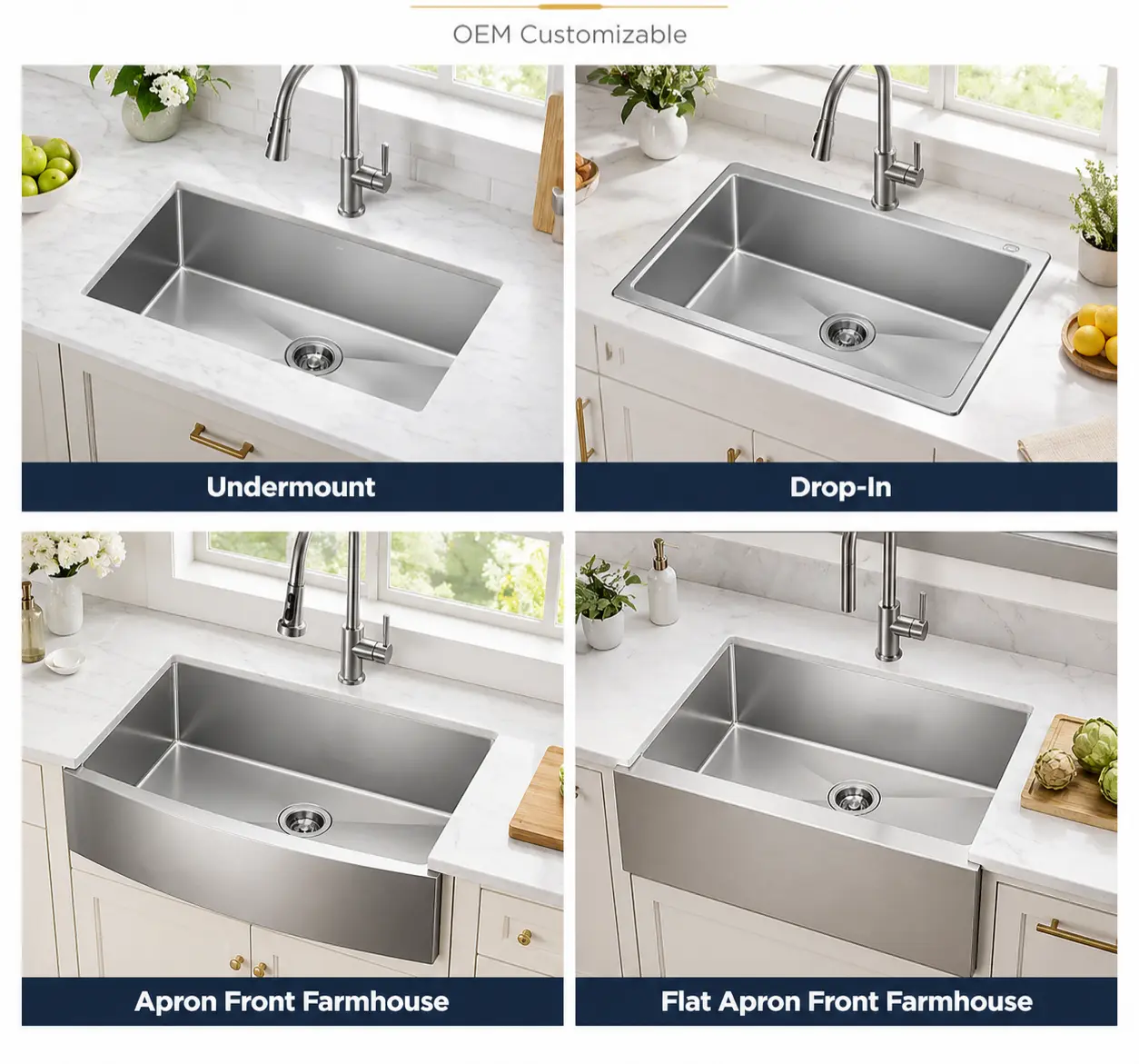
A handmade stainless steel sink can have accurately cut panels and still develop a slightly bowed or twisted rim after welding.
The main reason is not inaccurate cutting.
It is uneven thermal expansion and shrinkage during welding.
When a welded area heats up, the stainless steel expands. The surrounding cooler metal restrains that expansion. As the weld and heat-affected area cool, they contract again.
Quick Answer
Handmade sink rims can warp after welding because welding heats only a small part of the stainless steel at one time.
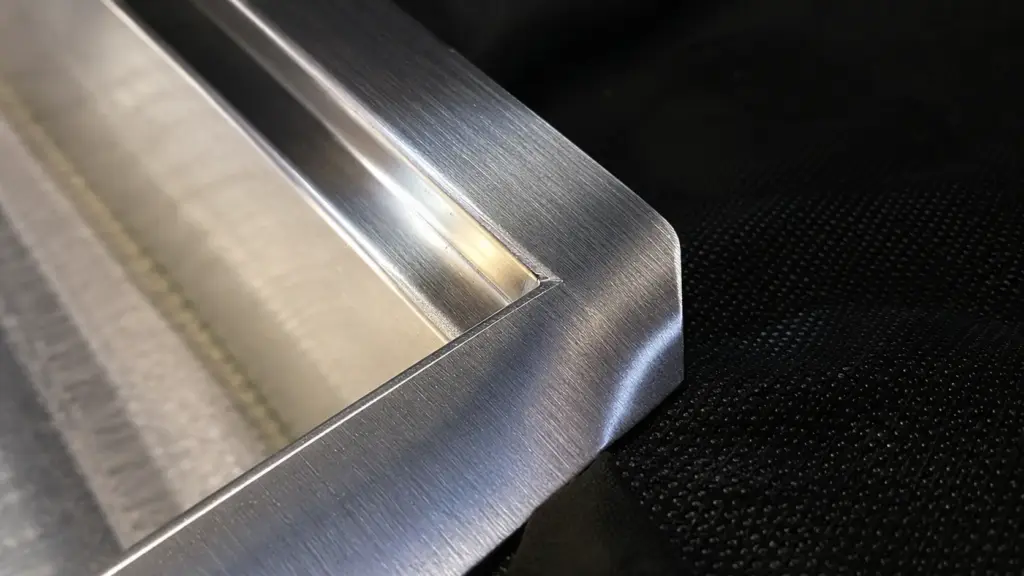
The sequence is:
Local Heating → Thermal Expansion → Restraint → Cooling → Uneven Shrinkage → Residual Stress → Distortion
The result may appear as:
- one raised corner
- a bowed front or rear rim
- diagonal twist
- uneven flange contact
- slight bowl-to-rim distortion
The effect is influenced by:
- welding heat input
- weld length
- welding sequence
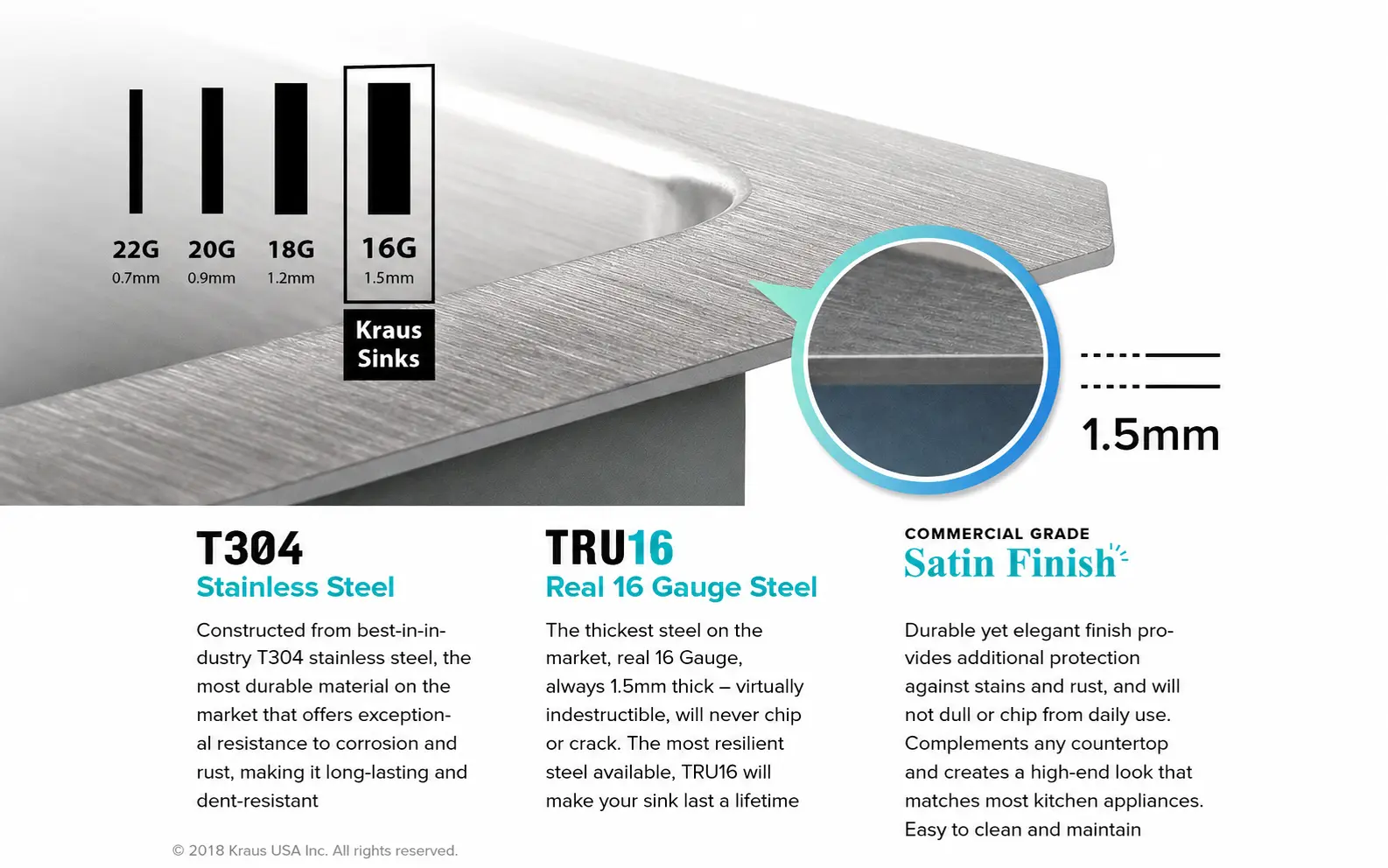
- sheet thickness
- sink size and geometry
- fixture and restraint
- cooling behavior
- later grinding and finishing
A handmade sink can have correct length and width but still have a rim-flatness problem because dimensional size and geometric flatness are different conditions.
What Actually Happens to Stainless Steel During Welding?
Welding does not heat the entire sink uniformly.
The weld zone becomes much hotter than the surrounding sheet.
That creates three different regions:
- the weld itself
- the heat-affected zone beside the weld
- relatively cool surrounding stainless steel
These regions do not expand and contract at the same time.
During Heating
The hot metal wants to expand.
But the surrounding cooler sheet restricts that movement.
During Cooling
The welded area contracts.
Because some deformation has already occurred during heating, the metal does not always return to its original geometry.
After Cooling
Residual stress remains inside the fabricated structure.
If the shrinkage forces are not balanced, the sink can:
- bow
- twist
- pull inward
- lift at a corner
This is welding distortion.
Why Does the Rim Move When the Weld Is Down in the Bowl?
Because the sink is one connected structure.
A welded corner does not shrink independently from the rest of the bowl.
The shrinkage force can transfer through:
- sidewalls
- bowl bottom
- upper flange
- workstation ledge
- apron structure
A small dimensional change around a welded joint can therefore create a visible movement farther away at the rim.
Why Are Long Straight Rims Sensitive to Small Distortion?
A long rim acts like a visible reference line.
Even a small angular change at one end can create a noticeable gap farther along the edge.
This is why distortion can be more noticeable on:
- large single-bowl sinks
- workstation sinks
- wide top-mount sinks
- long handmade trough sinks
- apron-front sinks
The problem is not necessarily that the rim changed dramatically.
A small accumulated angular distortion can become visible across a long span.
Why Can One Corner Lift Higher Than the Others?
A raised corner usually indicates the structure has developed some degree of twist rather than a simple uniform bow.
For example, if shrinkage around:
- one corner
- one sidewall
- one welded sequence
differs from the opposite side, the upper frame can rotate slightly.
The finished rim may then behave like a twisted rectangle:
two corners sit correctly
one corner lifts
the opposite geometry compensates
This is why checking only the four outer dimensions cannot reveal every flatness problem.
Welding Shrinkage Is Directional
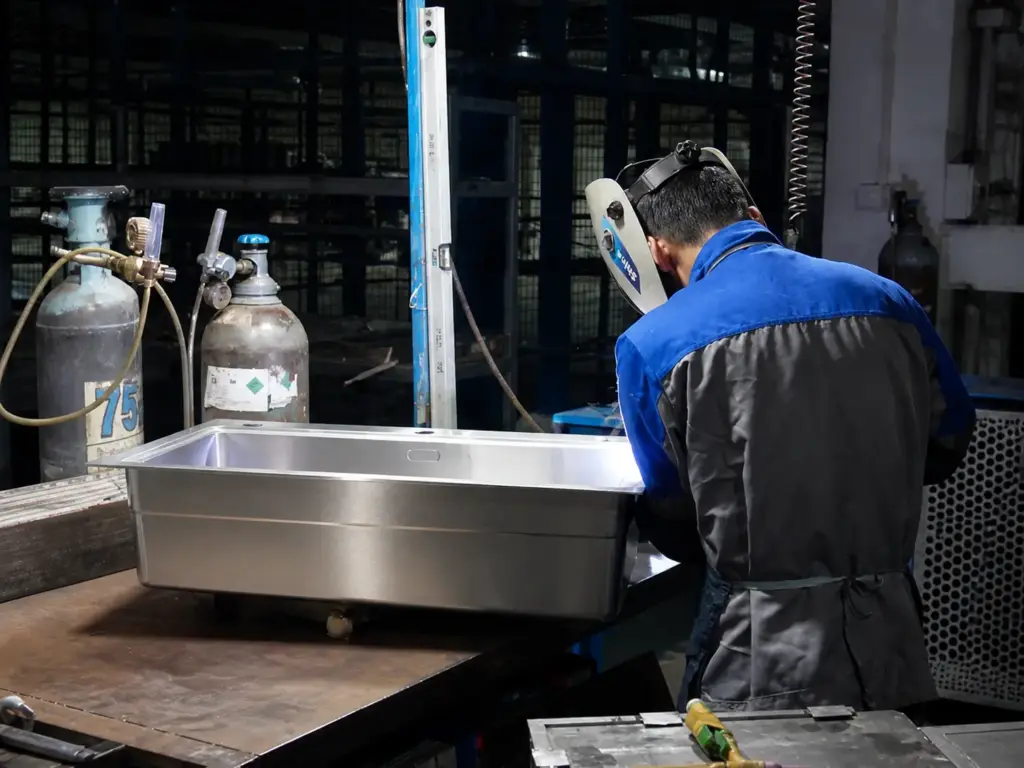
Weld shrinkage does not occur in only one direction.
It can occur:
- along the weld
- across the weld
- angularly through the joint
These different shrinkage modes can produce different visible results.
Longitudinal Shrinkage
Contraction occurs along the direction of the weld.
Transverse Shrinkage
The material pulls across the joint.
Angular Distortion
Uneven contraction through the joint causes the connected sheets to change angle.
On a fabricated sink, several of these effects can occur together.
Why Welding Sequence Matters
Imagine welding all of one side before moving to the opposite side.
Heat and shrinkage accumulate in one region first.
That can pull the structure toward that side.
A more balanced welding sequence distributes heat and shrinkage around the sink rather than concentrating it in one direction.
This is why handmade sink welding is not only about:
making the joint continuous.
The sequence also influences the geometry of the completed bowl.
More Welding Heat Can Mean More Distortion
Higher heat input generally creates:
- a larger heated zone
- greater thermal expansion
- more cooling shrinkage
But distortion is not controlled simply by using the lowest possible heat.
The weld still needs sufficient penetration and continuity for the joint design.
The manufacturing problem is therefore a balance between:
weld integrity
and:
heat control.
Why Thin Stainless Steel Responds More Easily
Thinner sheet has lower bending stiffness.
That means the same thermal shrinkage force can move the structure more easily than it would move a substantially thicker section.
This is one reason handmade sink fabrication depends on:
- sheet thickness
- panel geometry
- welding process
- fixture design
as one system.
Does a Thicker Handmade Sink Never Warp?
No.
Thicker material is more resistant to deformation, but thickness alone does not eliminate welding distortion.
A large or heavily welded structure can still move if:
- heat input is high
- welding is unbalanced
- restraint is poor
- geometry concentrates stress
So:
thicker steel reduces sensitivity to deformation; it does not remove thermal shrinkage.
Why Sink Geometry Matters
Different sink structures distribute welding stress differently.
Consider:
Simple Single Bowl
Relatively simple perimeter and corner structure.
Double Bowl
Adds:
- divider
- additional welded joints
- more connected panels
Workstation Sink
May add:
- welded ledges
- larger upper structure
- more long straight edges
Apron-Front Sink
Adds a large visible front structure that must remain aligned with the bowl and upper rim.
The more interconnected the structure becomes, the more important shrinkage balance becomes.
What Role Does a Welding Fixture Play?
A fixture helps hold the components in the intended geometry during fabrication.
It can help control:
- alignment
- squareness
- bowl position
- rim position
But fixture restraint does not make welding shrinkage disappear.
If a heavily stressed sink is simply forced flat while hot, it may move after:
- unclamping
- cooling
- grinding
The goal is therefore not only to hold the sink in shape.
It is to control the welding process so excessive stress is not created in the first place.
Why Can a Sink Move After It Is Removed From the Fixture?
Because residual stress remains after welding.
While the sink is clamped, the fixture may prevent some movement.
When the fixture is released, part of that internal stress can redistribute.
The sink may then:
- spring slightly
- lift at a corner
- develop a small bow
This is one reason final geometry is checked after fabrication rather than assuming the fixture guarantees the finished result.
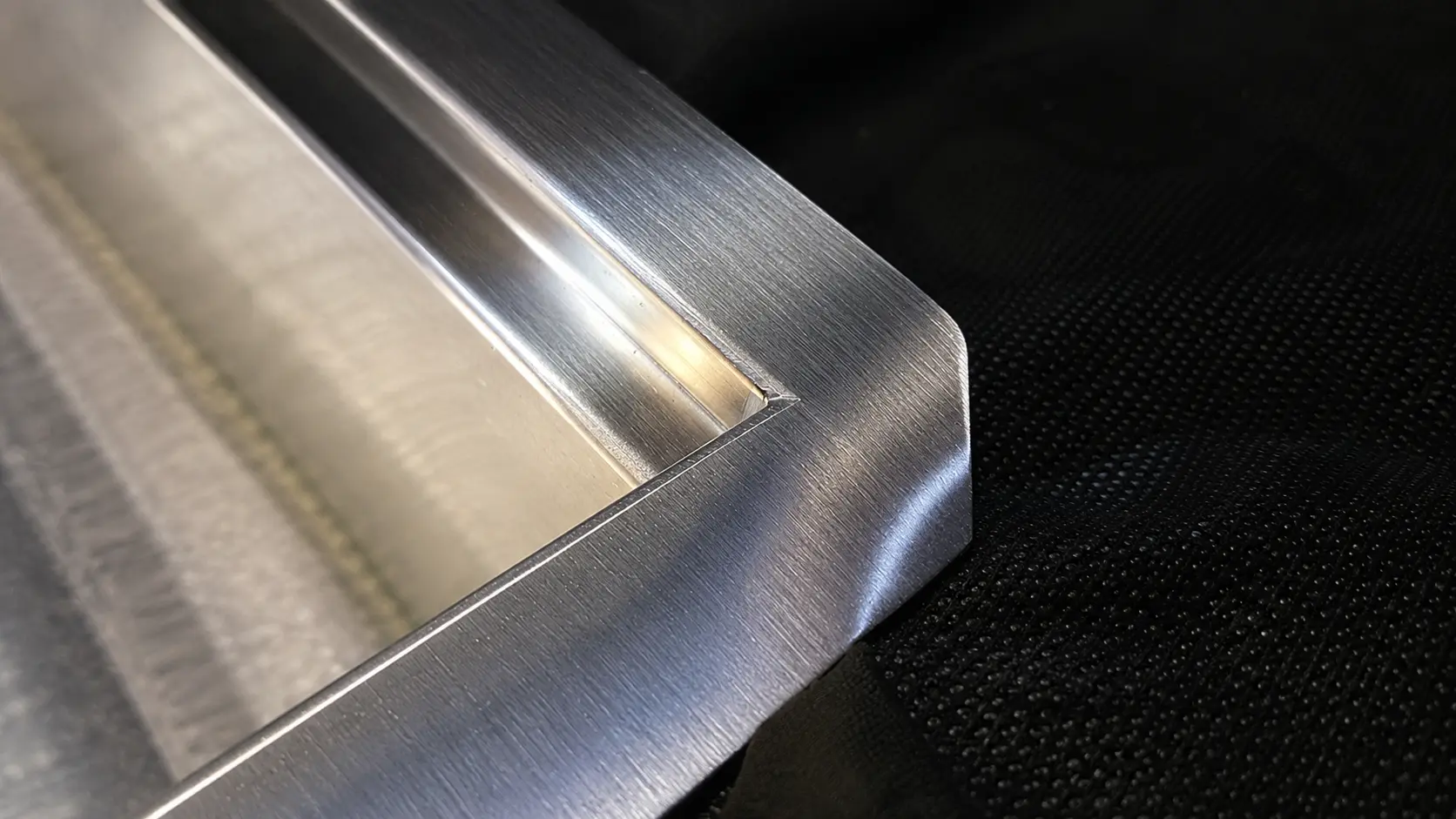
Grinding Can Change the Final Condition Too
Handmade sink production does not stop when welding is complete.
The welded areas are usually:
- ground
- blended
- polished
- brushed
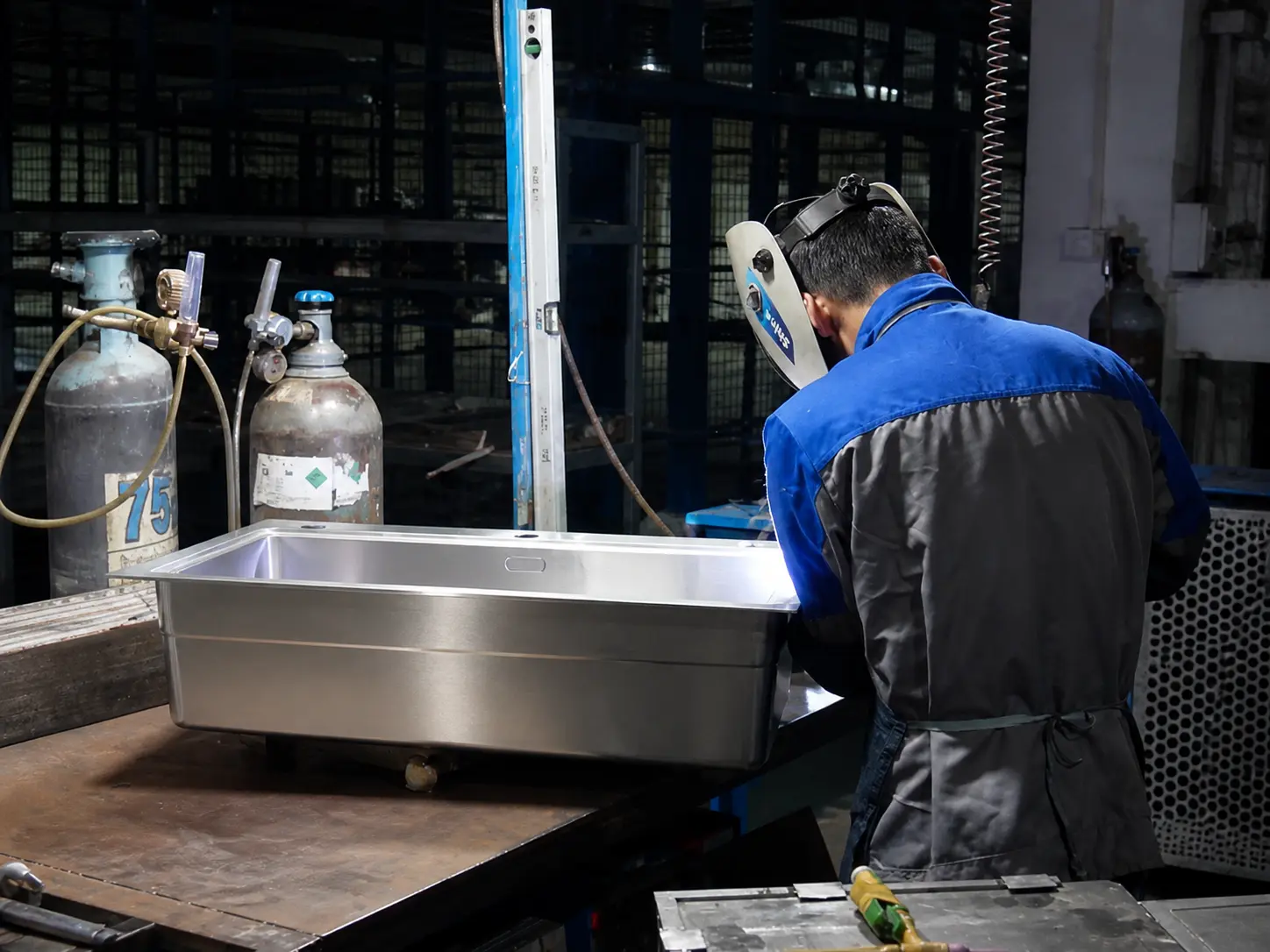
as part of the finishing process. Matrix’s Stainless Steel Sink Manufacturing shows this fabrication sequence from welding through grinding and polishing.
Grinding can introduce additional localized heat.
More importantly, finishing can release or redistribute some stress around welded areas.
So rim flatness should be evaluated on the finished fabricated sink, not only immediately after welding.
Why Can the Sink Be Flat After Welding but Move Later?
Several stages can alter the final condition:
Welding → Cooling → Unclamping → Grinding → Polishing → Handling
The sink may therefore look acceptable at one intermediate stage but change slightly after subsequent operations.
This is why flatness is a finished-product geometry issue.
Is Rim Warpage the Same as Incorrect Overall Dimensions?
No.
These conditions should be separated.
Dimensional Error
Example:
Target width: 500 mm
Finished width: outside the agreed tolerance
Rim Warpage
Example:
Length and width are correct
One corner sits above the reference plane
The first is a linear-dimensional problem.
The second is a geometric-flatness problem.
A Simple Example
Imagine a handmade sink with:
Overall size: 750 × 450 mm
After welding:
- length is correct
- width is correct
- bowl depth is correct
but one front corner sits above the plane created by the other corners.
The sink can therefore pass:
L × W × D
while still failing the expected rim condition.
This is why Matrix’s Quality Control & Inspection lists rim flatness separately from overall dimensions for handmade sinks.
Bowing and Twisting Are Different
A rim can distort in more than one way.
Bow
One edge curves upward or downward along its length.
Twist
Opposite sides or corners no longer lie in the same plane.
Local Lift
A small region near:
- corner
- weld
- ledge
moves independently from most of the rim.
These conditions may require different process corrections.
Can Grinding a Weld Flat Fix a Warped Rim?
Not necessarily.
Grinding changes the surface around the weld.
It does not automatically remove the residual stress that distorted the whole sink.
If the structural geometry has moved, simply polishing the weld more cannot restore the entire rim plane.
Can the Sink Simply Be Bent Back Flat?
Mechanical correction may sometimes be part of fabrication control.
But forcing the rim back into position does not explain why it moved.
If the underlying production process repeatedly creates the same deformation, the more useful correction is usually in:
- welding sequence
- heat input
- fixture
- fabrication balance
rather than repeated end-of-line straightening.
Why Repeated Warpage in the Same Location Matters
Suppose one unit has a raised corner.
That can come from an isolated fabrication or handling event.
But if many sinks show:
the same corner
moving in the same direction
the pattern suggests something systematic in the production sequence.
Possible sources include:
- weld order
- fixture condition
- joint geometry
- repeated finishing process
The pattern itself provides useful process information.
Why Handling Can Be Confused With Welding Warpage
A large handmade sink can also be distorted after fabrication through:
- stacking
- impact
- inadequate rim support
- transport
The visible result may look similar.
The distinction is usually easier to understand by checking:
- whether the deformation repeats across production
- whether it existed before packing
- whether packaging shows impact
- whether the weld structure itself is consistent
Welding distortion and shipping deformation can create the same symptom through different mechanisms.
Rim Flatness and Water Drainage Are Different Problems
A warped upper rim can change the installed orientation of the bowl.
That can indirectly affect drainage if the sink is pulled out of level during installation.
But the two conditions should not be confused.
Water pooling can also be caused by:
- bowl low spots
- slope
- drain flange
- installation level
See Why Water Pools in a Kitchen Sink for the separate drainage mechanism.
Handmade vs Pressed Rim Distortion
The source of distortion differs.
Handmade Sink
The main mechanisms can include:
- welding heat
- cooling shrinkage
- residual stress
- fabrication
- finishing
Pressed Sink
The main mechanisms are more likely related to:
- forming stress
- springback
- trimming
- flange forming
- handling
That is why the manufacturing route matters when diagnosing the same visible symptom.
How Rim Flatness Is Checked
A finished sink can be evaluated against a defined flat reference or other agreed inspection method.
The purpose is to identify:
- edge bow
- diagonal twist
- raised corners
- local gaps
rather than simply re-measuring length and width.
The exact acceptance limit depends on:
- sink size
- installation type
- product geometry
- agreed specification
There is no useful reason to invent one universal flatness number for every handmade sink.
Manufacturing Chain Behind Rim Flatness
The final rim condition is influenced throughout fabrication:
Sheet Cutting
↓
Bending
↓
Fit-Up
↓
Fixture
↓
Welding
↓
Cooling
↓
Grinding / Polishing
↓
Final Flatness
This is why rim flatness cannot be controlled only at final inspection.
Common Misunderstandings
“The laser-cut panels were accurate, so the finished rim must be flat.”
No. Welding can change the geometry after accurate cutting.
“The weld looks clean, so distortion is impossible.”
No. Weld appearance and residual thermal stress are different issues.
“The length and width are correct, so the sink is not warped.”
No. A twisted rim can still have correct outer dimensions.
“Thicker stainless steel cannot warp.”
Incorrect. It is more resistant to deformation, but welding still creates thermal expansion and shrinkage.
“If the sink is clamped flat during welding, it will remain perfectly flat.”
Not necessarily. Residual stress can redistribute after cooling and unclamping.
Quick Answer Table
| Question | Explanation |
|---|---|
| Why does the rim warp? | Uneven welding heat and cooling shrinkage |
| Why can one corner lift? | Unbalanced residual stress can twist the structure |
| Why can dimensions still pass? | Length / width do not measure flatness |
| Does thicker steel eliminate warpage? | No |
| Can fixtures help? | Yes, but process heat and welding balance still matter |
| Can finishing affect the result? | Yes, the final condition should be checked after fabrication |
Buyer Takeaway
The key mechanism is:
Welding does not simply join stainless steel. It temporarily heats, expands and then shrinks part of the sink structure.
If that shrinkage is unbalanced, the finished rim can move even when the original sheet dimensions were correct.
For handmade sinks:
Weld Quality ≠ Rim Flatness
Both need to be controlled separately.
Frequently Asked Questions
Why does stainless steel warp when welded?
Localized welding heat causes uneven thermal expansion and cooling shrinkage, leaving residual stresses that can distort the structure.
Why does only one corner of a handmade sink lift?
Uneven shrinkage can twist the upper structure, causing one or more corners to move out of plane.
Can a handmade sink have correct dimensions but a warped rim?
Yes. Length and width can remain correct while the rim is bowed or twisted.
Do thinner handmade sinks warp more easily?
Lower bending stiffness can make thinner structures more sensitive to the same distortion forces, although geometry and welding conditions also matter.
Does TIG welding eliminate distortion?
No welding process eliminates thermal expansion and shrinkage. Process control still matters.
Can grinding cause additional movement?
Grinding and finishing can add localized heat or redistribute existing stress, which is why final flatness is checked after finishing.
Are pressed sinks affected by the same welding distortion?
Not usually for the main bowl because they are mold-formed rather than fabricated from welded panels. Their rim geometry can change for different reasons.
Explore Handmade Sink Manufacturing
Matrix manufactures handmade stainless steel sinks through sheet cutting, bending, welding, grinding, polishing and final inspection.
See Handmade Kitchen Sinks or the complete Stainless Steel Sink Manufacturing Process for the production route.