Quick Answer
Pressed sinks usually have a higher practical MOQ because production depends on:
- Tooling cost
- hydraulic press setup
- material batching
- forming and trimming operations
- line scheduling
- surface-finishing batches
- production efficiency per run
- Tooling change labor cost
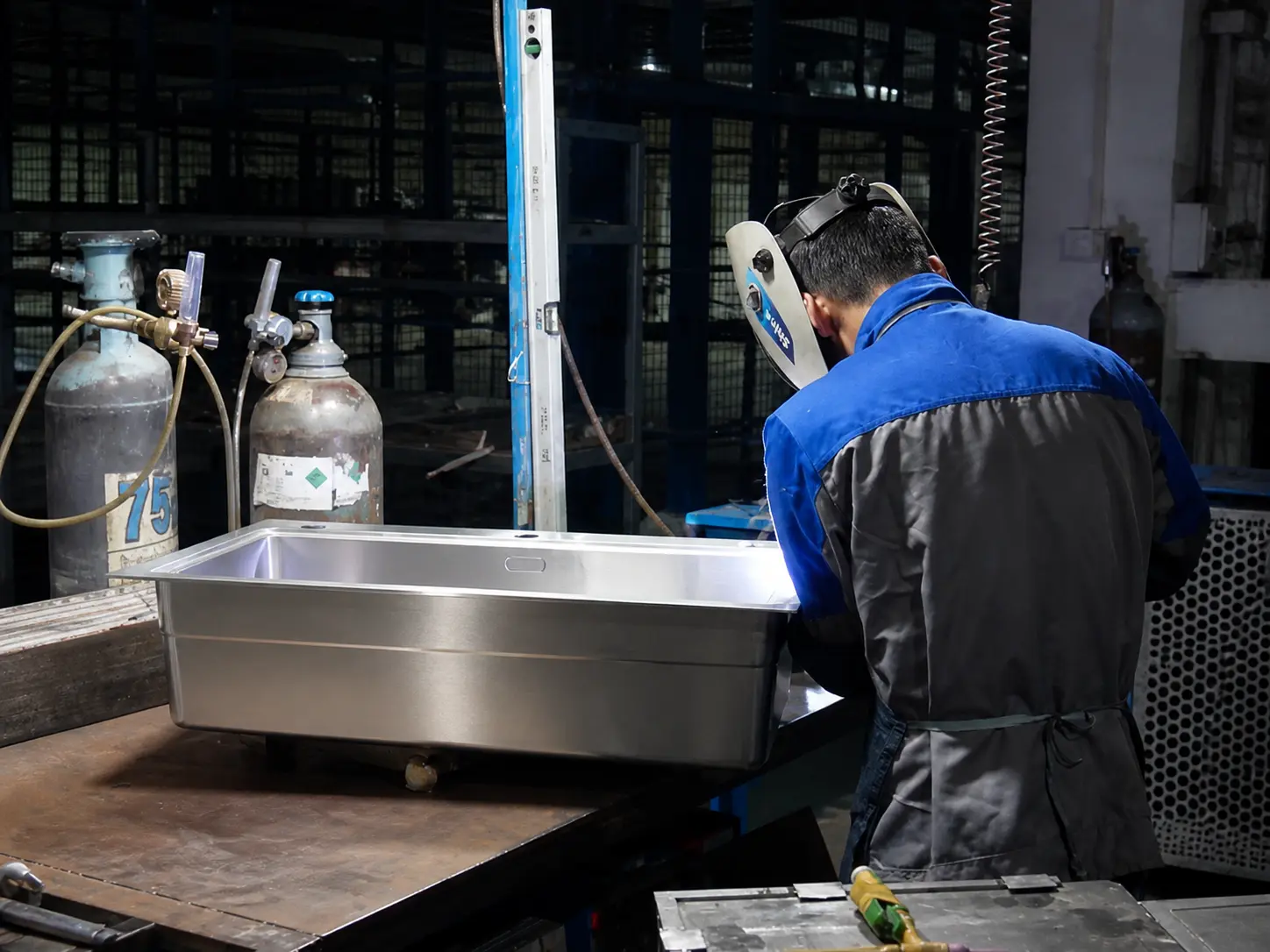
Handmade sinks rely more on flexible sheet fabrication — cutting, bending, welding and polishing — so smaller quantities of one model are often easier to schedule.
That is why:
Pressed MOQ is driven more by production-run efficiency, while handmade MOQ is driven more by fabrication labor and material planning.
A higher pressed-sink MOQ does not automatically mean the supplier is less flexible. It reflects a different manufacturing process.
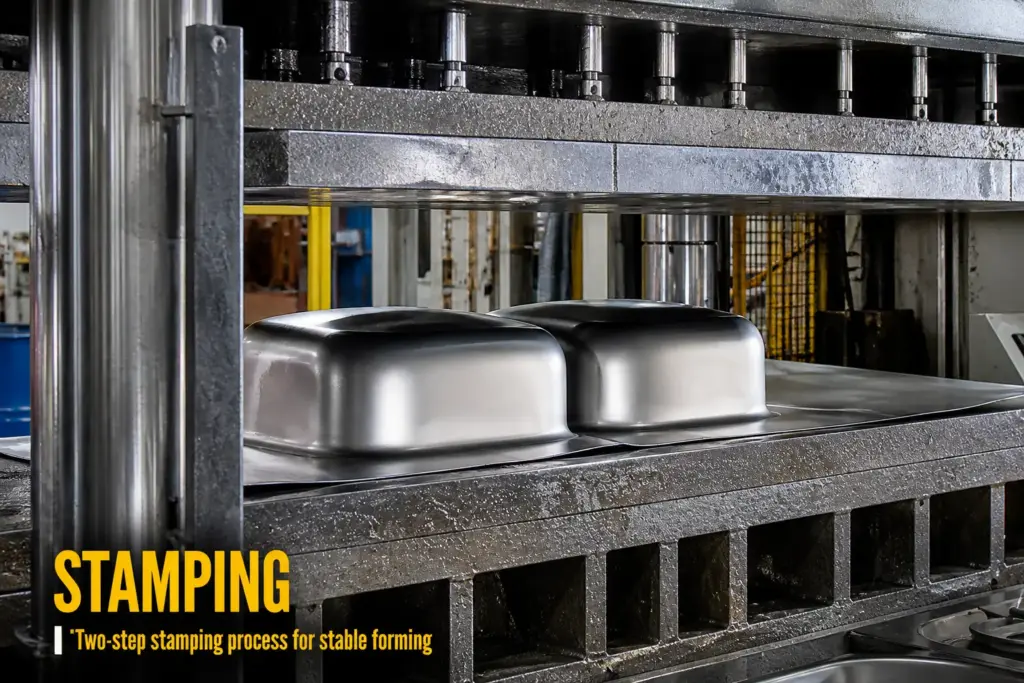
1. Start with How the Two Sinks Are Made
The MOQ difference becomes easier to understand once the production routes are separated.
Handmade Sink
Typical route:
stainless steel sheet
→ cutting
→ bending
→ welding
→ grinding
→ polishing
→ assembly
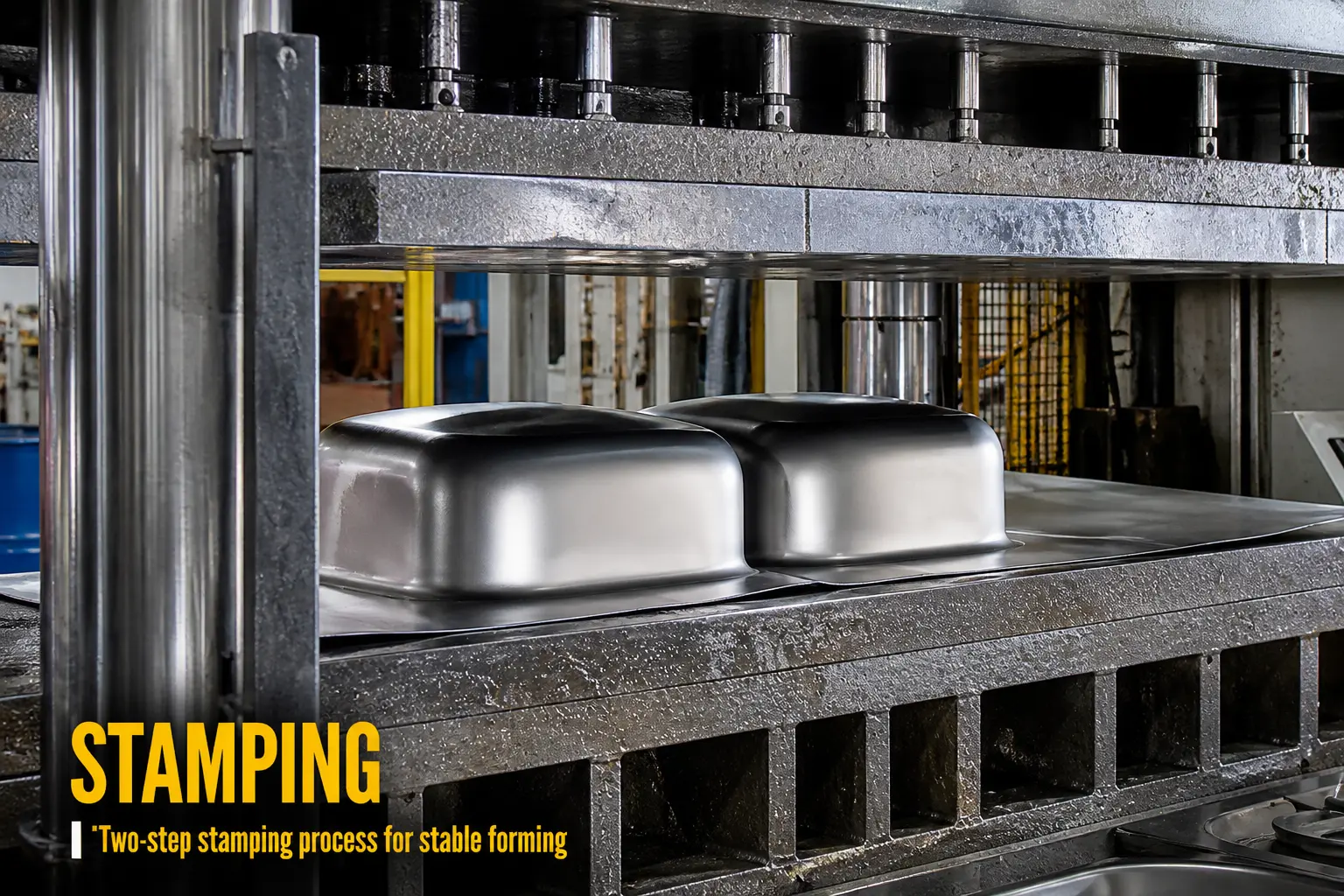
Pressed / Drawn Sink
Typical route:
stainless steel sheet
→ blanking
→ hydraulic drawing
→ forming
→ trimming
→ edge processing
→ finishing
Pressed production depends more heavily on:
- mold setup
- press scheduling
- repeated forming cycles
- batch efficiency
That makes very small production runs less economical.
2. A Pressed Sink Needs a Specific Mold
Every main pressed sink geometry depends on tooling.
Changing from one model to another may mean changing:
- drawing mold
- trimming setup
- edge-forming setup
- secondary fixtures
Even when the mold already exists, production still needs to be prepared around that model.
If a factory runs only a very small quantity, the setup time is spread across fewer sinks.
That pushes the practical unit cost up.
3. Hydraulic Press Setup Has a Cost Even Before the First Sink Is Good
Pressed production is not simply:
Put sheet in machine → press → finished sink.
Before stable production, operators may need to confirm:
- mold installation
- alignment
- press settings
- material condition
- lubrication
- drawing result
- trimming
- forming consistency
The same preparation and administering cost may be required whether the run is:
20 pcs
or
500 pcs.
This is why factories usually prefer to spread setup across a larger batch.
4. Material Is Easier to Plan in Batches
Pressed sink production often works better when material is prepared for a defined production run.
The factory may need to organize:
- stainless steel grade
- sheet thickness
- blank size
- sheet quantity
A very small order can create inefficient:
- sheet purchasing
- blanking
- handling
- material balance
especially when the specification is not shared with another running model.
5. Production-Line Efficiency Matters
Pressed sinks move through multiple operations.
For example:
forming
→ trimming
→ edge processing
→ hole processing
→ polishing
→ sound pad
→ undercoating
→ packing
A short batch means more frequent:
- model changes
- setup
- work-in-process movement
- production interruption
A larger batch allows the same model to keep moving through the line.
That is the main reason MOQ is not simply a sales policy.
6. Handmade Production Is More Flexible at Small Quantities
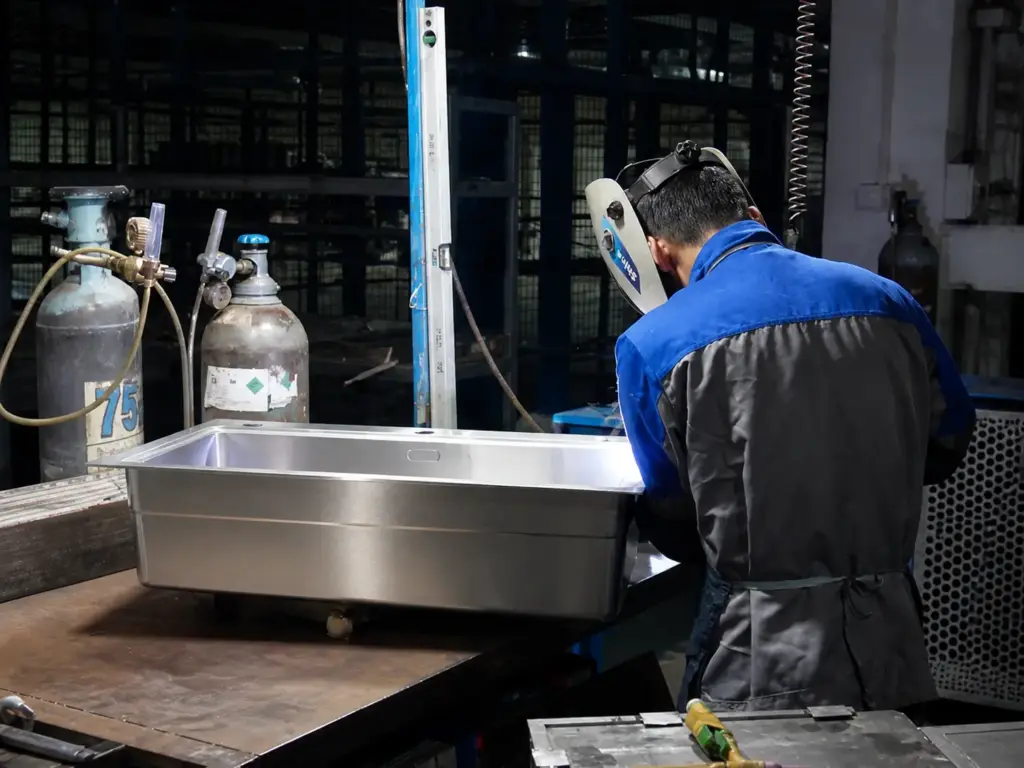
Handmade sinks are more labor-intensive, but the fabrication route is also more flexible.
A custom model can often start from:
- laser-cut sheet
- bending dimensions
- welding specification
- approved drawing
without requiring a full deep-drawing mold for the bowl.
That makes smaller custom batches easier to arrange.
The trade-off is that handmade sinks rely more heavily on skilled fabrication and manual finishing.
7. Lower MOQ Does Not Mean Lower Unit Cost
This distinction matters.
Handmade may support:
lower quantity per model
but that does not automatically mean:
lower price per sink.
Handmade production uses more:
- welding labor
- grinding
- polishing
- individual fabrication work
Pressed sinks can become highly efficient once the production volume is large enough.
So there are two different questions:
What is the minimum practical quantity?
and
Which production method gives the best unit economics at our target volume?
They are not the same question.
8. Existing Mold Helps — But Does Not Remove MOQ
Buyers sometimes assume:
The factory already has the mold, so I should be able to order 10 pcs.
Existing tooling removes the cost of opening a new main mold.
But It does not remove:
- mold setup
- machine scheduling
- material batching
- trimming
- polishing
- finishing
- packing
So an existing mold can lower the barrier to entry, but there can still be a practical production MOQ.
For the tooling decision itself, see:
Existing Sink Mold vs New Tooling: What Buyers Should Know.
9. New Tooling Changes the MOQ Discussion Again
A new pressed sink adds:
- mold investment
- mold development
- trial forming
- sample approval
For this type of project, the factory should evaluate more than the first order.
Useful questions include:
- expected first order
- expected annual quantity
- number of SKUs
- expected product life
- whether geometry is exclusive
- whether an existing mold could work instead
A new pressed mold for a very small, one-time order is rarely the same commercial decision as developing a repeat retail SKU.
10. Finish Can Create a Second MOQ
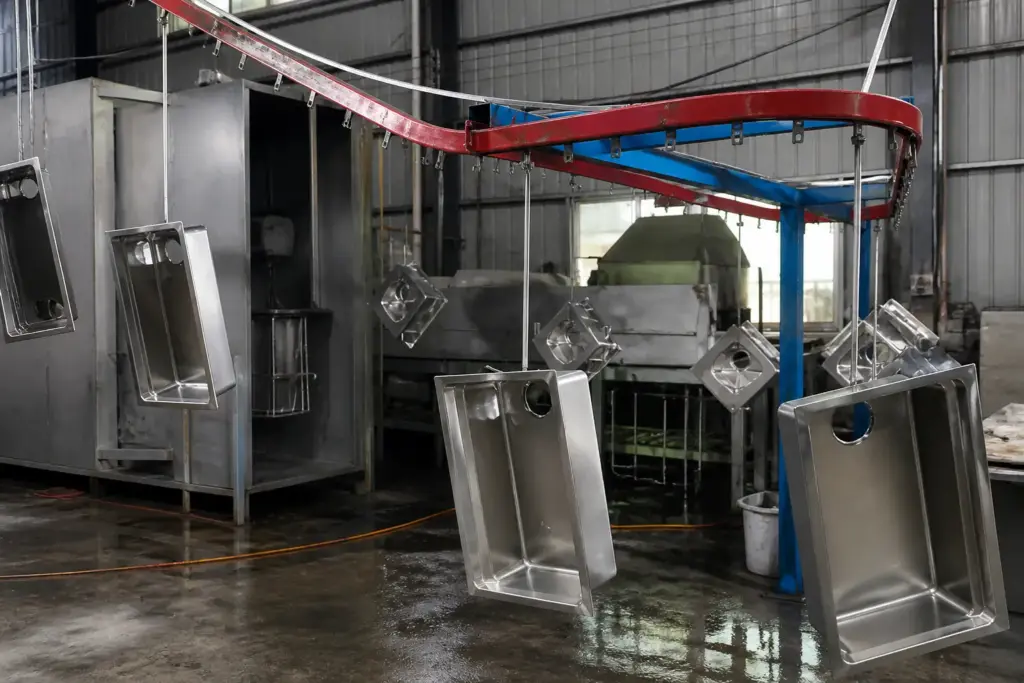
The sink body’s production MOQ is not always the only MOQ.
For example, specialty finishes may depend on:
- batch color processing
- external finishing partner
- minimum processing quantity
- color consistency
A sink factory may be able to manufacture the body quantity but still face a different practical minimum for:
PVD / colored finish.
The same can happen with:
- printed carton
- accessory color
- custom component
- private-label packaging
So always ask:
Is this MOQ for the sink body, or for the complete finished SKU?
11. Accessories Can Have Their Own MOQ
A workstation sink may include:
- grid
- cutting board
- roll-up rack
- colander
- drain
- soap dispenser
The sink factory may support one quantity while an accessory supplier requires another.
This is why private-label MOQ should be reviewed at the SKU level, not only the sink-body level.
Matrix’s Private Label Product Programs explains how product, accessories, branding and packaging come together in one program.
12. Custom Cartons Can Also Change the Practical Starting Quantity
Suppose the sink MOQ is acceptable at:
3 pcs/model
but the printed carton supplier requires a larger printing run.
The buyer now has several options:
- increase the order
- print extra cartons for future use
- use standard carton + label
- review another packaging method
This is why one universal statement such as:
MOQ = 50 pcs
can be misleading for private-label projects.
The practical MOQ depends on the complete configuration.
13. Mixed-Model Orders Can Sometimes Help
For importers buying multiple SKUs, mixed-model orders may improve the overall commercial fit.
But model mixing does not automatically solve every MOQ.
The factory still needs to consider whether the models share:
- material
- thickness
- finish
- accessories
- packaging
- production route
For example:
five handmade models
may be easier to combine than:
five completely different pressed molds with different finishes.
Mixed-model feasibility should therefore be reviewed case by case.
14. A Better Way to Ask About MOQ
Instead of asking only:
What is your MOQ?
send:
Product: Pressed single bowl
Existing Mold: Preferred
Material: SUS304
Thickness: 0.8 mm
Finish: Satin
Models: 3
Quantity: 100 pcs/model
Packing: Private-label carton
Now the factory can evaluate the actual production program.
MOQ without specification is often not very meaningful.
Handmade vs Pressed MOQ Logic
| Factor | Handmade | Pressed / Drawn |
|---|---|---|
| Main Bowl Mold | Not required | Required |
| Model Change | More flexible | Mold / setup dependent |
| Small Custom Batch | Easier | Less efficient |
| Fabrication Labor | Higher | Lower at scale |
| Tooling Investment | Not tooling required | Existing or new mold |
| High-Volume Efficiency | Moderate | Strong |
| New Geometry | Flexible | Tooling required |
| MOQ Logic | Labor + material | Setup + mold + batch efficiency |
Should Buyers Always Choose Handmade for Small Orders?
No.
If an existing pressed model already matches the requirement, pressed production can still make sense.
The decision should consider:
- target product
- quantity
- required customization
- unit-cost target
- expected repeat volume
The lowest MOQ should not decide the manufacturing route by itself.
Buyer Takeaway
Pressed sink MOQ is usually higher because the factory is spreading:
mold setup + hydraulic forming + material preparation + line setup
across a production batch.
Handmade production is more flexible because individual models can be fabricated without the same deep-drawing setup.
So when a supplier gives different MOQ for handmade and pressed sinks, ask:
What part of the production process is driving the MOQ?
That answer is much more useful than negotiating the number without understanding it.
FAQ
Why does an existing pressed mold still have an MOQ?
Because the mold still needs to be installed and run through a production batch. Forming, trimming, finishing and packing setup remain even when no new tooling is required.
Is handmade sink MOQ always lower?
Often, but not universally. Material, finish, structure, packaging and project complexity can all affect the practical minimum.
Does PVD increase sink MOQ?
It can. Specialty finishing may have its own processing or batching requirement separate from the sink-body production quantity.
Can several sink models be combined to meet MOQ?
Sometimes. It depends on whether the models can share material, finish, production scheduling, accessories and packing arrangements.
Does a higher MOQ mean a supplier is less flexible?
Not necessarily. MOQ can reflect the economics of the manufacturing route rather than a sales policy.
Planning a Sink Program?
Use the Kitchen Sink RFQ Checklist to send the model, production method, material, finish, packaging and quantity together.
For Matrix’s current private-label commercial references, see:
Private Label Product Programs
or review: