Quick Answer
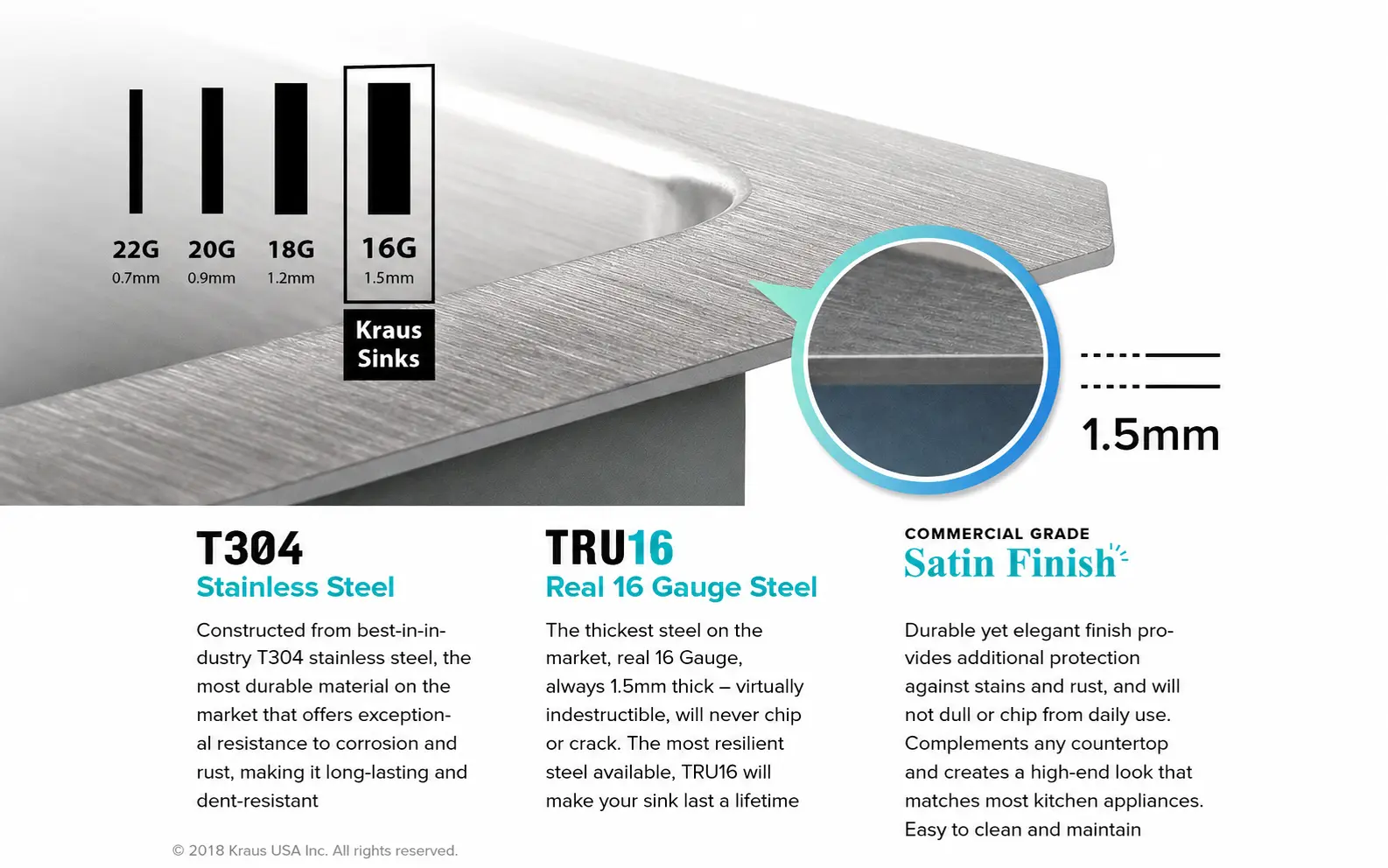
Sink weight cannot prove stainless steel thickness because total weight is affected by:
- overall size
- bowl dimensions
- bowl depth
- rim width
- single vs double bowl structure
- pressed-sink thinning
- reinforcement
- sound pads
- undercoating
A scale tells you:
how much the complete sink weighs
It does not tell you:
how thick the stainless steel is at the sidewall, radius or bowl bottom.
If minimum thickness matters, measure the steel directly at defined locations and compare the readings with the approved specification.
Weight is a screening check. Thickness is a measurement check.
1. Weight Is a Whole-Product Measurement
Suppose a sink weighs:
7.5 kg
That number includes the effect of the entire sink geometry.
It does not tell you whether the stainless steel sidewall is:
0.8 mm
1.0 mm
1.2 mm
unless the dimensions, structure and other materials are already known.
That makes weight useful for comparison only when the products are genuinely equivalent.
2. A Larger Sink Naturally Weighs More
Compare:
Sink A
700 × 450 mm
Sink B
800 × 500 mm
Even if both use exactly the same steel thickness, Sink B may weigh more because it contains more stainless steel.
So:
heavier = thicker
is not a valid conclusion unless geometry is normalized first.
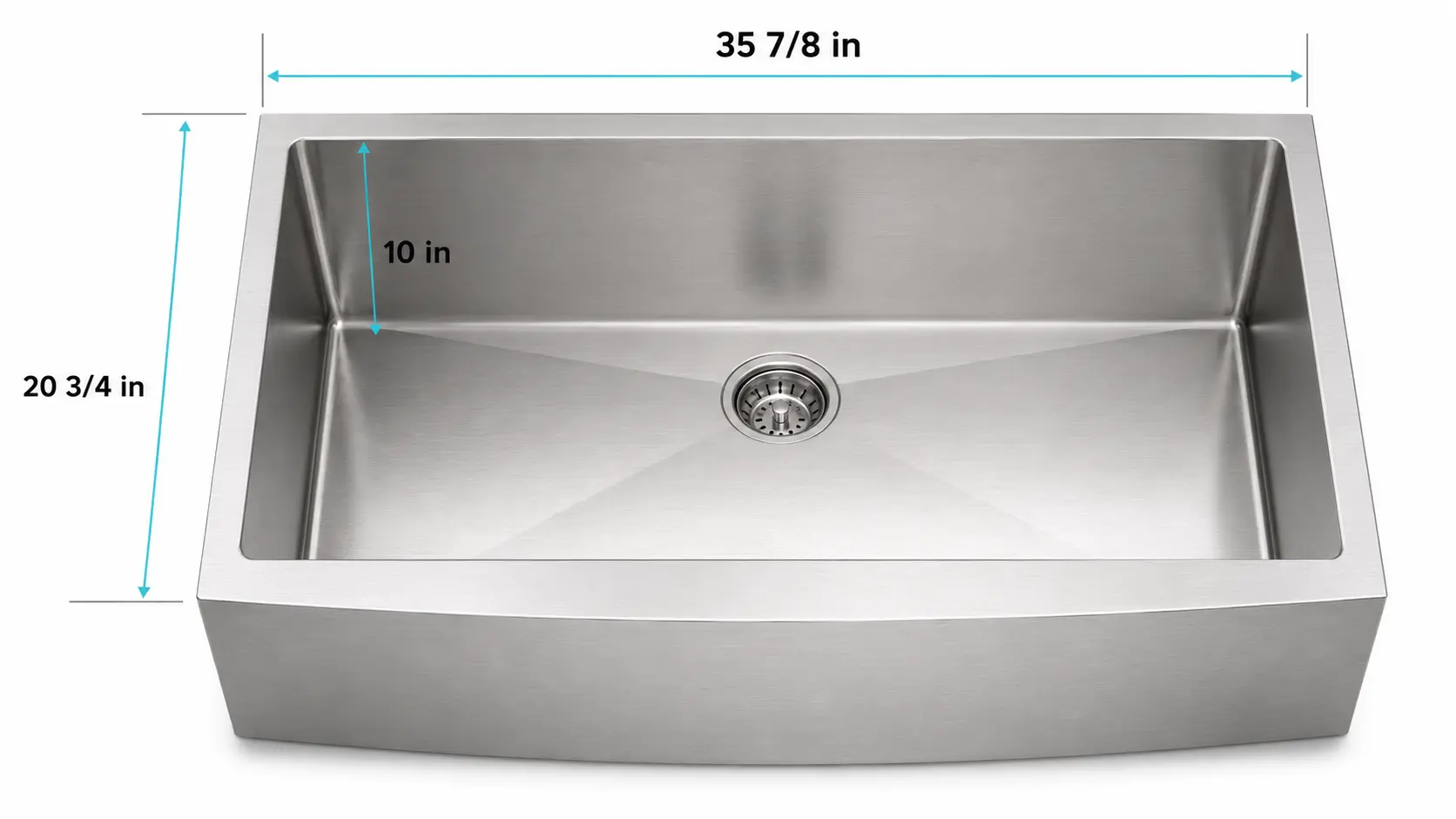
3. Bowl Depth Changes Weight
A deeper bowl generally uses more material area.

For example:
800 × 500 × 180 mm
and:
800 × 500 × 220 mm
have the same outside length and width.
They do not have the same bowl geometry.
The deeper version can weigh more without using thicker steel.
4. Rim Width Changes Weight
A wide top-mount rim contains more metal than a narrow undermount flange.
That means two sinks with:
- same bowl
- same material
- same thickness
can still have different weight because the upper structure is different.
5. Double Bowls and Dividers Change the Calculation
A double-bowl sink may include:
- additional bowl wall
- divider
- different bottom structure
A single-bowl sink of similar outside size does not.
So weight should not be used to compare thickness across different bowl configurations.
6. Handmade Structures May Use More Than One Thickness
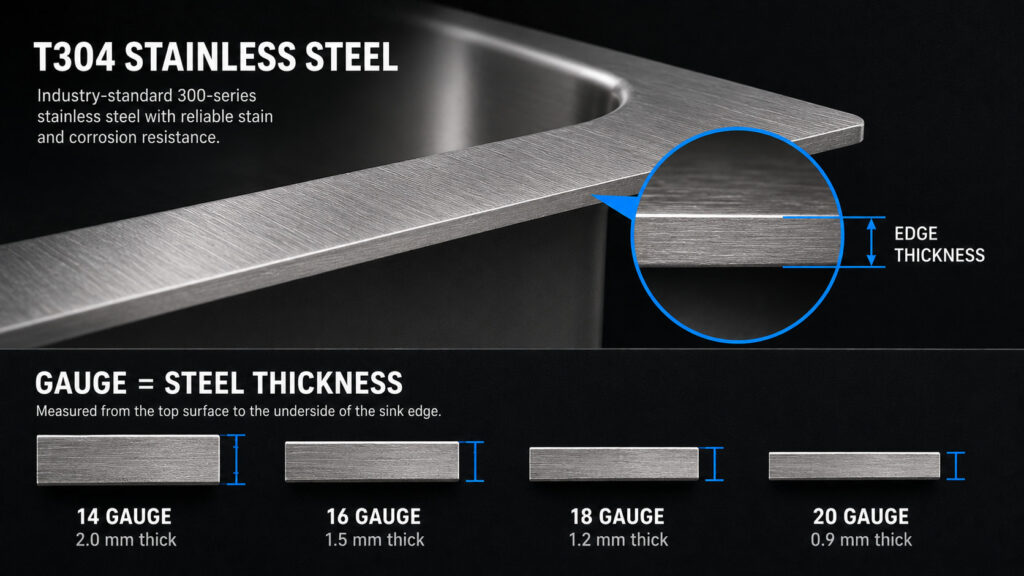
A handmade sink may use:
3.0 mm upper plate + 0.8 mm bowl
Another may use:
1.2 mm throughout.
Which one should weigh more?
The answer depends on:
- size
- rim area
- bowl depth
- structural design
A single total weight cannot tell you which part is thicker.
For handmade sinks, specify each structural thickness separately.
7. Pressed Sinks Can Thin During Forming
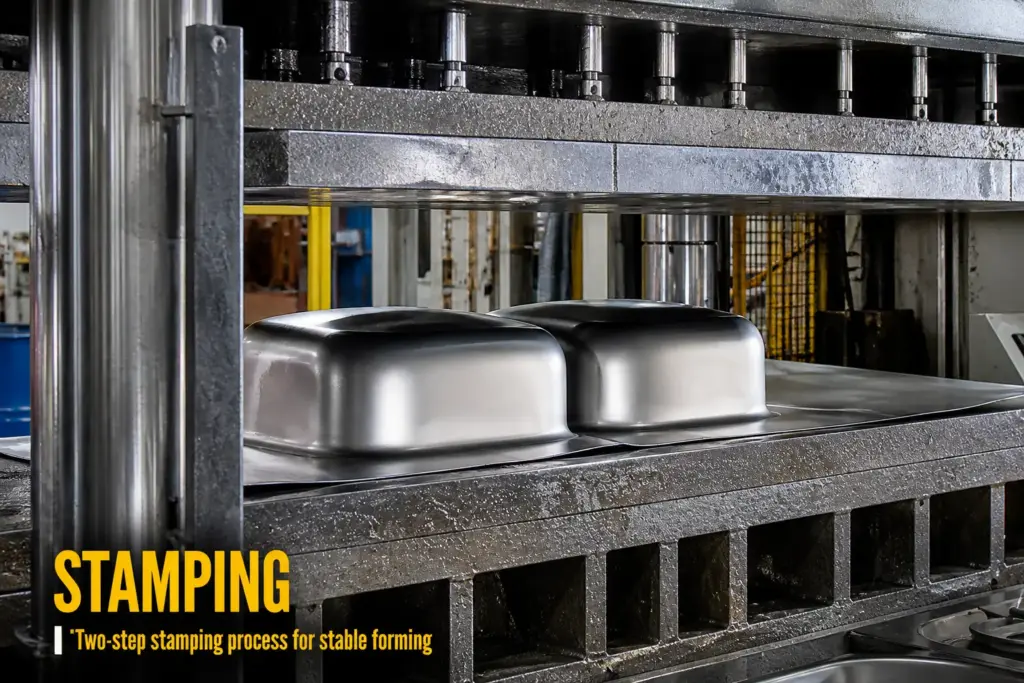
This is where weight becomes especially weak as a thickness check.
A pressed sink begins as a flat sheet.
During deep drawing:
metal moves and stretches.
The finished sink may have different thickness at:
- flange
- upper sidewall
- middle wall
- lower radius
- bowl bottom
The total mass of stainless steel may remain close to the original blank mass, while its thickness distribution changes significantly.
That means a pressed sink can have the expected total weight and still contain locally thinner areas.
8. Why Weight Cannot Detect Local Thinning
Imagine the same amount of stainless steel being redistributed across a deeper bowl.
The scale still sees:
almost the same total steel mass.
But the wall thickness may now be:
- thicker in one area
- thinner in another
This is why deep-drawn products need location-specific measurement.
A total-weight check cannot tell you where the metal moved.
9. Sound Pads Add Weight Without Adding Stainless Steel
Finished sink weight may include:
- sound-deadening pads
- adhesive
- reinforcement
A supplier can increase pad coverage and make the finished sink heavier without changing the stainless steel thickness at all.
So if you compare finished weights, make sure the pad specification is also the same.
10. Undercoating Adds Weight Too
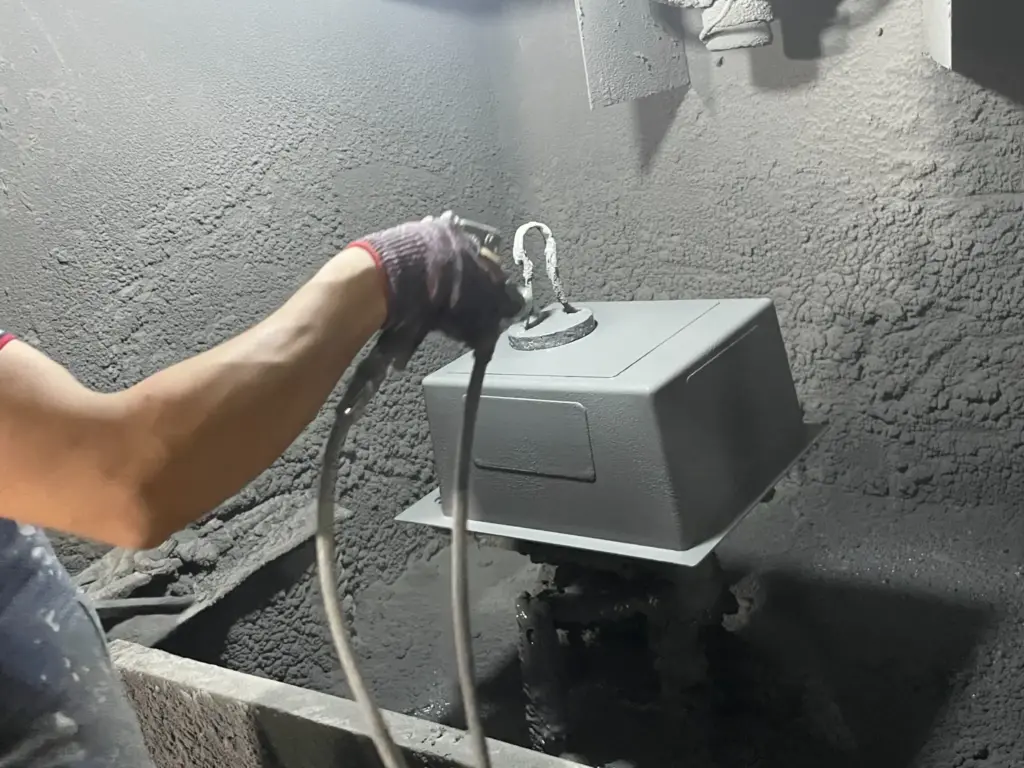
Anti-condensation or sound-damping coating can add additional mass.
Two sinks may use the same steel but different:
- coating coverage
- coating quantity
- underside treatment
The heavier sink is not necessarily made from thicker stainless steel.
11. Accessories Can Distort Weight Comparisons
Always confirm what weight is being reported.
It may refer to:
- bare sink
- sink + drain
- sink + clips
- sink + grid
- complete accessory set
- net carton weight
- gross carton weight
For material comparison, use:
bare sink-body weight
if weight is going to be used at all.
12. What Is Weight Actually Good For?
Weight is still useful as a consistency check.
Suppose:
Approved Sample
Net sink weight:
7.4 kg
Repeat Production
Typical weight:
7.3–7.5 kg
Then one unit appears at:
6.4 kg
That is a useful warning signal.
The buyer should investigate:
- dimensions
- thickness
- missing reinforcement
- missing sound pad
- coating
- wrong model
So weight can identify an abnormal unit or batch.
It still does not tell you which specification changed.
13. Measure Thickness Directly
For a handmade sink, possible measurement points include:
- bowl wall
- bowl bottom
- rim
- reinforced plate
For a pressed sink:
- flange
- upper sidewall
- middle sidewall
- lower sidewall
- lower radius
- bowl bottom
The measurement map should follow the actual sink geometry.
14. Do Not Measure Only the Flange
This is particularly important on pressed sinks.
The flange normally experiences less deep-drawing deformation than the bowl.
So a reading such as:
1.0 mm flange
does not prove:
minimum finished thickness = 1.0 mm.
If thinning is the concern, measure the formed areas.
15. Starting Sheet Thickness and Finished Thickness Answer Different Questions
Starting Sheet Thickness
Answers:
What material entered production?
Finished Thickness
Answers:
What thickness remains at this location after forming?
Both can matter.
For pressed sinks, they should not be treated as interchangeable.
See How to Specify Stainless Steel Sink Thickness in an RFQ.
16. A Better Incoming Inspection
For thickness-sensitive pressed sinks, the buyer can define:
Before Forming
- SUS grade
- sheet thickness
After Forming
- measurement locations
- actual readings
- minimum requirement if applicable
Final Product
- dimensions
- depth
- weight as a consistency reference
This gives much more information than weighing only the finished sink.
17. A Simple Thickness Measurement Map
For a pressed single-bowl sink, a basic inspection map might include:
| Point | Location |
|---|---|
| A | Flange |
| B | Upper Sidewall |
| C | Middle Sidewall |
| D | Lower Sidewall |
| E | Bottom Radius |
| F | Bowl Bottom |
The exact map should follow the product design.
A deeper sink may require additional attention around highly formed areas.
18. Weight Still Works Well for Repeat-Order Monitoring
Once a product is fully frozen, net weight becomes more useful.
If all of these remain constant:
- dimensions
- thickness
- accessories
- sound pads
- coating
- structure
then weight can provide a quick production consistency signal.
The important distinction is:
use weight to detect change
not:
use weight to prove thickness.
Thickness vs Weight: What Each Can Tell You
| Check | What It Tells You |
|---|---|
| Net Sink Weight | Overall product consistency |
| Starting Sheet Measurement | Incoming material thickness |
| Flange Thickness | Local flange thickness |
| Sidewall Thickness | Local formed thickness |
| Bottom Radius Thickness | Critical deep-draw thickness |
| Bowl Bottom Thickness | Finished bottom thickness |
| Measurement Map | Thickness distribution |
Buyer Takeaway
If the sourcing question is:
Is this sink unusually light?
weigh it.
If the sourcing question is:
Is this stainless steel actually the thickness we specified?
measure it.
And if the question is:
Did deep drawing make some parts thinner?
measure several locations.
A scale can tell you that something changed. A thickness map can tell you what changed.
FAQ
Can sink weight confirm 16 gauge?
No. Weight depends on dimensions, depth, rim structure, pads, coating and other variables.
Why can a heavier sink still have thinner areas?
Because it may be larger or contain more material elsewhere while having local thinning in formed areas.
Is weight useful for QC?
Yes. Once the specification is frozen, abnormal weight can help flag production changes or missing components.
Where should a pressed sink thickness be measured?
Several formed locations should be checked, including the sidewall, lower radius and bowl bottom where relevant.
Should incoming sheet thickness also be measured?
Yes, when thickness is a critical specification. Incoming and finished measurements answer different questions.
Building a Thickness Inspection Plan?
Matrix’s Kitchen Sink Quality Control & Inspection outlines material and finished-product inspection points.
For pressed-sink production, review the Stainless Steel Sink Manufacturing Process.
If you are defining the requirement before quotation, use the Kitchen Sink RFQ Checklist and specify thickness before sample development.