
The best stainless steel kitchen sink is not necessarily the biggest, deepest or thickest one you can afford.
It is the sink that fits your cabinet, countertop, cooking habits and cleaning preferences without creating installation or plumbing problems.
For most households, a practical starting point is:
- SUS304 stainless steel
- 18-gauge construction
- A 27- to 33-inch single bowl
- An 8- to 9-inch bowl depth
- A brushed or satin finish
- Slightly rounded corners, such as R10 or R15
- A rear or offset drain when under-sink storage matters
- Undermount installation for suitable stone or quartz countertops, or top mount for easier replacement and wider countertop compatibility
This is not a universal specification. Your cabinet and countertop must be checked before the final choice.
Choose in this order
- Measure the cabinet and countertop
- Choose the installation type
- Select the sink width
- Decide between single and double bowl
- Choose the bowl depth
- Compare stainless steel grade and gauge
- Review the surface finish and corner radius
- Choose the drain position
- Check sound control
- Confirm the faucet, accessories and installation parts
Starting with size and installation prevents the most expensive mistake: buying a sink that looks right online but does not fit the kitchen.
1. Measure the cabinet before looking at sink sizes
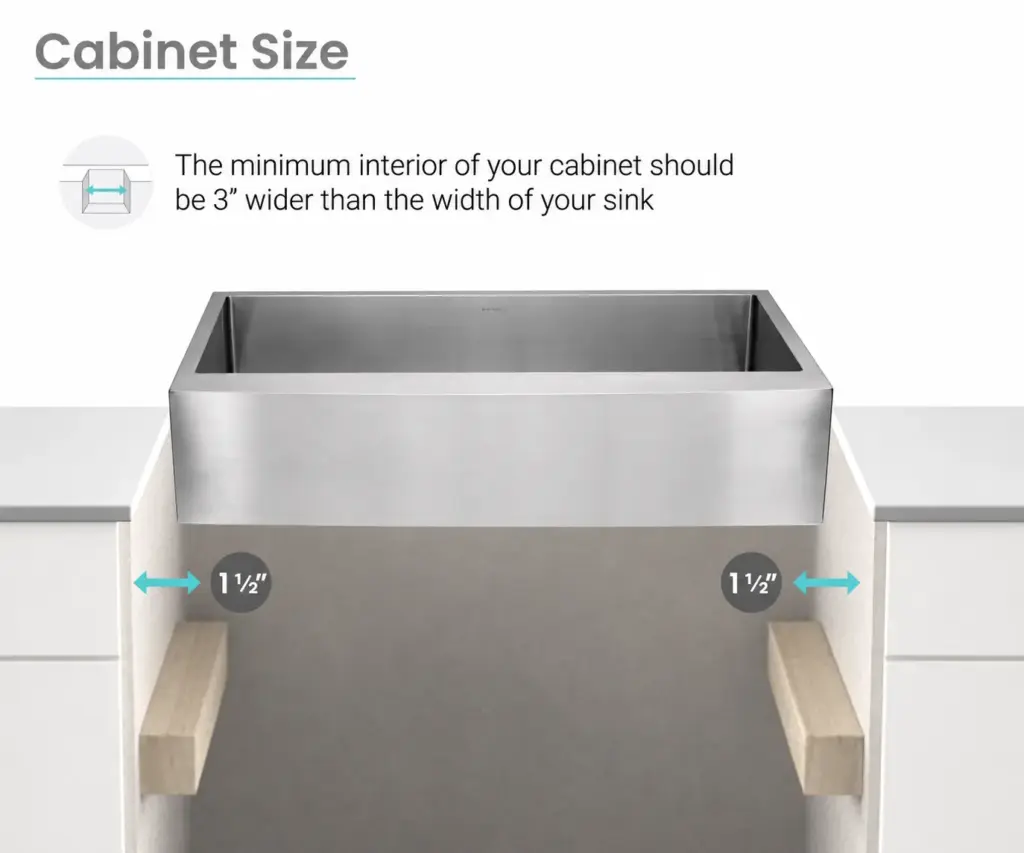
Do not begin with the countertop opening alone. Start by measuring the inside width of the base cabinet under the sink.
Determine the cabinet size before choosing a sink. Every sink model should list a minimum cabinet requirement in its specification sheet.
Record these measurements:
- Inside cabinet width
- Countertop depth from front to back
- Existing cut-out dimensions, if replacing a sink
- Available space for clips or mounting rails
- Drain and water-line locations
- Clearance for a garbage disposal, filter or waste bin
Then compare them with four dimensions on the sink specification sheet:
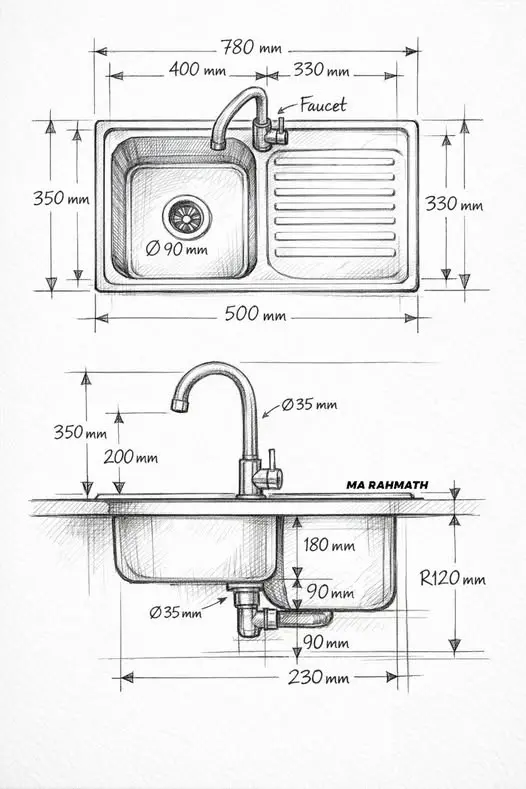
- Overall sink size
- Inside bowl size
- Cut-out size
- Minimum base cabinet width
A 30-inch sink does not automatically fit every 30-inch cabinet. The rim, mounting hardware and installation method need additional space. Always follow the minimum cabinet size stated for the exact model.
Common sink-width starting points
| Sink width | Often suitable for | What to check |
|---|---|---|
| 15–20 inches | Bar, prep area, kitchenette or very small kitchen | Limited cookware capacity |
| 21–25 inches | Compact apartments and smaller base cabinets | Bowl depth and usable internal width |
| 27–30 inches | Small-to-medium family kitchens | Cabinet width and faucet position |
| 30–33 inches | Many standard family kitchens | Usually needs a larger sink base than the sink itself |
| 36 inches and above | Large kitchens, oversized bowls and workstation layouts | Counter space, cabinet support and plumbing clearance |
These are shopping ranges, not installation rules. The model’s technical drawing is the final reference.
2. Choose the installation type for the countertop
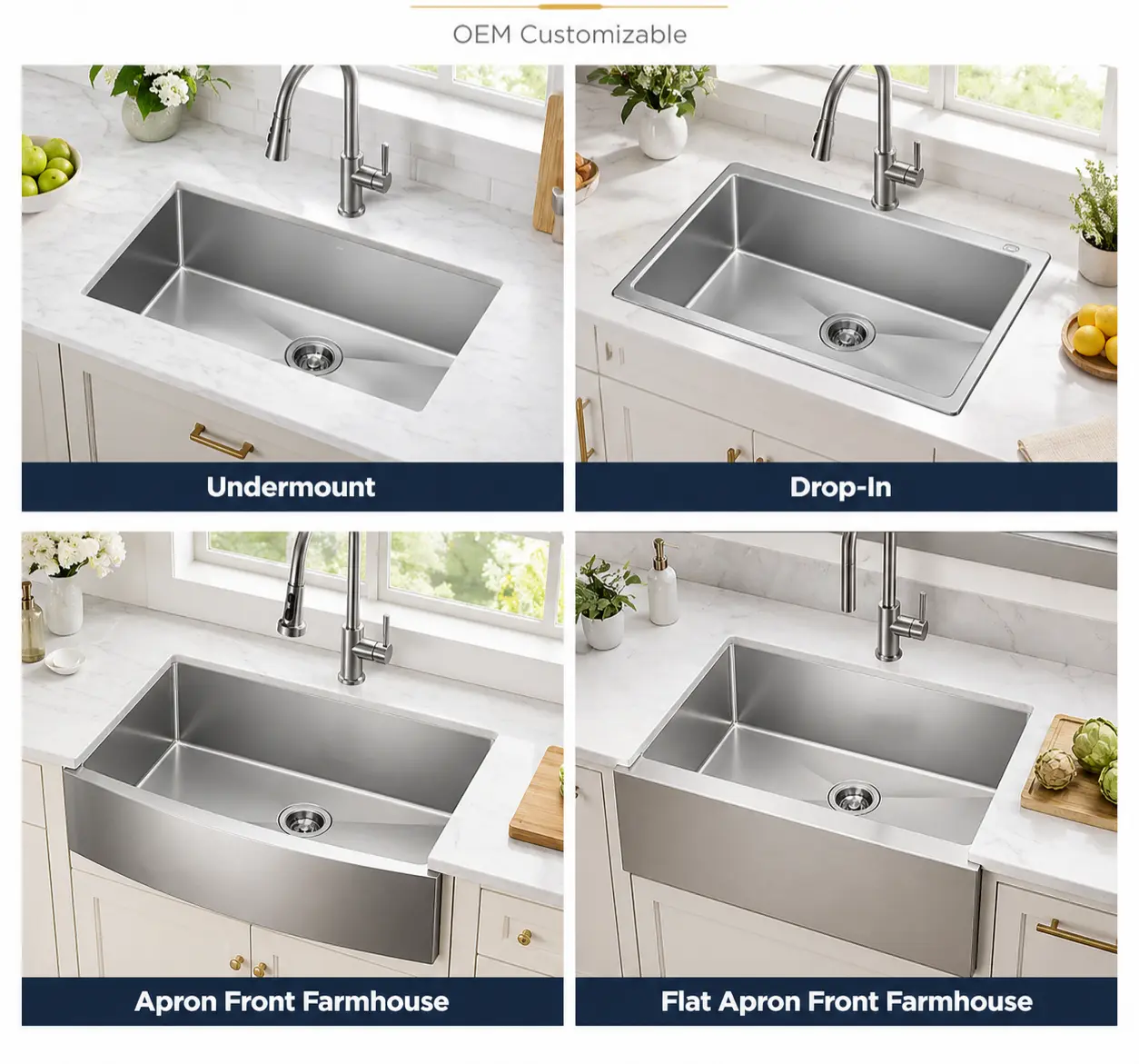
The installation style changes the appearance, cleaning experience, labor cost and countertop requirements.
Undermount sink
An undermount sink is installed below the countertop. There is no top rim to catch crumbs, so water and food debris can be wiped directly into the bowl.
Best for:
- Quartz
- Granite
- Stone
- Suitable solid-surface countertops
- Modern kitchens with a clean countertop line
Check before choosing:
- The countertop edge will be exposed and must be properly finished
- The sink needs reliable support, not sealant alone
- The cut-out must be accurate
- Installation and future replacement are more involved
Top mount or drop-in sink
A top mount sink drops into the countertop opening, with the rim resting on top.
Best for:
- Laminate countertops
- Replacement kitchens
- DIY-friendly or faster installation
- Rental homes
- Projects where countertop conditions vary
Check before choosing:
- The visible rim needs regular cleaning
- The rim should be flat and easy to seal
- The new sink must cover the existing opening if it is a replacement
Top mount is not automatically a lower-quality choice. In a renovation with an existing cut-out or moisture-sensitive countertop, it may be the safer option.
Apron-front or farmhouse sink
An apron-front sink has an exposed front panel and creates a stronger visual feature.
It usually requires:
- A compatible or modified cabinet
- A support frame
- Careful apron-height measurement
- Planning before the countertop is fabricated
If the cabinets and countertop are already finished, an apron-front sink is rarely a simple last-minute change.
Compare the main options in the Matrix undermount vs top mount sink guide.
3. Choose a sink width that preserves useful counter space
The biggest sink that fits is not always the best sink.
A wider bowl makes it easier to wash sheet pans and stockpots, but it can reduce preparation space in a smaller kitchen. It may also require a wider cabinet and change the location of the faucet, dishwasher or waste system.
Ask three questions:
- What is the largest item you regularly wash?
- How much counter space can you afford to lose?
- Does the sink base leave enough room for plumbing and storage?
For many households, a sink between 27 and 33 inches offers a useful balance. Compact kitchens may work better with a 21- to 25-inch bowl, while larger workstation kitchens may benefit from 33 inches or more.
4. Choose single or double bowl by how you actually cook
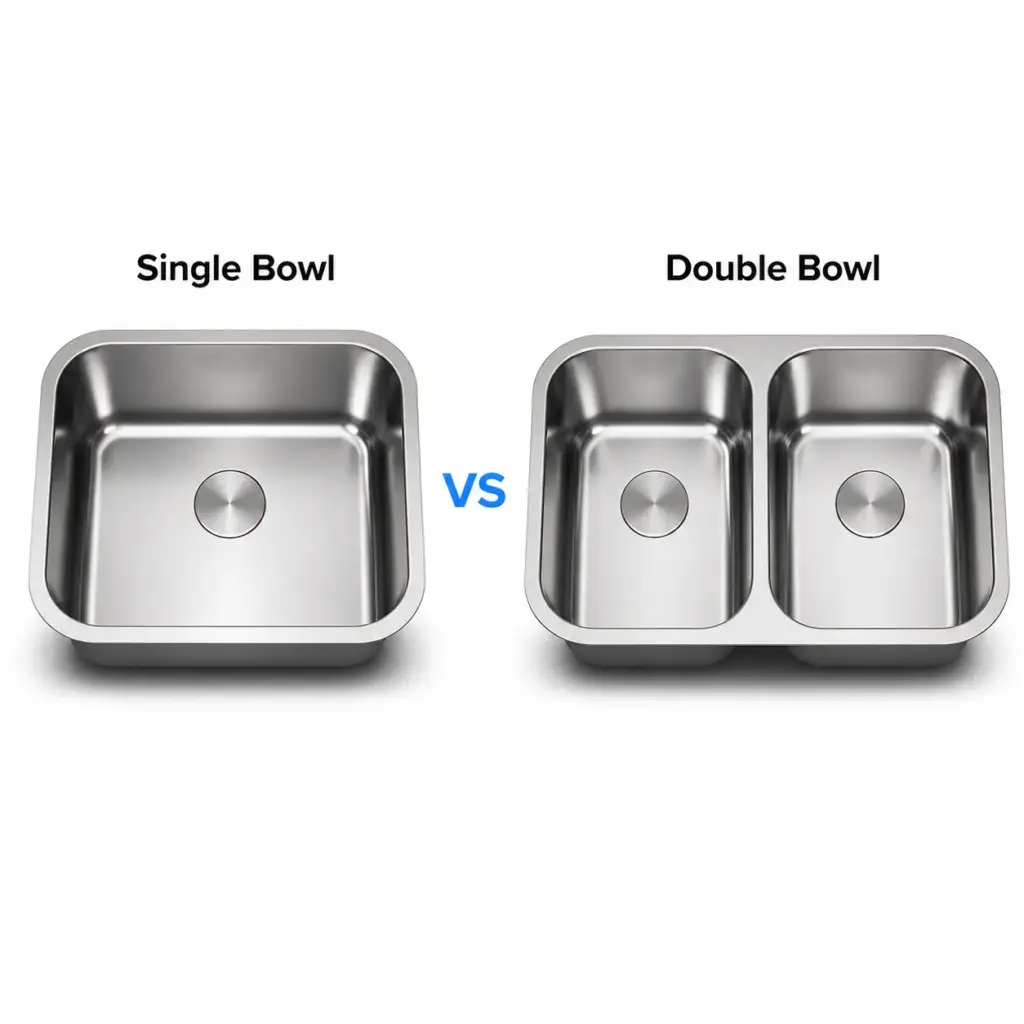
Single bowl
A single bowl kitchen sink gives you one open washing area.
Choose it if you:
- Wash large pans, baking trays or woks
- Use a dishwasher for most plates and cutlery
- Want maximum usable space in a smaller sink width
- Plan to use workstation accessories
Double bowl
A double bowl creates separate zones for washing, rinsing, soaking or food preparation.
Choose it if you:
- Often wash dishes by hand
- Like to separate dirty and clean items
- Want one bowl available while the other is in use
- Already prefer a traditional two-bowl workflow
60/40 or low-divide bowl
An unequal double bowl provides one larger section for cookware and one smaller section for rinsing or food preparation. A low divider makes it easier to accommodate wider pans while retaining two work zones.
There is no universally better layout. A single bowl usually offers more flexible space; a double bowl offers more separation.
5. Choose the right bowl depth
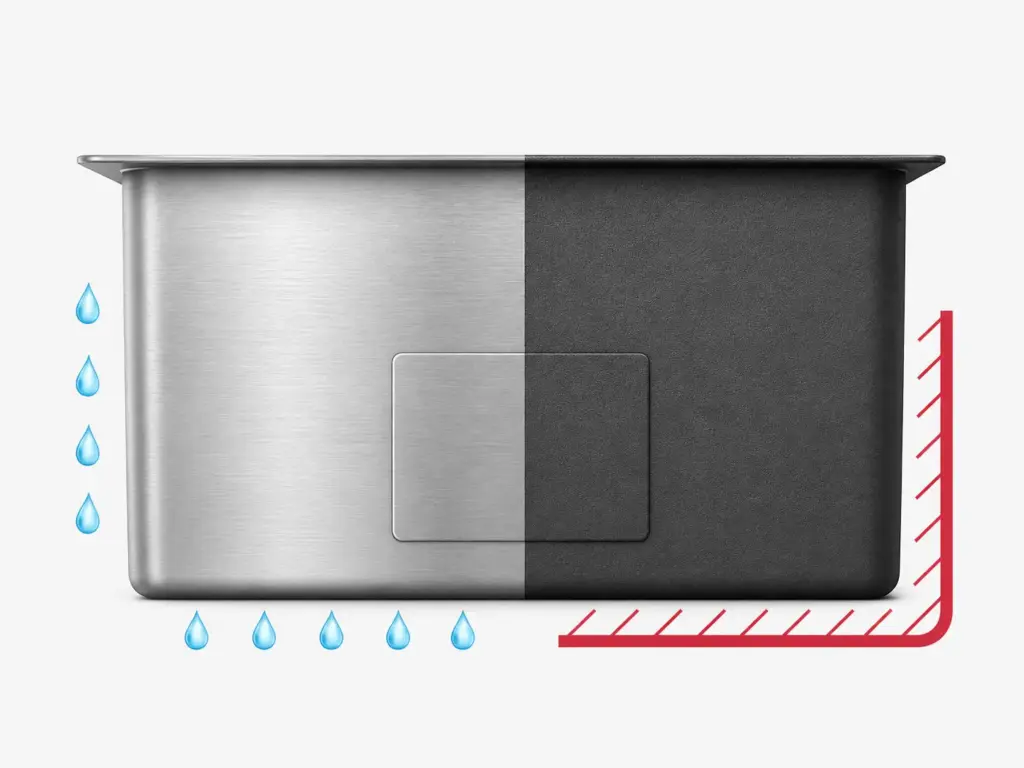
Depth affects washing capacity, splashing, comfort and under-sink space.
Deeper 9- or 10-inch bowls hold larger items and contain more splashing, but they reduce cabinet space and require the user to reach farther down.
| Bowl depth | Best suited to | Possible drawback |
| 6–7 inches | Accessible kitchens, bar sinks and light use | Less capacity and more splashing |
| 8 inches | Compact kitchens and moderate daily use | Less room for tall pots |
| 9 inches | A strong all-round choice for many families | Uses more cabinet space than a shallow bowl |
| 10 inches or more | Large cookware and heavy washing | More bending and less plumbing/storage clearance |
For most family kitchens, 8 to 9 inches is a comfortable range. Choose 10 inches or more only after checking the drain height, garbage disposal, P-trap and user comfort.
More depth is not automatically more ergonomic. A tall user may find a very deep undermount sink uncomfortable because the countertop thickness adds to the effective reach.
See the deep kitchen sink guide for more detail on cabinet and plumbing clearance.
6. Choose the stainless steel grade
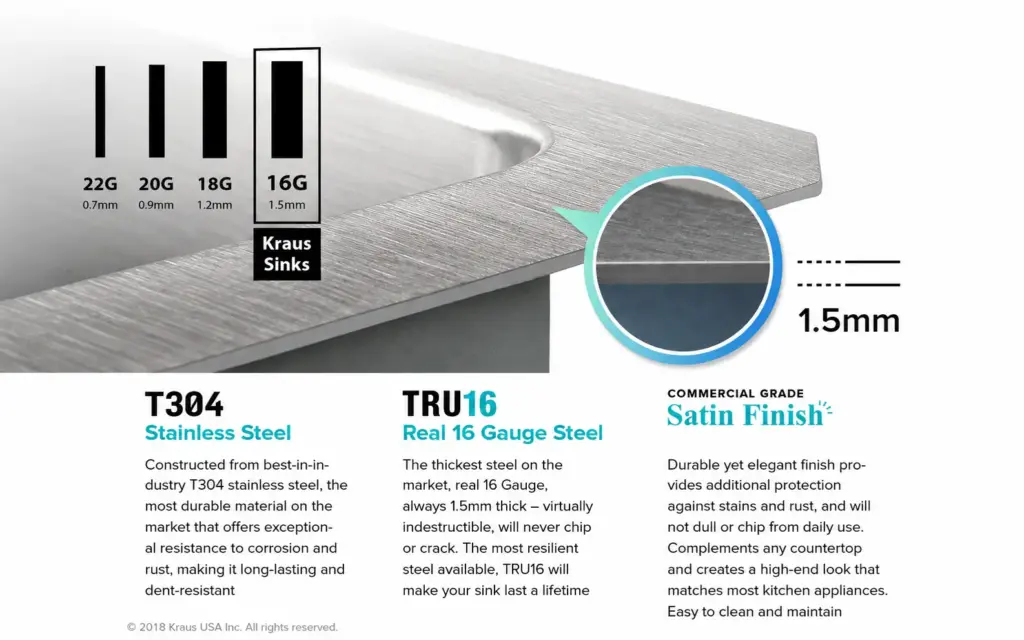
SUS304: the practical household standard
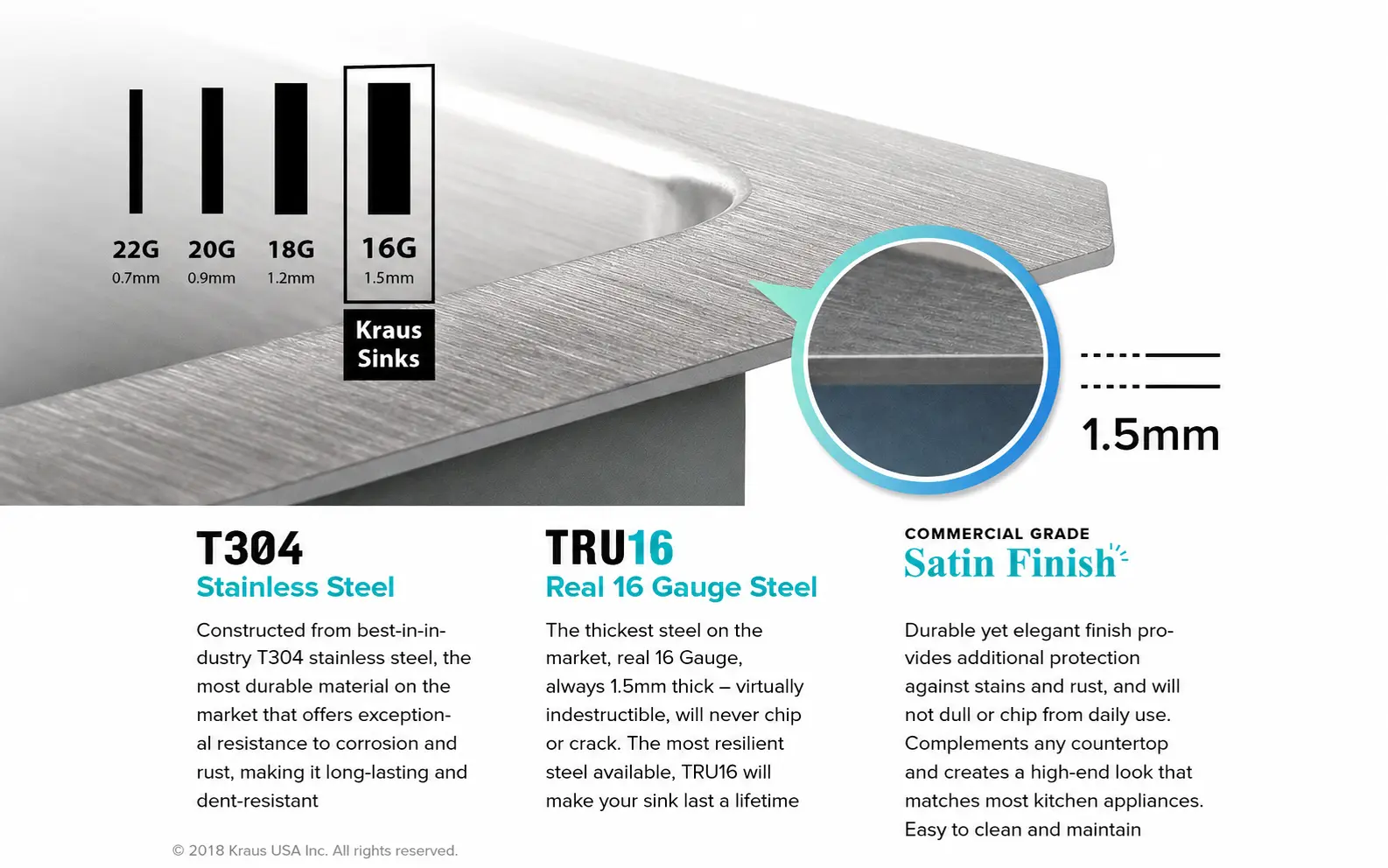
SUS304 is the safest general recommendation for most indoor family kitchens. It offers a good balance of corrosion resistance, formability, availability and price.
SUS201: a value option with less corrosion margin
SUS201 can be used in value-oriented indoor sinks, but it generally has less corrosion margin than 304. Product quality, finish and care conditions become more important.
SUS316: useful for specific environments
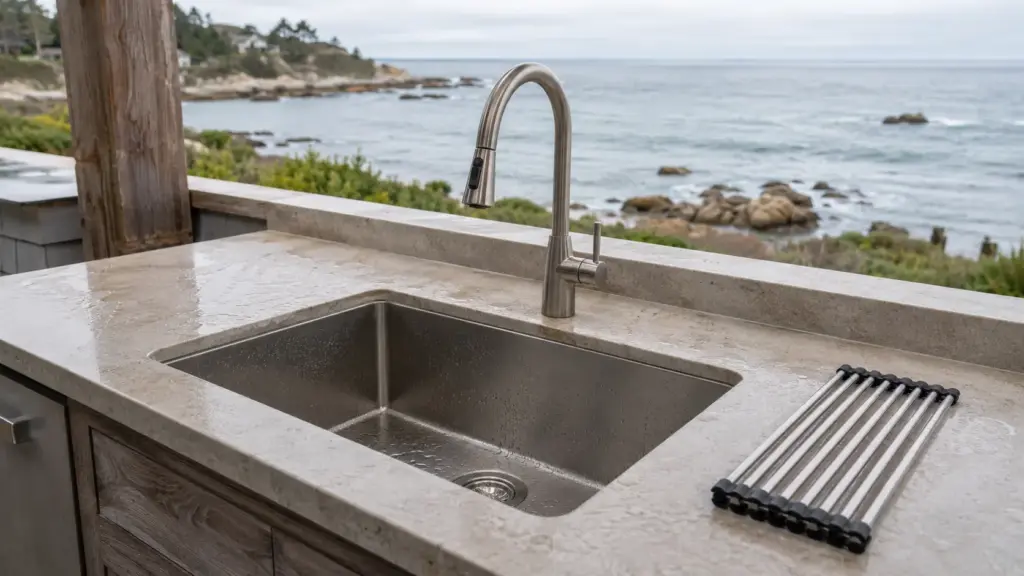
SUS316 contains molybdenum and offers more resistance to localized corrosion in chloride-heavy environments. It may be useful in some coastal, outdoor or specialist applications, but it is unnecessary for many normal indoor kitchens.
Do not pay for 316 expecting the sink to become thicker, quieter or more scratch-resistant. Those characteristics depend on other parts of the specification.
Read the full comparison of 201 vs 304 vs 316 stainless steel sinks.
7. Choose 16 gauge or 18 gauge without overbuying
Gauge describes the thickness of the stainless steel. A lower gauge number means thicker steel.
16 gauge
Choose 16 gauge when you want:
- A heavier, more substantial feel
- A large bowl with greater rigidity
- A premium handmade or workstation sink
- Additional dent resistance for demanding use
18 gauge
Choose 18 gauge when you want:
- A strong balance of durability, weight and price
- A practical sink for normal family use
- Easier handling and installation
- A wider choice of models
For most households, 18 gauge provides a sensible balance of durability, weight and price. Move to 16 gauge when the bowl size, product structure, expected use or premium feel justifies the added thickness.
Gauge alone does not determine quality. A thick sink can still have poor drainage, weak polishing, inadequate sound pads or an uneven rim.
Compare the differences in the Matrix 16 gauge vs 18 gauge sink guide.
8. Choose a surface finish you can live with
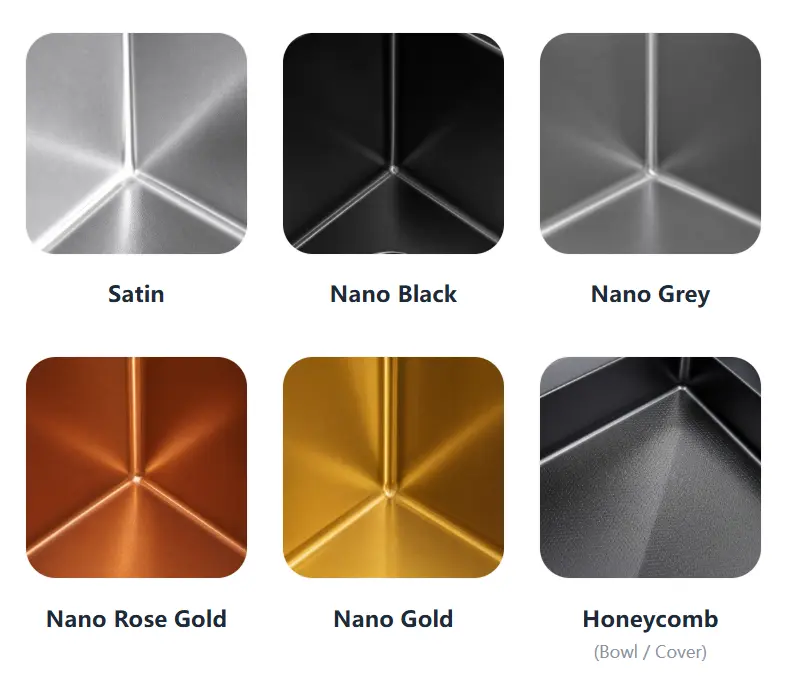
All stainless steel sinks will develop fine marks with use. The goal is not to find a completely scratch-proof sink. It is to choose a finish that ages in a way you can accept.
Brushed or satin finish
The most practical choice for many homes.
Advantages:
- Disguises fine scratches better than a mirror finish
- Fits most kitchen styles
- Easier to maintain visually
- Usually blends well with stainless appliances
Check that the brushing is even and runs in a consistent direction.
Polished or mirror finish
Creates a brighter, more reflective appearance but usually shows fingerprints, water spots and scratches more clearly.
Choose it for appearance—not because it is easier to maintain.
Black, PVD and colored finishes

Colored stainless steel can create a more distinctive kitchen, but the surface needs realistic care expectations.
Before choosing, confirm:
- The recommended cleaning method
- Whether abrasive pads or chemicals should be avoided
- How scratches and wear will appear
- Whether matching drains and accessories are available
- Whether the color has been reviewed under real kitchen lighting
Be cautious with terms such as “scratch-proof” or “nano.” Ask what the finish actually is and how it should be maintained.
9. Choose a corner radius that balances style and cleaning
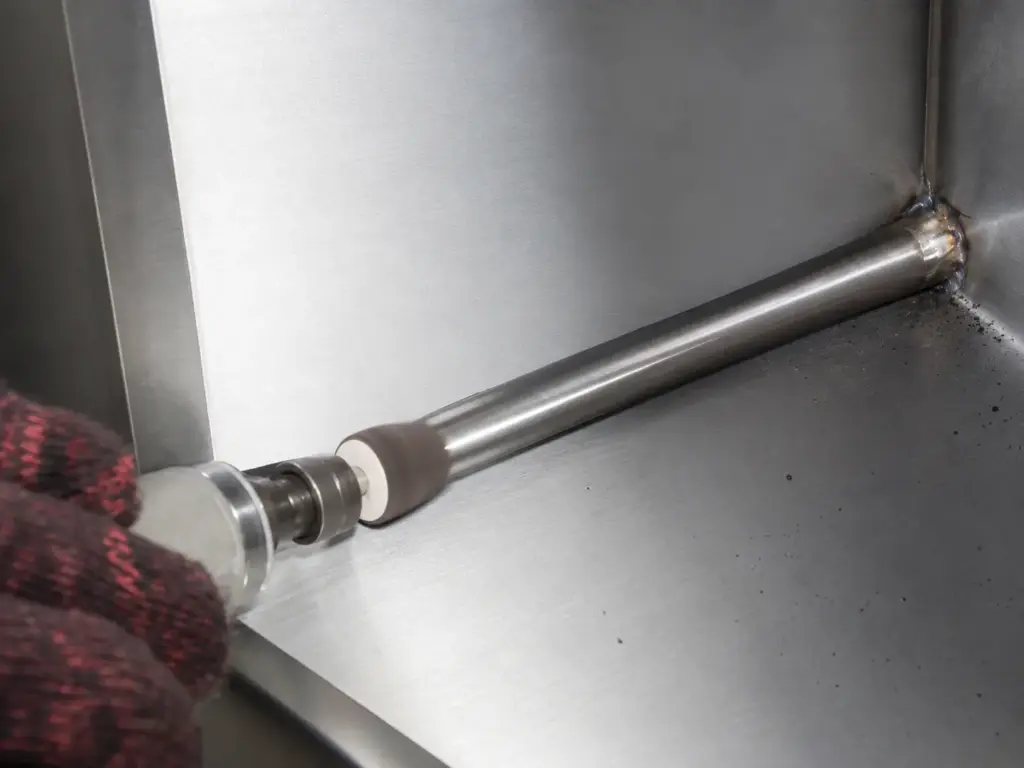
Corner radius describes how sharp or rounded the inside corners are.
Zero-radius or R0 corners
- Sharp, architectural appearance
- Maximum flat bowl area
- More difficult to wipe clean at the corner seams
- Dependent on good welding and polishing
R10 or R15 corners
- Modern appearance with slight rounding
- Easier to clean than R0
- A practical compromise for many homes
Larger rounded corners
- Easiest to clean
- Softer, more traditional appearance
- Commonly found on pressed sinks
For most households, a small but visible radius such as R10 or R15 offers a good balance. The sharpest corner is not automatically the most premium choice.
10. Choose the drain position for the cabinet as well as the bowl
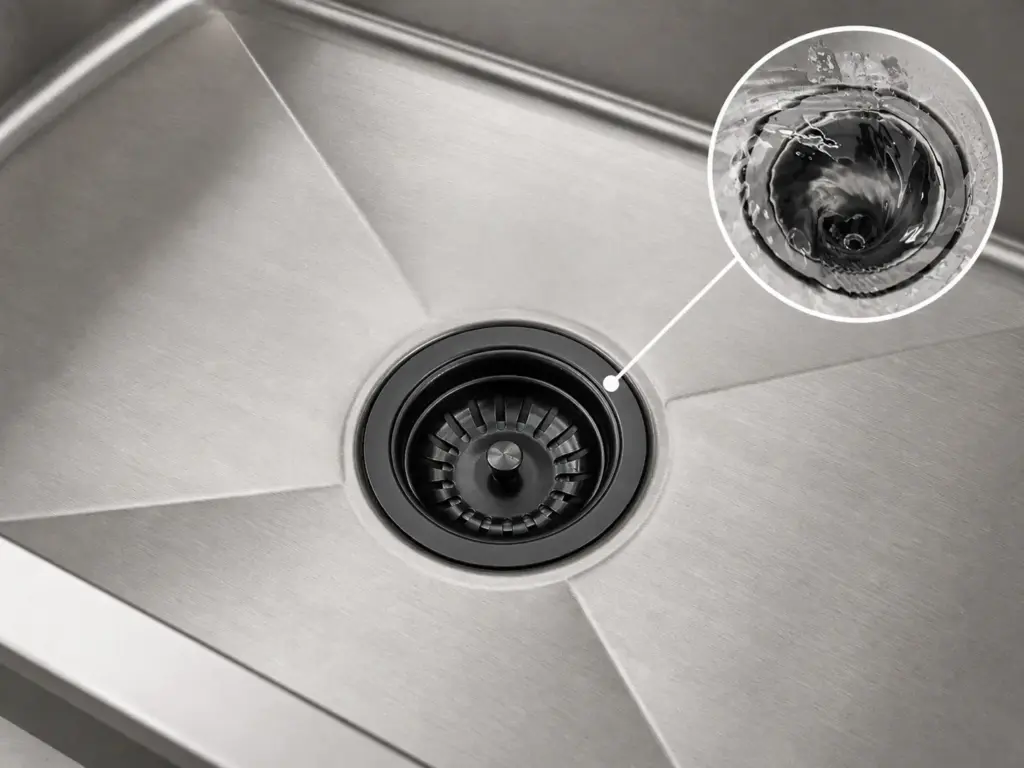
Center drain
A center drain is familiar and works with many standard plumbing layouts. However, dishes can cover it, and the plumbing may occupy the middle of the cabinet.
Rear or offset drain
A rear or offset drain can:
- Leave more usable space in the bowl
- Keep the drain open when dishes are in the sink
- Move plumbing toward the back of the cabinet
- Create more room for waste bins or storage
It must still align with the home’s plumbing, garbage disposal and bottom grid. Check the cost of moving existing pipes before changing the drain location during a replacement project.
11. Do not judge noise by gauge alone
Thicker steel can reduce vibration, but sound-control construction also matters.
Look underneath the sink for:
- Sound-deadening pads on the bottom and side walls
- Secure pad adhesion
- Adequate coverage rather than one small decorative pad
- Undercoating that is even and properly bonded
Both steel thickness and sound-deadening pads affect sink noise. Pad material, position, coverage and adhesion can be just as important as the gauge number.
An 18-gauge sink with well-designed pads can be quieter than a poorly treated 16-gauge sink.
12. Decide whether you will actually use workstation accessories
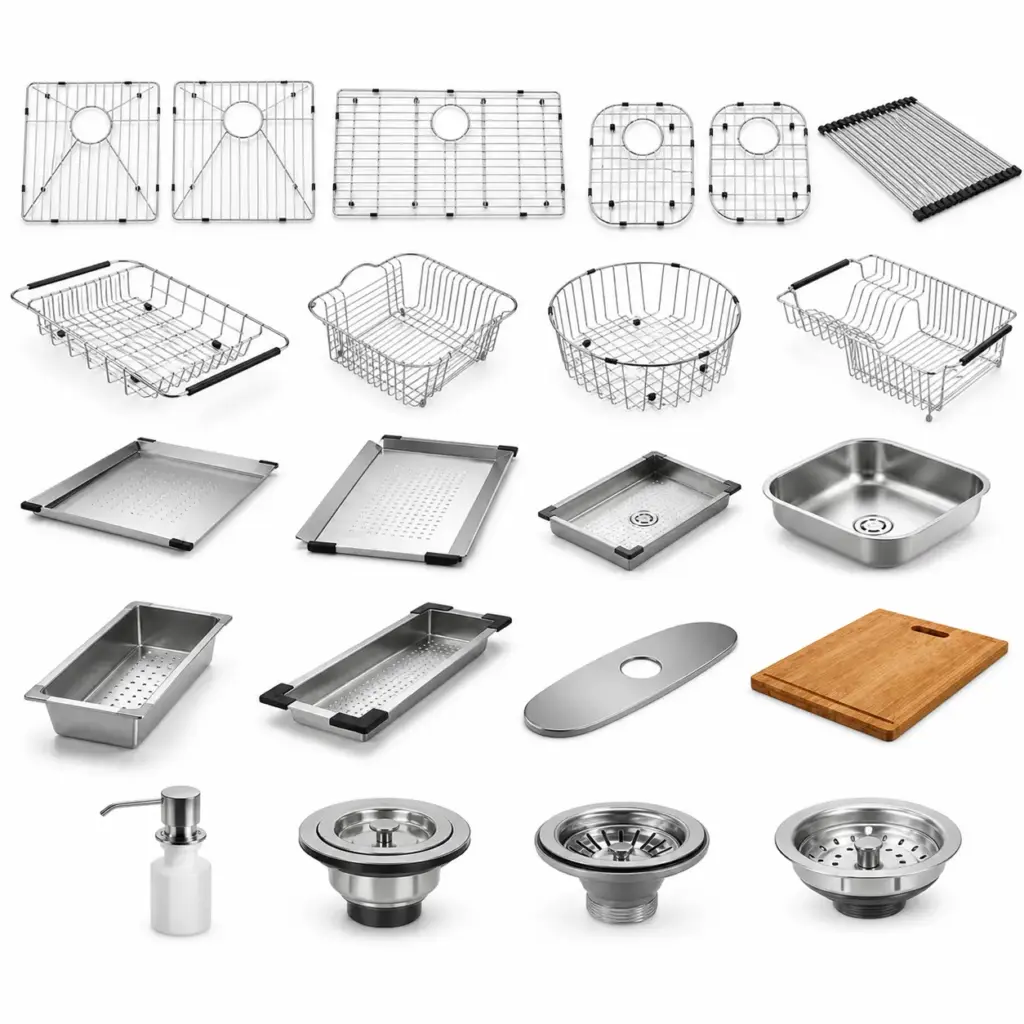
A workstation kitchen sink has built-in ledges for cutting boards, colanders, drying racks and other accessories.
It can be useful when:
- Counter space is limited
- You prepare food directly over the sink
- You regularly use a colander or drying rack
- The accessories can be stored conveniently
Before paying for a large accessory set, ask:
- Will I use these pieces every week?
- Are replacements available?
- Are they dishwasher-safe or easy to clean?
- Do they fit securely without wobbling?
- Where will I store them?
More accessories do not always create a better sink. Unused accessories become clutter.
13. Match the faucet to the sink
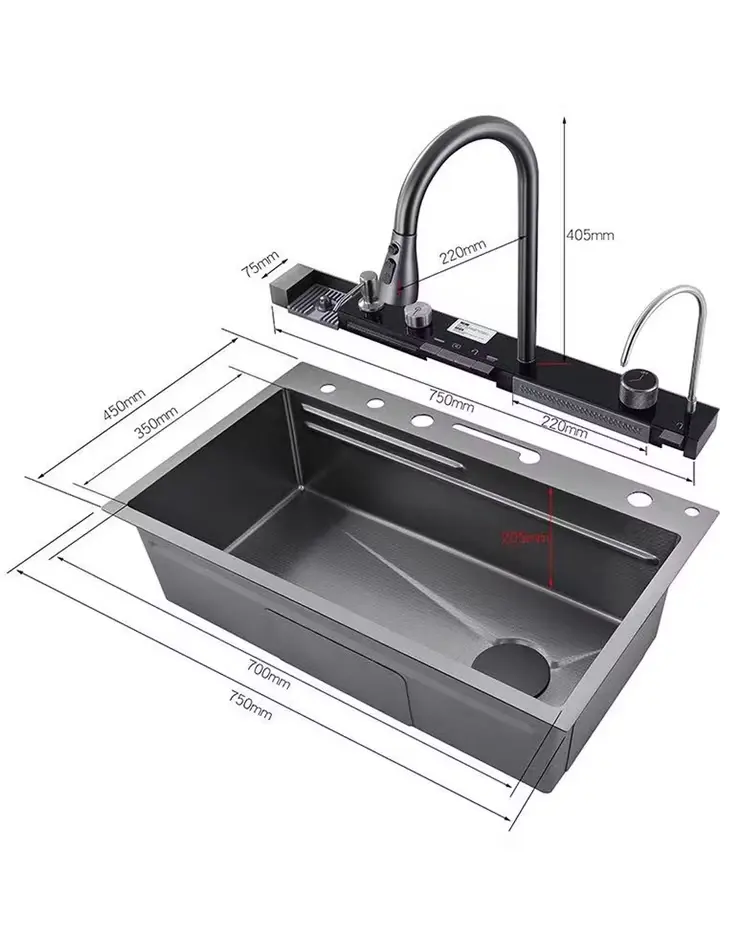
Check the faucet and sink together before ordering.
Confirm:
- Number and diameter of faucet holes
- Faucet base size
- Spout reach toward the center of the bowl
- Faucet height below windows or cabinets
- Pull-down hose clearance
- Splash risk with a shallow bowl or high spout
- Holes for a soap dispenser, filtered-water faucet or air gap
A high faucet with a short reach can splash water onto the countertop. A pull-down hose can also conflict with pipes, bins or filters below the sink.
Matrix’s sink and faucet installation guides explain the main compatibility checks.
Six common mistakes to avoid
- Buying by outside width without checking the minimum cabinet size
- Choosing undermount before confirming the countertop material
- Choosing the deepest bowl without checking plumbing clearance
- Assuming 16 gauge automatically means better overall quality
- Choosing sharp corners without considering cleaning
- Paying for accessories that will not be used or cannot be replaced
The best specification for different households
| Household need | Suggested starting point |
| Small apartment | 21–27-inch single bowl, 8-inch depth, 18 gauge, brushed finish |
| Typical family kitchen | 27–33-inch single bowl, 8–9-inch depth, SUS304, 18 gauge, R10/R15 corners |
| Frequent large-cookware use | 30–36-inch large single bowl, 9–10-inch depth, 16 or 18 gauge |
| Mostly hand-washed dishes | Double bowl or 60/40 configuration, around 8–9 inches deep |
| Limited counter space | Single-bowl workstation with a carefully selected accessory set |
| Easy-cleaning priority | Undermount with suitable countertop, brushed finish and rounded corners |
| Renovation or laminate countertop | Top mount/drop-in model sized to cover the existing cut-out |
These are starting points. Always confirm the exact model against the cabinet, countertop and plumbing.
Final recommendation
For most households, begin with a SUS304, 18-gauge, brushed stainless steel single bowl with an 8- to 9-inch depth and slightly rounded corners.
Then adjust the specification based on:
- Cabinet width
- Countertop material
- Largest cookware
- Hand-washing habits
- Under-sink storage
- Preferred cleaning effort
- Installation budget
Do not let a premium label replace practical measurements. Fit, drainage, finish quality and installation matter more in daily use than one impressive specification.
How Matrix approaches stainless steel sink selection
Matrix Manufacture Co., Ltd. manufactures stainless steel kitchen sinks for brands, importers, wholesalers and project buyers. Our product range includes handmade and pressed/drawn sinks, undermount and top mount models, single and double bowls, workstation sinks and selected surface finishes.
The same details that help a homeowner choose the right sink—cabinet fit, installation, depth, drainage, finish and accessories—also help brands reduce returns and build better product ranges.
Homeowners can explore the Matrix stainless steel kitchen sink range. Brands, distributors and project buyers can send Matrix their target market, sizes, installation type, finish, accessory plan and order requirements for review.
Discuss a Stainless Steel Sink Program
Frequently asked questions
What is the best stainless steel kitchen sink for most homes?
A SUS304, 18-gauge, brushed single-bowl sink with an 8- to 9-inch depth is a practical starting point for many homes. The correct width and installation type depend on the cabinet and countertop.
What is the most common kitchen sink size?
Many family kitchens use sinks in the 27- to 33-inch range, with 30- and 33-inch models widely available. Do not select by width alone; check the minimum cabinet size, cut-out and bowl dimensions for the exact model.
Is a 9-inch-deep sink too deep?
Nine inches works well for many households because it contains splashing and accommodates cookware. It may feel too deep for some users or reduce under-sink clearance, especially with undermount installation.
Is 16 gauge better than 18 gauge?
16 gauge is thicker, but 18 gauge is sufficient for many residential kitchens. Finish quality, drainage, sound pads, rim flatness and installation also affect the sink’s performance.
Is undermount or top mount easier to clean?
Undermount is usually easier for wiping the countertop because there is no top rim. Top mount is generally easier to install and replace and works with a wider range of countertop materials.
Is a single or double bowl better?
A single bowl is better for large cookware and open working space. A double bowl is better for people who prefer separate washing and rinsing zones. Choose according to daily habits rather than appearance alone.
What stainless steel finish hides scratches best?
A brushed or satin finish generally disguises fine scratches better than a polished mirror finish. No stainless steel sink is completely scratch-proof.
Are workstation sinks worth it?
They can be worthwhile in kitchens with limited counter space or for people who regularly use cutting boards, colanders and drying racks over the sink. They are less useful when the accessories are rarely used or difficult to store.