304 stainless steel is corrosion-resistant. It is not corrosion-proof.
So when brown or orange spots appear on a SUS304 kitchen sink, the correct conclusion is not automatically:
“The factory used the wrong stainless steel.”
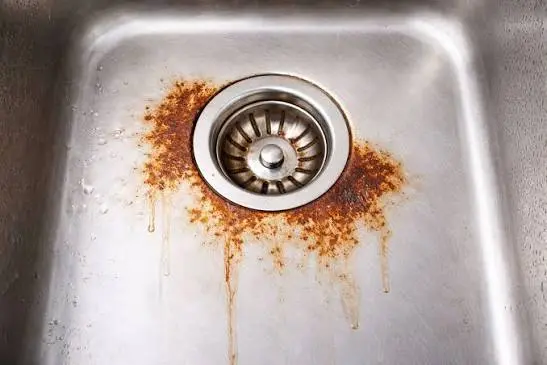
Rust-like marks can come from several very different causes, including surface iron contamination, chloride exposure, aggressive cleaning chemicals, trapped moisture, fabrication contamination or an actual material problem.
For buyers and QC teams, the important question is:
Is the stainless steel itself corroding, or is something on the surface creating the rust-like mark?
Quick Answer
A SUS304 kitchen sink can develop rust-like spots even when the base material is genuinely 304.
Common causes include:
- free-iron contamination on the surface
- steel particles left from fabrication or grinding
- chloride exposure
- aggressive cleaning chemicals
- standing moisture or deposits
- contamination from tools, racks or packaging
- actual material-grade or corrosion-resistance problems
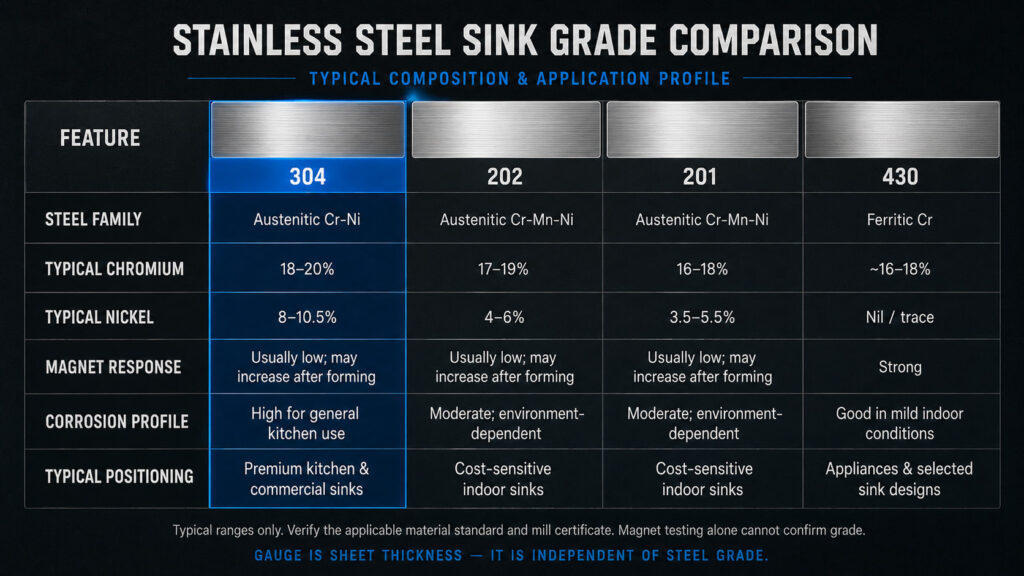
A visible rust spot alone does not prove that the sink is SUS201 or another lower-grade stainless steel.
The correct investigation should separate:
Surface Contamination → Environmental Exposure → Material Verification
before rejecting the production batch.
First: “Rust-Like Spot” and “Wrong Material” Are Not the Same Diagnosis
A buyer may see:
- orange dots
- brown marks
- small rust-colored pits
- discoloration around corners
- marks near welds or drain areas
and immediately suspect:
wrong stainless steel.
But the visible color only shows that iron oxidation is present somewhere in the system.
It does not tell you whether the iron came from:
- the SUS304 base material
- embedded carbon-steel particles
- contaminated tools
- grinding dust
- external metal contact
- the surrounding environment
1. Free-Iron Contamination Can Rust on Top of SUS304
This is one of the most important causes to understand.
SUS304 contains chromium, which helps form a thin passive oxide layer that protects the stainless steel surface.
But if ordinary iron or carbon-steel particles become embedded on that surface, those particles can rust independently.
Possible sources include:
- grinding tools previously used on carbon steel
- steel wire brushes
- contaminated worktables
- metal dust
- fabrication equipment
- warehouse or installation debris
The visible result can look like:
“the stainless steel is rusting”
when the actual corrosion is occurring on contaminated iron sitting on the stainless surface.
2. Grinding and Fabrication Can Introduce Contamination
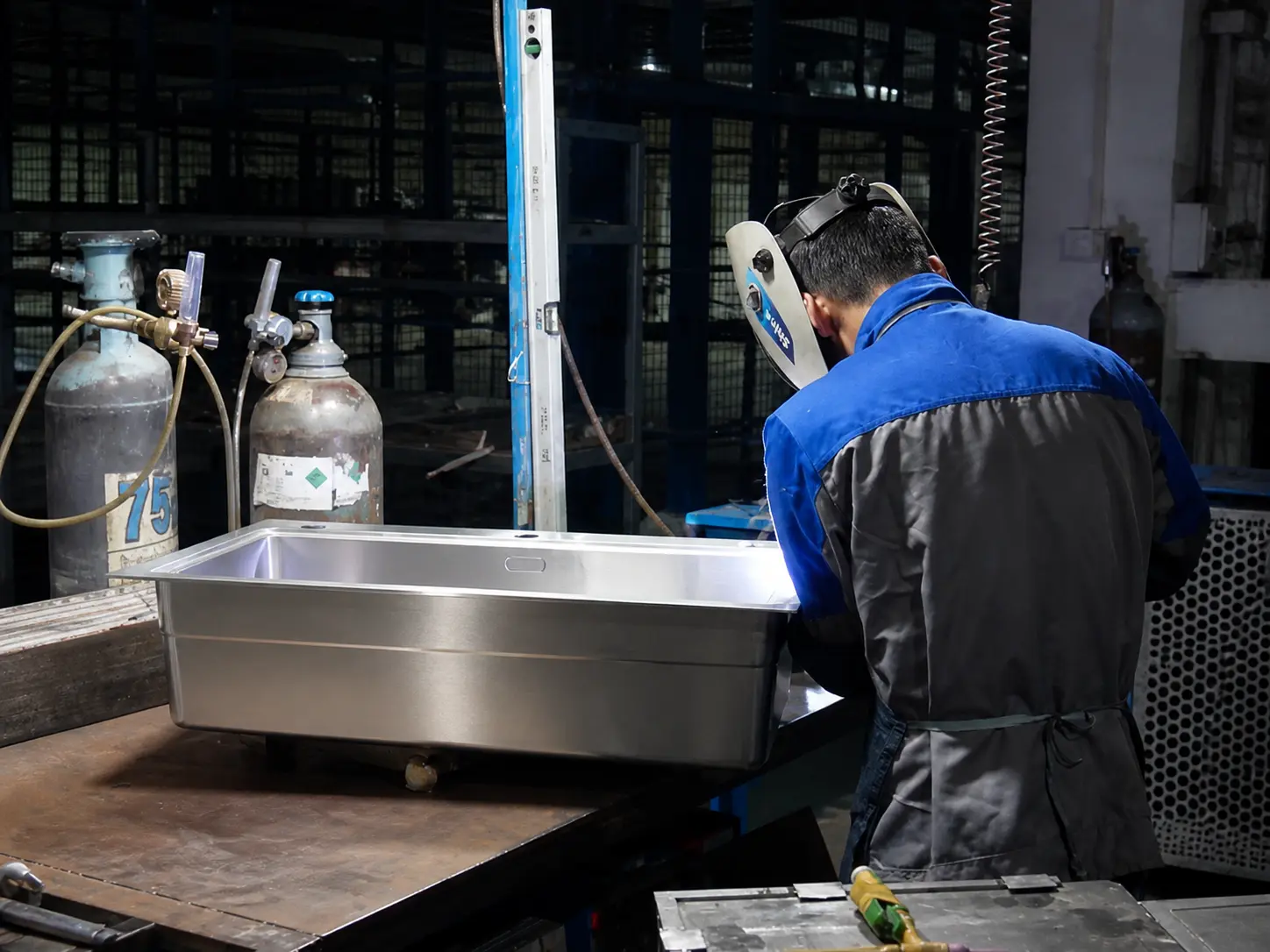
Kitchen sink production includes operations such as:
- cutting
- welding
- grinding
- polishing
- brushing
If tools, abrasive media or work areas are contaminated with ordinary steel particles, those particles can transfer to the sink surface.
This is one reason surface condition should be reviewed as part of production QC rather than judging material grade only by appearance.
Matrix’s Quality Control & Inspection separates material, surface condition and finished-product inspection instead of treating them as one check.
3. Chlorides Can Attack Stainless Steel
SUS304 performs well in normal kitchen environments, but chloride exposure can increase corrosion risk.
Possible chloride sources include:
- salt
- salty water
- some cleaning chemicals
- bleach-containing products
- coastal environments
The risk depends on:
- concentration
- contact time
- temperature
- surface condition
- whether deposits remain on the surface
This is why:
“304 stainless steel” does not mean “immune to every chemical environment.”
4. Cleaning Chemicals Can Create a False Material Complaint
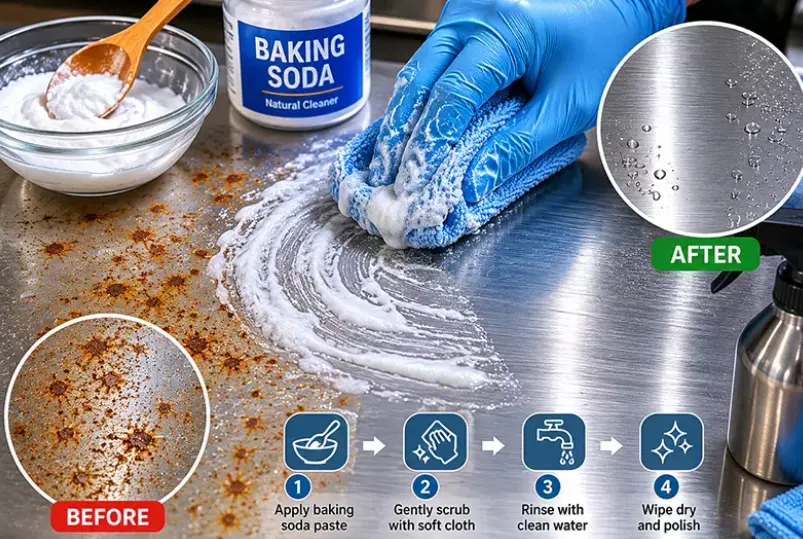
A sink can leave the factory in acceptable condition and later develop discoloration after exposure to an unsuitable cleaner.
Products containing strong chlorides or aggressive chemicals can damage the passive surface condition.
When a customer reports rust-like marks, the investigation should therefore include:
- what cleaner was used
- how long it remained on the sink
- whether the surface was rinsed
- whether the mark appeared before or after installation
5. Standing Water Alone Does Not Automatically Mean the Material Is Bad
Standing water can leave:
- mineral deposits
- discoloration
- residue
- local staining
Depending on water chemistry, these marks may be confused with corrosion.
If the sink also has a local low spot, the same area may repeatedly retain:
- water
- salts
- cleaner residue
which increases the chance of visible staining.
For drainage-related diagnosis, see Why Water Pools in a Kitchen Sink.
6. Welded and Ground Areas Deserve Separate Attention
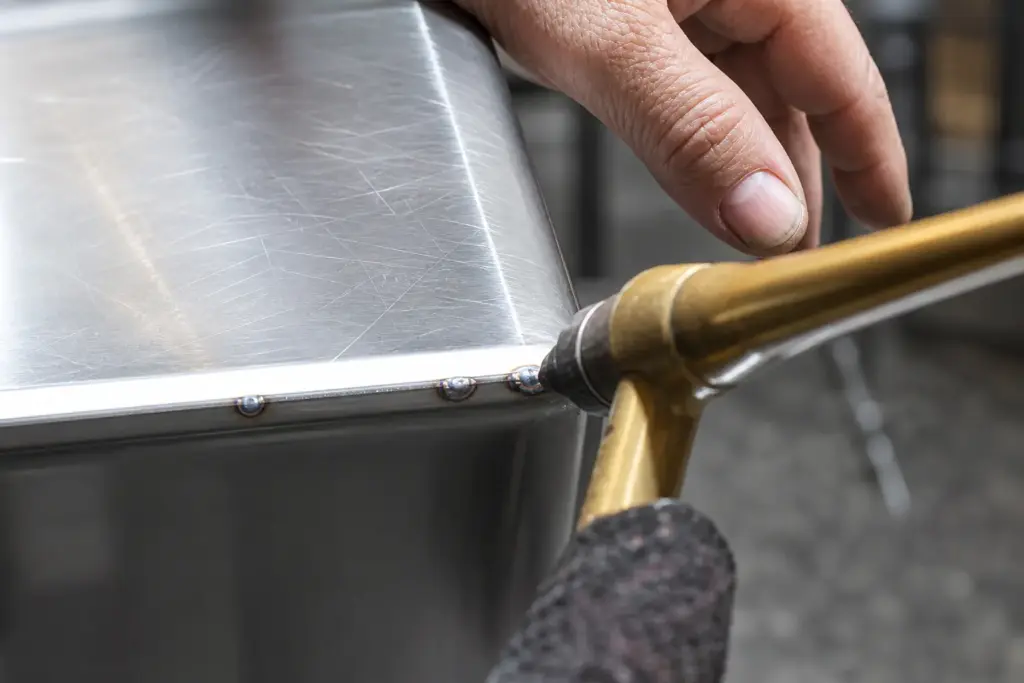
On handmade sinks, welded corners are later:
- ground
- blended
- polished
- brushed
These areas have a different processing history from the untouched sheet surface.
If rust-like marks repeatedly appear only around:
- welds
- ground corners
- repaired areas
the investigation should look at:
- fabrication cleanliness
- grinding tools
- surface finishing
- contamination
rather than immediately assuming the entire sheet is the wrong grade.
7. Drain Components Can Be the Source
The sink bowl may be SUS304 while another component uses a different material.
Possible components include:
- drain
- screws
- clips
- grids
- mounting parts
If rust appears only around one accessory, first determine whether the corrosion is coming from:
the sink body
or:
the attached component.
How Can You Tell Surface Contamination From a Material Problem?
There is no single visual test that gives a perfect answer.
Use several pieces of evidence.
Step 1 — Check the Location
Ask where the marks appear.
Examples:
Only around welds / grinding areas
→ fabrication contamination becomes more likely
Only around drain or accessory contact
→ inspect the component
Random small orange dots
→ surface iron contamination may be possible
Widespread corrosion across the bowl
→ material or environmental exposure deserves stronger investigation
Step 2 — Check Whether the Pattern Repeats
Compare:
- one sink
- several sinks from the same batch
- approved sample
- previous repeat orders
If only one sink is affected, local contamination or handling becomes more likely.
If many sinks show the same pattern in the same area, investigate the production process or material batch.
Step 3 — Check Whether the Mark Is Surface-Level
A superficial rust-colored deposit and a true corrosion pit are not the same condition.
Look for:
- whether the mark can be removed
- whether the stainless surface underneath is intact
- whether pitting remains after cleaning
A removable surface deposit usually points toward a different cause from deep localized corrosion.
Step 4 — Review Material Traceability
If the material grade is being questioned, do not use the rust spot itself as proof.
Check:
- approved material specification
- raw-material batch records
- supplier material documentation
- production traceability
Matrix’s Is a Stainless Steel Sink Magnetic? explains the same principle from another angle: appearance or magnetic behavior alone cannot identify the stainless steel grade.
Step 5 — Use Composition Verification When Needed
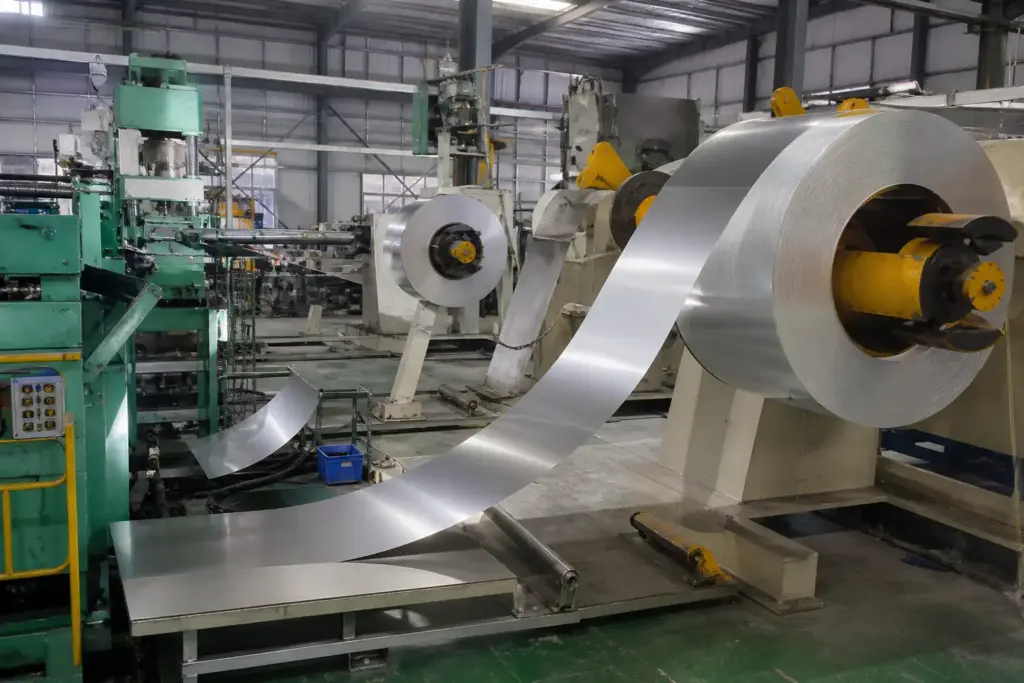
If a commercial dispute remains, material composition can be checked using:
- XRF / PMI screening
- laboratory chemical analysis where required
The purpose is to answer:
What alloy is the sink actually made from?
not:
Does the sink have a rust-colored mark?
Those are different questions.
Rust-Like Spot Diagnostic Table
| Observation | More Relevant Investigation |
|---|---|
| Small orange dots on surface | Free-iron contamination |
| Marks near grinding / welds | Fabrication contamination / finishing |
| Marks around drain only | Drain or component material |
| Marks after bleach / cleaner use | Chemical exposure |
| Marks after standing salty water | Chloride exposure |
| Removable brown deposit | Surface contamination or residue |
| Deep pits remain after cleaning | Corrosion investigation |
| Same pattern across many units | Process / material batch review |
| One isolated unit | Local contamination / handling |
Does Rust Mean the Sink Is SUS201 Instead of SUS304?
No.
SUS201 may provide less corrosion margin than SUS304 in some environments, but visible rust alone cannot identify the grade.
A genuine SUS304 sink can still show rust-like marks because of:
- external iron contamination
- chloride exposure
- chemicals
- surface damage
- fabrication contamination
If the grade itself is in doubt, verify the material separately.
Does a Magnet Help?
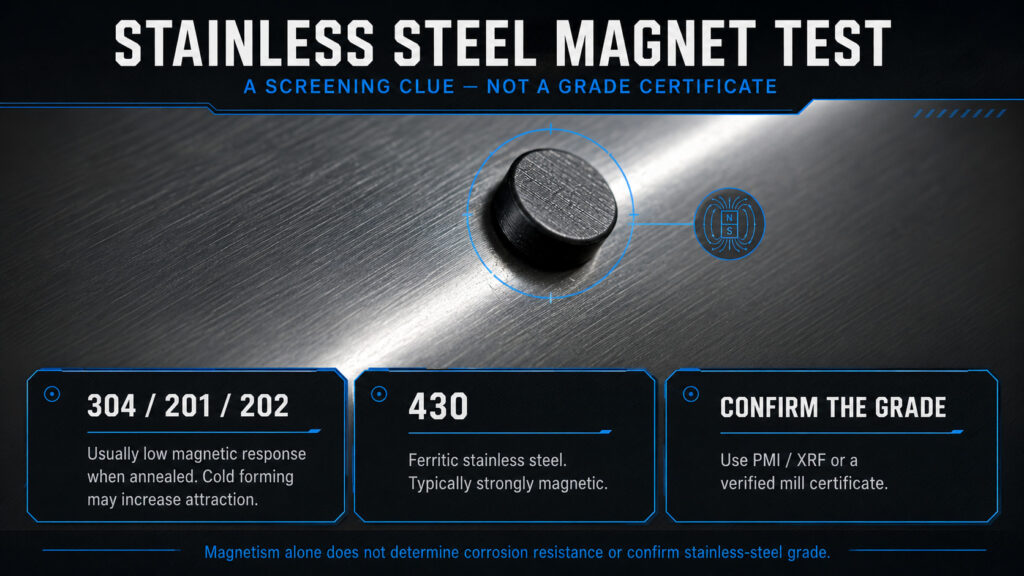
Not reliably.
Cold-worked SUS304 can become locally magnetic after:
- pressing
- bending
- welding
So:
rust + magnetic response
still does not prove:
wrong stainless steel.
Use material verification instead of combining two unreliable visual shortcuts.
Should the Whole Batch Be Rejected?
Not automatically.
Before treating the issue as a batch-level material failure, determine:
- how many units are affected
- where the marks appear
- whether the pattern repeats
- whether the marks are removable
- what cleaning or environment the sink experienced
- whether the material batch can be verified
This separates:
Local Surface Issue
from:
Systematic Production Issue
from:
Actual Material Problem
What Does This Mean for OEM Sink QC?
For repeat-order programs, material and surface condition should be controlled separately.
A practical inspection chain is:
Material Grade
→ Raw-Material Traceability
→ Surface Condition
→ Fabrication / Grinding Cleanliness
→ Finished Surface Inspection
→ Batch Comparison
Matrix’s Quality Control & Inspection uses confirmed product specifications, drawings, approved samples and surface references as inspection inputs rather than relying only on the final appearance.
What Should Be Defined in the RFQ?
If corrosion resistance matters commercially, define the actual material grade:
SUS304
rather than:
stainless steel.
For projects with more demanding chloride exposure, the material selection may need to be reviewed separately instead of assuming SUS304 is suitable for every environment.
The Kitchen Sink RFQ Checklist can be used to define material, thickness, finish and application requirements before quotation.
Common Misunderstandings
“304 stainless steel never rusts.”
Incorrect.
304 is corrosion-resistant, not corrosion-proof.
“A rust spot proves the factory used SUS201.”
No.
Surface iron contamination or environmental exposure can create similar marks.
“If the rust can be cleaned off, the material must be fine.”
Not automatically.
It suggests the issue may be surface-related, but the root cause should still be identified if the problem repeats.
“If the sink is magnetic and has rust spots, it cannot be 304.”
No.
Magnetic response and rust-like marks are both insufficient to identify the grade.
“Every rust complaint is a material claim.”
No.
The root cause may be:
- material
- contamination
- fabrication
- installation
- cleaning
- environment
Buyer Takeaway
When rust-like marks appear on a SUS304 sink, do not start with:
“Is the supplier using fake 304?”
Start with:
“Where is the oxidation coming from?”
The investigation should follow:
Surface Contamination → Environment → Fabrication → Material Verification
The most important distinction is:
A rust-colored mark is evidence of oxidation. It is not, by itself, proof of the stainless steel grade.
Frequently Asked Questions
Can SUS304 kitchen sinks rust?
SUS304 is highly corrosion-resistant in normal kitchen use, but it can still develop corrosion or rust-like marks under contamination, chloride exposure or aggressive chemical conditions.
Why does my new stainless steel sink have orange dots?
Small orange dots can come from free-iron contamination, fabrication dust or external metal particles oxidizing on the surface.
Does rust mean my sink is not SUS304?
No. Material grade should be verified separately through traceability or composition testing.
Why does rust appear around welded corners?
Welded and ground areas have additional fabrication and finishing steps, which can introduce contamination or alter the surface condition.
Can bleach damage SUS304?
Strong chloride-containing cleaners can increase corrosion risk, especially if they remain on the surface.
Can XRF confirm whether the sink is SUS304?
XRF can provide strong alloy-composition screening and help verify whether the major alloying elements are consistent with SUS304.
Should one rust spot cause an entire batch rejection?
Not automatically. First determine whether the issue is isolated, repeatable, surface-related or linked to the material batch.
Investigating a Stainless Steel Material or Surface Issue?
For OEM and repeat-order programs, separate material verification from surface inspection.
See Matrix’s Sink Sourcing Risks and Quality Control & Inspection for how material, thickness, surface condition and repeat-order references are handled.