A stainless steel sink can show magnetic response and still be SUS304. For buyers, the important question is not whether a magnet sticks, but whether the material grade can be verified against the actual production batch.
Quick Answer
Yes. SUS304 can become slightly magnetic after cold forming, bending, pressing or welding.
This is especially common around highly worked areas such as:
- pressed bowl corners
- bottom radii
- drain-forming areas
- handmade bends
- welded zones
SUS304 is mainly austenitic in its normal annealed condition, but cold deformation can transform part of the structure into strain-induced martensite, increasing magnetic response.
Therefore:
A magnet test alone cannot prove that a kitchen sink is SUS304 or prove that it is not SUS304.
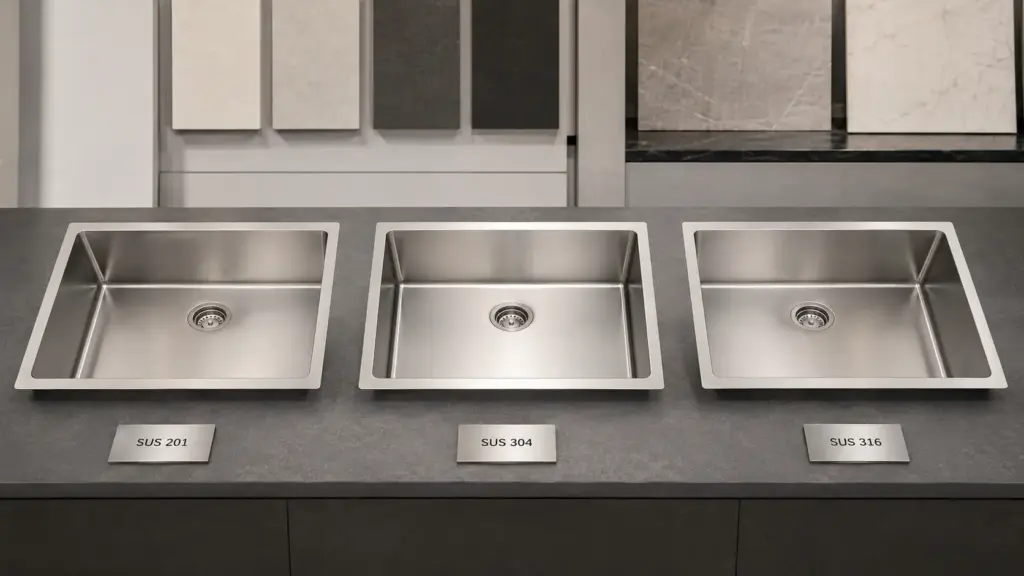
For B2B material verification, use a stronger chain of evidence:
- material specification
- supplier / mill material documents where available
- batch traceability
- XRF or PMI when grade verification is required
- finished-product testing when project risk justifies it
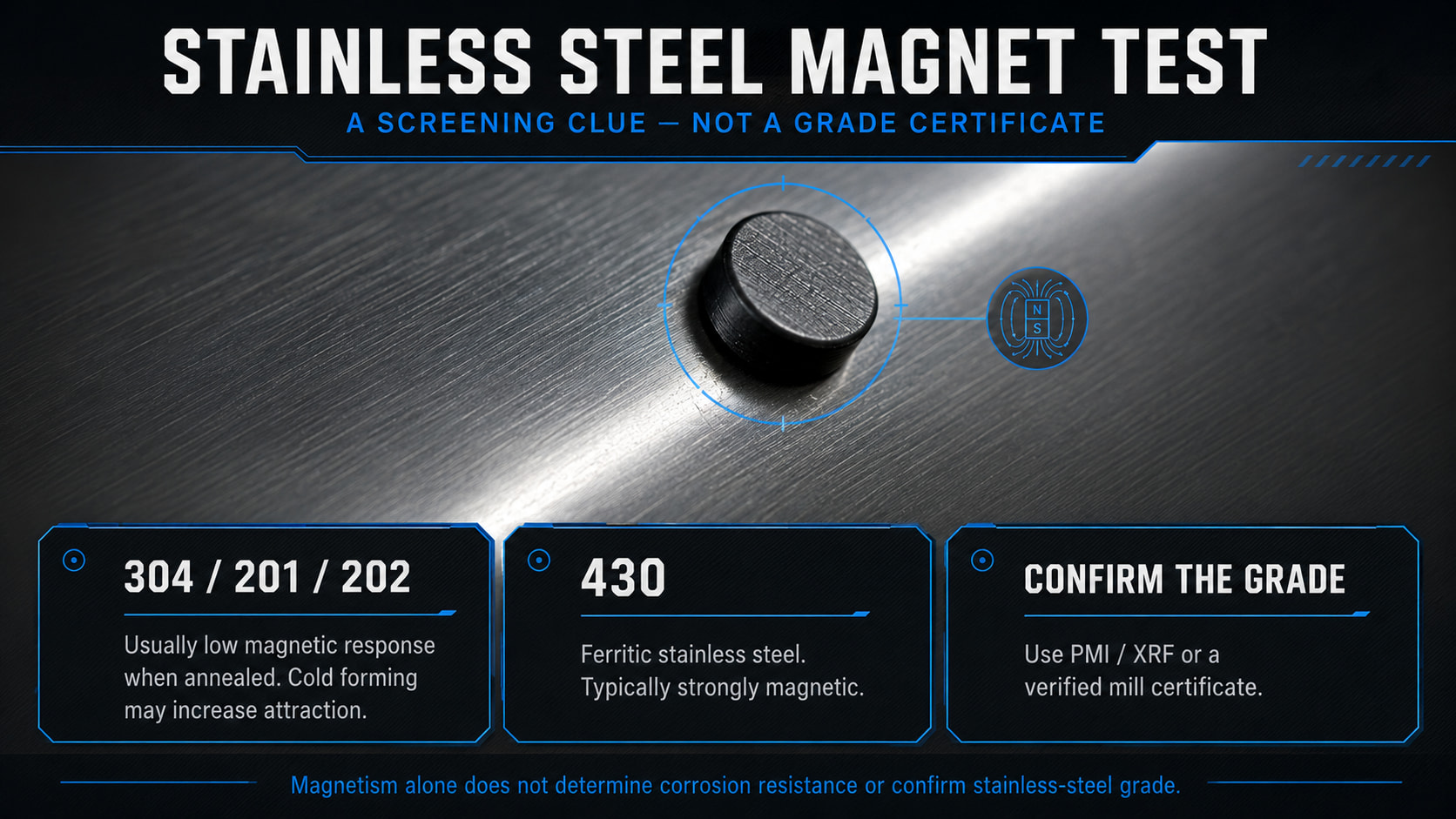
A household magnet is best treated as a screening clue, not a material certificate.
Why Buyers Get This Wrong
A common sourcing assumption is:
304 stainless steel should not attract a magnet.
Therefore:
if a magnet sticks, the sink must be SUS201 or another cheaper grade.
That conclusion is too simple.
The magnetic behavior of stainless steel depends on more than the grade name.
It can also change with:
- cold working
- forming severity
- welding
- material condition
- test location
So the same SUS304 sink may show:
very weak magnetic response on the flange
but:
noticeably stronger response around a heavily formed corner.
Why SUS304 Is Usually Described as Non-Magnetic
SUS304 is an austenitic stainless steel.
In an annealed condition, its microstructure is predominantly austenitic, which normally produces very low magnetic response.
That is why 304 is commonly described as:
non-magnetic
or:
essentially non-magnetic.
But this description does not mean:
SUS304 can never respond to a magnet after manufacturing.
What Happens During Sink Forming?
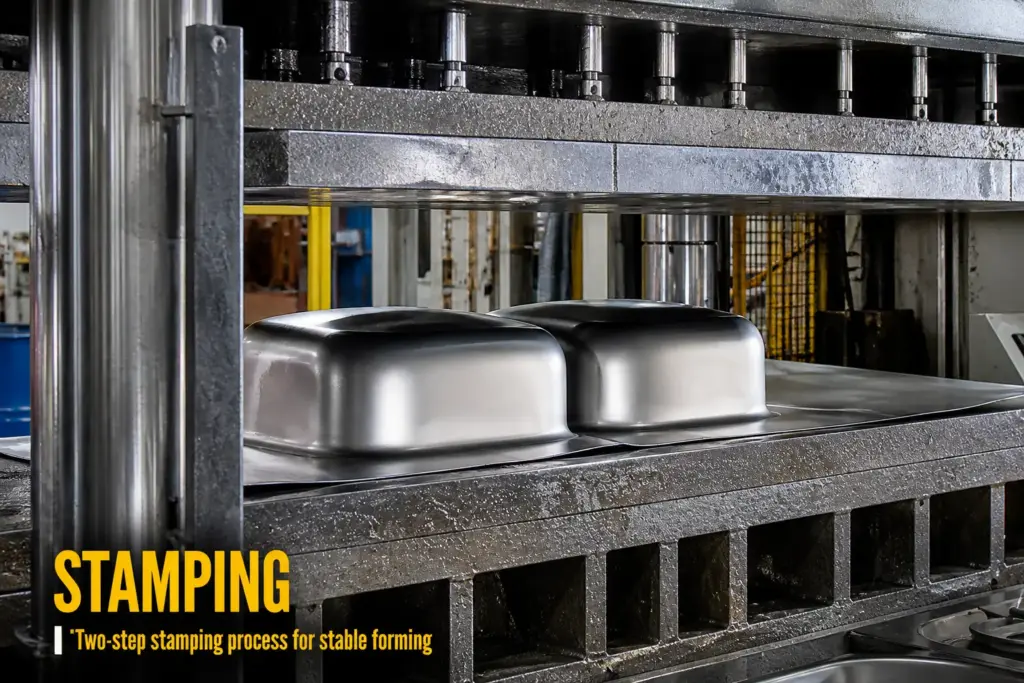
Pressed sinks undergo substantial cold deformation.
A flat sheet may be:
- drawn into the bowl
- stretched around corners
- bent around radii
- formed around the drain
- restrained and compressed at the flange
These processes change the material locally.
In highly deformed zones, part of the austenitic structure can transform into strain-induced martensite.
Martensite has a stronger magnetic response.
This is why magnetism may appear unevenly across the same finished sink.
Where Is Magnetic Response More Likely?
On a pressed sink, stronger response may appear around:
- rectangular corners
- lower sidewalls
- bottom radii
- divider transitions
- drain-forming areas
These are also locations where forming strain can be higher.
The flat flange may show much weaker response because it normally experiences less severe deformation.
For a deeper explanation of how forming redistributes stainless steel, see:
How Pressed Sink Forming Changes Stainless Steel Thickness.
Handmade SUS304 Sinks Can Also Show Magnetism
Magnetic response is not limited to pressed sinks.
Handmade sinks are fabricated through processes such as:
- cutting
- bending
- welding
- grinding
- polishing
Cold bending can increase magnetic response near formed edges.
Welding can also change the local metallurgical condition around the weld and heat-affected area.
Therefore, testing only:
one bend
or:
one welded corner
does not reliably identify the base stainless steel grade.
Why a Magnet Cannot Distinguish SUS201 from SUS304 Reliably
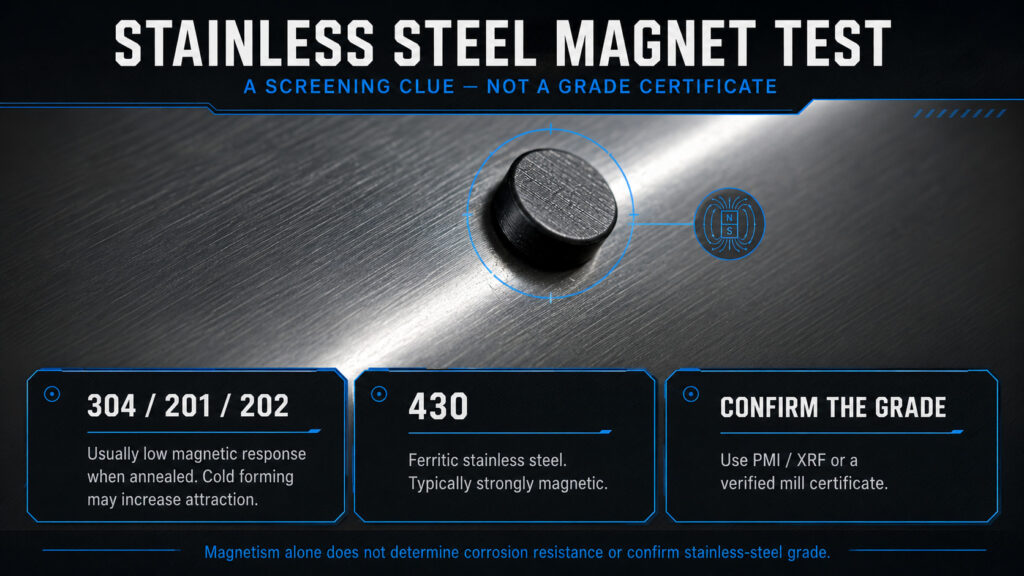
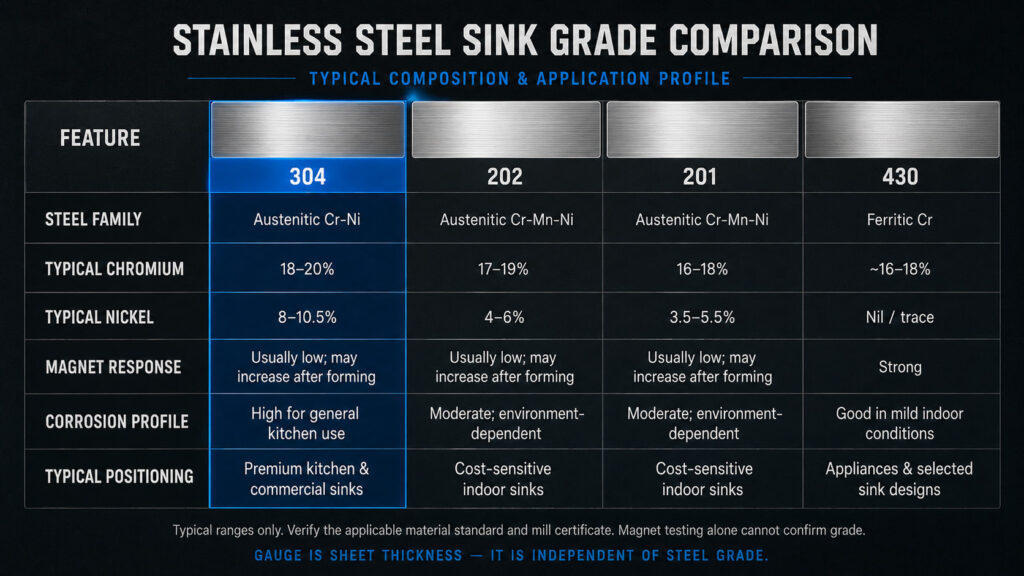
Both SUS201 and SUS304 are commonly used austenitic stainless steels.
Their magnetic behavior after forming can overlap.
That means:
strong attraction does not automatically mean SUS201
and:
weak attraction does not automatically prove SUS304.
A magnet does not directly measure:
- chromium content
- nickel content
- manganese content
- molybdenum content
- exact stainless steel grade
It only shows magnetic response.
What a Magnet Test Can Actually Tell You
A magnet test is still useful when used correctly.
It can help identify:
- unexpectedly strong magnetic behavior
- differences between batches
- differences between sink zones
- possible material inconsistency that deserves further investigation
For example:
Approved Sample
Weak magnetic response across most of the bowl.
Repeat Order
Several units show very strong attraction across broad, lightly formed areas.
That does not prove the material is wrong.
But it is a reasonable reason to investigate further.
Where Should a Magnet Test Be Performed?
If buyers use a magnet as a screening check, do not test only one location.
Compare several areas:
| Location | Why Check It |
|---|---|
| Flat rim / flange | Lower-deformation reference |
| Upper sidewall | Moderate forming |
| Lower sidewall | Higher forming strain |
| Bottom radius | Highly formed zone |
| Bowl bottom | Comparison point |
| Drain area | Secondary forming |
| Weld / bend | Handmade comparison |
The pattern can be more informative than one simple:
sticks / does not stick
result.
Do Not Use Different Magnets for Comparison
Magnet strength varies significantly.
If magnetic response is being used for batch screening, use:
- the same magnet
- the same test locations
- similar contact distance
- the same sink orientation where practical
Otherwise the comparison has little value.
Even then, it remains a screening method rather than material identification.
How Should Buyers Actually Verify SUS304?
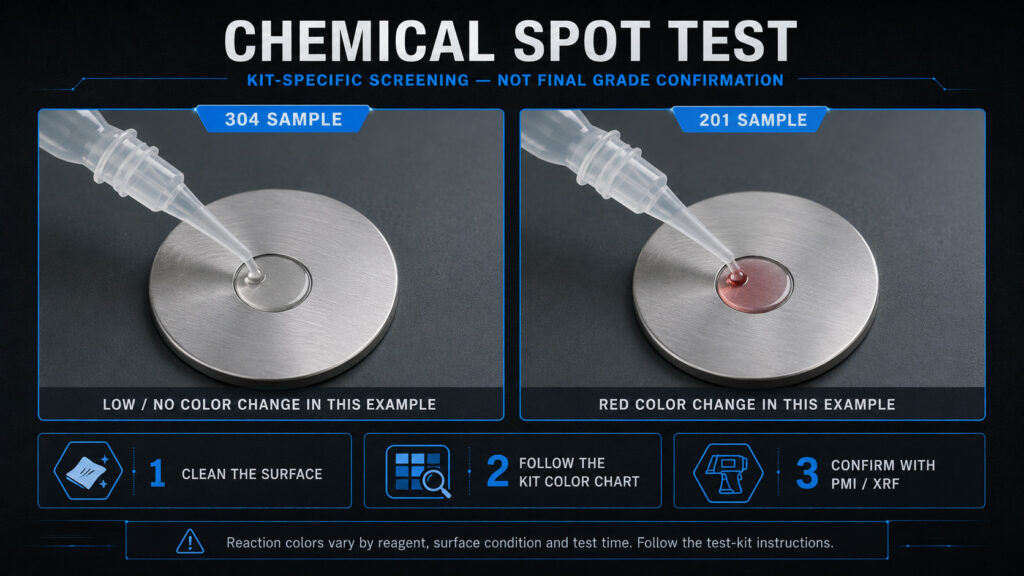
There are several levels of verification.
Level 1 — Purchase Specification
The RFQ and PO should clearly state:
Material: SUS304
not:
stainless steel.
The approved drawing or product specification should use the same material designation.
This establishes the contractual requirement.
Level 2 — Material Documentation
Where available, review supplier or mill documentation showing:
- material grade
- batch / heat reference
- chemical composition
- sheet specification
The document is most useful when it can be linked to the material actually used for the production order.
A certificate that cannot be connected to the purchased batch provides weaker evidence.
Level 3 — Incoming Material Traceability
The factory should be able to connect:
incoming stainless steel
to:
production order
through appropriate material identification or batch control.
For buyers, the important question is not simply:
Do you have a 304 certificate?
It is:
Can this document be linked to the steel used for my order?
Level 4 — XRF / PMI Screening
When stronger material confirmation is required, XRF or other PMI methods can be used to analyze alloy composition.
XRF can identify major alloying elements such as:
- chromium
- nickel
- molybdenum
- manganese
and can help distinguish common stainless steel grades.
However, test capability and interpretation depend on:
- instrument
- calibration
- test method
- material surface
- operator
- grade being differentiated
So even XRF should be used as part of a defined verification process rather than treated as a magic one-click answer.
Level 5 — Independent Laboratory Testing
For higher-risk programs, buyers may specify third-party material analysis.
This can be useful when:
- material grade is contract-critical
- the market has compliance requirements
- a supplier dispute exists
- random shipment verification is needed
- SUS316 or another special grade is being specified
The required test method and acceptance criteria should be agreed before production.
MTC vs XRF vs Magnet Test
| Method | What It Can Tell You | Main Limitation |
|---|---|---|
| Magnet | Magnetic response | Cannot identify exact grade |
| Material Certificate / MTC | Declared batch composition / grade | Must be traceable to actual material |
| XRF / PMI | Alloy composition screening | Method and instrument limitations |
| Laboratory Analysis | More formal material verification | Higher cost and longer process |
The strongest system does not depend on only one of these.
It connects:
Specification → Material Batch → Production → Verification
Why Traceability Matters More Than the Document Alone
Suppose a supplier sends a genuine SUS304 mill certificate.
That proves the certificate refers to a batch of SUS304.
It does not automatically prove:
the stainless steel used in your specific sinks came from that batch.
This is why buyers should consider:
- incoming material identification
- batch records
- production linkage
- inspection records
when material grade is commercially important.
Matrix’s Quality Control & Inspection explains how material verification can be connected with dimensions, thickness, finish and repeat-order inspection.
Magnetism and Corrosion Resistance Are Different Questions
A sink becoming slightly magnetic after cold forming does not automatically mean its corrosion resistance has disappeared.
Magnetic response and corrosion performance are different material properties.
Corrosion behavior also depends on:
- alloy composition
- chloride exposure
- surface condition
- contamination
- cleaning chemicals
- fabrication
- environment
So do not use magnet strength as a corrosion-resistance test.
Can SUS316 Also Become Magnetic?
SUS316 is also an austenitic stainless steel and is generally low in magnetic response in its annealed condition.
Cold working can alter magnetic behavior, although the response depends on composition and deformation.
Therefore, the same principle applies:
Do not identify SUS304 or SUS316 using a household magnet alone.
Why Finished Sink Testing Can Be Different from Raw Sheet Testing
Incoming flat sheet has not yet experienced sink forming.
The finished sink has.
So a buyer may find:
Incoming Sheet
Very little magnetic response.
Finished Bowl Corner
Stronger magnetic attraction.
That difference does not automatically indicate a material change.
It may reflect the manufacturing history of the same sheet.
A Better Incoming Material Control Process
For material-sensitive projects, buyers can define:
Before Production
- stainless steel grade
- sheet thickness
- material documentation where required
- incoming identification
During Production
- batch linkage
- correct material release to production
Finished Product
- dimension and thickness inspection
- material verification when required
- repeat-order comparison
This is much stronger than checking a finished sink with a magnet after everything has already been produced.
What Should Buyers Put in the RFQ?
Do not write:
304 stainless steel, non-magnetic.
The second requirement can create confusion because forming itself can change magnetic response.
A clearer specification is:
Material: SUS304
Thickness: X.X mm
Material Verification: Supplier material documentation / batch traceability where required
Third-Party Verification: To be agreed if required by project
If exact material verification is commercially critical, define the required method before quotation.
Use the Kitchen Sink RFQ Checklist to define material together with dimensions, thickness, finish, accessories and packing.
Common Buyer Misunderstandings
“304 stainless steel should never attract a magnet.”
Incorrect.
Cold-worked SUS304 can show magnetic response.
“If the magnet sticks strongly, it must be SUS201.”
Not necessarily.
Magnetic response alone cannot identify the exact stainless steel grade.
“If the magnet does not stick, it must be SUS304.”
No.
A weak magnetic response does not prove grade either.
“One material certificate proves my finished sinks are SUS304.”
Only if the material documentation can be reliably linked to the steel used for that production order.
“XRF is always unnecessary if the supplier provides an MTC.”
That depends on project risk and verification requirements.
Documentation and physical verification answer different questions.
“Magnetism means poor corrosion resistance.”
Not automatically.
Magnetic response and corrosion resistance are different properties.
Buyer Takeaway
Do not ask:
“Does the magnet stick?”
and use that as the final decision.
Ask:
“What material was specified, how is the production batch linked to that material, and what verification method is appropriate for this project?”
For B2B sourcing:
Magnet = Screening
Material Documentation = Batch Evidence
XRF / PMI = Physical Grade Screening
Traceability = The Link Between Them
A magnet can tell you that something deserves investigation.
It cannot tell you the stainless steel grade by itself.
Frequently Asked Questions
Is SUS304 stainless steel magnetic?
SUS304 is generally very low in magnetic response when annealed, but cold forming can make finished areas slightly or noticeably magnetic.
Why is my SUS304 sink magnetic at the corners?
Corners can experience higher forming strain, which can create strain-induced martensite and increase magnetic response.
Can a magnet distinguish SUS304 from SUS201?
Not reliably. Both grades can show magnetic response depending on material condition and manufacturing history.
Does magnetism prove that a sink is not SUS304?
No. Cold-worked SUS304 can become magnetic.
How can buyers verify SUS304?
Use the purchase specification, traceable material documentation and, when required, XRF / PMI or independent laboratory testing.
Is XRF better than a magnet test?
For identifying alloy composition, yes. A magnet only indicates magnetic response and cannot determine exact stainless steel grade.
Should every sink order be XRF tested?
Not necessarily. The level of verification should follow project risk, contractual requirements and the buyer’s quality-control plan.
Can pressed SUS304 become more magnetic than flat sheet?
Yes. Deep drawing and local cold deformation can increase magnetic response in highly formed areas.
Need to Verify a Sink Material Specification?
Send the material grade, thickness, production method and verification requirement with your RFQ.
Matrix can review whether the project should rely on standard material documentation, batch traceability or additional grade verification before production.