A magnet cannot reliably identify whether a kitchen sink is made from SUS304.
SUS304 can develop localized magnetic response after pressing, bending or welding, while magnetic strength itself does not reveal the steel’s chromium, nickel or manganese content.
To verify SUS304, the stronger approach is to connect:
Material Specification → Material Batch → Production Traceability → Composition Verification
Depending on the project, that verification can include material documentation, XRF / PMI screening or independent laboratory analysis.
Quick Answer: How Can You Check Whether a Kitchen Sink Is Really SUS304?
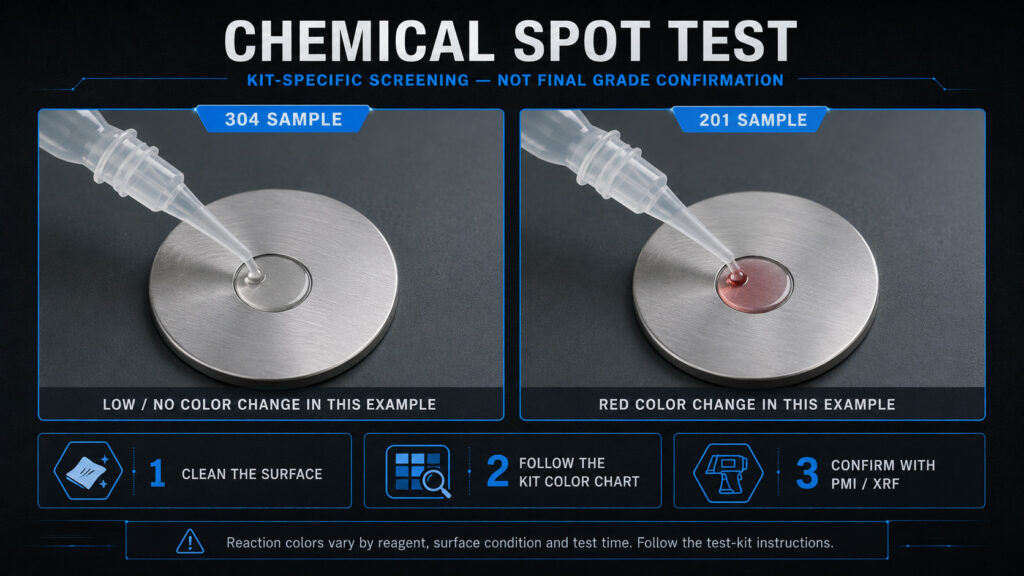
There is no single household test that can reliably prove SUS304.
The most useful verification methods are:
- Check the material specification — the drawing, RFQ or PO should clearly state SUS304.
- Check batch-linked material documentation — an MTC or supplier material report is useful only when it can be linked to the steel used for the order.
- Use XRF / PMI when physical grade verification is needed — alloy composition can be checked directly on the material or finished sink.
- Use independent laboratory analysis for higher-risk disputes or formal verification.
A magnet can be used as a quick screening clue, but not as final proof of grade.
SUS304 verification is a chemistry and traceability question, not a magnetism question.
Why a Magnet Cannot Prove SUS304
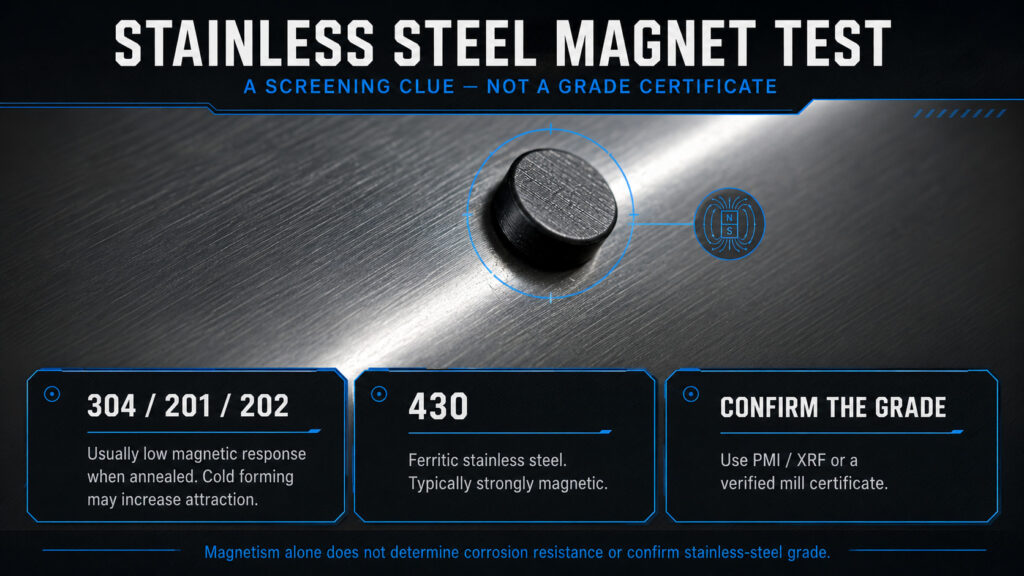
SUS304 is an austenitic stainless steel and normally has very low magnetic response in the annealed sheet condition.
But kitchen sink manufacturing changes the material locally.
Processes such as:
- deep drawing
- cold bending
- drain forming
- corner forming
- welding
can increase magnetic response in highly worked areas.
This means the same SUS304 sink can show:
- little attraction on a flat flange
- stronger attraction around a pressed corner
- localized response around bends or welded areas
So:
magnet sticks ≠ automatically SUS201
and:
magnet does not stick ≠ automatically SUS304.
For the metallurgical explanation, see Is a Stainless Steel Sink Magnetic? Why the Magnet Test Cannot Prove 304 Grade.
What Actually Defines SUS304?
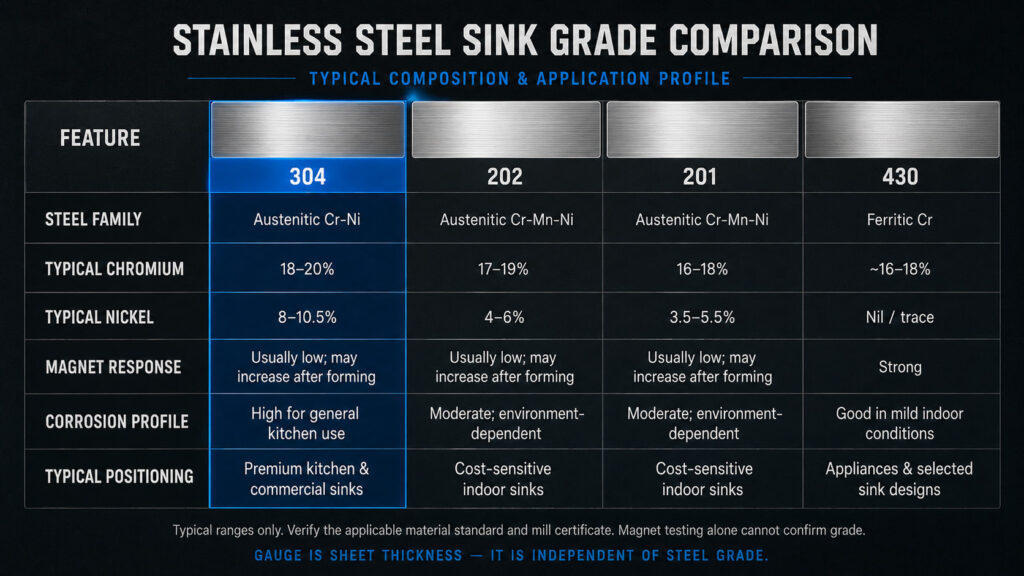
SUS304 is defined by its alloy composition, not by:
- sink weight
- surface color
- magnetic response
- polishing appearance
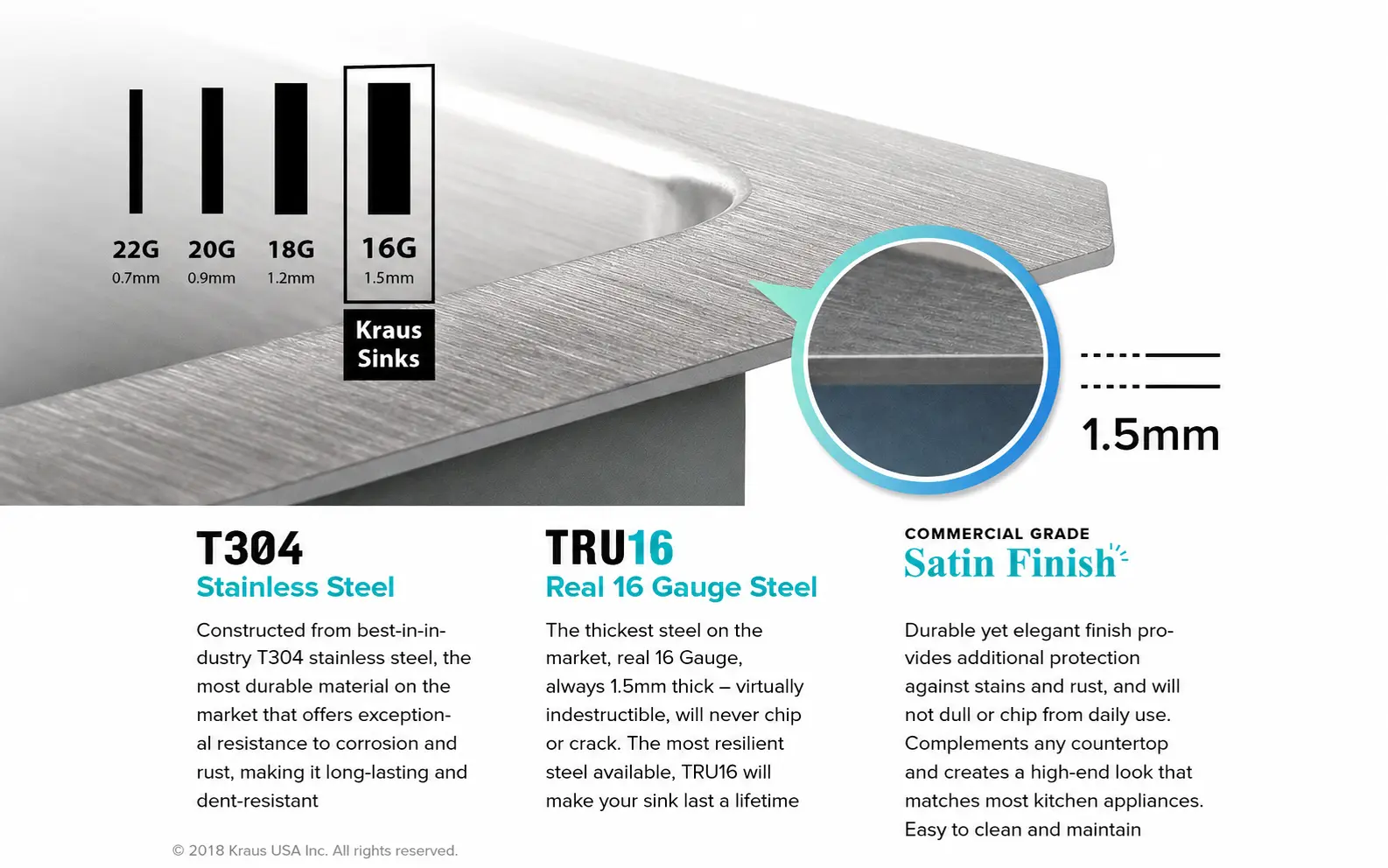
- gauge
Chromium and nickel are among the key alloying elements used to distinguish common austenitic stainless steels.
This is why a material-grade test should ultimately answer:
What is the alloy composition of this steel?
rather than:
How strongly does a magnet stick to it?
Method 1 — Start With the Product Specification
The first layer of verification is simple:
the product specification should actually state:
SUS304
not merely:
stainless steel.
The same material designation should appear consistently across:
- RFQ
- quotation
- approved drawing
- PO
- production specification
This does not physically prove the material by itself.
But without a clear material requirement, there is nothing objective to verify against later.
SUS304 and Thickness Are Separate Specifications
This distinction matters.
For example:
SUS304 / 1.2 mm
contains two different requirements.
SUS304
Defines the stainless steel grade.
1.2 mm
Defines the material thickness.
A sink can therefore be:
- genuine SUS304 but thinner than specified
- correct thickness but made from the wrong stainless steel grade
Material verification and thickness inspection should not be treated as the same test.
Matrix’s Quality Control & Inspection separates material identification from thickness and dimensional inspection for this reason.
Method 2 — Check the Material Certificate or Material Report
A material certificate or supplier report can provide information such as:
- material grade
- chemical composition
- batch or heat reference
- material specification
This is stronger evidence than a magnet test because it relates to material composition.
But there is an important limitation:
A genuine SUS304 certificate only proves something about the material batch stated on that document.
It does not automatically prove that the same steel was used for a particular sink order.
The Real Question Is Traceability
Suppose a factory has an MTC showing:
SUS304
The more useful question is:
Can that material record be connected to the stainless steel actually used for this production batch?
A useful traceability chain looks like:
Material Receipt → Batch Identification → Production Order → Finished Sink
Without that link, a material document may be authentic but unrelated to the products being inspected.
What Does MTC Mean?
MTC commonly refers to a:
Material Test Certificate
Depending on the steel supplier and document format, it may contain:
- grade
- chemical composition
- batch / heat number
- dimensional information
- mechanical properties where applicable
The exact document varies by steel supplier.
For kitchen sink sourcing, the important point is not the document name alone.
It is whether the material information can be traced to the production material.
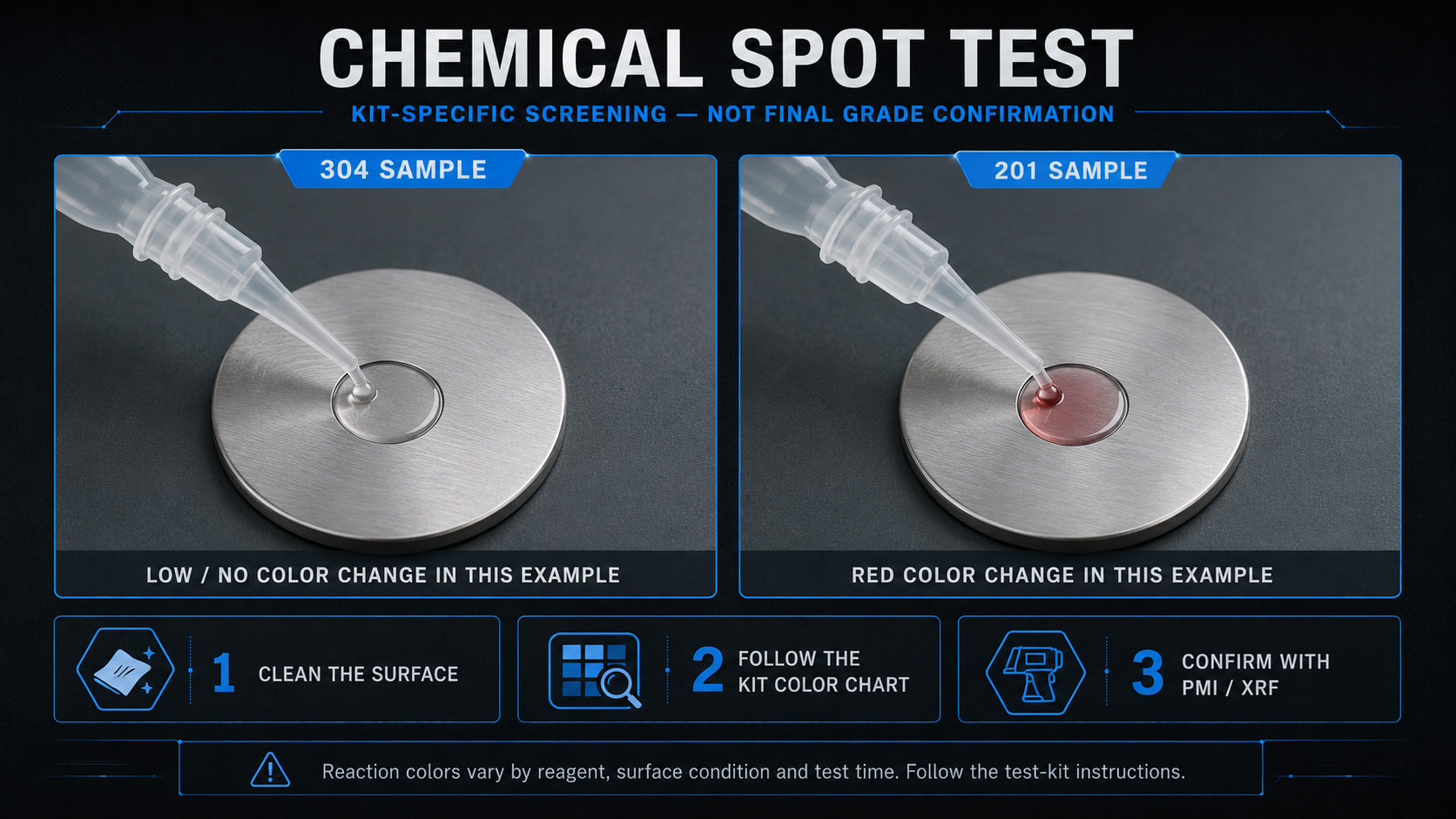
Method 3 — Use XRF / PMI to Check Alloy Composition
When physical material verification is required, XRF is one of the practical tools commonly used for alloy identification.
XRF stands for:
X-ray fluorescence
It measures characteristic X-rays emitted by elements in the tested material and can identify major alloying elements.
For common stainless steels, an XRF reading can provide information on elements such as:
- chromium
- nickel
- manganese
- molybdenum
This makes it far more useful than a magnet when distinguishing common stainless steel families.
What Is PMI?
PMI means:
Positive Material Identification
It is a broader term for methods used to verify alloy composition.
Portable XRF is one common PMI technique.
The purpose is to answer:
Does the tested material chemistry correspond to the specified alloy?
rather than simply:
Does the material react to a magnet?
Can XRF Distinguish SUS304 From SUS201?
In many practical sink-material checks, the difference in major alloy composition makes XRF useful for distinguishing common 304 and 201 stainless steels.
The analysis can show differences in elements such as:
- nickel
- manganese
- chromium
However, results still depend on:
- instrument capability
- calibration
- surface condition
- test method
- operator
For contractual disputes or formal certification, the required test method should therefore be agreed rather than relying only on an informal handheld reading.
Where Should XRF Be Tested?
For incoming material, testing can be carried out on the stainless steel sheet before fabrication.
For finished products, accessible sink areas can also be screened.
The important point is to test:
the actual material associated with the order.
Testing a random sheet elsewhere in the factory does not verify the finished SKU.
Does PVD or Surface Treatment Affect XRF Testing?
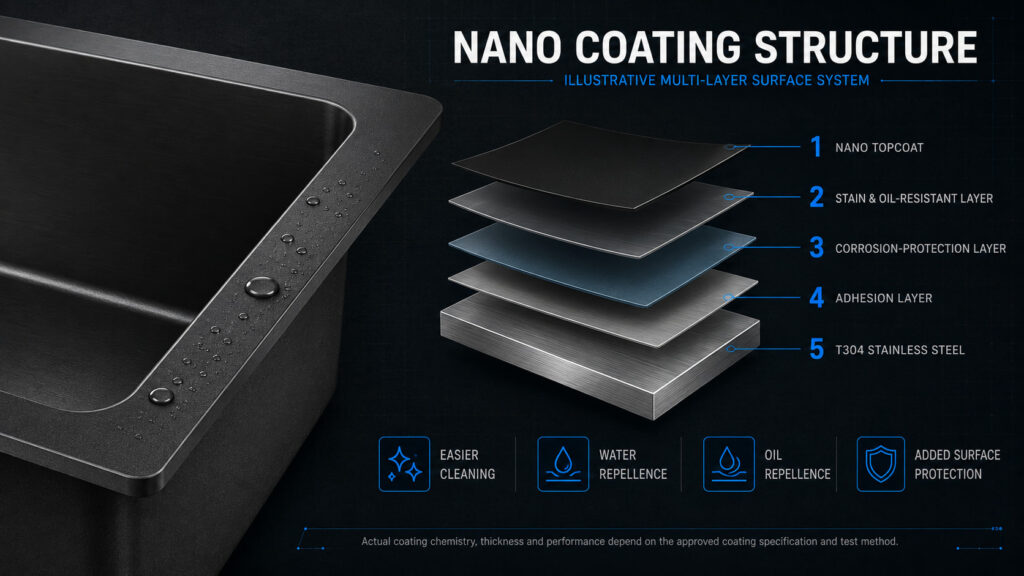
Surface coatings can complicate surface-based composition measurements.
For a colored or coated sink, the test method and location should be selected carefully so the reading represents the stainless steel substrate rather than only the surface layer.
Where material grade verification is critical, it is often cleaner to establish the grade at the incoming raw-material stage before decorative finishing.
Method 4 — Independent Laboratory Analysis
For higher-risk or disputed projects, material can be sent to an independent laboratory for composition analysis.
This can be appropriate when:
- there is a supplier dispute
- material grade is contract-critical
- random shipment verification is required
- XRF results are unclear
- a formal test report is required
The specific analytical method should follow what needs to be verified.
Why Incoming Material Verification Is Usually Cleaner Than Waiting Until the Sink Is Finished
A finished sink has already been:
- formed
- welded
- polished
- coated in some cases
- assembled
Incoming stainless steel sheet provides a simpler material-control point.
The ideal sequence is therefore:
Specify SUS304 → Verify Incoming Material → Maintain Batch Traceability → Inspect Finished Sink
rather than:
Finish the Whole Order → Use a Magnet → Start Questioning the Material.
Handmade and Pressed Sinks Use the Same Material Principle
The production route changes how the sink is formed.
It does not change what defines SUS304.
Handmade Sink
The stainless steel is:
- cut
- bent
- welded
- ground
- polished
Pressed / Drawn Sink
The stainless steel is:
- blanked
- deep drawn
- stretched locally
- trimmed
- punched
- finished
In both cases, material grade is still a chemistry question.
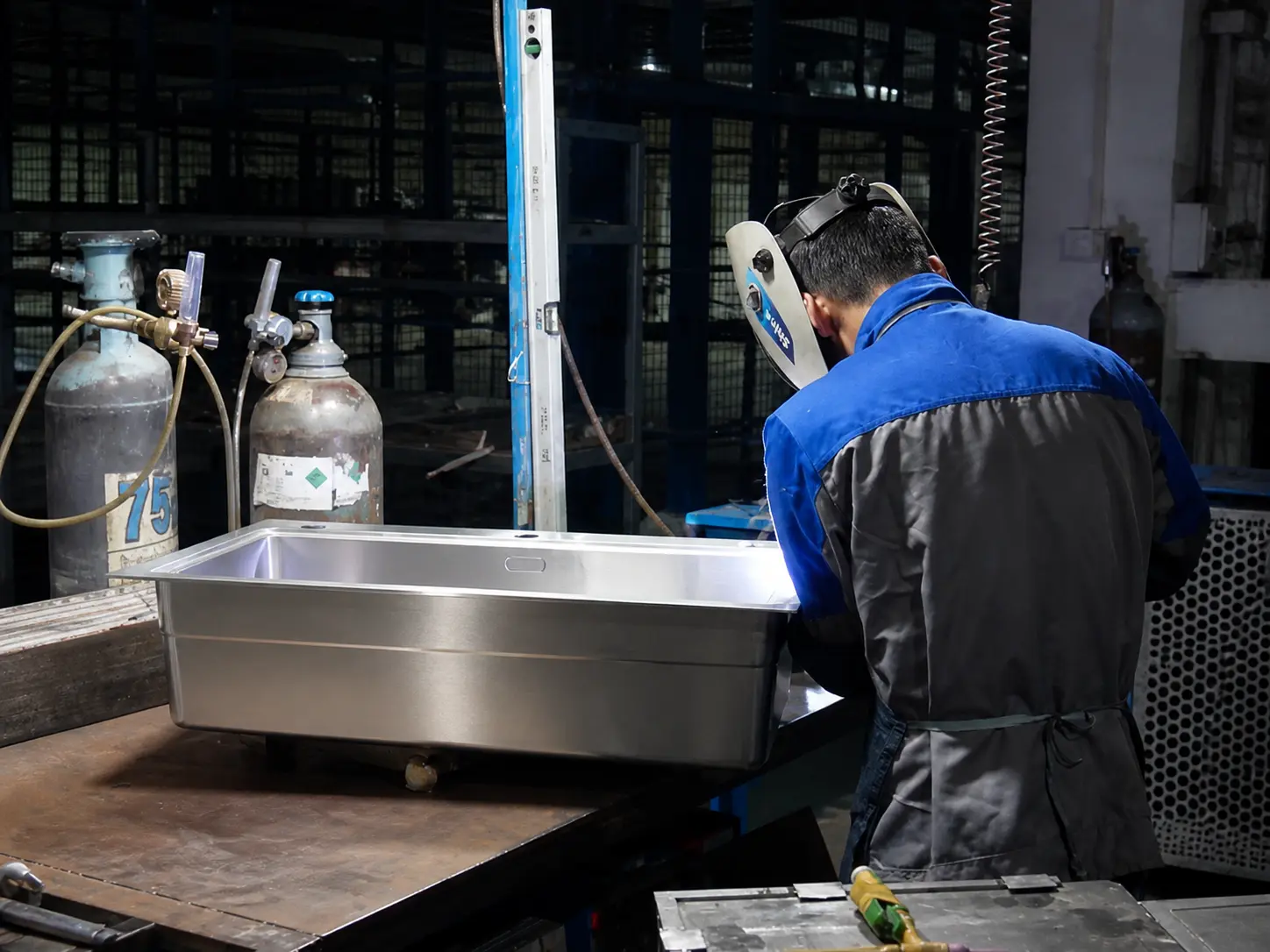
Matrix’s Stainless Steel Sink Manufacturing shows the two different production routes.
Why Finished SUS304 Can Show Different Magnetism Across the Same Sink
This is not unusual.
A pressed sink may show:
| Sink Area | Possible Magnetic Response |
|---|---|
| Flat flange | Very low |
| Upper wall | Low |
| Lower wall | Higher |
| Bottom radius | Higher |
| Rectangular corner | Higher |
| Drain-forming zone | Local increase |
The reason is different levels of cold deformation.
The magnetic pattern therefore says more about:
manufacturing history
than it does about exact alloy grade.
Why Weight Cannot Verify SUS304 Either
A heavier sink is not proof of SUS304.
Weight depends on:
- material thickness
- sink size
- bowl depth
- rim width
- sink geometry
- sound pads
- undercoating
SUS304 describes alloy composition.
Weight describes mass.
They answer completely different questions.
Why Thickness Cannot Verify SUS304
Likewise:
1.2 mm
does not mean:
SUS304.
SUS201, SUS304 or another stainless steel can all be supplied in similar thicknesses.
So a micrometer can verify thickness.
It cannot identify alloy grade.
A Practical SUS304 Verification Chain
For a specification-sensitive sink program, the evidence can be viewed in layers.
Layer 1 — Specification
Does the approved product requirement clearly state SUS304?
Layer 2 — Material Documentation
Is there material information for the steel batch?
Layer 3 — Traceability
Can the material batch be linked to the production order?
Layer 4 — Physical Verification
Does XRF / PMI or another appropriate method support the declared grade where required?
Layer 5 — Independent Verification
Is third-party analysis needed because of project requirements or a dispute?
Verification Method Comparison
| Method | What It Checks | Can It Prove SUS304 by Itself? |
|---|---|---|
| Magnet | Magnetic response | No |
| Thickness Gauge | Material thickness | No |
| Sink Weight | Total mass | No |
| MTC / Material Report | Declared material batch chemistry | Useful only with traceability |
| XRF / PMI | Alloy composition | Strong physical screening |
| Laboratory Analysis | Material composition | Stronger formal verification depending on method |
A Magnet Is Still Useful — Just for a Different Purpose
A magnet does not need to be completely discarded.
It can be useful for spotting an unexpected difference.
For example:
Approved Production
Only localized magnetic response around heavily formed corners.
New Batch
Strong magnetic attraction across large, lightly formed areas.
That difference may justify further investigation.
But the next step should be:
composition verification
not:
automatically reject as fake SUS304.
What Should Be Written in the RFQ?
If material grade matters, use:
Material: SUS304
and separately state:
Thickness: 1.2 mm
If additional material verification is required, specify the requirement before production rather than introducing it only after delivery.
The Kitchen Sink RFQ Checklist separates stainless steel grade, gauge / thickness and other product specifications so they can be confirmed independently.
Common Misunderstandings
“My magnet sticks, so this cannot be SUS304.”
Not necessarily. Cold-worked SUS304 can become magnetic.
“The magnet does not stick, so it must be SUS304.”
No. Low magnetic response does not identify alloy chemistry.
“The sink is 1.2 mm, so the material must be 304.”
No. Thickness and grade are separate properties.
“The sink is heavy, so it must be 304.”
No. Weight cannot identify alloy composition.
“The supplier sent an MTC, so my sinks are definitely 304.”
Only if the document can be reasonably connected to the steel used for that production batch.
“XRF and magnet testing are basically the same.”
No. A magnet measures magnetic response. XRF analyzes elemental composition.
Quick Decision Table
| Question | Best Evidence |
|---|---|
| Is the sink magnetic? | Magnet |
| Is the sheet 1.2 mm? | Thickness measurement |
| What alloy elements are present? | XRF / PMI |
| What grade did the steel supplier declare? | Material documentation |
| Did this material go into this order? | Batch traceability |
| Is formal independent verification required? | Laboratory test |
Buyer Takeaway
The wrong question is:
“Does SUS304 attract a magnet?”
The more useful question is:
“What evidence connects this finished sink to a verified SUS304 material batch?”
A practical verification chain is:
Specification → Material Record → Batch Traceability → XRF / PMI if Required
A magnet can identify unusual magnetic behavior.
It cannot identify SUS304 by itself.
Frequently Asked Questions
What is the most reliable way to check whether a kitchen sink is SUS304?
Material verification is strongest when the declared grade, material documentation, production traceability and physical composition testing agree.
Can a magnet identify SUS304?
No. Cold working can make SUS304 magnetic, and low magnetic response does not prove the grade either.
Can XRF identify SUS304?
XRF can measure major alloying elements and is commonly useful for stainless steel grade screening.
Can XRF distinguish SUS304 from SUS201?
It can often distinguish them through differences in major alloying elements, although test quality depends on the instrument and method.
Is an MTC enough to prove my sink is SUS304?
An MTC is much more useful when it can be connected to the actual material batch used for the order.
Can sink thickness prove material grade?
No. Grade and thickness are independent specifications.
Should SUS304 be tested before or after sink production?
Incoming-material verification provides a clean control point. Finished-product verification can also be used where required.
Need to Define a SUS304 Sink Specification?
For OEM stainless steel sink programs, specify material grade and thickness separately.
Matrix’s Quality Control & Inspection explains how material, thickness, dimensions and finished-product inspection are treated as separate control points.