Wrinkles and cracks are often opposite failures caused by the same problem: poor control of material flow.
During deep drawing, stainless steel must move into the die while also being restrained enough to keep the flange and walls stable.
If the material flows too freely:
wrinkles can form.
If the material is restrained too much or stretched too far:
thinning and cracking can occur.
For buyers and QC teams, the useful question is not:
“Was the sink pressed correctly?”
It is:
“Where is the defect, and what does that location tell us about the forming process?”
Quick Answer
Pressed stainless steel sinks can develop wrinkles or cracks when the material does not flow correctly during forming.
Common influencing factors include:
- draw depth
- corner radius
- blank-holder restraint
- tooling geometry
- lubrication
- material condition
- stainless steel thickness
- forming sequence
- friction
- local stretch
A simplified relationship is:
Too Much Material Flow
→ Compression / Instability
→ Wrinkling
Too Little Material Flow
→ Excessive Stretch
→ Thinning
→ Cracking
Wrinkling and cracking are different defects, but both can reveal how the stainless steel moved during forming.
1. Why Wrinkles Form
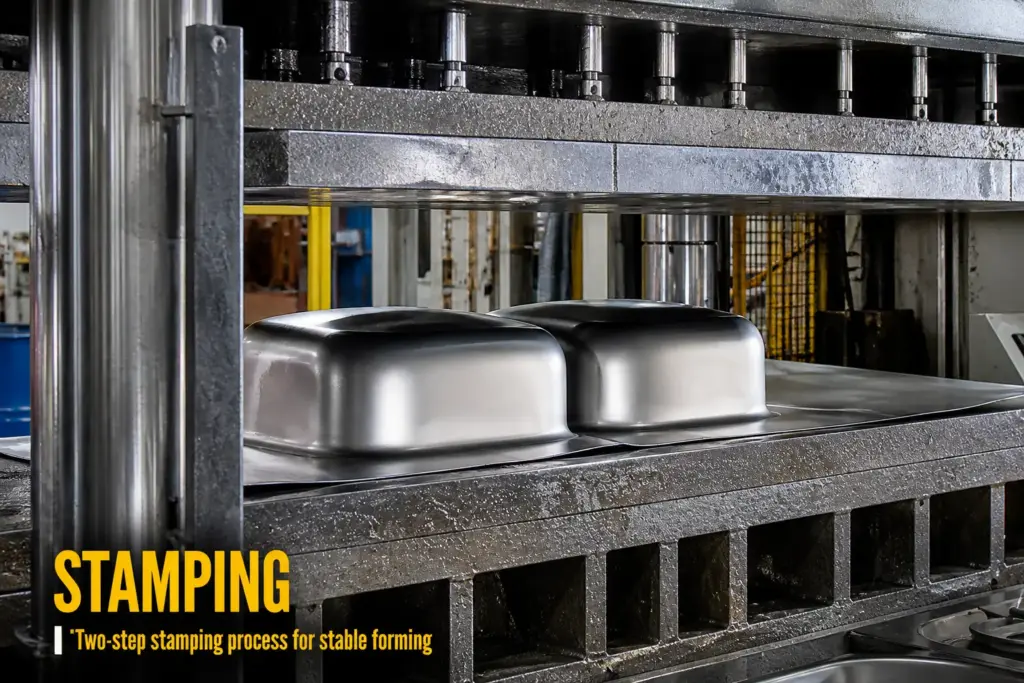
During deep drawing, material from the flat blank must move inward to form the bowl.
The flange area experiences compressive forces while the sheet is being pulled into the die.
If that material is not restrained enough, excess sheet can buckle.
The result may appear as:
- waves
- folds
- ripples
- local wrinkles
Wrinkling is often more visible around:
- flange areas
- upper sidewalls
- corner transitions
2. Why Cracks Form
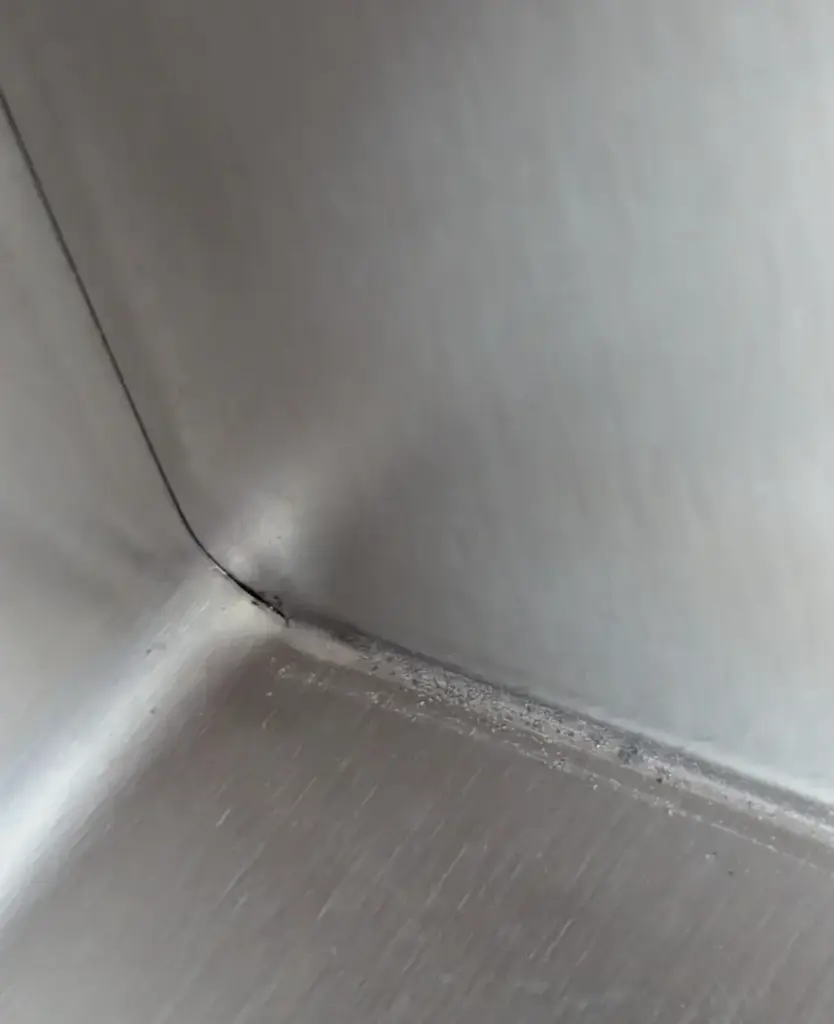
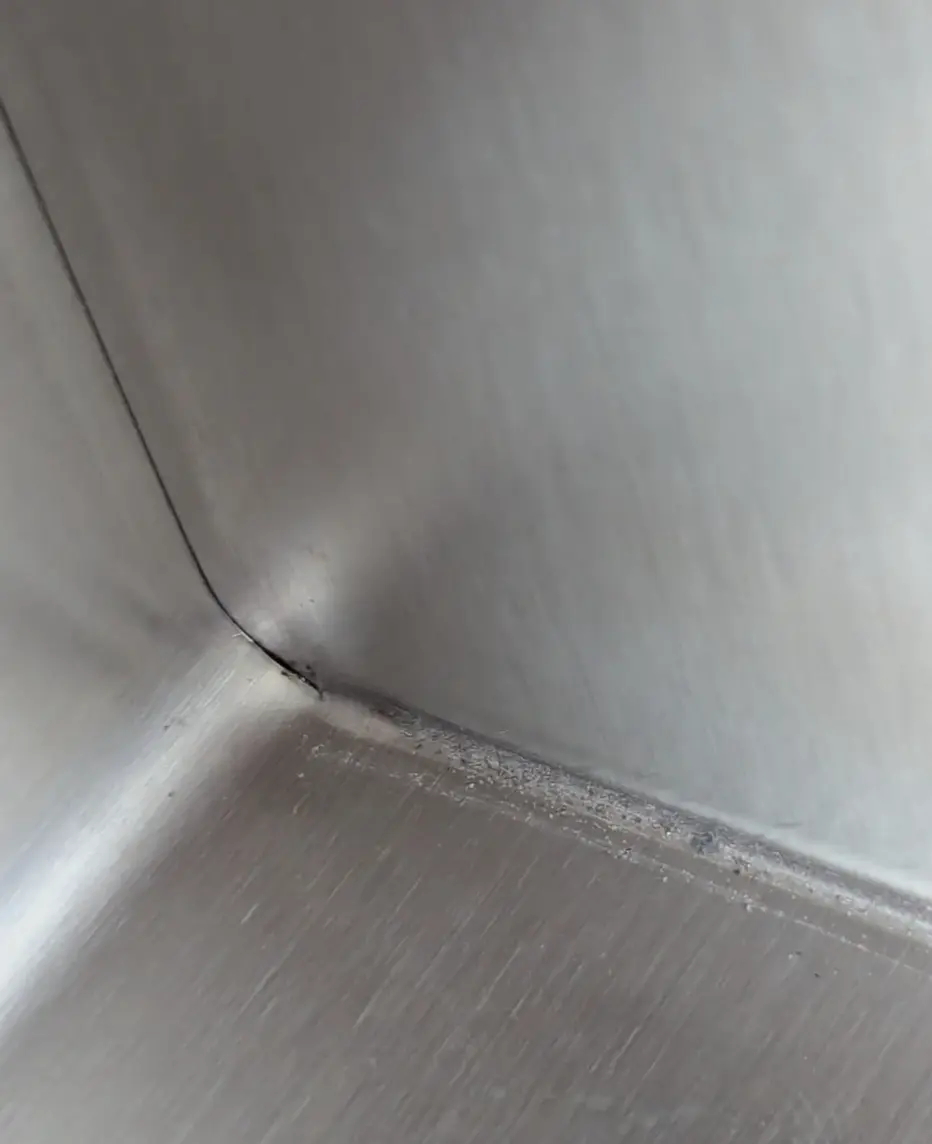
Cracking happens when the stainless steel is stretched beyond what the local area can tolerate.
Before the visible crack appears, the material usually experiences:
localized thinning.
Cracks can be influenced by:
- excessive draw depth
- tight corner radius
- high local strain
- excessive restraint
- insufficient lubrication
- unsuitable forming sequence
The most highly stretched areas deserve the closest attention.
3. Wrinkles and Cracks Can Exist in the Same Product Family
This sounds contradictory, but it is possible.
One part of the sink may have:
too much uncontrolled material flow
while another part experiences:
excessive stretching.
For example:
- flange area → wrinkle risk
- lower corner → thinning / crack risk
So the complete formed geometry needs to be evaluated, not only one defect location.
4. Draw Depth Changes Forming Difficulty
A deeper sink requires more material to move into the die.
As depth increases:
- material travels farther
- local strain can increase
- thinning risk becomes more important
- process window becomes narrower
This is why two pressed sinks with the same overall dimensions can have very different forming difficulty if one bowl is much deeper.
5. Tight Corner Radius Increases Local Strain
A tighter radius can create a sharper product appearance.
But it also forces the stainless steel through a more demanding transition.
This can increase:
- local stretching
- thinning
- risk of tearing
Especially around:
- lower bowl corners
- wall-to-bottom transitions
So radius is not only an aesthetic specification.
It is also a forming parameter.
6. Blank-Holder Restraint Matters
During deep drawing, the sheet cannot simply move freely.
It must be restrained.
If the restraint is too low:
the flange can buckle and wrinkle.
If restraint is too high:
material cannot feed into the die easily, increasing stretch and crack risk.
This is one of the key balancing conditions in pressed sink forming.
7. Tooling Geometry Controls Material Flow
The punch, die and radii determine how the sheet moves.
Tooling geometry influences:
- material path
- strain concentration
- corner transition
- finished shape
A pressed sink defect may therefore reflect:
- product geometry
- tooling condition
- forming setup
rather than material grade alone.
Matrix’s Pressed Kitchen Sinks are produced through a tooling-based forming route, which is fundamentally different from handmade fabrication.
8. Lubrication Reduces Friction During Forming
Stainless steel moves against tooling during the draw.
If friction is too high, material flow becomes more difficult.
That can contribute to:
- local stretching
- surface marking
- forming instability
Lubrication helps control this interaction.
It does not correct poor geometry, but it affects the forming window.
9. Material Thickness Affects Forming Behavior
Thicker sheet generally behaves differently from thinner sheet during drawing.
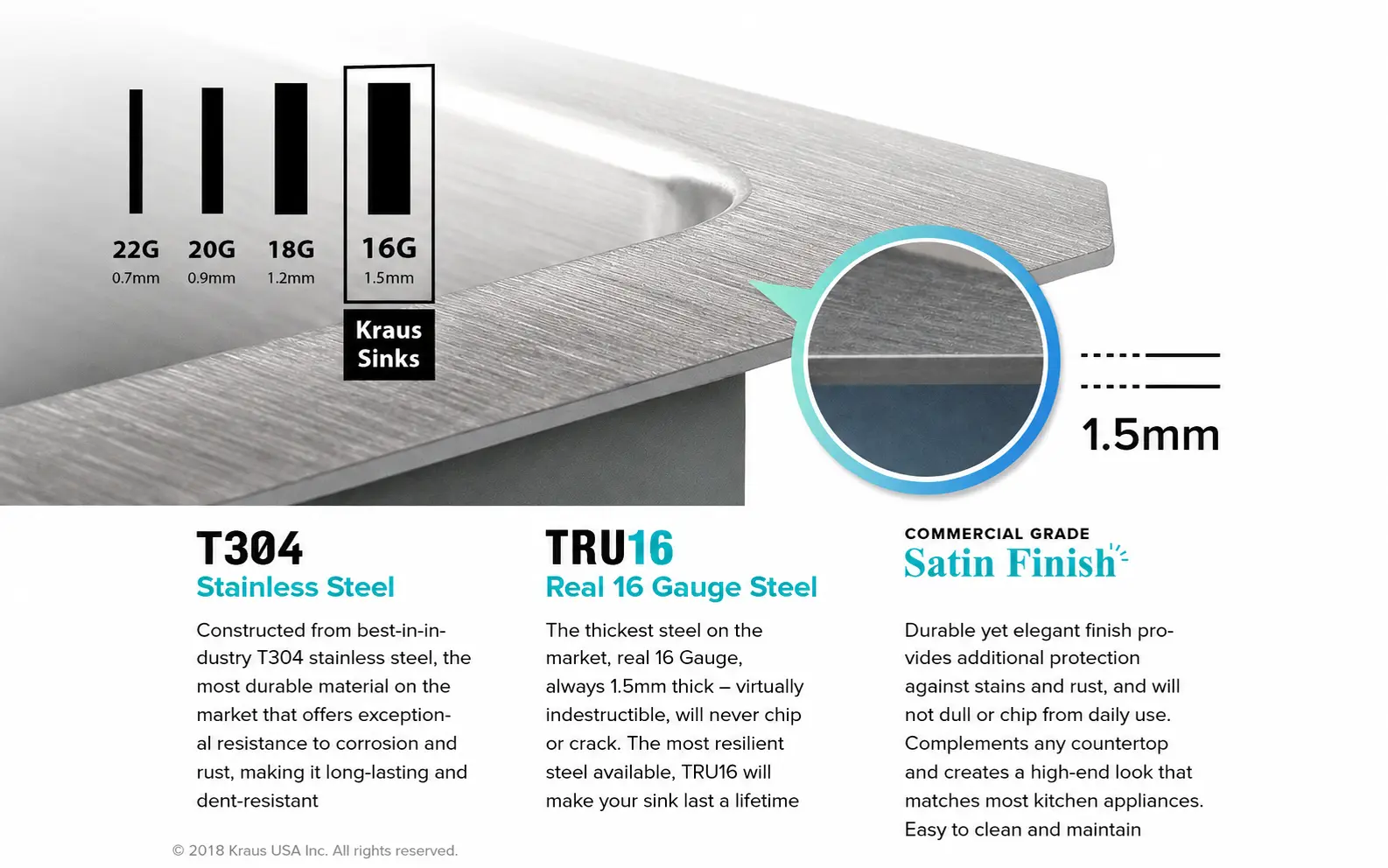
But incoming sheet thickness is only the starting point.
After forming, thickness is not uniform.
Some regions may remain close to the incoming value, while highly stretched areas can become thinner.
Matrix already explains this in:
How Pressed Sink Forming Changes Stainless Steel Thickness
That distinction is important because a crack is often preceded by excessive local thinning.
10. Material Grade Alone Does Not Explain Every Forming Defect
A Buyer may see a crack and immediately suspect:
wrong stainless steel.
But a forming crack does not automatically prove the alloy is wrong.
Possible causes also include:
- geometry
- tooling
- lubrication
- forming depth
- process setting
- local strain
If the material grade itself is in doubt, it should be verified separately.
11. Defect Location Helps Identify the Root Cause
Different locations suggest different investigation directions.
Wrinkles Near Flange
More relevant factors:
- excessive material flow
- insufficient restraint
- blank behavior
Crack Near Lower Corner
More relevant factors:
- local stretch
- tight radius
- depth
- thinning
Crack Along Sidewall
More relevant factors:
- material flow
- friction
- forming sequence
Repeated Mark in Same Location
More relevant factors:
- tooling
- process consistency
- product geometry
12. One Defective Sink and a Repeating Batch Defect Are Different
If only one sink shows a small forming defect, possible causes may include:
- local material variation
- handling
- isolated process issue
If many sinks show the same defect in the same location, the investigation should shift toward:
- tooling
- process settings
- geometry
- repeated production conditions
Pattern matters.
13. Cracking Should Not Be Hidden by Polishing
A surface mark can sometimes be reduced by finishing.
A structural crack cannot be treated as a cosmetic defect.
If cracking is present, the important question is whether the stainless steel has actually separated.
Grinding or polishing should not be used to hide a material failure.
14. Wrinkles Can Be Cosmetic or Functional
Not every wrinkle has the same impact.
A small flange wrinkle may be mostly cosmetic.
But a severe wrinkle can affect:
- rim flatness
- installation
- sealing
- visible appearance
So defect severity should be judged by function and location, not by the word “wrinkle” alone.
15. Why Pressed Sink QC Should Inspect More Than Overall Dimensions
A pressed sink can pass:
- length
- width
- depth
and still have a forming defect.
QC should also review:
- corners
- sidewalls
- flange
- surface marks
- local thinning where relevant
- cracks
- wrinkles
- rim flatness
Matrix’s Quality Control & Inspection separates dimensional checks from workmanship and surface inspection for this reason.
Pressed Sink Defect Diagnostic Table
| Observation | More Relevant Investigation |
|---|---|
| Wrinkles around flange | Material flow / restraint |
| Crack at lower corner | Local stretch / radius / thinning |
| Crack along wall | Forming depth / friction / flow |
| Same defect on many sinks | Tooling / process setting |
| One isolated defect | Local production variation |
| Rim distorted with wrinkles | Flange stability / forming |
| Surface stretch marks only | Forming / finishing review |
| Visible material separation | Structural crack |
What Should Buyers Review During Sample Approval?
For a pressed sink sample, review more than the nominal dimensions.
Useful checks include:
- overall dimensions
- bowl depth
- corner radius
- rim flatness
- sidewall condition
- lower corners
- visible wrinkles
- cracks
- surface stretch marks
- finished thickness where relevant
Matrix’s Factory Capabilities and Pressed Kitchen Sinks provide the production context for pressed / drawn sink programs.
Common Misunderstandings
“Wrinkles mean the stainless steel is too thin.”
Not necessarily.
Wrinkles are often related to unstable material flow and insufficient restraint.
“Cracks always mean bad material.”
No.
Material condition can matter, but geometry, friction, forming depth and tooling also affect cracking.
“If the overall dimensions pass, the sink forming is acceptable.”
No.
Local corners, walls and flange areas can still contain defects.
“A deeper sink only requires a deeper mold.”
No.
Greater depth changes material flow and local strain.
“Tight corner radius is only a design choice.”
No.
It also affects formability and local thinning risk.
Buyer Takeaway
Do not diagnose a pressed sink defect using:
Material Grade Only
Use:
Defect Location
→ Material Flow
→ Draw Depth
→ Corner Radius
→ Tooling
→ Local Thinning
→ Batch Pattern
The key distinction is:
Wrinkling usually points toward excess or unstable material flow, while cracking usually points toward excessive local stretching.
Both are useful clues to how the sink behaved during forming.
Frequently Asked Questions
Why do pressed stainless steel sinks wrinkle?
Wrinkles commonly form when compressive material around the flange or wall becomes unstable during drawing.
Why do pressed sink corners crack?
Lower corners can experience high local strain, especially with deep bowls or tight radii.
Does cracking mean the stainless steel grade is wrong?
Not necessarily. Material grade is only one possible factor.
Can a sink wrinkle and crack in different areas?
Yes. Different regions of the same sink can experience different material-flow conditions.
Does thicker stainless steel prevent cracks?
Not automatically. Forming geometry and process conditions still matter.
Should buyers inspect formed thickness?
For specification-sensitive pressed sink programs, finished thickness at critical locations can provide more useful information than incoming sheet thickness alone.
Developing a Pressed Sink Program?
Matrix supplies Pressed Kitchen Sinks for OEM and private-label programs.
For formed-thickness behavior, see How Pressed Sink Forming Changes Stainless Steel Thickness, and for production verification see Quality Control & Inspection and Factory Capabilities.