X-shaped grooves are common on handmade stainless steel sinks. They are usually described as drainage channels that guide water from the corners toward the drain.
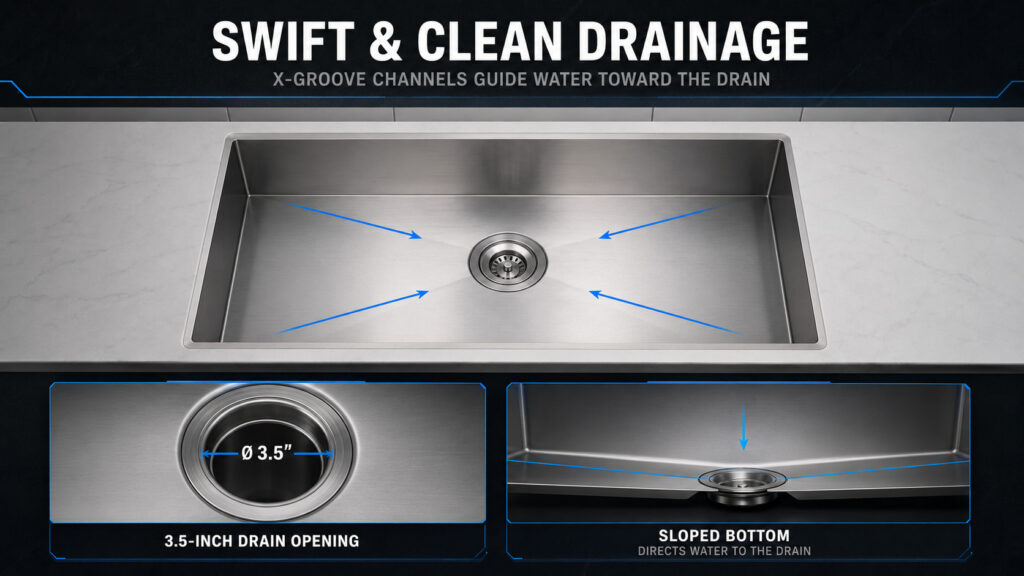
But do they really work?
The honest answer is:
X-grooves can help guide water, but they cannot compensate for an incorrectly sloped or uneven sink bottom.
A sink with visible X-grooves can still hold water. A sink without grooves can drain very well if its bottom has a smooth, continuous fall toward the drain.
For buyers, the lines themselves are not proof of drainage performance. The complete bottom geometry matters more.
The Short Answer
X-grooves may improve drainage when:
- Each groove continuously descends toward the drain
- The surrounding bottom panels also slope inward
- The sink bottom has no localized low spots
- The drain recess is lower than the surrounding steel
- The sink is manufactured without distortion
- The sink is installed level and properly supported
X-grooves may provide little benefit when they are only shallow decorative lines applied to an almost-flat bottom.
They can even highlight a drainage problem if water reaches a groove but becomes trapped in a low area between the groove and the drain.
What Are X-Grooves?
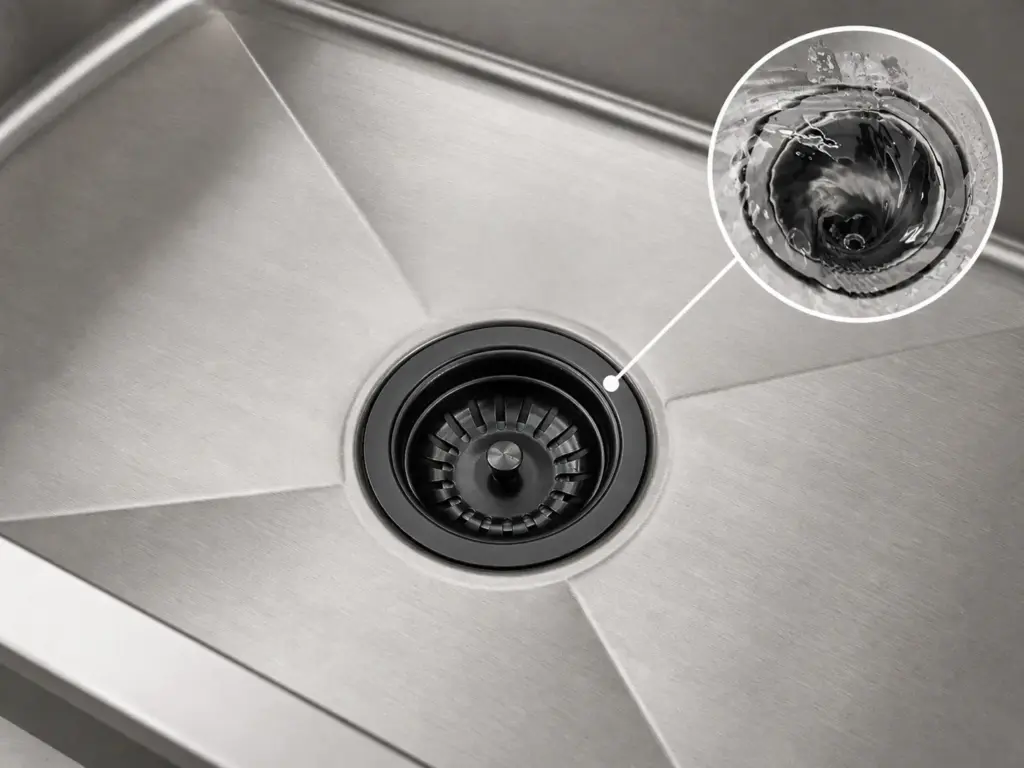
X-grooves are diagonal lines formed into the bottom of a kitchen sink. They usually run from the bowl corners or side areas toward the drain opening.
Depending on the sink design and manufacturing process, the visible X pattern may be created by:
- Shallow pressed channels
- Diagonal bending or cross-breaking
- Four sloped bottom panels meeting along visible lines
- A combination of pressing, bending and polishing
These structures are not all equivalent.
A visible line may be a functional channel, a crease between sloped planes or primarily a visual design detail. Two sinks can both be advertised as having X-grooves while using very different bottom structures.
X-Grooves Do Not Create Gravity
Water moves toward the drain primarily because of elevation difference.
For an X-groove to guide water, the groove must be higher at its outer end and lower at the drain end. If both ends are at almost the same elevation, the groove is simply a line in the steel.
The same principle applies to the rest of the bowl.
A well-designed sink bottom normally combines four elements:
- Overall bottom slope
The broad sink floor must descend toward the drain. - Local drainage channels
X-grooves may provide defined paths for some of the water. - Controlled flatness
The steel must not contain unintended depressions that become collection points. - A correctly formed drain recess
The water must be able to enter the drain instead of stopping behind a raised drain flange.
If one of these elements is incorrect, visible grooves cannot guarantee good drainage.
Visible X-Grooves vs a True Cross-Break
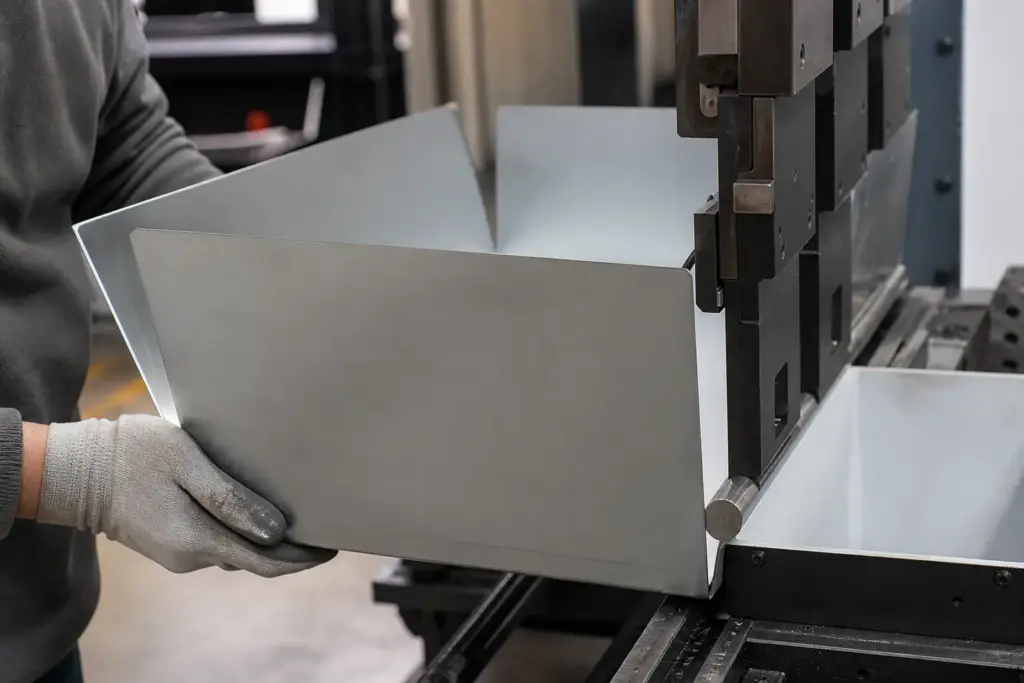
This distinction is important, especially for handmade sinks.
Decorative or shallow X-grooves
These are narrow lines formed into a relatively flat sink bottom. They may guide water that is already close to the line, but large areas between the grooves still depend on the overall bottom slope.
If the surrounding panels are flat or uneven, water can remain in the four sections between the X-shaped channels.
Structural cross-break
A true cross-break divides a broad sheet-metal bottom into multiple shallow planes. Each plane is intended to fall toward the drain area.
In this structure, the visible X may represent the meeting lines between sloped sections rather than four isolated channels.
A correctly controlled cross-break can also help reduce the tendency of a large sheet-metal panel to appear excessively flat or flexible. However, the visible pattern still does not prove that all four planes descend correctly.
Smooth continuous slope
Some pressed or drawn sinks have no visible X-grooves. Their bowl bottoms use a continuous molded contour leading to the drain.
When this contour is properly designed and formed, it can drain as well as—or better than—a handmade sink with prominent grooves.
Therefore, buyers should compare drainage results, not count visible lines.
The Four-Part Drainage Test
A useful way to evaluate a sink is to separate drainage into four questions.
| Question | What it reveals |
|---|---|
| Does water move away from the corners? | Corner and side-panel slope |
| Does it cross the main bottom area? | Overall bottom geometry |
| Does it reach the drain opening? | Groove continuity and local flatness |
| Can it enter the drain completely? | Drain recess and strainer height |
An X-groove mainly affects the third question. It cannot independently solve the other three.
Why Water Can Pool Between the Grooves
Imagine a sink bottom divided into four triangular areas by an X pattern.
The grooves may descend toward the drain, but the center of one triangular panel may be slightly lower than its edges. Water flowing across that section will collect in the localized depression instead of reaching the groove.
This can result from:
- Inconsistent bottom bending
- Heat distortion from welding
- Grinding or finishing stress
- Poor control of the drain embossing
- Uneven soundproofing or undercoating
- Storage or shipping deformation
- Improper installation pressure
This is why a dry photograph of an X-groove sink says very little about its actual drainage performance.
The Drain Recess Can Matter More Than the Grooves
Water can travel correctly across the entire sink bottom and still stop around the drain.
The drain area should transition downward into the waste opening. If the basket strainer or drain flange sits above the surrounding sink surface, it creates a small barrier.
Water may then form a ring around the drain.
Common causes include:
- An insufficiently recessed drain opening
- An incompatible basket strainer
- A thick gasket installed in the wrong position
- Excess sealant beneath the flange
- A distorted drain embossing
- Incorrect tightening of the drain assembly
In this situation, adding deeper X-grooves would not solve the problem. The water reaches the drain area but cannot cross the raised edge.
For drain fitting dimensions, see the Matrix Kitchen Sink Drain Hole Sizes and Garbage Disposal Compatibility Guide.
Can X-Grooves Eliminate All Water?
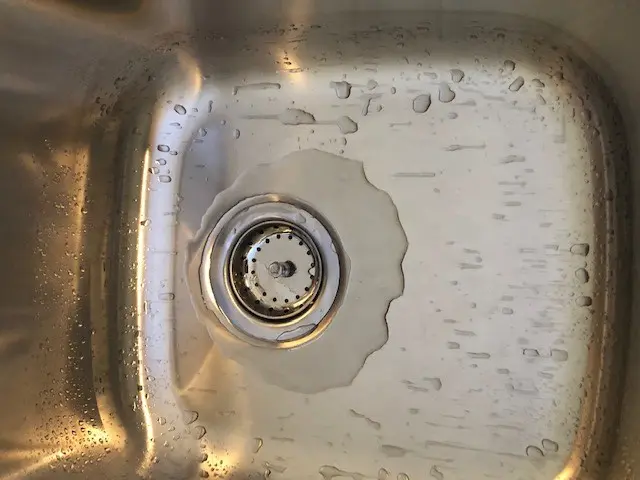
No kitchen sink should be expected to become completely dry without wiping.
Even when bulk water drains correctly, small droplets and a thin water film may remain because of:
- Surface tension
- Stainless steel grain
- Water hardness
- Detergent residue
- Oils from food or cookware
- Surface coatings
- Very small variations in the steel
This is different from a drainage defect.
Normal residual water
Normal residual water usually appears as:
- Scattered droplets
- A thin surface film
- Small beads along the brushed grain
- Moisture around a bottom grid foot
- Water that can be removed with one quick wipe
Potential drainage problem
A possible drainage problem is more likely when:
- A defined puddle remains in the same location
- Water has measurable depth
- Food particles repeatedly collect in that area
- Water remains long after normal rinsing
- One corner consistently drains more slowly
- Water stays behind a raised drain flange
The relevant question is not “Is the sink completely dry?” It is “Does the sink retain a repeatable puddle because of its geometry?”
Do Deeper X-Grooves Drain Better?
Not necessarily.
A deeper groove may carry more water once water enters it, but it can introduce other disadvantages:
- Food residue may collect inside the channel
- The groove can require more brushing to clean
- Sharp transitions can interrupt the surface finish
- Narrow grooves can retain small amounts of water
- Aggressive forming can make the bottom harder to control consistently
A wide, shallow and continuously descending channel may perform better than a deep groove with an uneven profile.
Groove depth should therefore be considered together with:
- Groove width
- Starting position
- Direction of fall
- Transition into the drain recess
- Cleanability
- Repeatability during production
More visible does not automatically mean more functional.
Does Drain Position Change X-Groove Performance?
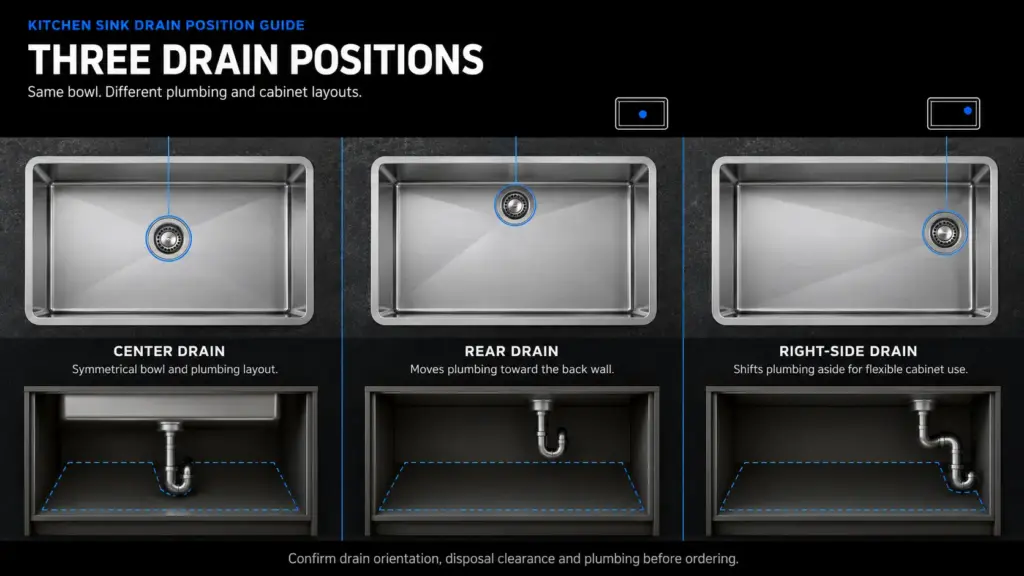
Yes.
Center-drain sinks
A center drain creates relatively balanced water paths. The distance from each corner to the drain is similar, making the bottom geometry easier to divide into four sections.
However, a center drain also places the plumbing and garbage disposal in the middle of the cabinet.
Rear-drain sinks
A rear drain can create more usable cabinet space, but water from the front corners must travel farther.
The front sections therefore need carefully controlled fall toward the rear drain. Adding visible grooves without sufficient front-to-rear slope may not produce good drainage.
Offset-drain sinks
An offset drain creates unequal water paths. Each bottom plane and groove must be designed for its actual distance and direction to the drain.
Simply moving a standard X pattern away from the center is not always enough.
Read Rear Drain vs Center Drain Kitchen Sinks for a comparison of drainage layout and cabinet use.
Large Workstation Sinks Are More Demanding
A large workstation sink has a longer and wider bottom than a compact sink. Water must travel farther from the outer corners to the drain.
This makes several factors more important:
- Overall bottom stiffness
- Consistent slope across a large surface
- Welding distortion control
- Correct drain location
- Bottom grid clearance
- Repeatable forming between batches
A long workstation sink may display clear X-grooves and still retain water if the large panels between the grooves contain low spots.
For this reason, drainage should be tested using a finished production sample—not approved only from a drawing or product image.
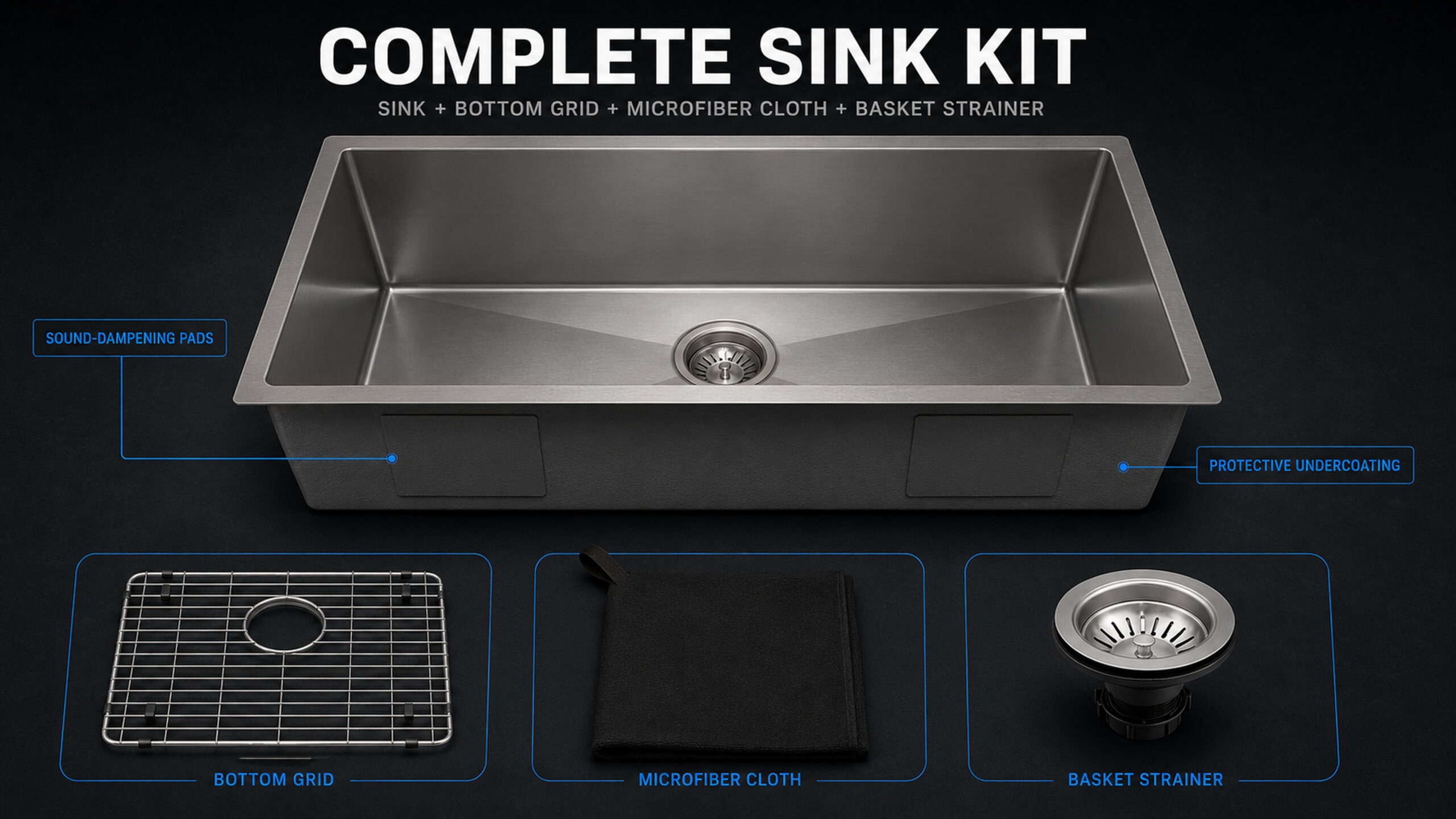
Matrix supplies workstation kitchen sinks with matched ledges, bottom grids, strainers and food-preparation accessories. For B2B programs, the sink and accessories should be evaluated as one system.
Can a Bottom Grid Affect Drainage?
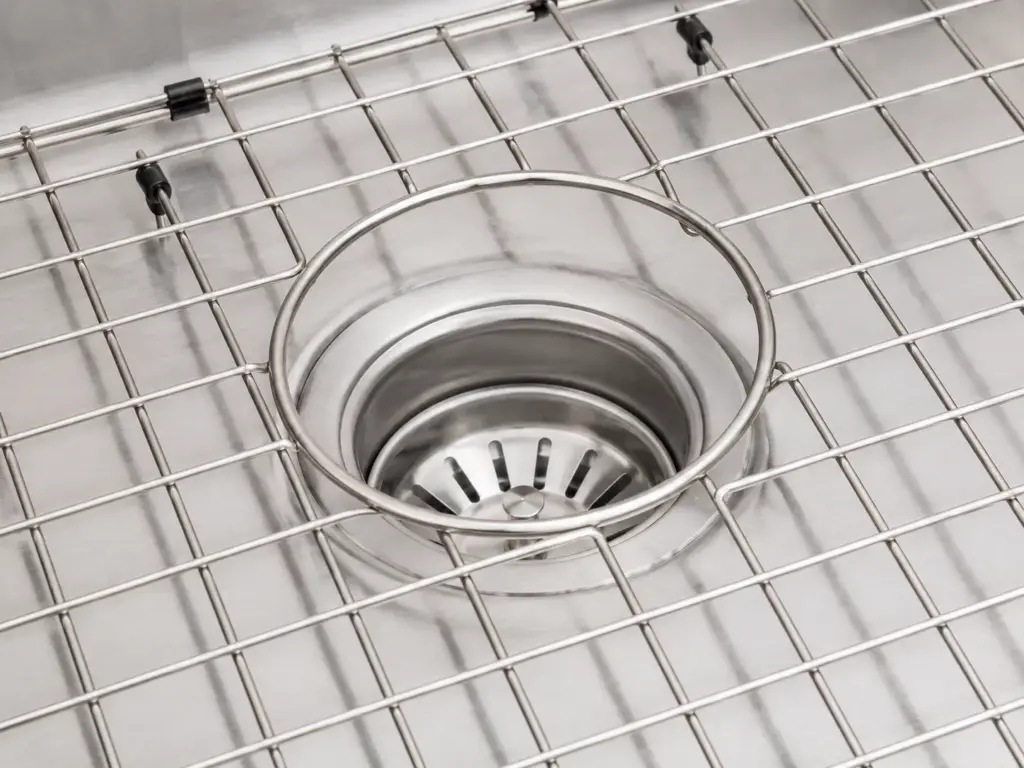
A bottom grid does not change the physical slope of the sink. However, it can change how users experience drainage.
Grid feet and wires can:
- Slow down the manual movement of food particles
- Create small wet areas around contact points
- Conceal residual water
- Make the bottom harder to wipe
- Prevent large cookware from blocking the drain directly
A correctly fitted grid should sit above the sink floor, align with the drain and remain easy to remove for cleaning.
Buyers should test drainage both with and without the grid. A grid should not be used to hide a poorly formed sink bottom.
Does a Nano or PVD Finish Improve Drainage?
A surface treatment may change the way water beads, spreads or appears on the sink. It does not correct the elevation of the sink bottom.
A water-repellent surface may produce more visible beads. A more wettable surface may leave a thin film. Neither observation alone proves that the sink has good or bad bottom slope.
Drainage geometry and surface behavior should be evaluated separately:
- Geometry determines where bulk water travels.
- Surface condition affects how the remaining water spreads or beads.
The word “nano” does not guarantee self-cleaning or zero water retention.
Installation Can Change the Result
A sink that drains correctly during factory testing can develop pooling after installation if it is mounted under stress.
Possible installation causes include:
- The countertop or cabinet is not level
- Mounting clips are tightened unevenly
- The sink rim is pulled against an uneven cutout
- The cabinet support pushes against the bowl
- Plumbing connections place sideways force on the drain
- A heavy disposal pulls on an inadequately supported assembly
- The sink was distorted during transport
The sink should be installed according to its intended rim reference. The installer should check both front-to-back and side-to-side level before blaming the X-grooves.
If an installed sink holds water, use the diagnostic process in Why Water Pools in a Kitchen Sink to separate product geometry from installation and drain-fitting problems.
A Practical Water Test for Home Buyers
A simple test can reveal more than the appearance of the grooves.
- Remove food, detergent and oily residue from the sink.
- Confirm that the drain is open and flowing normally.
- Rinse the complete bottom with clean water.
- Stop the faucet and allow the bulk water to drain.
- Observe the four corners, the panels between the grooves and the drain recess.
- Record where defined puddles remain.
- Repeat the test from the same starting condition.
Do not judge the sink by a few individual droplets. Look for a puddle that repeatedly appears in the same location.
If water stays around the drain only, inspect the strainer flange. If it stays in one corner, check level and local bottom geometry. If it remains across most of the bowl, the overall bottom slope may be insufficient.
A Better B2B Sample-Approval Method
Wholesalers, importers, kitchen brands and project buyers need a repeatable inspection method.
“Good drainage” is too subjective for a purchase specification. The buyer and supplier should agree on a documented test.
1. Define the installation reference
Place the sink on a controlled support fixture using the intended rim or mounting reference.
Confirm that the reference plane is level before adding water.
2. Install the intended drain assembly
The basket strainer, waste fitting or drain cover can affect the final result. Testing only an empty drain hole may hide a raised-flange problem.
Use the same drain component intended for the retail or project package.
3. Use a repeatable water volume and application method
Apply the same quantity of water to the same test areas on every sample.
The test can include:
- Each corner
- Each panel between the grooves
- The area opposite an offset drain
- The complete bowl bottom
4. Use a fixed observation time
Photograph or assess the sink after the same drainage interval each time.
The agreed method should distinguish between scattered droplets and a defined puddle.
5. Record the location of residual water
A simple bowl map can identify whether water remains:
- In a corner
- Between two grooves
- Along a welded side
- Around the drain
- Under the bottom grid
- Across a large section of the bowl
The location often reveals the manufacturing or assembly cause.
6. Establish an agreed acceptance limit
There is no useful value in writing “perfect drainage” on an order without defining what it means.
The buyer and supplier can agree on factors such as:
- Maximum permitted puddle size
- Maximum observable depth
- Observation time after rinsing
- Number of allowed affected areas
- Test condition with the specified strainer
- Sample frequency during production
The acceptance limit should reflect the product design, market expectation and approved reference sample.
7. Check production units, not only the development sample
Drainage can vary if welding, bottom forming, drain pressing or handling changes between batches.
Inspection should include representative units from mass production, particularly for large handmade sinks.
Manufacturing Details B2B Buyers Should Review
When evaluating an X-groove sink, request more than overall dimensions.
The technical review should include:
- Sink bottom drawing
- Drain center position
- Bottom-panel structure
- Intended direction of fall
- Groove width and depth
- Groove transition into the drain area
- Drain embossing dimensions
- Basket strainer fit
- Bowl and rim flatness
- Welding-distortion control
- Bottom grid clearance
- Water-test method
- Approved sample records
- Batch inspection requirements
For handmade models, also check whether the drainage structure can be repeated across different sink sizes. A groove pattern that works on a 24-inch sink may not perform identically on a 33-inch workstation model.
Matrix develops handmade stainless steel kitchen sinks for brands, wholesalers and project buyers. Drain position, bowl depth, bottom structure, accessories and packaging can be reviewed during sample development.
Marketing Claims Buyers Should Question
Be cautious with claims such as:
- “X-grooves guarantee complete drainage”
- “Zero standing water”
- “Self-cleaning sink bottom”
- “Four drainage lines remove all residue”
- “Deeper grooves always drain faster”
- “Nano coating prevents all water spots”
A more defensible product description is:
A sloped sink bottom with formed drainage channels is designed to guide bulk water toward the drain. Minor droplets or water film may remain depending on surface condition, installation and use.
This wording explains the design intention without promising a physically unrealistic completely dry surface.
X-Groove Sink Buyer Scorecard
| Evaluation point | Good sign | Warning sign |
| Overall bottom | Continuous fall toward drain | Large nearly flat areas |
| X-grooves | Descend into drain recess | Decorative lines ending before drain |
| Corner drainage | Water leaves all corners | Repeat puddle in one corner |
| Panel flatness | No localized depression | Water trapped between grooves |
| Drain recess | Lower than surrounding bottom | Raised strainer or drain lip |
| Cleaning | Smooth, accessible transitions | Deep or sharp debris-catching channels |
| Installation | Rim supported without distortion | Uneven clips or cabinet pressure |
| Production control | Documented sample and batch test | Visual inspection only |
| Product claims | Measured and qualified | “Perfect drainage” without test criteria |
Frequently Asked Questions
Do X-grooves make a stainless steel sink drain faster?
They can guide some water toward the drain when the channels have a continuous downward fall. Overall drainage speed still depends on the complete bottom slope, drain opening, waste fitting and plumbing flow.
Can a sink without X-grooves drain properly?
Yes. A sink with a smooth, continuously sloped bottom can drain very well without visible channels.
Why does water remain between the X-grooves?
The bottom panel between the grooves may be too flat or contain a localized low spot. The sink may also be out of level or distorted during installation.
Why does water stop around the drain?
The drain recess may be too shallow, or the basket strainer flange may sit above the surrounding sink bottom. Excess sealant or an incompatible waste fitting can also create a raised edge.
Are deeper X-grooves better?
Not automatically. Groove direction and continuous fall matter more than visual depth. Deep, narrow grooves may also collect residue and require more cleaning.
Do X-grooves prevent water spots?
No. Water spots are mainly related to minerals, surface residue and drying. Drainage channels may reduce large puddles but cannot remove every droplet from the stainless steel.
Can installation cause an X-groove sink to pool water?
Yes. An out-of-level countertop, uneven clip pressure, cabinet interference or sink distortion can change the direction in which water moves.
Are X-grooves only used on handmade sinks?
They are especially common on handmade stainless steel sinks, but formed drainage lines or sloped bottom structures can also appear on other sink types. Pressed sinks often use smoother molded contours instead.
Final Verdict
X-grooves are not useless, but they are frequently given too much credit.
They can support drainage when they are part of a correctly engineered bottom structure. They cannot repair an almost-flat basin, a localized low spot, a raised drain fitting or an out-of-level installation.
The best-performing sink is not necessarily the one with the deepest or most visible X pattern. It is the sink in which:
- The complete bottom falls toward the drain
- The formed channels follow that fall
- The drain recess accepts water without a raised barrier
- Manufacturing remains consistent
- Installation does not distort the bowl
For consumers, a controlled water test is more useful than a product photograph.
For B2B buyers, drainage should be converted from a marketing claim into a documented sample and batch-inspection requirement.
Matrix supports stainless steel sink development for wholesale, private-label and project programs. Buyers can contact the Matrix team to review bottom structure, drain position, dimensional drawings, accessory matching and sample-testing requirements.