A kitchen sink can leave the factory in perfect condition and still arrive with:
- bent rim
- scratched surface
- damaged apron
- broken accessory
- torn carton
The reason is often simple:
Factory packing approval and real distribution stress are not the same test.
Quick Answer: Why Do Kitchen Sinks Arrive Damaged Even After Passing Factory Inspection?
Because packaging that works for:
- factory handling
- pallet storage
- container shipping
may not be strong enough for:
- parcel drops
- carton rotation
- corner impact
- conveyor handling
- repeated individual handling
The most common sink-shipping risks include:
- rim deformation
- corner impact
- accessory movement
- metal-to-metal contact
- PVD surface rubbing
- insufficient internal restraint
Kitchen sink packaging should be designed for the distribution route, not just for leaving the factory safely.
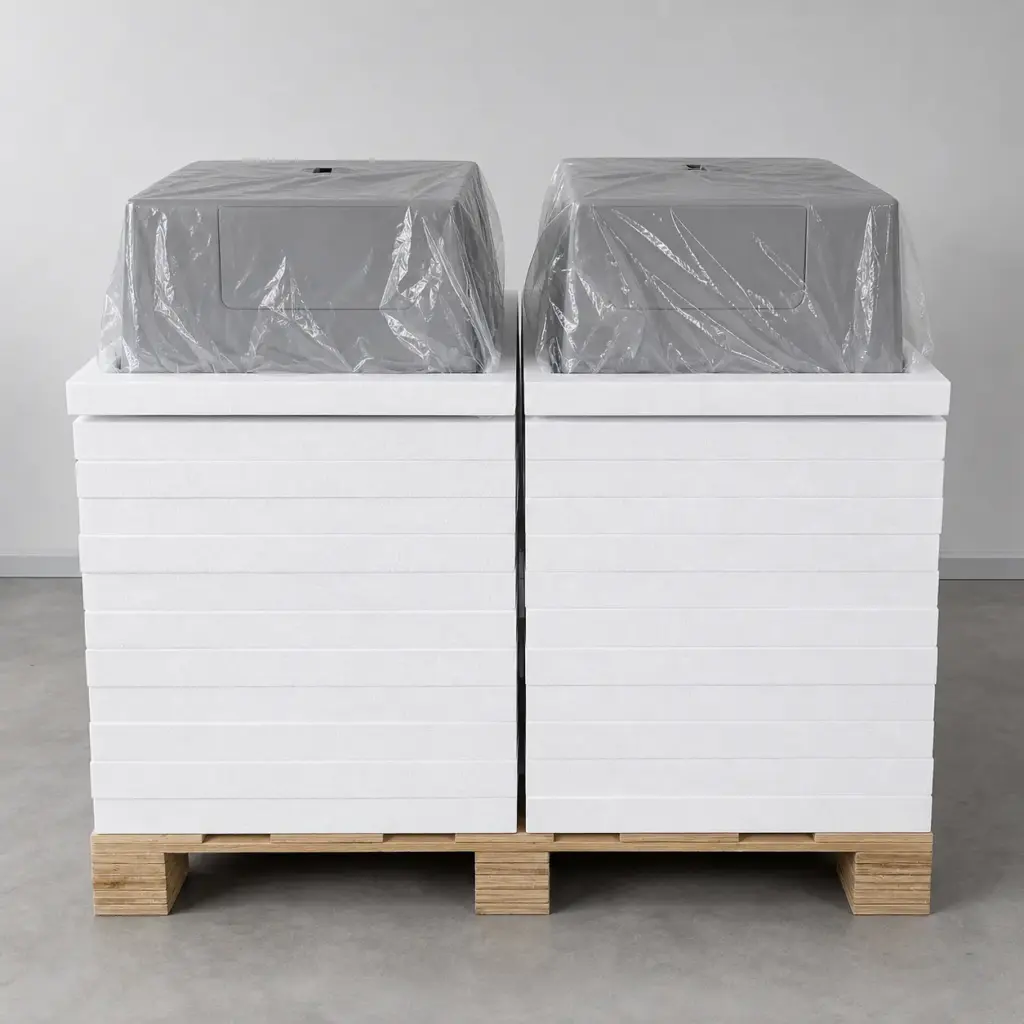
A good factory inspection proves the sink was correct before shipment.
It does not automatically prove the carton can survive every logistics channel.
Factory Handling Is Relatively Controlled
Inside the factory, cartons may be:
- carried manually
- moved on carts
- stacked in defined directions
- placed on pallets
This environment is relatively predictable.
The same carton entering a parcel network may be:
- turned upside down
- dropped on an edge
- slid across conveyors
- stacked unpredictably
- handled individually many times
That changes the packaging problem completely.
Pallet Freight and Parcel Shipping Are Different
Pallet / Container Distribution
Main risks often include:
- compression
- vibration
- long-duration stacking
- container movement
Parcel / Drop-Ship Distribution
Additional risks may include:
- free drops
- edge impact
- corner impact
- repeated orientation changes
- individual carton handling
A carton designed mainly around pallet loading may not adequately control parcel impact.
1. Sink Rims Are Easy to Deform
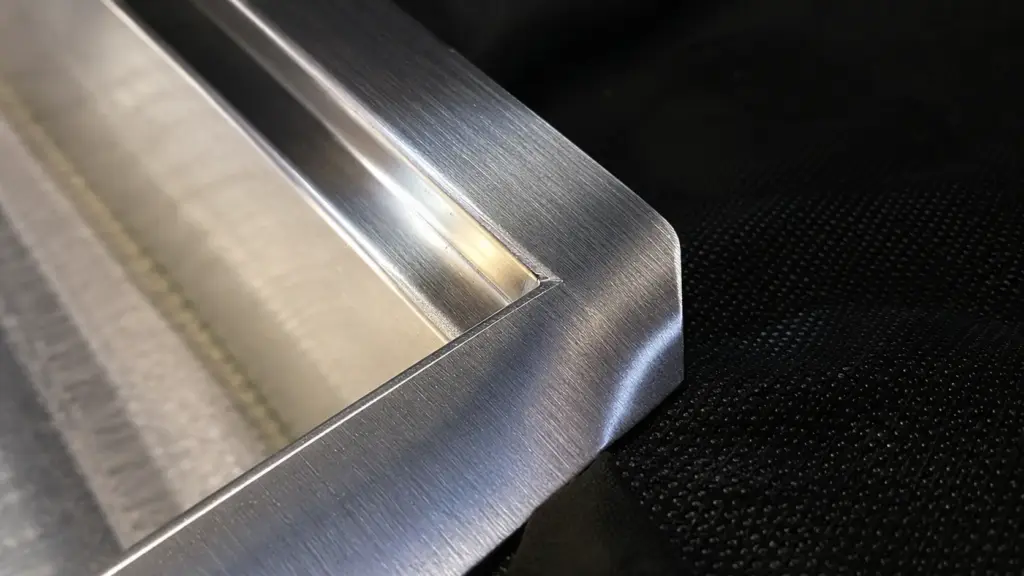
The rim is one of the most vulnerable structural areas.
This is especially true for:
- large handmade sinks
- wide top-mount sinks
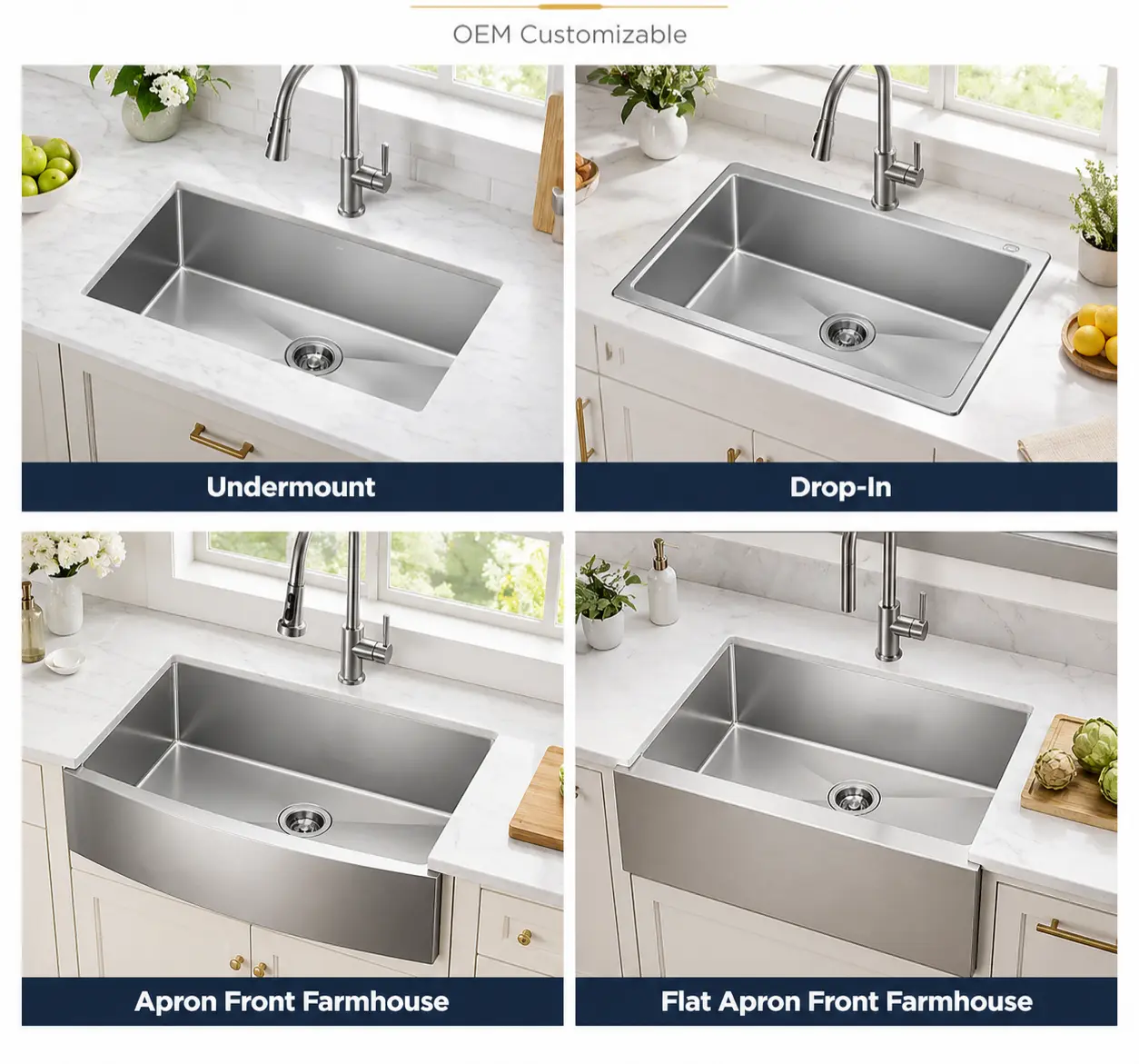
- apron-front sinks
- large workstation models
A carton can look acceptable while the sink rim inside has been:
- twisted
- bowed
- locally bent
That can later create:
- countertop gaps
- rocking
- installation claims
See Why Sink Rim Flatness Causes Installation Claims for why rim deformation matters even when the overall sink size still measures correctly.
2. Corners Take Disproportionate Impact
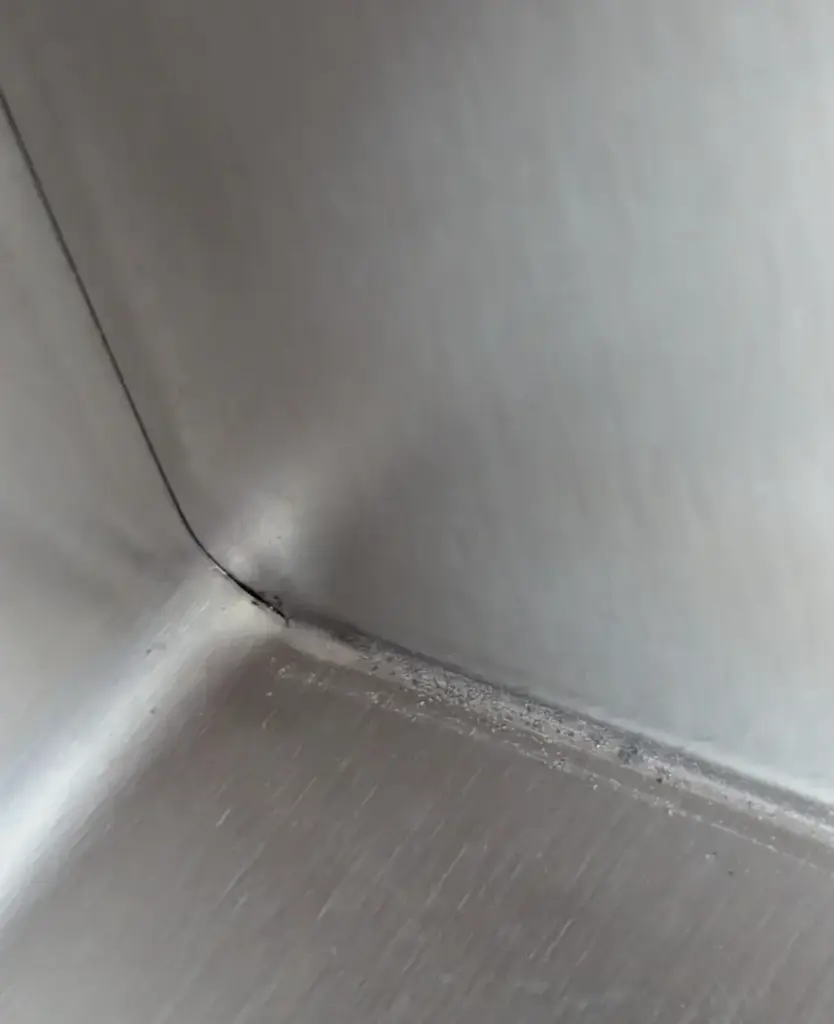
Parcel cartons often hit the ground on:
- one corner
- one edge
rather than perfectly flat.
The impact then concentrates in a small area.
For sinks, this can affect:
- front rim corner
- apron corner
- outer flange
- carton edge
This is why edge and corner protection can be more important than simply increasing carton thickness.
3. A Large Empty Space Inside the Carton Creates Movement
A sink should not be able to move freely inside its packaging.
If internal clearance is too large, the product can gain momentum before hitting:
- foam
- carton wall
- accessories
That can turn a small external impact into a larger internal impact.
The packaging should therefore control:
movement
not only:
contact.
4. Loose Accessories Can Damage the Sink
Workstation sinks introduce extra risk because the carton may contain:
- bottom grid
- cutting board
- colander
- roll-up rack
- drain
- clips
- soap dispenser
If these parts are not restrained, they can:
- move
- rub
- hit the sink
- tear protective film
A sink may therefore arrive scratched even though the carton itself has no major visible damage.
5. Metal-to-Metal Contact Is Especially Dangerous
Metal accessories should not be allowed to repeatedly touch the visible sink surface during transport.
Risk areas include:
- grid against bowl
- drain against rim
- clips against finish
- colander against bowl wall
Vibration during long-distance freight can create repeated rubbing even without a dramatic drop.
6. Decorative Finishes Need More Protection
A standard brushed sink and a PVD sink may not need exactly the same packing approach.
Colored and decorative finishes can be more sensitive to:
- rubbing
- abrasion
- accessory contact
- foam marking
- protective-film movement
A packaging system that is adequate for natural brushed stainless steel may not be appropriate for:
- gunmetal
- black
- gold
without additional review.
7. Protective Film Does Not Solve Structural Damage
Protective film can help reduce:
- surface scratches
- handling marks
It does not prevent:
- rim bending
- corner deformation
- carton crushing
These require structural protection from:
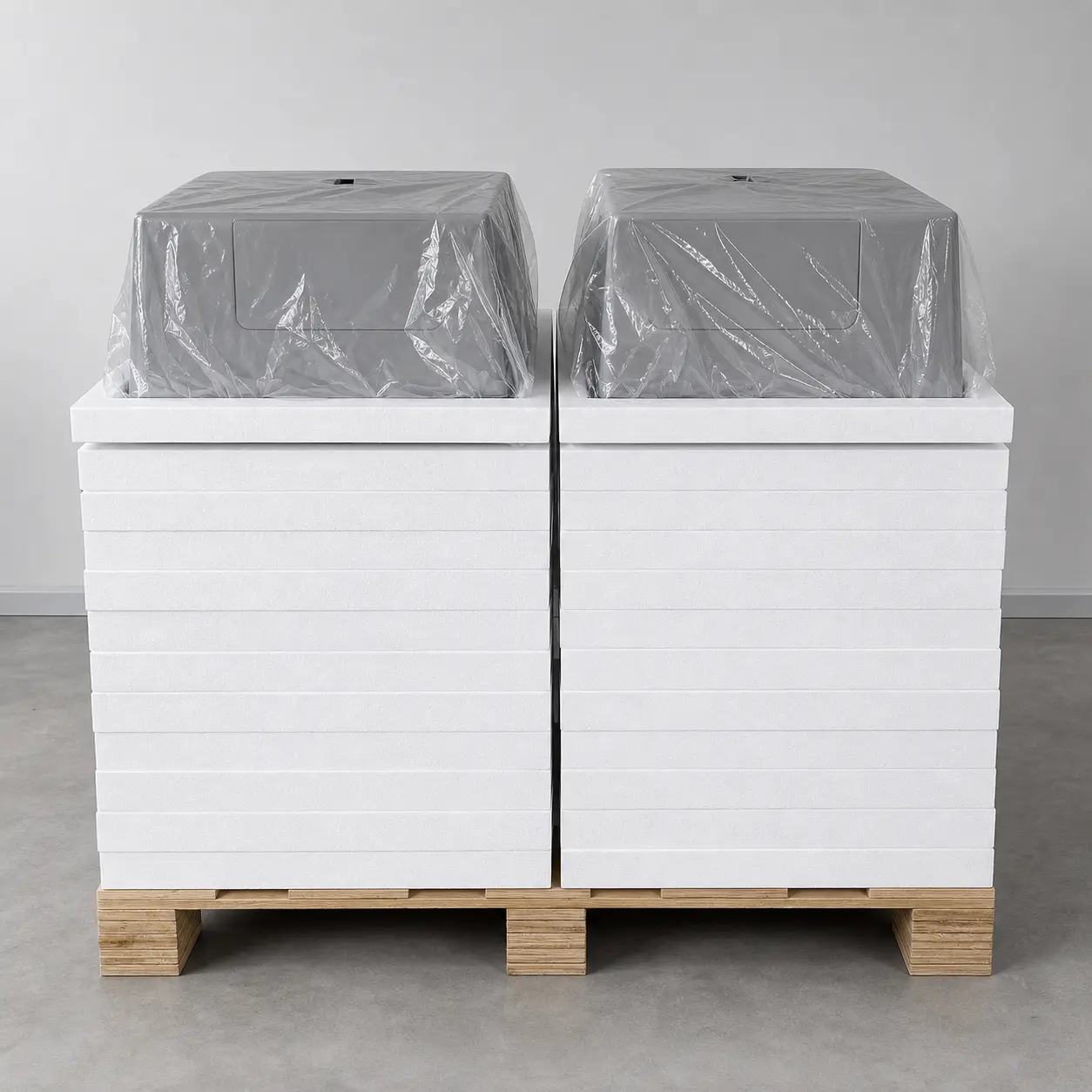
- foam
- edge support
- carton
- product restraint
8. More Foam Is Not Automatically Better
Packaging quality should not be judged only by:
foam thickness.
The important questions are:
- where is the foam?
- what area does it support?
- can the sink move?
- are vulnerable edges protected?
- are accessories separated?
- does the foam remain in position?
A thick foam block in the wrong location can provide less protection than a well-designed support structure.
9. Apron-Front Sinks Need Specific Protection
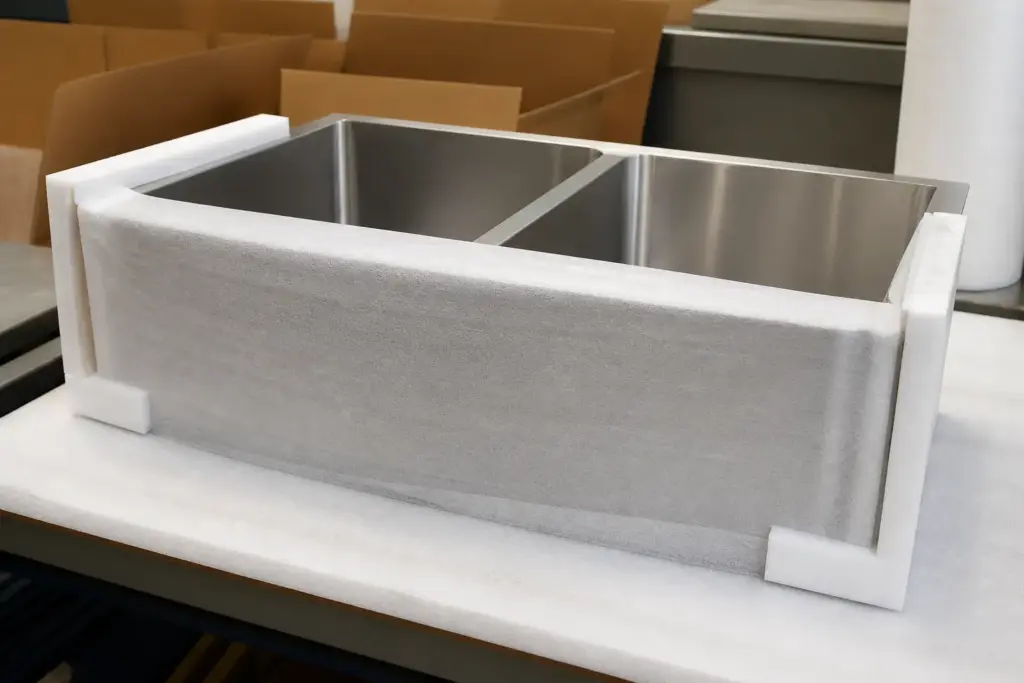
Farmhouse sinks have a large visible apron surface.
Transport risk includes:
- apron dent
- corner dent
- finish damage
The front face may therefore need a different protection strategy from a standard undermount bowl.
Generic “one packaging fits all models” can be risky for this product category.
10. Workstation Sinks Need a Packing Layout
For multifunction products, define where each accessory goes.
For example:
- drain in separate box
- grid restrained
- cutting board separated from metal
- colander fixed
- rack protected
Do not simply put all accessories:
inside the bowl.
The accessory packing layout should be part of the approved SKU.
11. Packaging Should Match the Sales Channel
Consider three programs.
Wholesale Container Program
Product moves:
factory → container → importer warehouse
Parcel handling may be limited.
Retail Distribution
Product moves:
factory → warehouse → store / dealer
Cartons may be handled several times.
E-Commerce / Drop-Ship
Product moves:
factory / warehouse → parcel carrier → consumer
Individual carton risk is higher.
The packaging requirement should therefore follow the final distribution route.
12. “Export Packing” Is Too Vague for an RFQ
A quotation saying:
Export carton
does not define:
- pcs per carton
- foam structure
- rim protection
- accessory layout
- pallet
- parcel suitability
For serious B2B programs, packaging should be specified like any other product component.
13. Packing Cost Should Not Be Reduced Blindly
Packaging is often one of the first places suppliers are asked to reduce cost.
Possible changes include:
- thinner carton
- less foam
- fewer protective components
- more sinks per carton
Each change may save money.
But it can also change:
- damage rate
- carton CBM
- labor
- warehouse handling
- claim cost
The buyer should evaluate the complete logistics cost rather than packaging price alone.
14. Multi-Piece Cartons Change the Risk
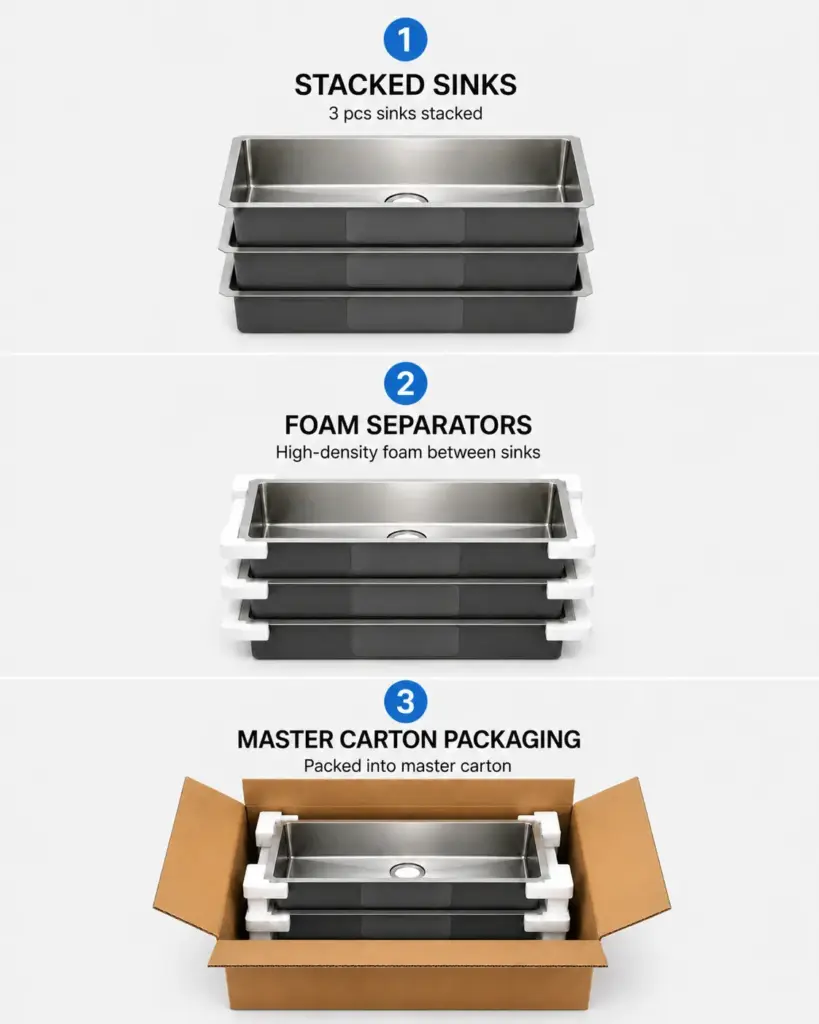
Compare:
1 pc / carton
Each sink has its own protective system.
3 pcs / carton
The packing must also control:
- sink-to-sink contact
- stacking pressure
- internal movement
A multi-piece carton can be efficient for wholesale programs, but the protection method needs to reflect the product structure.
15. Shipping Damage Can Be Misdiagnosed as Factory Quality
Suppose a customer reports:
one raised corner.
Possible causes include:
- welding distortion
- forming issue
- packing compression
- transit impact
- installer damage
Before deciding, compare:
- factory inspection photo
- carton condition
- packing configuration
- adjacent units
- batch pattern
A single damaged unit does not automatically prove a production-process problem.
How to Diagnose Transit Damage
Step 1 — Photograph the Carton Before Opening
Record:
- crushed corners
- holes
- water exposure
- straps
- pallet condition
Step 2 — Record Product Position
Check whether the sink moved inside the carton.
Step 3 — Inspect the Protection
Look at:
- foam
- edge protectors
- film
- accessory separation
Step 4 — Identify the Damage Pattern
For example:
- rim bend
- corner dent
- scratch
- apron dent
Step 5 — Compare With Undamaged Units
If the same defect appears across many intact cartons, production may deserve more attention.
If damage correlates strongly with crushed cartons, logistics becomes more likely.
Factory QC vs Packaging Validation
These are different activities.
Factory QC
Checks whether the product is correct before packing.
Examples:
- dimensions
- finish
- rim flatness
- accessories
Packing Inspection
Checks whether:
- packing matches the approved layout
- product is restrained
- vulnerable areas are protected
Transport Validation
Tests whether the packaging can survive the intended logistics conditions.
Do not treat all three as the same thing.
Packaging Validation Should Reflect the Actual Route
If the buyer requires formal packaging testing, the test method should be agreed before production.
Do not publish or apply a random drop-test height simply because it appears online.
The correct validation can depend on:
- product weight
- carton size
- carrier requirement
- destination market
- distribution route
The acceptance basis should follow the buyer’s logistics program.
What Buyers Should Define in the RFQ
At minimum, communicate:
- pcs per carton
- target distribution channel
- parcel / pallet / container
- private-label carton requirement
- visible finish sensitivity
- accessory configuration
- pallet requirement where relevant
The Kitchen Sink RFQ Checklist helps define product and packaging requirements before quotation.
Packing Specification Example
| Item | Requirement |
|---|---|
| Product | Workstation Sink |
| Finish | Gunmetal |
| Pcs / Carton | 1 |
| Surface Protection | Required |
| Rim Protection | Required |
| Grid | Separated |
| Drain | Individual box |
| Cutting Board | Isolated from metal |
| Movement | Product restrained |
| Carton | Approved structure |
| Distribution | Parcel / warehouse / container defined |
This is much clearer than:
Good export packaging.
Packaging Should Be Approved With the Golden Sample
For private-label programs, sample approval should include more than the sink.
Approve:
- sink
- accessories
- labels
- carton
- internal packing layout
Matrix’s Private Label Product Programs treats packaging as part of the delivered SKU because product quality does not end when the sink leaves the production line.
Pre-Shipment Inspection Should Include Packing
Before loading, check:
- carton quantity
- pcs per carton
- accessory position
- foam
- labels
- shipping marks
- pallet
- visible carton condition
See the Kitchen Sink Pre-Shipment Inspection Checklist for the broader PSI structure.
Buyer Takeaway
A sink passing factory QC proves:
the product was acceptable before shipment.
It does not prove:
the packaging is suitable for the distribution route.
For transport-sensitive programs, control:
Product Geometry → Internal Restraint → Rim Protection → Accessory Separation → Carton → Distribution Route
The better packaging question is not:
“Is the carton strong enough?”
It is:
“What actually happens to this carton between the factory and the final customer?”
Frequently Asked Questions
Why do sinks arrive damaged even after passing factory QC?
Because factory inspection verifies the product before shipping, while parcel handling can introduce drop, impact, vibration and orientation risks.
What part of a kitchen sink is most vulnerable during shipping?
Rims, corners, apron fronts and decorative surfaces often need particular protection.
Can accessories scratch the sink during transport?
Yes. Loose metal accessories can rub or impact the sink surface during vibration and handling.
Is thicker foam always better?
No. Foam location, structural support and product restraint matter as much as thickness.
Should parcel packaging differ from container packaging?
Often yes. Parcel shipments can involve more individual drops and orientation changes.
Should packaging be approved during sample development?
For OEM and private-label programs, yes. Packing layout should be part of the approved complete SKU.
Can transport damage look like a manufacturing defect?
Yes. Rim deformation, dents and scratches should be investigated using both factory and shipping evidence.
Reviewing Sink Packaging for an Import Program?
Send the sink size, weight, accessory configuration and distribution route together with the RFQ.
Matrix can review whether the proposed packing should be designed mainly for pallet/container distribution or for higher-risk individual parcel handling.