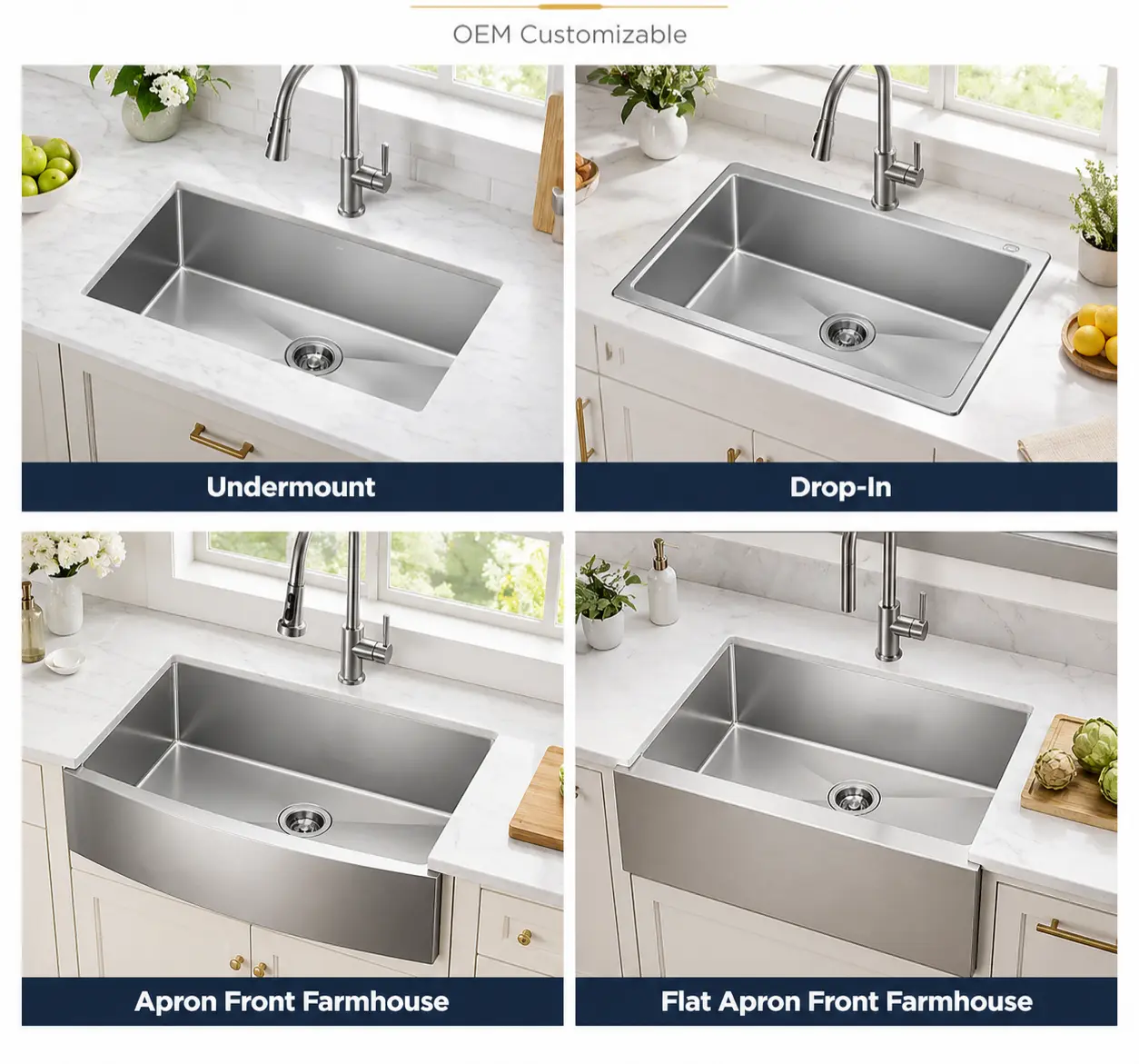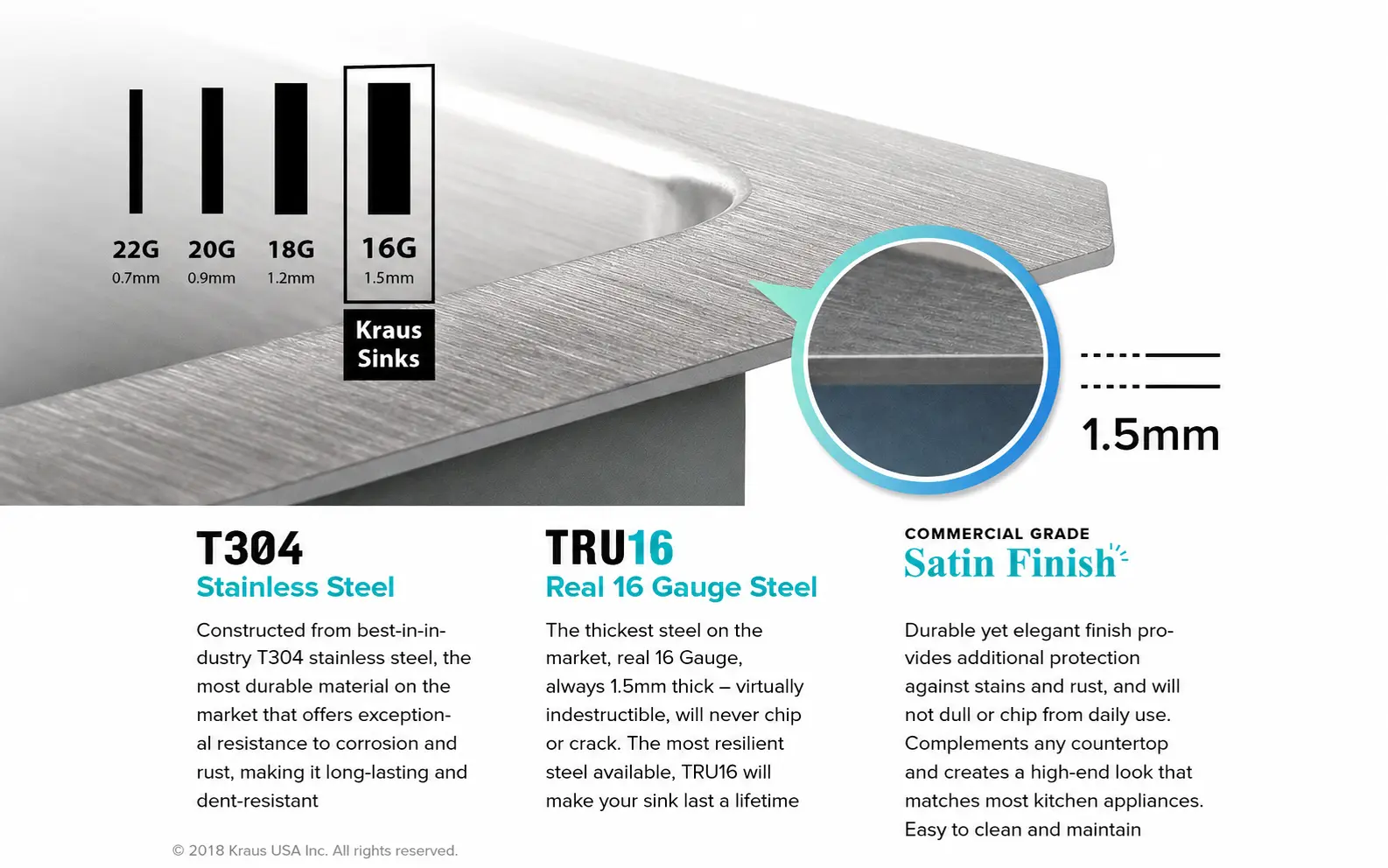

Honeycomb and nano kitchen sinks are often sold as if they were the same technology. They are not.
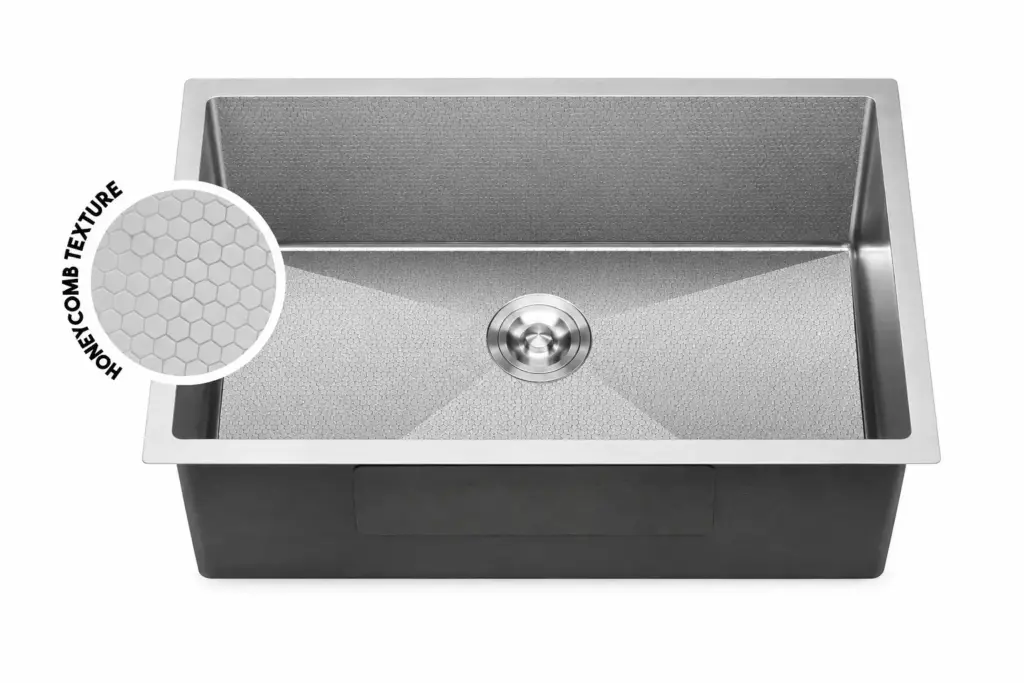
A honeycomb sink usually has a visible hexagonal or geometric texture embossed into part of the stainless steel surface.
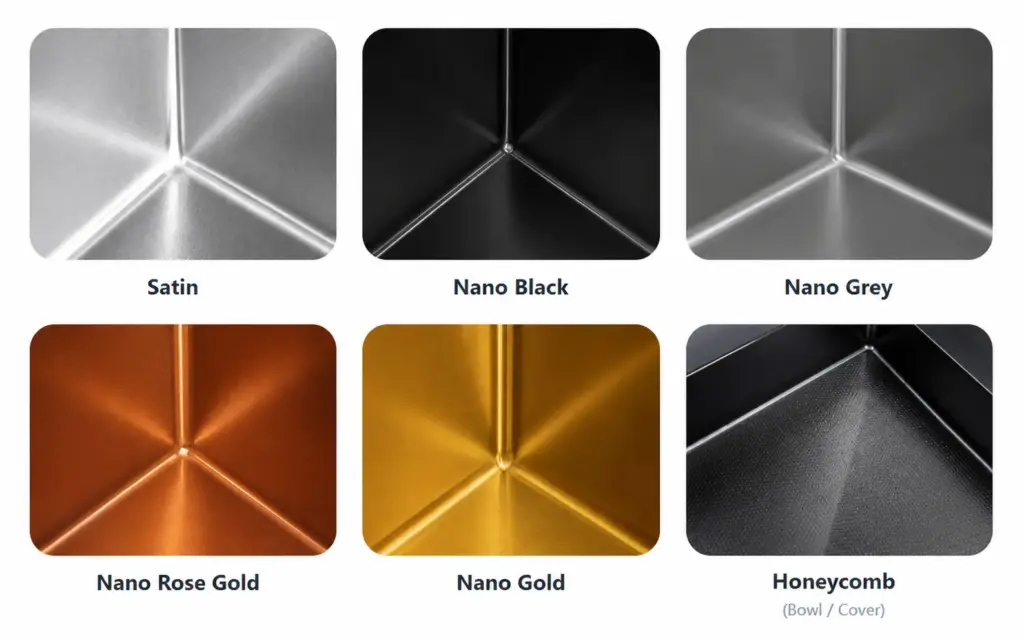
A nano sink usually refers to a stainless steel sink with an added surface treatment or coating. However, “nano” is a broad marketing term and does not identify one universal material or manufacturing process.
A sink can be:
- Honeycomb without a nano coating
- Nano-coated with a smooth surface
- Both honeycomb-textured and nano-coated
- Standard brushed stainless steel with neither feature
The important question is not whether the product says “honeycomb nano.” It is what the actual surface structure is, what finish process was used and how the sink should be maintained.
The short answer
| Sink type | What it usually means | Main advantage | Main trade-off |
|---|---|---|---|
| Honeycomb sink | Embossed or textured stainless steel surface | Can make fine wear and contact marks less visually obvious | Texture may require more detailed cleaning |
| Nano-coated sink | Stainless steel with an added surface treatment or coating | May improve water beading, fingerprint resistance or cleaning behavior, depending on the actual finish | Performance and durability vary by coating process |
| Honeycomb + nano sink | Textured steel combined with a surface coating | Strong visual differentiation and potential maintenance benefits | More variables to inspect and more finish-sensitive care |
| Brushed stainless steel sink | Mechanically brushed stainless steel without a decorative coating | Predictable appearance, broad acceptance and easier finish matching | Fine scratches and water marks still develop with use |
None of these surfaces is automatically scratch-proof, rust-proof, antibacterial or maintenance-free.
Counterintuitive truth #1: honeycomb and nano describe different things
Honeycomb describes the physical texture of the surface.
Nano generally describes a surface treatment or coating claim.
The honeycomb pattern can remain visible even if no special coating is present. A nano-coated sink can be completely smooth without any honeycomb pattern.
When sellers combine the terms, they are usually describing two features on the same product—not one single material.
What is a honeycomb kitchen sink?
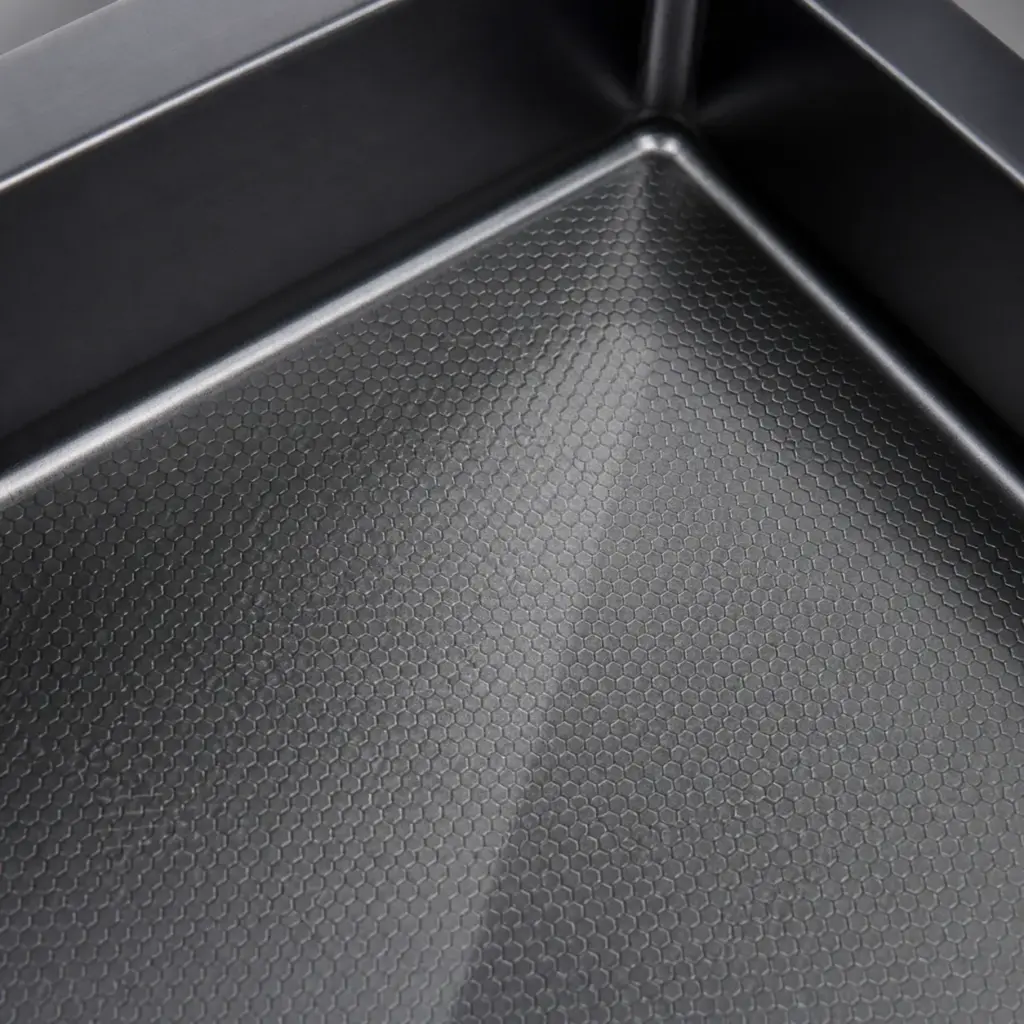
A honeycomb kitchen sink uses a repeated hexagonal or geometric pattern on the bowl surface. The texture may cover:
- Only the bowl bottom
- The bottom and lower sidewalls
- Most of the visible bowl
- A removable cover or working panel
- Selected sections of a workstation sink
The pattern is commonly created by pressing, embossing or forming the stainless steel surface.
The exact appearance varies. Some patterns are shallow and subtle, while others are deep and highly visible.
What are the real benefits of a honeycomb surface?
1. It can make fine scratches less noticeable
A textured pattern breaks up reflected light. This can make some fine contact marks less obvious than they would appear on a smooth, highly reflective surface.
That is different from preventing scratches.
Sharp tools, heavy cookware and abrasive cleaners can still mark the steel or any coating applied over it.
2. It creates a differentiated appearance
Honeycomb texture gives the sink a more technical or modern look. It is often used in workstation, multifunctional and dark-colored sink programs.
For a homeowner, this is mainly a design preference. For a brand or distributor, it can help distinguish a premium product line from standard brushed sinks.
3. It changes how contact marks appear
Cookware touches the raised texture differently from a completely smooth bowl. Depending on the pattern, this may reduce the visual concentration of sliding marks in some areas.
It does not eliminate wear, and the pattern itself should not be advertised as proof of greater surface hardness.
4. It can help hide part of the normal aging process
Standard stainless steel develops a visual patina through fine scratches and use. A honeycomb pattern can make that aging look less uniform and therefore less obvious.
Whether this is attractive depends on the user’s expectations.
What are the disadvantages of honeycomb sinks?
More detailed cleaning
Deep or sharply defined texture can hold residue, grease or mineral deposits around the pattern.
A shallow, well-finished pattern may be easy to wipe. A deep or rough pattern may require more attention than smooth brushed steel.
Harder to refinish uniformly
If a plain brushed sink develops a visible mark, the grain direction is usually easy to understand. A textured surface can be more difficult to restore without changing the pattern or finish.
Quality varies with embossing control
Poorly controlled embossing can create:
- Inconsistent pattern depth
- Distorted hexagons
- Sharp texture peaks
- Visible tool marks
- Local bowl deformation
- Drainage problems
- Inconsistent appearance between batches
Texture can be mistaken for performance
A strong-looking pattern does not prove the sink has better steel, greater thickness or better drainage.
The base material and product construction still need to be checked.
What is a nano kitchen sink?

“Nano kitchen sink” is not one standardized product definition.
In the market, the term may refer to:
- A clear surface treatment
- A hydrophobic or water-repellent finish
- An anti-fingerprint layer
- A dark or colored coating
- A coating combined with PVD or another finish process
- A general marketing name for a smoother, easier-cleaning surface
Because the term is broad, two products called “nano sinks” may use different materials, processes and care instructions.
Do not assume “nano” automatically means PVD. Do not assume every black stainless steel sink uses the same coating.
Matrix explains the differences between several finish directions on its PVD and colored stainless steel sink page.
What can a nano surface realistically do?
Depending on the actual finish, a nano-treated surface may offer:
- Improved water beading
- Reduced fingerprint visibility
- Easier removal of some oil or food residue
- A smoother or more uniform visual finish
- Added black, grey or metallic color
- Different scratch visibility from standard brushed steel
These are potential characteristics, not universal guarantees.
The finish needs to be evaluated by the actual sample, care instructions and agreed performance expectations.
What a nano coating does not automatically prove
The word “nano” alone does not prove:
- Permanent scratch resistance
- Antibacterial performance
- Resistance to every chemical
- Permanent water repellency
- Higher stainless steel grade
- Thicker steel
- Better drainage
- Lifetime color stability
- Maintenance-free use
If a supplier or seller makes a specific performance claim, ask how that claim was evaluated and what care conditions apply.
Counterintuitive truth #2: water beading is not a durability test
A new coated surface may make water form visible droplets. This can demonstrate current surface behavior, but it does not show how the finish will perform after months or years of:
- Cleaning
- Cookware contact
- Food acids
- Salt exposure
- Mineral deposits
- Abrasive particles
- Temperature changes
Water beading can be useful, but it should not be treated as complete proof of coating durability.
Honeycomb vs nano vs brushed stainless steel
| Feature | Honeycomb textured | Nano-coated | Standard brushed |
| Surface appearance | Visible hexagonal or geometric pattern | Smooth or textured depending on product | Linear brushed grain |
| Main purpose | Texture, differentiation and scratch masking | Surface behavior, color or easier cleaning depending on finish | Practical everyday appearance |
| Scratch-proof | No | No | No |
| Cleaning | Depends on texture depth | Depends on coating and care instructions | Generally straightforward |
| Repair or refinishing | More difficult around texture | Coating-specific and often difficult | Usually more predictable |
| Color options | Stainless, black, grey or other finishes | Often used for black, grey and colored directions | Mostly natural stainless appearance |
| Quality depends on | Embossing, base steel, finish and drainage | Surface preparation, coating process and care | Steel, brushing, forming and finish consistency |
| Best for | Design-led or differentiated sink programs | Buyers wanting a specific finish behavior or color | Broad residential and practical kitchen use |
Is a honeycomb nano sink better than a normal stainless steel sink?
Not automatically.
A honeycomb nano sink may be the better choice if you want:
- A textured modern appearance
- Black or grey surface options
- Less obvious fine wear
- A premium workstation-style product
- Stronger visual differentiation
A standard brushed sink may be the better choice if you want:
- A simple, familiar appearance
- Predictable cleaning
- Easier matching with common appliances
- Fewer coating-related care concerns
- A more established finish for long-term use
The right choice depends on whether you value visual differentiation enough to accept more finish-specific maintenance.
Choose the base stainless steel before choosing the surface
Honeycomb and nano do not replace the underlying stainless steel specification.
Check:
- Stainless steel grade
- Material thickness
- Handmade or pressed construction
- Bowl depth
- Rim flatness
- Drain position
- Sound pads and undercoating
- Installation type
- Accessory fit
For most household kitchen sinks, SUS304 is a practical material starting point. A surface coating does not convert lower-corrosion-margin steel into a different stainless steel grade.
Read the Matrix guide to 201 vs 304 vs 316 stainless steel sinks for a complete material comparison.
Gauge still matters—but not in the way marketing suggests
A honeycomb pattern can make a sink look heavier or more technical, but the pattern does not tell you whether the sink is 16 or 18 gauge.
Likewise, a nano coating is extremely different from the thickness of the steel underneath it.
For most homes, 18 gauge can provide a practical balance of durability, weight and cost. A 16-gauge sink can feel more substantial and may suit large or premium workstation designs.
The complete structure should be reviewed in the Matrix 16 gauge vs 18 gauge sink guide.
Does honeycomb texture improve drainage?
Not by itself.
Drainage depends on:
- Bowl-bottom geometry
- Overall slope
- Drain depression
- Drain position
- Local high and low areas
- Whether the installed sink is level
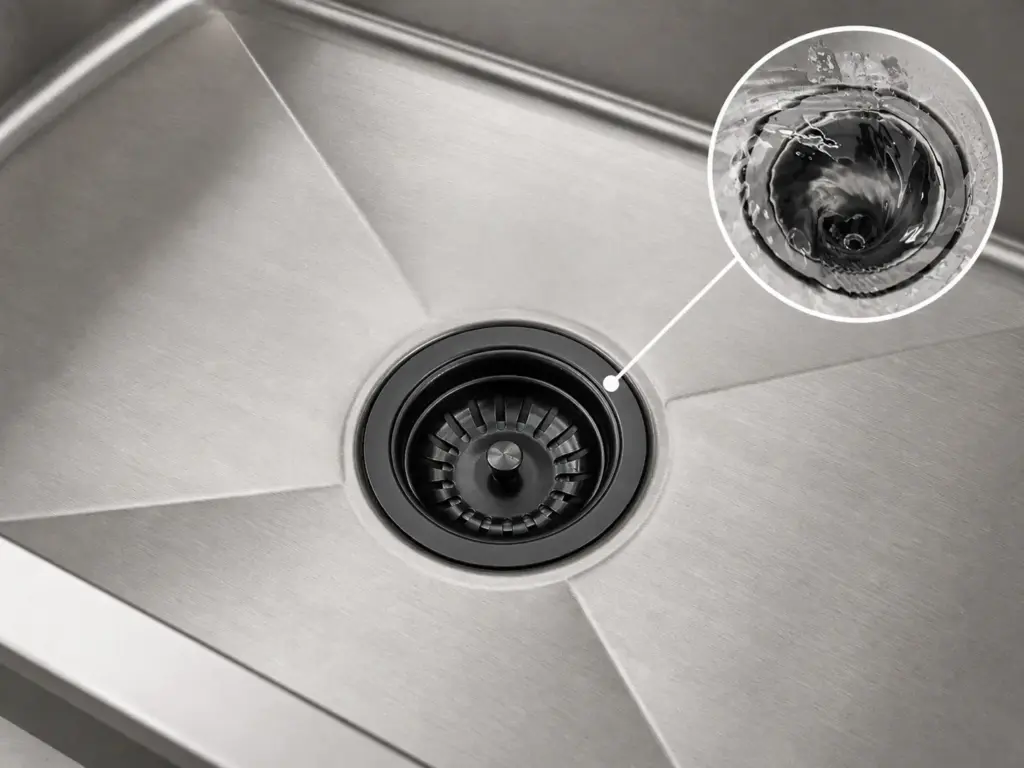
A honeycomb pattern can exist on a bowl that still retains water. Inspect actual water flow rather than assuming the texture controls drainage.
The pattern should also be reviewed around the drain area. Deep embossing or poor forming should not distort the sealing surface.
Are honeycomb and nano sinks easier to clean?
The answer depends on the exact surface.
A nano-treated smooth surface may be easier to wipe when:
- The coating is uniform
- Residue does not bond strongly to the surface
- The recommended cleaning method is followed
- The coating remains in good condition
A honeycomb surface may be easy to maintain when:
- The texture is shallow
- Pattern edges are smooth
- Drainage is controlled
- Residue is rinsed before it dries
Cleaning may be harder when:
- The texture is deep or rough
- Hard-water deposits collect around the pattern
- Oil or food residue dries in recessed areas
- Abrasive tools damage the coating
- The user expects the surface to clean itself
“Easy-clean” should mean easier routine maintenance—not no cleaning.
How to clean a honeycomb or nano kitchen sink
Follow the care instructions provided for the specific finish. A safe general routine is:
- Rinse away food particles and salt residue.
- Wash with mild dish soap and warm water.
- Use a soft cloth or non-abrasive sponge.
- Clean along the pattern without forcing abrasive material into the texture.
- Rinse thoroughly.
- Dry with a soft cloth to reduce water spots.
Avoid using these unless the finish instructions specifically allow them:
- Steel wool
- Wire brushes
- Aggressive abrasive powders
- Harsh chlorine-based cleaners
- Strong acids or alkalis
- Sharp tools for removing dried residue
Do not leave salty water, metal cans, wet cast-iron cookware or harsh cleaning products sitting in the bowl for long periods.
How to inspect a honeycomb surface
Under consistent lighting, check:
- Pattern alignment
- Embossing depth
- Consistent hexagon shape
- Sharp or rough peaks
- Missing or blurred pattern areas
- Cracks from forming
- Local distortion
- Water retained around embossed sections
- Transition between textured and smooth areas
- Drain-hole flatness
- Pattern consistency across the batch
Run a soft cloth over the surface. It should not catch on sharp texture points or unfinished edges.
How to inspect a nano or colored coating
Check:
- Uniform color
- Gloss or matte consistency
- Complete coverage
- Edge and corner coverage
- Pinholes, bubbles or peeling
- Discoloration around welded or formed areas
- Water-mark visibility
- Contact marks from accessories
- Finish match between sink, drain and faucet
- Consistency with the approved sample
The full stainless steel sink quality inspection checklist can be used to review dimensions, finish, drainage, accessories and packaging together.
What B2B buyers should ask before ordering

For an importer, distributor or private-label brand, “honeycomb nano sink” is not a complete specification.
Ask:
- Where is the honeycomb pattern applied?
- Is the pattern embossed, pressed or created another way?
- What is the base stainless steel grade?
- What is the nominal and finished thickness?
- What does “nano” mean for this specific model?
- Is the surface clear, black, grey or another color?
- Is the finish PVD, another coating direction or a combined process?
- What care instructions apply?
- Which performance claims can be supported?
- How is color and texture approved for repeat orders?
- Do drains, grids and accessories match the finish?
- How is the visible surface protected during shipping?
If these questions cannot be answered, the product name is stronger than the product specification.
Sample approval checklist
Before approving a sample, review:
- Overall sink dimensions
- Bowl size and depth
- Base material and gauge
- Texture location and pattern direction
- Pattern depth and consistency
- Finish type and color
- Visible scratch expectation
- Water flow and pooling
- Rim flatness
- Drain and faucet-hole fit
- Workstation ledge and accessory fit
- Sound pads and undercoating
- Cleaning instructions
- Packaging protection
- Label and finish name
Keep the approved physical sample or finish reference for repeat-order comparison. Screen images cannot accurately show metallic tone, texture depth or gloss level.
Packaging matters more for textured and coated sinks
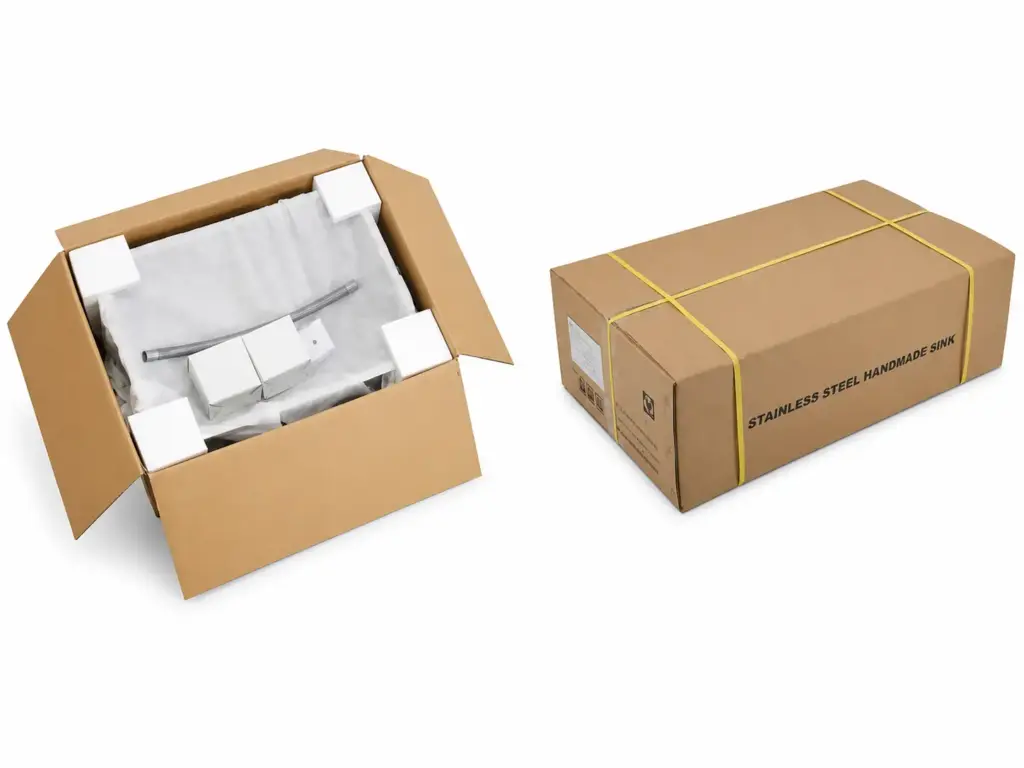
Honeycomb and nano surfaces can be damaged when accessories move against the bowl during shipping.
Packaging should include appropriate:
- Surface protection
- Rim and corner protection
- Accessory separation
- Soft barriers around drains and grids
- Protection for workstation ledges
- Model and finish identification
- Care instructions
- Carton support for the shipping method
A bottom grid should not rub directly against a black or coated bowl. Cutting boards, colanders and drain parts should be secured separately.
Common marketing claims to question
“100% scratch-proof”
No daily-use sink surface should be assumed to resist every sharp object, abrasive cleaner or heavy cookware impact.
“Permanent antibacterial surface”
Antibacterial performance is a specific claim. The word “nano” alone does not prove it.
“Self-cleaning”
Water beading or easier wiping does not remove the need for regular cleaning.
“Never rusts”
Coatings do not eliminate material selection, iron contamination, chloride exposure or care conditions.
“Honeycomb makes the steel harder”
The pattern changes the surface geometry and visual behavior. It should not be treated as proof of a specific hardness improvement without defined evidence.
“All black sinks are PVD”
Black stainless steel sinks can use different finish processes. The actual finish should be confirmed before the product is described or sold.
Which surface should you choose?
| Your priority | Suggested direction |
| Simple everyday maintenance | Brushed or satin stainless steel |
| Fine scratch masking | Shallow honeycomb or textured finish |
| Modern black appearance | Approved black or nano finish with clear care guidance |
| Premium workstation design | Honeycomb + selected finish with tested accessories |
| Easy future matching | Standard brushed stainless steel |
| Private-label differentiation | Honeycomb or colored finish with physical sample approval |
| Lowest finish-related risk | Uncoated brushed stainless steel |
The safest choice is not always the most technologically named surface. It is the surface whose construction, care and limitations are clearly understood.
Final recommendation
Choose a honeycomb sink if you like the textured appearance and want fine daily wear to appear less obvious.
Choose a nano-treated sink if the actual finish offers a surface behavior or color you value—and the manufacturer can clearly explain the process, care and limitations.
Choose a honeycomb nano sink only after checking both systems separately:
- Is the texture well formed and easy to clean?
- Is the coating uniform and realistically described?
- Does the sink drain properly?
- Is the base stainless steel suitable?
- Are accessories and packaging designed for the surface?
Do not choose by the “nano” label alone. A well-made brushed SUS304 sink can still be a better long-term product than a poorly specified honeycomb nano sink.
How Matrix approaches honeycomb and nano sink programs

Matrix Manufacture Co., Ltd. manufactures stainless steel kitchen sinks for brands, importers, wholesalers, distributors and project buyers.
Matrix can review selected honeycomb and colored stainless steel sink directions based on the sink model, base material, gauge, surface sample, installation type, drain, accessories, packaging and target market.
For colored or nano black programs, finish naming should follow the confirmed process and approved physical sample. For honeycomb programs, pattern consistency, drainage, cleaning access, accessory contact and packaging protection should be reviewed before bulk production.
Buyers can explore Matrix PVD and colored stainless steel sinks, black kitchen sinks and workstation kitchen sinks.
Discuss a Honeycomb or Nano Sink Program
Frequently asked questions
What is a honeycomb kitchen sink?
A honeycomb kitchen sink has a visible hexagonal or geometric texture embossed into part of the stainless steel surface. The pattern mainly changes appearance, contact behavior and scratch visibility.
What is a nano kitchen sink?
A nano kitchen sink generally refers to a stainless steel sink with an added surface treatment or coating. The term is broad, so the actual finish process, color, performance and care instructions should be confirmed.
Are honeycomb and nano sinks the same?
No. Honeycomb describes a physical surface texture. Nano generally describes a surface treatment or coating. One sink may include either feature or both.
Are honeycomb sinks scratch-proof?
No. The pattern may make some fine scratches less visible, but sharp objects, cookware and abrasive cleaning can still mark the surface.
Are nano sinks scratch-proof?
No. A nano-treated surface may change scratch behavior or improve resistance to light marks, depending on the coating, but it cannot be assumed to resist all scratching.
Are honeycomb sinks difficult to clean?
It depends on the pattern depth and finish quality. A shallow, smooth texture can be manageable, while deep or rough embossing may hold more residue and mineral deposits.
Is nano coating the same as PVD?
Not necessarily. “Nano” is a broad market term, while PVD describes a specific finish process. Buyers should confirm the actual process instead of treating the names as interchangeable.
Do nano sinks prevent water spots?
Some finishes may improve water beading or make spots easier to remove, but hard-water deposits can still form. Regular rinsing and drying are still useful.
Is a honeycomb nano sink better than brushed stainless steel?
It offers stronger visual differentiation and may make some wear less noticeable, but brushed stainless steel provides a simpler and more predictable finish. The better choice depends on appearance, care expectations and product quality.
What should buyers inspect before ordering honeycomb nano sinks?
Check the base steel, thickness, texture consistency, finish process, color, drainage, rim flatness, drain fit, accessory contact, care instructions, packaging and repeat-order sample control.