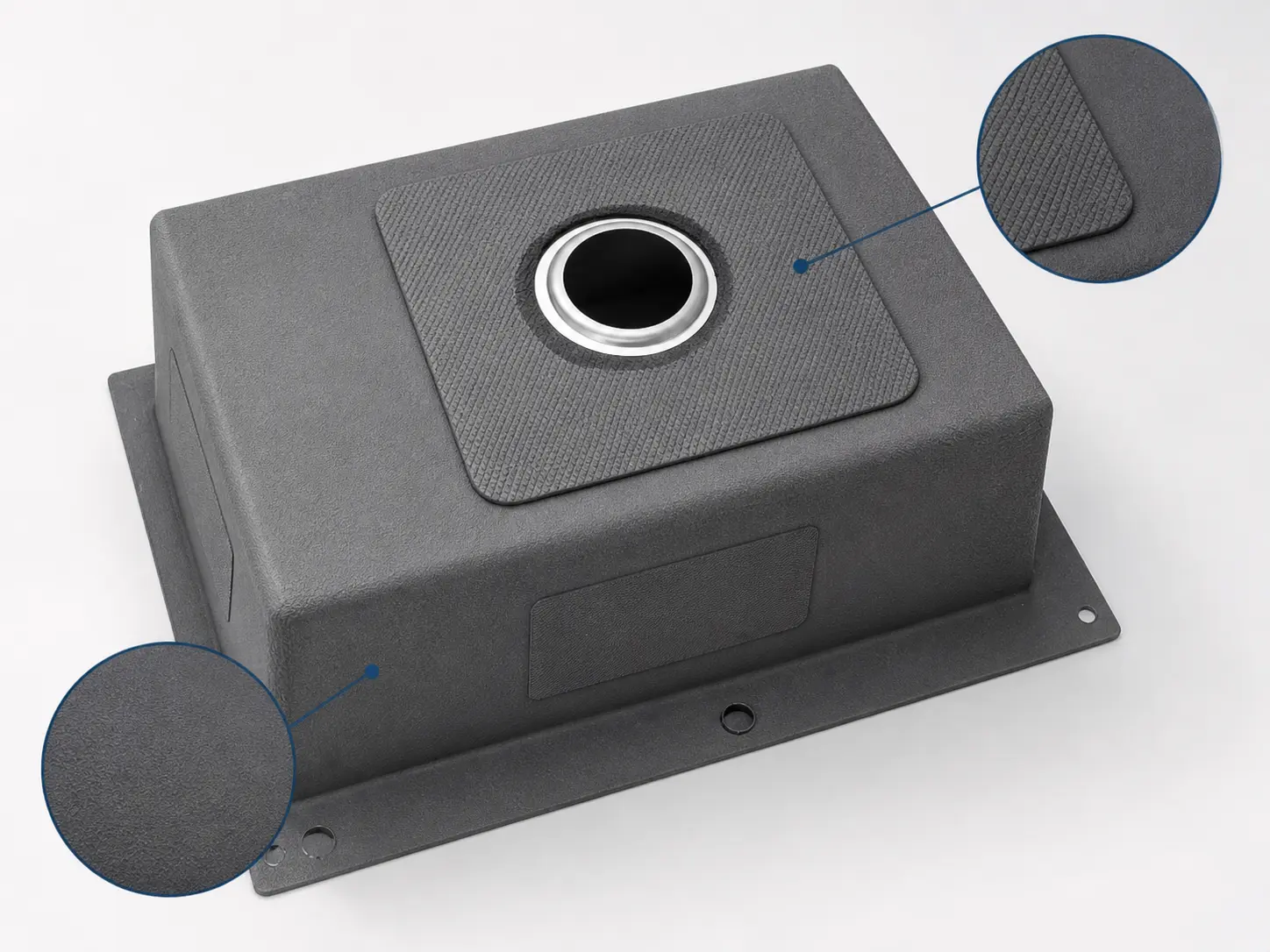
Sink soundproofing pads and undercoating are not the same thing, and neither makes a stainless steel sink completely soundproof.
Sound-dampening pads provide the most direct control of bowl vibration and metallic ringing. Undercoating may add secondary damping, but its performance depends on the formulation. An anti-condensation coating is primarily intended to slow heat transfer and reduce condensation risk.
A well-designed hybrid system—pads on the main vibrating panels plus a compatible, fully cured undercoating—is a strong general solution. Steel thickness, formed geometry, bowl size, faucet stream, installation, plumbing and garbage disposal vibration still affect the result.
For buyers, the important questions are not simply whether pads and coating are present. Their purpose, material, placement, adhesion, coverage, curing and repeatability determine whether they provide real value.
The short answer
- Best for reducing metallic ringing: dense, firmly bonded sound-dampening pads placed on the main vibrating panels.
- Best for helping control condensation: a properly specified anti-condensation undercoating.
- Best overall system: appropriate steel and bowl geometry, strategic pads, compatible undercoating and stable installation.
- Most misleading claim: “fully soundproof,” because pads and coating cannot eliminate faucet impact, rattling accessories, plumbing noise or disposal motor noise.
- Most important B2B check: compare the approved pad layout and cured coating against production; do not accept “soundproofing included” as the complete specification.
Soundproofing, sound dampening and sound absorption are not the same
“Sink soundproofing” is the phrase consumers commonly search, but sound dampening or vibration damping is more technically accurate.
- Soundproofing normally implies blocking sound from passing between spaces. A sink treatment does not create that kind of enclosure.
- Vibration damping reduces how strongly and how long the steel bowl vibrates after impact.
- Sound absorption reduces reflected airborne sound, usually through porous or fibrous materials. Dense sink pads mainly damp the metal panel rather than absorb room sound.
- Vibration isolation interrupts a transmission path between components. Pads bonded directly to the bowl do not fully isolate a disposal or pipe from the sink.
This article retains the keyword “soundproofing” for search clarity, but the engineering objective is controlled vibration and lower perceived noise.
Sound pads vs undercoating at a glance
| Feature | Sound-dampening pads | Sink undercoating |
|---|---|---|
| Typical form | Dense flexible sheets or patches bonded to the sink exterior | Sprayed or applied layer covering selected exterior areas |
| Primary role | Reduce panel vibration, ringing and impact resonance | Depends on formulation: secondary damping, thermal insulation, condensation control or a combination |
| Common location | Bottom and selected sidewalls | Exterior bowl surfaces, around or over pad areas depending on the specification |
| Main quality risks | Small size, poor placement, weak adhesion, trapped air or peeling | Uneven coverage, incomplete curing, cracking, rub-off, overspray or odor |
| Can it make a sink silent? | No | No |
| What should buyers confirm? | Material, thickness, size, quantity, location, adhesive and contact | Intended function, formulation or approved sample, coverage, application sequence, cured condition and consistency |
Are sink soundproofing pads worth it?

Yes, especially on stainless steel sinks with broad bottom or sidewall panels.
Pads can shorten the ringing response when water, cookware or cutlery excites the steel. Their value is usually most noticeable when the pad is dense enough, bonded across its full surface and positioned on a panel that would otherwise resonate.
They are less effective when they are installed as small decorative patches, attached over oil or dust, or placed only where they are easy to photograph.
Which is better: sound pads or undercoating?
For direct vibration control, sound pads are usually the more important component. For condensation control, a suitable anti-condensation undercoating is more relevant.
Neither is universally better because they solve overlapping but different problems. A spray formulated mainly for acoustic damping should not automatically be treated as an anti-condensation layer, and a thermal anti-condensation coating should not be assumed to provide the same damping as a dense pad.
For a mainstream stainless steel kitchen sink, a tested hybrid system is normally the strongest specification.
Why stainless steel sinks make noise
Stainless steel is strong and practical, but a sink bowl is also a relatively large metal structure. When water, dishes or a garbage disposal apply energy to the bowl, the steel vibrates and radiates sound into the air. Some vibration also travels through the drain, rim, countertop, clips, pipes and cabinet.
Common noise sources include:
- water striking the bowl floor;
- cookware or cutlery contacting the steel;
- large flat panels ringing after impact;
- garbage disposal vibration passing through the drain flange;
- loose mounting hardware or sink supports;
- drain pipes touching the cabinet;
- a high faucet stream striking a grid, drain or steep sidewall.
Sound pads and undercoating mainly address vibration in the sink body. They cannot independently correct loose plumbing, an unstable installation or a noisy disposal.
Panel size and stiffness matter
A broad, flat panel can respond differently from a smaller panel reinforced by bends, ribs, ledges or drain embossing. Sink geometry can therefore change sound even when material gauge and pad area are identical.
This is one reason a tap test between unrelated sink shapes is not a reliable test of pad quality alone.
Impact noise and transmitted vibration are different
Water and dishes create impact noise directly at the bowl. A garbage disposal or touching drain pipe can transmit vibration through connected structures.
Pads can damp the bowl response in both cases, but vibration transmitted into the cabinet may require better mounting, clearance or plumbing support rather than additional pad coverage.
How sink soundproofing pads work?

Sound-dampening pads are bonded to the exterior of the bowl, where they add mass and flexible damping to the stainless steel panel.
When the steel tries to vibrate, the pad absorbs part of that mechanical energy. This changes the sharp metallic ring into a shorter, duller response.
Pads are commonly made from rubber-like, EVA, butyl-based or other engineered damping materials. The material name alone does not determine performance. Density, thickness, flexibility, adhesive quality and placement all matter.
What sound pads can reduce
Well-applied pads can help reduce:
- ringing when water hits the sink;
- vibration from dishes and cookware;
- the hollow or “tinny” character of a large bowl;
- some vibration transferred by a garbage disposal;
- perceived noise from large bottom and sidewall panels.
What sound pads cannot fix
Pads cannot fully correct:
- a loose sink mount;
- pipes knocking against the cabinet;
- a disposal with excessive mechanical vibration;
- poor faucet and drain alignment;
- rattling bottom grids or accessories;
- noise transmitted through the countertop or cabinet structure.
Treat the pad as one part of the acoustic system, not as a universal repair.
What is sink undercoating?
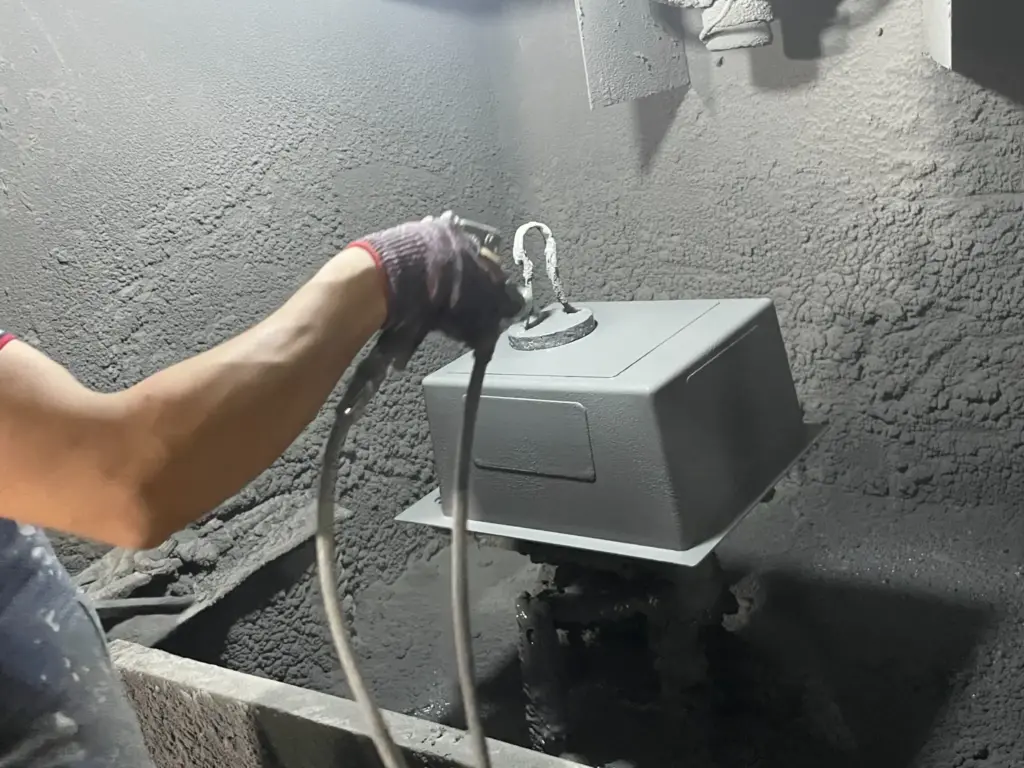
Undercoating is a functional layer applied to the outside of a stainless steel sink bowl. It is hidden inside the cabinet after installation.
Depending on the product specification, it may be a latex-based, rubberized or other formulated coating. Different products sold as undercoating may be designed for different priorities. Their functions can include:
- adding a secondary damping layer to the exterior panel;
- providing thermal insulation;
- helping reduce condensation on the cold exterior of the bowl;
- giving the underside a more uniform protected appearance.
Undercoating should not be confused with the visible finish inside the sink. A brushed or satin bowl surface is the working stainless steel finish. The undercoating is applied to the non-visible exterior.
Not all sink undercoatings are equivalent
The term “undercoating” describes where the material is applied, not a universal chemical formula or guaranteed performance level.
One coating may be developed mainly for acoustic damping. Another may prioritize thermal insulation and condensation control. A third may be a hybrid. Color and apparent thickness do not reveal which function has been validated.
Before approving a product claim, buyers should confirm:
- intended function;
- approved material or reference sample;
- application area;
- cured thickness, applied weight or other control method;
- adhesion and flex behavior;
- condensation or acoustic test method where claimed.
How anti-condensation undercoating works
Condensation can form when the outside of a sink becomes colder than the dew point of the surrounding cabinet air.
This may happen when:
- very cold water or ice sits in the bowl;
- the kitchen or cabinet air is warm and humid;
- airflow inside the cabinet is limited;
- the steel exterior cools quickly;
- moisture is already present from a small leak or damp environment.
A properly specified anti-condensation undercoating slows heat transfer and separates part of the cold steel surface from humid air. This can reduce the likelihood or amount of visible condensation.
It cannot guarantee a completely dry cabinet in every condition. High humidity, leaks, uninsulated plumbing and prolonged cold-water exposure can still create moisture.
The correct claim is that undercoating helps reduce condensation—not that it permanently eliminates every source of cabinet moisture.
Counterintuitive truth: more pad coverage does not automatically mean better sound control
A large pad photographed on the underside can look impressive, but performance depends on where the steel actually vibrates.
The most effective locations are often the broad, relatively flat panels on the bowl bottom and sidewalls. A smaller pad placed near a high-vibration area may contribute more than a larger pad installed on a stiff or poorly prepared surface.
Coverage percentage alone does not reveal:
- pad density;
- material damping behavior;
- adhesive strength;
- contact with the steel;
- placement relative to panel vibration;
- coating quality around the pad;
- sink geometry and steel thickness.
For B2B comparison, use a placement drawing and controlled sound test rather than choosing the sink with the largest visible patch.
Counterintuitive truth: a thick coating can still be poor-quality coating
An unusually thick undercoating may hide inconsistent application without providing reliable performance.
Possible problems include:
- a wet or uncured center;
- cracking during handling;
- soft material that rubs onto packaging;
- strong persistent odor;
- uneven weight and appearance;
- overspray on the rim, drain or mounting areas;
- trapped contamination below the coating;
- poor adhesion to oily stainless steel.
The target should be a controlled, fully cured and repeatable layer—not the thickest layer possible.
If coating thickness or applied weight matters, define the measurement method in the purchase specification.
Do thicker stainless steel sinks still need sound pads?
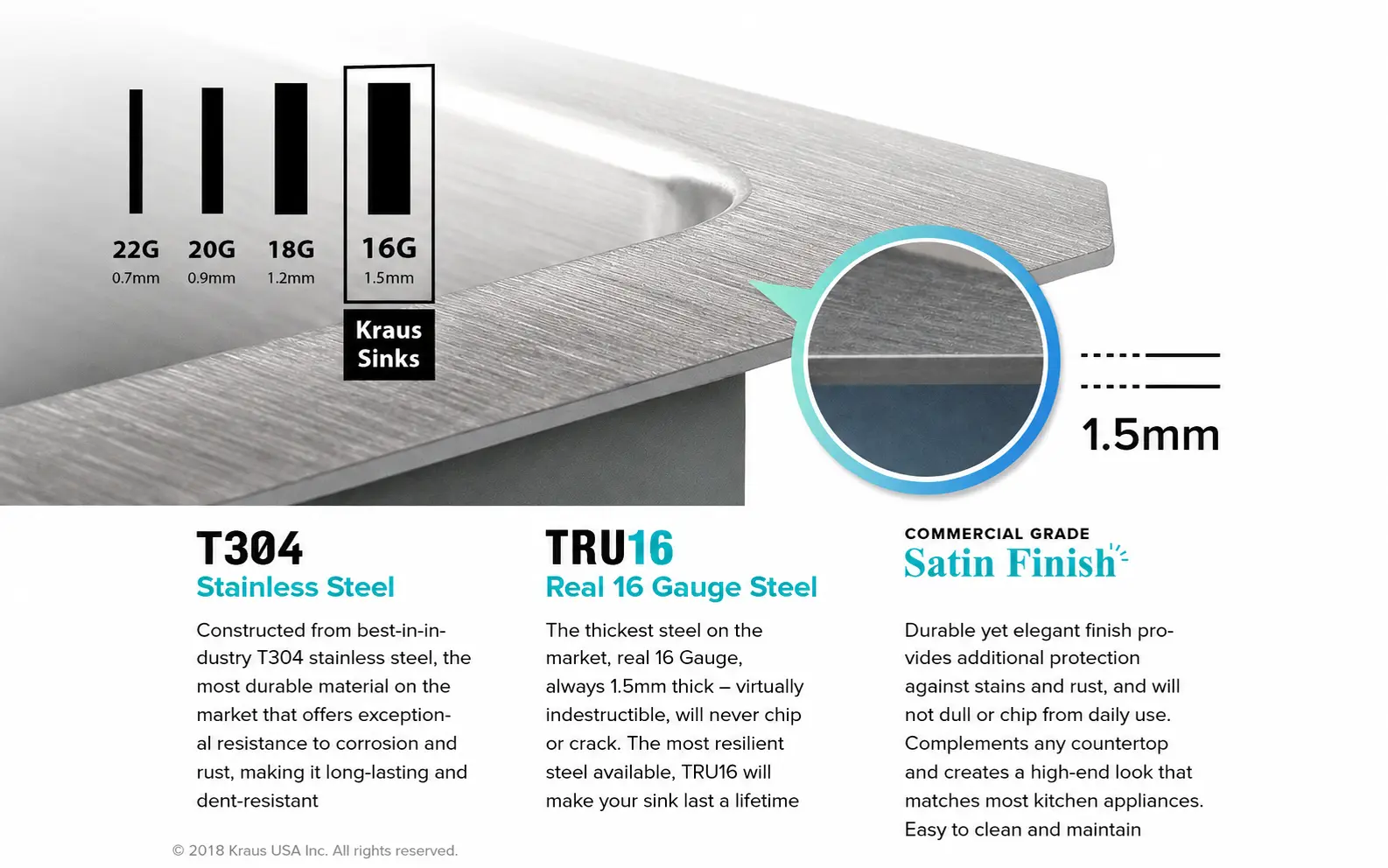
Thicker stainless steel generally has a more substantial acoustic response than very light steel, but thickness does not remove the value of damping.
A large 16-gauge bowl can still vibrate when water strikes a broad flat panel. An 18-gauge sink with well-positioned pads and stable installation may sound better than a poorly installed thicker sink with weak damping.
Steel thickness, bowl geometry and acoustic treatment should be evaluated together.
Matrix explains why thickness is only one quality variable in its 16 gauge vs 18 gauge sink guide. Its 16 gauge stainless steel sink overview also identifies pad location, coating area and adhesion as separate inspection points.
Where should sink sound pads be placed?
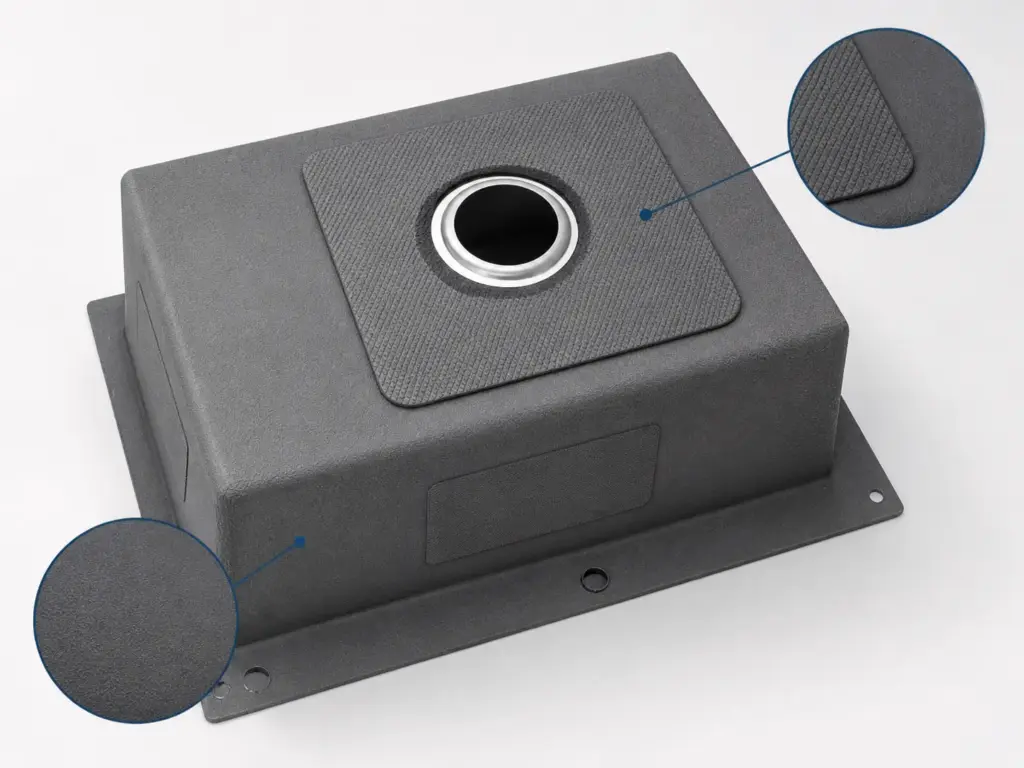
The correct layout depends on the panel size and stiffness, not a fixed pad count.
| Sink area | Why it may need damping | What to check |
| Bowl bottom | Receives direct impact from water, cookware and dishes | Treat the broad panel without interfering with the drain emboss or disposal mount |
| Front and rear walls | Deep or wide walls can produce a hollow response | Place pads on the main flexible zones and keep edges fully bonded |
| Left and right walls | Large single bowls may contain additional resonant panels | Match treatment to bowl width, bends and ledges |
| Double-bowl compartments | Each bowl has its own panel behavior | Plan both bowls rather than copying a single-bowl layout |
| Drainboard or deck | Large flat decks can also vibrate | Specify deck treatment separately where noise control is required |
Full coverage vs strategic coverage
“Full soundproofing” is often a marketing phrase rather than an engineering definition.
It may mean:
- pads on the bottom and all four sidewalls;
- undercoating across most of the exterior;
- a combination of several pads and sprayed coating;
- simply more coverage than another model.
Strategic coverage can perform well when the pads are placed on the main vibrating panels. Broader coverage may provide additional damping and stronger premium presentation, but only when adhesion and material quality remain controlled.
For buyers, replace the phrase “full coverage” with measurable requirements:
- pad dimensions;
- quantity;
- material and thickness;
- exact locations;
- coating area;
- acceptance sample;
- sound-test method.
Sound pads, undercoating and garbage disposals
A garbage disposal attaches at the drain and introduces vibration directly into the sink structure.
Pads and undercoating can reduce some bowl resonance, but they do not isolate the disposal completely. Disposal noise also depends on:
- motor and grinding design;
- mounting flange and ring;
- sink thickness around the drain;
- drain position;
- plumbing support;
- contact between pipes and cabinet panels;
- sink mounting and countertop structure.
If the disposal or pipes touch the cabinet, vibration may bypass the bowl treatment and enter the cabinetry directly.
Check the Matrix guide to kitchen sink drain-hole sizes and garbage-disposal compatibility before assuming sound pads will solve a disposal-installation problem.
Does sink depth affect noise?

Depth changes the size of the sidewalls and the distance between the faucet and bowl floor.
A deeper sink may contain splashing better, but a longer water drop can create a stronger impact when the stream reaches bare steel, a bottom grid or cookware. Large deep sidewalls can also provide more panel area that may need damping.
This does not make deep sinks inherently noisy. It means faucet position, steel thickness, bowl geometry and pad placement should be developed together.
See the Matrix comparison of 8 vs 9 vs 10 inch sink depth for the other capacity, reach and cabinet-clearance tradeoffs.
Does sink installation affect sound?
Yes. A well-treated bowl can still rattle if the installation is unstable.
Undermount sinks
Check:
- continuous support and correct fixing;
- secure clips or brackets;
- appropriate sealant contact;
- no loose contact with the cabinet;
- plumbing clearance;
- countertop and reveal alignment.
Top-mount sinks
Check:
- rim contact with the countertop;
- clip tension and spacing;
- sealant beneath the rim;
- deck flatness;
- faucet-deck reinforcement;
- pipes or accessories that can vibrate against the cabinet.
Apron-front and large workstation sinks
These sinks require proper independent support. Their weight should not be carried by the drain plumbing, disposal or a small number of countertop clips.
The Matrix installation guides provide additional mounting references.
What homeowners should look for
Before buying a stainless steel sink, examine the underside or request a clear underside image.
Look for:
- pads on the broad bowl bottom;
- additional sidewall treatment on large or deep sinks;
- pads sitting flat without raised edges;
- undercoating that appears even and fully cured;
- clean drain and mounting areas;
- no visible cracks, bubbles or loose coating;
- no pad overlap that interferes with clips or accessories;
- consistent treatment between both bowls of a double sink.
Do not judge sound performance from one catalog phrase. Compare steel thickness, bowl size, pad layout and installation requirements together.
Simple ways to compare sink sound
A showroom tap test can provide a quick impression, but it is not a complete test.
For a more useful comparison:
- support both sinks in a similar way;
- use the same tap location and force;
- compare the bottom and each sidewall;
- run the same faucet flow from the same height;
- listen for initial impact and how long ringing continues;
- repeat with the bottom grid installed;
- compare the installed sink if possible.
An uninstalled sink held in the air may sound very different after it is secured to a countertop. The support condition must remain consistent.
For a formal B2B comparison, use a fixed test fixture, controlled water flow and sound measurement at a defined position.
Can soundproofing be added after installation?
Purpose-built damping pads or coatings can sometimes be added to an accessible sink underside, but factory application is usually easier to control.
Before adding material:
- turn off and protect nearby electrical equipment;
- make sure the steel is clean, dry and free of oil;
- check that the material is suitable for stainless steel and cabinet conditions;
- avoid covering drain hardware, disposal mounts, clips, labels and service points;
- confirm that added material will not contact hot components or moving parts;
- allow the product to cure as instructed.
Do not apply general construction foam or an unknown adhesive simply because it feels soft. Expansion, odor, adhesion, moisture behavior and future service access must be considered.
Common soundproofing defects
| Defect | Why it matters | Inspection focus |
| Pad edge lifting | Reduces bonded contact and can lead to further peeling | Check the full perimeter, especially curved walls and corners |
| Trapped air or folds | Creates unbonded areas and inconsistent damping | Look and press lightly where the agreed inspection method permits |
| Wrong pad size or location | Changes the tested panel treatment | Compare with the approved layout, not only the pad count |
| Wet or tacky coating | Can transfer to packaging and indicates incomplete curing | Confirm the cured condition before packing |
| Cracking, blistering or flaking | Shows weak adhesion or poor flexibility | Inspect after normal handling and agreed conditioning |
| Overspray | Can interfere with drain sealing, clips, rim bonding or appearance | Keep defined exclusion zones clean |
| Persistent strong odor | May indicate insufficient curing or a material inconsistency | Evaluate after the agreed cure and ventilation period |
| Batch inconsistency | Makes the approved sample unrepresentative | Compare pad and coating details across the inspection sample |
What B2B buyers should specify
“Soundproofing included” is not a complete sink specification.
| Specification item | Sound pads | Undercoating |
| Material | Material type or approved reference sample | Intended function, coating type or approved sample |
| Construction | Thickness, density or agreed pad construction | Cured thickness, applied weight or another agreed control method |
| Layout | Dimensions, shape, quantity and exact location per bowl | Required coverage zones and clean exclusion zones |
| Attachment | Adhesive, surface preparation and full-contact requirement | Surface preparation, adhesion and application sequence |
| Appearance | Permitted bubbles, folds and edge lift | Color if relevant; no cracks, blisters, rub-off or unacceptable overspray |
| Process | Sequence relative to coating | Cure time and condition before packing |
| Performance | Approved tap, impact or water-flow reference | Acoustic or condensation test where a performance claim is required |
| Batch control | Inspection quantity and layout comparison | Coverage, curing and defect sampling method |
The drawing or work instruction should show the locations visually. Written phrases such as “large pads” or “full coating” can be interpreted differently by different production teams.
How to inspect pads and undercoating before shipment
| Inspection area | Sound-pad check | Undercoating check |
| Specification | Correct pad count, size and position | Correct coverage and clean exclusion zones |
| Adhesion | Full contact; no lifted edges, folds or large bubbles | No cracking, blistering, flaking or rub-off |
| Condition | No contamination or packing damage | Fully cured and non-tacky |
| Interfaces | Clear of the drain, clips and service areas | No overspray on the rim, drain or mounting surfaces |
| Consistency | Matches the approved layout across samples | Similar appearance and coverage across the batch |
Press lightly along the pad perimeter where the agreed method permits. Do not perform an aggressive peel test on finished goods unless the test and sampling plan were defined before production.
If condensation performance is a product requirement, use a controlled test with an agreed water temperature, ambient temperature, humidity and observation time. A casual ice test without controlled conditions is difficult to repeat.
The Matrix stainless steel sink quality inspection checklist provides a broader framework for material, dimension, drainage, accessory and packaging control.
How to test acoustic performance for an OEM program
A repeatable comparison needs a defined method.
The test plan can specify:
- sink model and sample quantity;
- mounting or support fixture;
- room and background-noise conditions;
- faucet flow rate and drop height;
- water-impact location;
- tap tool, drop object or impact method;
- microphone position;
- measurement unit and recording duration;
- comparison sink or approved sample;
- pass/fail or reference criteria.
Test the pad-and-coating system together with the production sink. A loose material coupon does not represent how the completed bowl responds.
Useful outputs can include:
- peak sound level during a defined impact or water-flow event;
- decay time, showing how quickly metallic ringing falls after impact;
- tonal character or frequency content, which helps identify a persistent metal ring;
- repeatability across samples, showing whether production units behave like the approved sample.
A single phone recording or one hand tap is useful for screening, not for a defensible numerical marketing claim. If the test reports decibels, define the weighting, time response, microphone distance and background-noise limit.
Avoid publishing an exact noise-reduction percentage or decibel claim unless it is supported by a controlled test that matches the marketed configuration.
Recommended strategy for B2B sink programs
A practical acoustic specification should match the product channel.
Cost-controlled retail or project sinks
Use an effective, repeatable pad layout on the main vibrating panels. Confirm adhesion and avoid adding decorative coverage that does not improve the tested result.
Core residential sinks
Combine bottom and relevant sidewall pads with controlled undercoating. Position the system as part of overall sink quality rather than an isolated premium claim.
Premium, deep or workstation sinks
Evaluate broader sidewall coverage, thicker steel, large-panel vibration, disposal use and faucet impact together. Premium positioning should be supported by a controlled sample comparison and consistent production.
These are product-development directions, not fixed quality grades. A smaller well-engineered sink may need less treatment than a large deep bowl.
Final recommendation
Look for a complete acoustic system, not the largest pad or thickest coating.
A well-designed stainless steel sink should combine:
- appropriate steel thickness;
- strategically placed, firmly bonded sound pads;
- even and fully cured undercoating where specified;
- stable installation;
- compatible drain and disposal components;
- faucet alignment that limits harsh water impact;
- repeatable quality control.
Pads handle the main bowl vibration. A compatible undercoating can add secondary damping, insulation or condensation control according to its formulation. Installation determines whether those features can perform as intended.
Develop sound-controlled sink programs with Matrix

Matrix supports brands, wholesalers and project buyers with custom stainless steel kitchen sink programs, including steel thickness, bowl structure, sound-pad layout, undercoating, drain position, finish and accessory matching.
For a sound-control specification, provide:
- sink size, depth and bowl layout;
- handmade or pressed construction;
- steel grade and thickness;
- target pad material and layout;
- required undercoating area;
- disposal and installation requirements;
- target market and product position;
- reference sample or test method;
- packaging and private-label requirements;
- expected order quantity.
Contact Matrix to review a sink sample, sound-pad layout or repeatable production specification.
Frequently asked questions
Are sink soundproofing pads worth it?
Yes. Properly bonded pads on the main vibrating panels can noticeably reduce metallic ringing. Small decorative pads or poorly bonded pads provide less value.
Which is better: sink sound pads or undercoating?
Pads are generally more direct for vibration damping. A suitable undercoating is more relevant for condensation control and can add secondary damping. A tested hybrid system is a strong overall solution.
Is “soundproofing” the correct technical term?
It is the common search and marketing term. Vibration damping or sound deadening is more accurate because the treatment reduces bowl resonance rather than blocking all sound.
What do sink soundproofing pads do?
They reduce vibration and metallic ringing in the stainless steel bowl by adding flexible damping to the exterior panels.
What does sink undercoating do?
Its function depends on the formulation. It may provide secondary damping, thermal insulation, condensation control or a combination of these functions.
Are sound pads and undercoating the same?
No. Pads are bonded sheets or patches. Undercoating is an applied layer. They can be used separately or together, depending on the sink specification.
Does undercoating completely prevent condensation?
No. It can reduce condensation risk, but cabinet humidity, cold-water exposure, ventilation and plumbing leaks also affect moisture.
Is 16 gauge quieter than 18 gauge?
Thicker steel can provide a more substantial acoustic response, but pad placement, bowl size, installation and undercoating also matter. Gauge alone does not predict the installed sound.
Do more sound pads always make a sink quieter?
Not automatically. Pads must have the right damping properties, placement and adhesion. Strategic coverage can outperform poorly applied larger pads.
Can sound pads reduce garbage disposal noise?
They can reduce some bowl resonance, but they cannot eliminate motor, mounting, pipe or cabinet vibration.
Why is my soundproofed sink still noisy?
Possible causes include loose installation, a high faucet stream, rattling grids, pipes touching the cabinet, weak pad adhesion or disposal vibration.
Can I add soundproofing to an existing sink?
Sometimes, if the underside is accessible and purpose-built materials are used. Keep drain, disposal, clips and service areas clear, and follow the material instructions.
What should B2B buyers inspect?
Check pad material, thickness, size, location and adhesion, plus coating coverage, curing, cracking, rub-off, overspray, odor and batch consistency.