“SUS304 + 18 Gauge” sounds like a complete specification. It is not.
It tells you two important things:
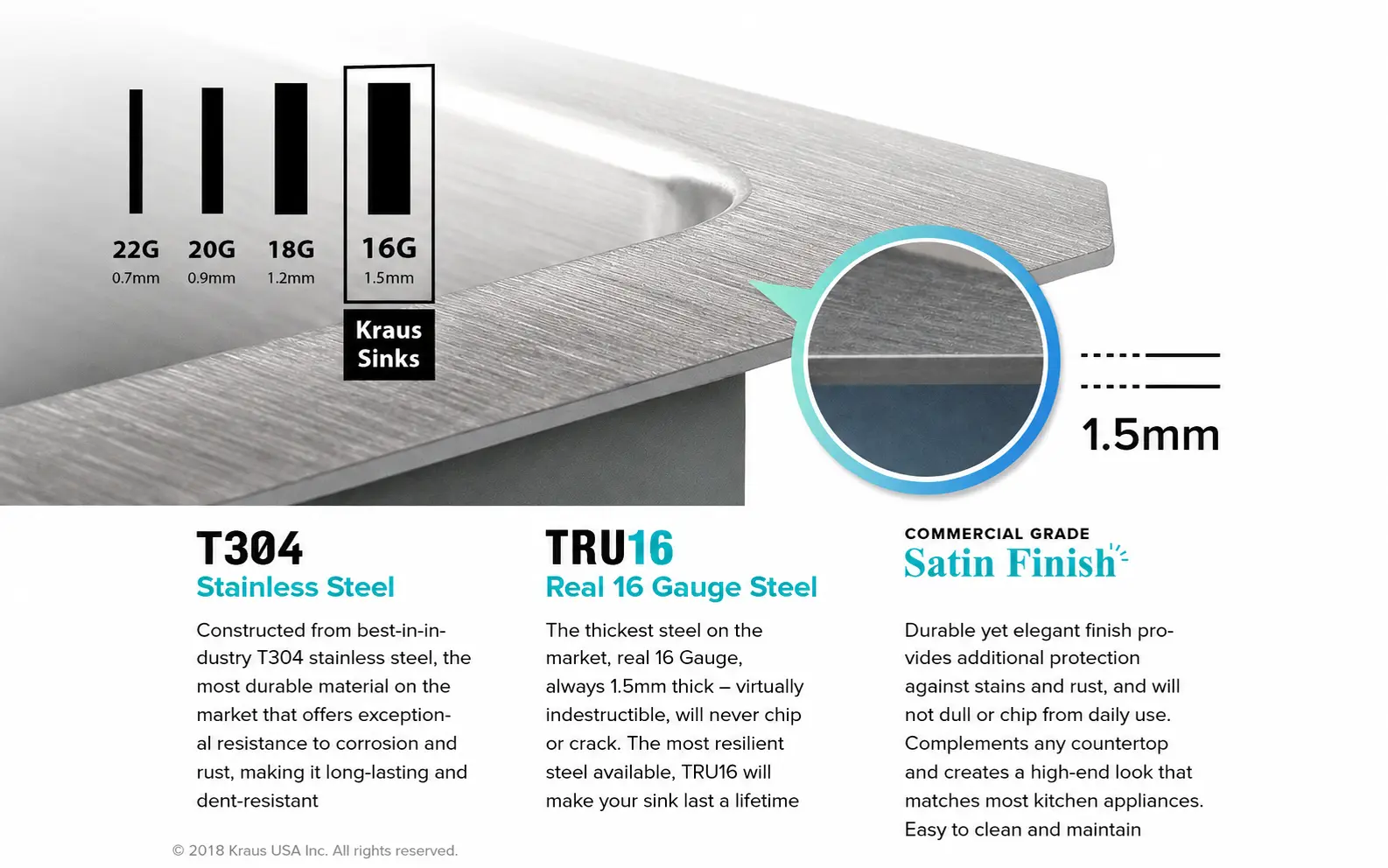
- the intended stainless steel grade
- the nominal material thickness
But it does not tell you:
- where the thickness is measured
- how the sink is manufactured
- what the finished bowl geometry is
- whether the rim is flat
- how the surface finish should look
- what sound-deadening treatment is used
- which drain and accessories are included
- how the sink should fit the countertop
- what QC standard the supplier should follow
- what must remain consistent in repeat orders
For OEM buyers, the important distinction is:
Material grade and gauge define two inputs. They do not define the finished sink.
Quick Answer
A kitchen sink specified only as:
SUS304 + 18 Gauge
is still incomplete because the finished product also depends on:
- actual incoming sheet thickness
- finished thickness after forming
- handmade or pressed construction
- bowl dimensions
- depth
- corner radius
- flange / rim geometry
- drain position
- surface finish
- sound pads / undercoating
- accessories
- installation method
- packaging
- inspection criteria
Two suppliers can both quote:
SUS304 / 18 Gauge
and still be offering materially different products.
The same material grade and nominal gauge do not guarantee the same finished sink.
1. SUS304 Defines the Alloy Grade — Not the Complete Product
SUS304 tells the buyer what stainless steel grade is intended.
That matters because material grade affects:
- corrosion resistance
- fabrication behavior
- commercial value
But SUS304 does not define:
- bowl geometry
- finished thickness
- workmanship
- surface appearance
- accessories
- installation fit
A buyer should therefore treat:
SUS304
as one material requirement, not as a complete quality statement.
2. “18 Gauge” Does Not Automatically Tell You the Finished Thickness Everywhere
This is especially important for pressed sinks.
A buyer may assume:
18 gauge sheet = 18 gauge everywhere on the finished sink.
That is not necessarily true.
During forming, stainless steel can become thinner in highly stretched areas.
Typical locations that may behave differently include:
- lower sidewalls
- bottom radii
- rectangular corners
- other high-strain areas
Matrix explains this in:
How Pressed Sink Forming Changes Stainless Steel Thickness
The key distinction is:
Starting sheet thickness is not the same as minimum finished thickness.
3. Incoming Thickness and Finished Thickness Are Different Measurements
For a pressed sink, buyers should distinguish:
Incoming Sheet Thickness
Measured before forming.
Finished Sink Thickness
Measured after forming at defined locations.
These values can differ.
So an RFQ that says only:
18 gauge
still leaves an important question unanswered:
Is the requirement referring to incoming material, finished wall thickness, or both?
4. Weight Does Not Prove Minimum Thickness
Another common shortcut is:
heavier sink = thicker sink.
Weight can help identify:
- major batch changes
- geometry differences
- component differences
But it cannot tell the buyer where the thinnest local section is.
Matrix covers this separately in:
Why Sink Weight Cannot Prove Stainless Steel Thickness
A useful distinction is:
Weight is a screening check. Thickness is a measurement check.
5. Handmade and Pressed 18-Gauge Sinks Are Not the Same Product
Two sinks may both be:
SUS304 / 18 Gauge
but one is handmade and the other is pressed.
That changes the product significantly.
Handmade Sink
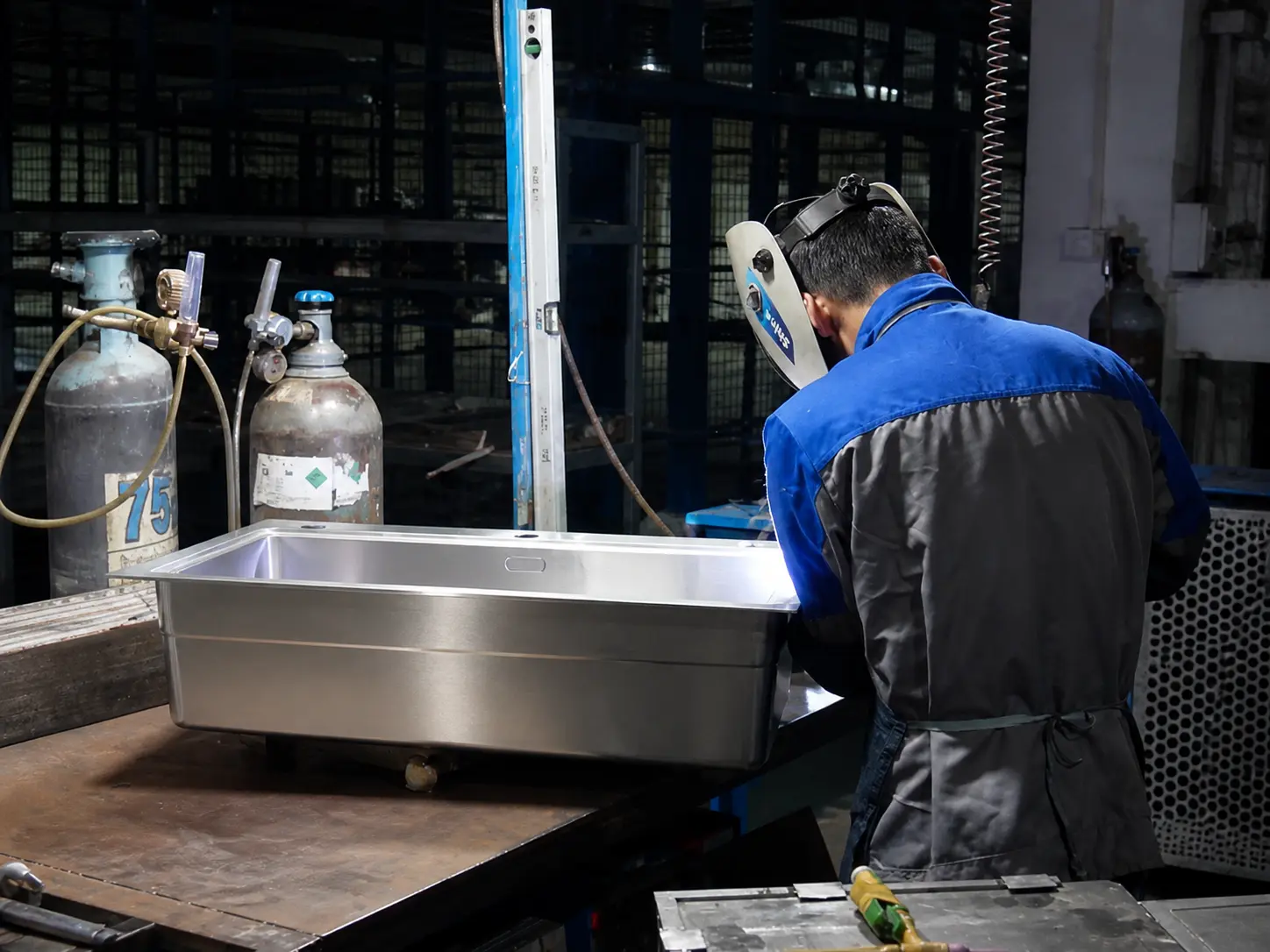
The sink is fabricated through:
- cutting
- bending
- welding
- grinding
- polishing
- brushing
This route can offer more flexibility in:
- dimensions
- depth
- corner radius
- flange geometry
- custom configurations
See Matrix’s Handmade Kitchen Sinks.
Pressed Sink
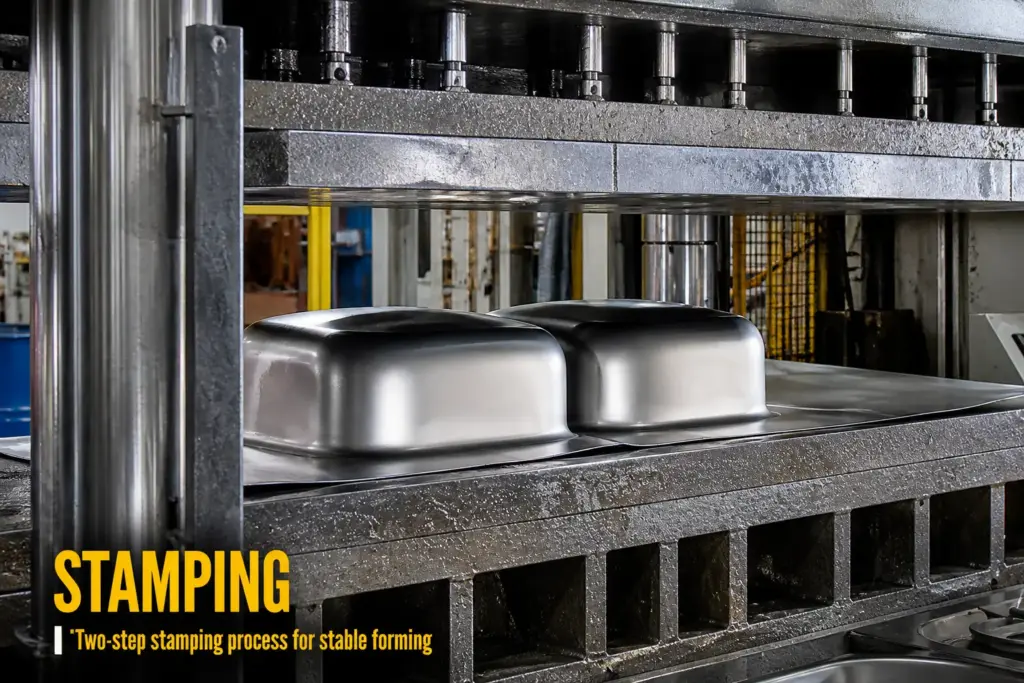
The bowl is formed through tooling.
Its geometry depends more heavily on:
- mold design
- forming depth
- corner radius
- material flow
- trimming
See Matrix’s Pressed Kitchen Sinks.
So:
same material + same gauge does not mean same manufacturing route.
6. Bowl Geometry Changes the Product More Than the Gauge Label Suggests
Two 18-gauge sinks can have the same overall size and still feel very different.
Why?
Because of:
- bowl opening
- bottom footprint
- depth
- corner radius
- wall angle
- rim width
- workstation ledge
For example:
Sink A
30″ overall
28″ bowl opening
9″ depth
tight radius
Sink B
30″ overall
27″ bowl opening
10″ depth
larger radius
Both may be:
SUS304 / 18 Gauge
but their usable space and installation behavior are different.
For this issue, see:
Why Can Two Kitchen Sinks With the Same Overall Size Have Different Bowl Capacity?
7. Corner Radius Is Not Just a Style Detail
Corner radius affects:
- usable bowl space
- cleaning
- visual appearance
- formability
- workstation fit
- pressed forming behavior
A sink with:
R10
is not automatically equivalent to another sink that simply looks “square.”
The finished geometry matters.
8. Rim and Flange Geometry Affect Installation
A buyer can receive the correct SUS304 and 18-gauge material and still have an installation problem.
Why?
Because the sink may have the wrong:
- flange width
- rim geometry
- cut-out relationship
- flatness
- installation interface
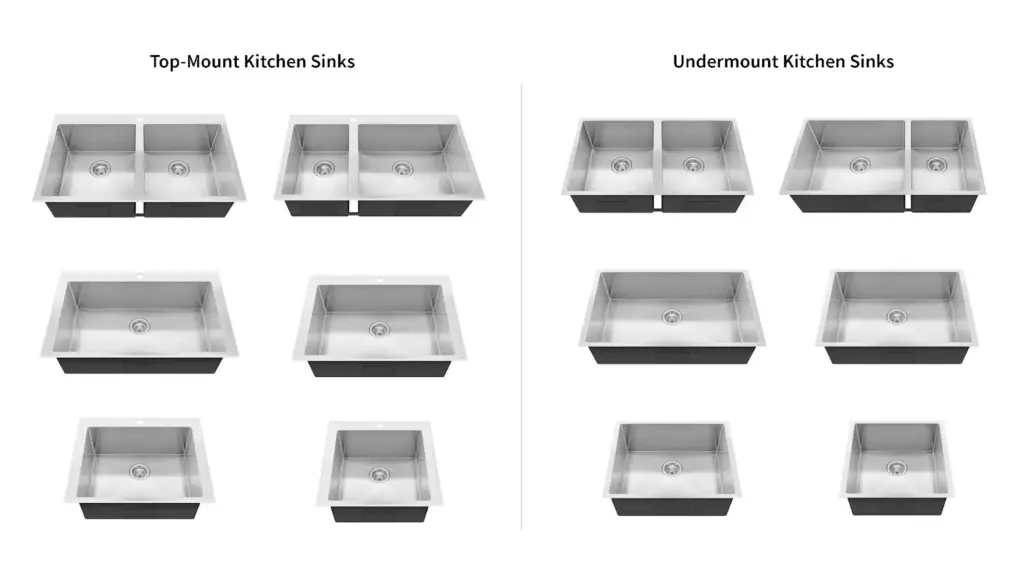
This matters especially when comparing:
- top-mount
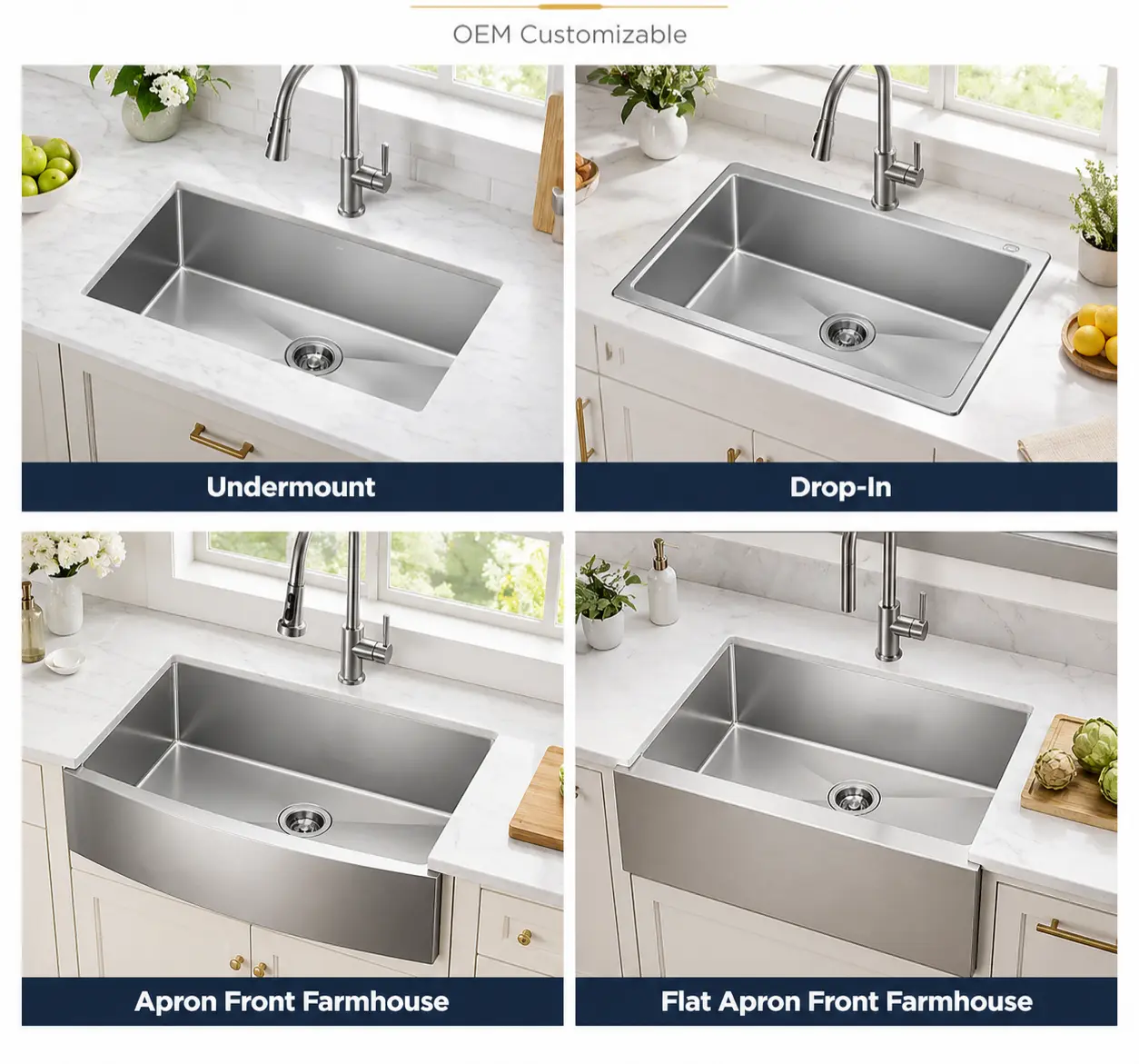
- undermount
- replacement sinks
Matrix’s Top-Mount Kitchen Sinks and Undermount Kitchen Sinks illustrate why the same bowl can require different installation geometry.
9. Rim Flatness Is a Separate Quality Requirement
A sink can be:
- SUS304
- 18 gauge
- dimensionally correct
and still fail installation because the rim is not flat enough.
This can cause:
- rocking
- visible gaps
- uneven sealing
- difficult installation
That means:
material specification does not replace geometry control.
Matrix’s Quality Control & Inspection treats rim flatness as a separate inspection item.
10. Surface Finish Is Not Defined by “SUS304 + 18 Gauge”
Two SUS304 sinks can look noticeably different because the surface finish depends on:
- brushing direction
- abrasive condition
- polishing
- surface preparation
- corner blending
- finish reference
For repeat-order programs, simply writing:
brushed
may still be too broad.
See:
Why Can Brushed Stainless Steel Sink Finishes Look Different Between Batches?
The important distinction is:
Material consistency and finish consistency are different controls.
11. Sound Performance Is Not Defined by Gauge Alone
A buyer may assume:
18 gauge means the acoustic performance is known.
But sink sound also depends on:
- bowl geometry
- large unsupported surfaces
- sound-deadening pads
- undercoating
- installation support
A thick sink can still sound hollow.
For this issue, see:
Why Does a Thick Stainless Steel Sink Still Sound Hollow?
So:
Gauge affects stiffness. It does not fully define acoustic performance.
12. Drain Compatibility Is Another Separate Specification
The sink may meet:
SUS304 / 18 Gauge
but still use a drain configuration that is wrong for the project.
Buyers should confirm:
- drain-hole size
- drain position
- flange fit
- garbage disposal compatibility
- cabinet clearance
Matrix’s Kitchen Sink Drain Hole Sizes & Garbage Disposal Compatibility explains why drain-hole diameter alone does not define the complete installation interface.
13. Accessories Can Change the Product Without Changing the Main Specification
A workstation sink may include:
- cutting board
- colander
- roll-up rack
- bottom grid
- drain
Two suppliers can quote the same:
SUS304 / 18 Gauge / 30″ workstation sink
but provide very different:
- accessory materials
- dimensions
- fit
- finish
- packaging
Matrix’s Workstation Kitchen Sinks show why accessory geometry should be treated as part of the product system.
14. Packaging Is Part of the Commercial Product
A sink can be manufactured correctly and still arrive damaged.
Packaging can affect:
- rim protection
- corner protection
- surface scratches
- accessory movement
- PVD finish protection
So for OEM and private-label orders, the real specification may also need to define:
- carton
- foam
- accessory placement
- protective film
- label
- palletization where relevant
The phrase:
SUS304 / 18 Gauge
says nothing about delivered condition.
15. QC Criteria Can Change the Product Even When the Specification Looks the Same
Consider two suppliers.
Both quote:
SUS304 / 18 Gauge
Supplier A checks:
- overall dimensions
- bowl depth
Supplier B checks:
- thickness
- rim flatness
- drain position
- surface finish
- workstation fit
- packing
The line item may look the same.
The acceptance system is not.
This is why Matrix’s Quality Control & Inspection uses multiple inspection categories rather than treating material grade as the whole quality standard.
16. Sample Approval Adds Information the Drawing Cannot Fully Capture
A drawing can define:
- dimensions
- radius
- drain position
- thickness requirement
But it may not fully capture:
- corner workmanship
- brushing appearance
- polishing transition
- accessory feel
- overall visual standard
That is where an approved physical sample becomes useful.
For private-label programs, see:
Private-Label Product Programs
17. Repeat Orders Need More Than the Same Drawing
Even if the drawing remains unchanged, the next batch can differ because of:
- material batch
- finish
- accessories
- component supplier
- packaging
- QC reference
Matrix explains this in:
Why Can Repeat-Order Kitchen Sinks Differ Even When the Drawing Has Not Changed?
This is why:
drawing consistency is not the same as complete SKU consistency.
18. Two “SUS304 + 18 Gauge” Quotations Can Still Describe Different Products
Consider two quotations:
| Item | Supplier A | Supplier B |
|---|---|---|
| Material | SUS304 | SUS304 |
| Gauge | 18 Gauge | 18 Gauge |
| Overall Size | 30″ | 30″ |
| Production Route | Handmade | Pressed |
| Finished Thickness Map | Not Defined | Defined |
| Finish Reference | Generic Brushed | Approved Sample |
| Sound Pad | Small Standard Pads | Larger Defined Layout |
| Drain | Standard | Specified Model |
| Accessories | Generic | Approved Set |
| Packaging | Standard Carton | Defined Foam + Carton |
| QC | Basic Dimensions | Defined CTQ + Surface + Fit |
At first glance:
same material
same gauge
same size
But commercially, these are not necessarily equivalent sink programs.
What Should a More Complete Sink Specification Include?
A stronger OEM specification can include:
Material
- SUS304 / SUS316
- traceability requirement where needed
Thickness
- nominal gauge
- incoming thickness
- finished thickness locations where relevant
Geometry
- overall dimensions
- bowl dimensions
- depth
- corner radius
- rim / flange
- drain position
Production Route
- handmade
- pressed / drawn
Surface
- brushed / satin / PVD
- finish reference
- brushing direction where important
Acoustic Treatment
- sound pads
- undercoating where required
Accessories
- drain
- bottom grid
- cutting board
- colander
Installation
- top-mount / undermount
- cut-out
- reveal where applicable
Packaging
- carton
- foam
- accessory placement
- branding
QC
- CTQ dimensions
- surface standard
- flatness
- accessory fit
- approved sample reference
What Should Buyers Put in the RFQ?
Instead of:
30″ SUS304 18 Gauge Sink
a stronger starting RFQ may define:
30″ undermount single-bowl sink
SUS304
18 gauge incoming sheet
specified bowl dimensions and depth
defined corner radius
brushed finish to approved reference
drain position
sound-deadening requirement
accessory set
private-label packing
The exact detail depends on the project.
Matrix’s Kitchen Sink RFQ Checklist can be used to structure these requirements before quotation.
Common Misunderstandings
“If both suppliers quote SUS304 + 18 gauge, the products are equivalent.”
No.
Those specifications cover only material grade and nominal thickness.
“18 gauge tells me the minimum thickness everywhere.”
Not necessarily, especially for pressed sinks.
“SUS304 automatically means good corrosion performance.”
It is a strong standard material for many applications, but surface contamination, environment and fabrication still matter.
“A detailed drawing makes the approved sample unnecessary.”
Not always.
Visual workmanship and finish can be difficult to define completely on a drawing.
“If the sink dimensions pass, the product is fully compliant.”
No.
Surface, flatness, accessories, drain compatibility and packaging can still fail.
“A heavier 18-gauge sink must be better.”
Not necessarily.
Weight does not identify minimum local thickness or explain geometry.
Buyer Takeaway
Do not treat:
SUS304 + 18 Gauge
as a complete kitchen sink specification.
Think of it as the start of the specification:
Material Grade
→ Thickness Definition
→ Production Route
→ Geometry
→ Finish
→ Installation
→ Accessories
→ Packaging
→ QC
The key distinction is:
SUS304 tells you what alloy the sink should use.
18 gauge tells you a nominal thickness category.
Neither one tells you what the finished sink will actually be.
Frequently Asked Questions
Is SUS304 18 gauge enough to specify a good kitchen sink?
No. It defines important material requirements, but geometry, finish, construction, accessories, installation and QC also need to be considered.
Can two SUS304 18-gauge sinks have different quality?
Yes. Production route, finished thickness, geometry, finish, flatness, accessories and QC can all differ.
Does 18 gauge mean the same thickness everywhere on a pressed sink?
Not necessarily. Forming can create local thinning.
Is a heavier 18-gauge sink automatically better?
No. Weight does not prove minimum local thickness or overall product quality.
Does SUS304 define the sink finish?
No. Material grade and surface finish are different specifications.
What should buyers specify beyond SUS304 and gauge?
At minimum, review dimensions, bowl geometry, production route, finish, drain, accessories, installation, packaging and QC requirements.
Defining an OEM Kitchen Sink Specification?
Matrix supports Handmade Kitchen Sinks and Pressed Kitchen Sinks for different geometry, volume and customization requirements.

For project definition, use the Kitchen Sink RFQ Checklist, or review Custom Kitchen Sink Programs and Quality Control & Inspection.