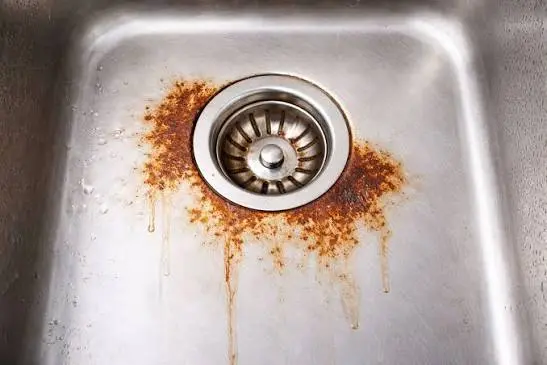
Rust-colored spots on a stainless steel sink do not automatically mean the sink is made from poor or fake material.
The orange color may come from iron particles sitting on the sink, not from the stainless steel bowl itself. Steel wool, construction dust, wet food cans, rusty cookware, drain components and iron in the water can all leave material that later rusts.
But stainless steel is corrosion-resistant—not corrosion-proof. Chlorine bleach, salt deposits, unsuitable acids, trapped moisture, fabrication contamination and the wrong material for the environment can damage its protective surface and cause real pitting.
The correct question is therefore not only, “What grade is this sink?” It is:
Is the rust sitting on the surface, coming from another component, or forming inside the stainless steel?
The answer in 30 seconds
- Orange spots disappear and the steel remains smooth: usually external iron contamination or a removable deposit.
- A brown ring matches a can, pan or tool: usually rust transferred from that object.
- Marks repeatedly form below the faucet: check iron in the water, aging pipes and mineral deposits.
- A small rough hole remains after cleaning: possible chloride pitting; the sink surface has lost metal.
- Rust returns at the same weld or corner: investigate welding, grinding, polishing and cross-contamination.
- Rust is limited to the drain or screw: inspect the component separately from the sink bowl.
- The sink attracts a magnet: this alone does not prove it is not 304.
Why stainless steel can show rust
Stainless steel contains chromium. On a clean surface exposed to oxygen, chromium helps form an extremely thin passive layer that protects the metal below.
This layer performs best when the surface is:
- clean and regularly rinsed;
- free from ordinary steel particles;
- exposed to oxygen;
- not covered by concentrated salt or chemical residue;
- correctly welded and finished;
- made from a grade suited to its environment.
The passive layer can naturally reform after minor surface disturbance. However, concentrated chlorides can locally break it down. Deposits and tight crevices can also restrict oxygen and hold aggressive residue against the steel.
Stainless steel should therefore be understood as corrosion-resistant under suitable conditions, not as a material that can never show discoloration or corrosion.
201 vs 304 vs 316: which stainless steel sink is more likely to rust?
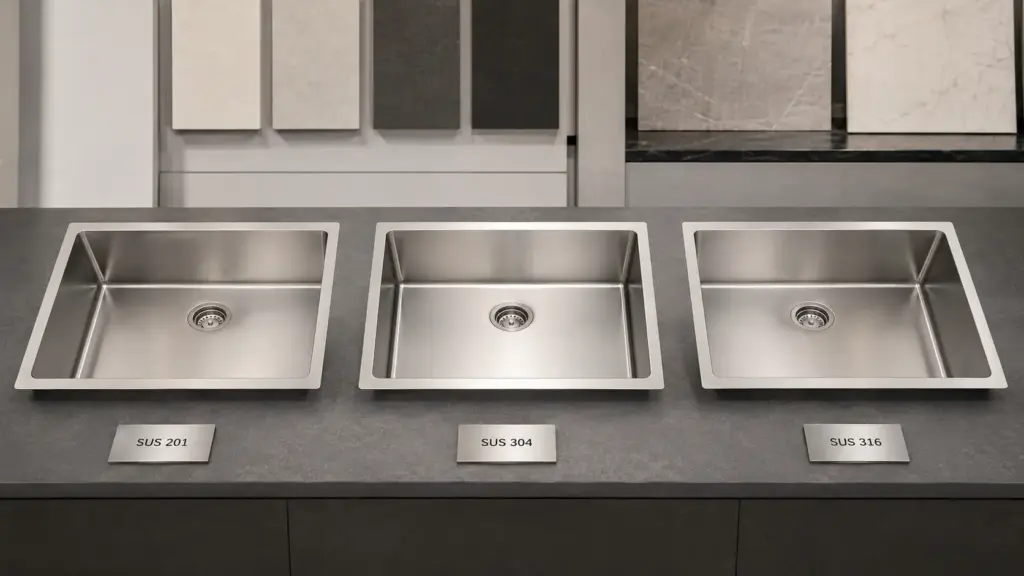
Material grade matters, but it is only one part of corrosion performance. Surface finish, fabrication, cleaner exposure, water quality and maintenance can change the result.
| Sink material | Main difference | Typical sink positioning | Chloride resistance | What a rust spot means |
|---|---|---|---|---|
| 201 stainless steel | Uses manganese to replace part of the nickel used in 300-series steel | Cost-controlled residential, utility or market-specific sink programs | Can perform well in mild indoor conditions, but grade consistency and actual exposure require attention | Does not automatically prove material failure; inspect contamination, chemicals and grade together |
| 304 stainless steel | Standard chromium-nickel austenitic stainless steel | Mainstream residential kitchen sinks, handmade sinks and many premium programs | Suitable for normal indoor kitchen use, but vulnerable to concentrated chlorides and hydrochloric acid | Often caused by external iron or misuse, but genuine pitting remains possible |
| 316 stainless steel | Contains molybdenum, which improves resistance to chloride pitting | Coastal, outdoor or higher-exposure applications where the environment justifies it | Better chloride-pitting resistance than 304 under comparable conditions | Still not rustproof; contamination, aggressive chemicals and poor fabrication can cause problems |
| 430 stainless steel | Ferritic chromium stainless steel with little or no nickel; normally magnetic | Selected cost-sensitive products, components or market-specific applications | Generally less suitable than 304 or 316 for demanding chloride exposure | Strong magnet attraction may be normal for the grade; verify what material was actually specified |
201 stainless steel sinks
201 is not simply “fake 304.” It is a recognized austenitic stainless steel that uses more manganese and less nickel than 304. It is commonly selected where cost and strength matter.
In a mild, regularly cleaned indoor kitchen, a properly made 201 sink can perform satisfactorily. Its suitability still depends on:
- the exact material composition;
- surface condition and finish;
- forming and welding quality;
- chloride exposure;
- water and cleaning practice;
- consistency between production batches.
The professional B2B question is not whether 201 is always bad. It is whether the material was declared correctly and matches the intended market.
304 stainless steel sinks
304 is the mainstream reference grade for residential stainless steel kitchen sinks. Its formability makes it suitable for pressed bowls, while its corrosion resistance and fabrication characteristics also support handmade sink production.
304 is a sensible specification for most indoor kitchens, but it can still show rust-colored contamination. It can also pit when bleach, chloride cleaners, concentrated salt or hydrochloric acid remains on the surface.
The label “304” does not correct poor welding, dirty grinding tools, an unsuitable drain component or contaminated packaging.
316 stainless steel sinks
316 includes molybdenum, which improves resistance to chloride pitting and crevice corrosion. It can be valuable for coastal, outdoor and other higher-exposure environments.
However, 316 is not automatically the best choice for every kitchen. It adds cost and still requires correct fabrication, regular cleaning and realistic exposure control. Hydrochloric acid and concentrated aggressive chemicals can damage both 304 and 316.
The Matrix guide to 201 vs 304 vs 316 stainless steel sinks explains why the most expensive grade is not always the most appropriate sink specification.
What about “18/8 stainless steel”?
“18/8” generally refers to approximate chromium and nickel content associated with common austenitic stainless steel. It is a useful description, but it should not replace a clearly agreed material grade in a B2B purchase specification.
When material identity matters, define the grade and the agreed verification method instead of relying only on a marketing phrase.
Important: grade, gauge and rust resistance are not the same
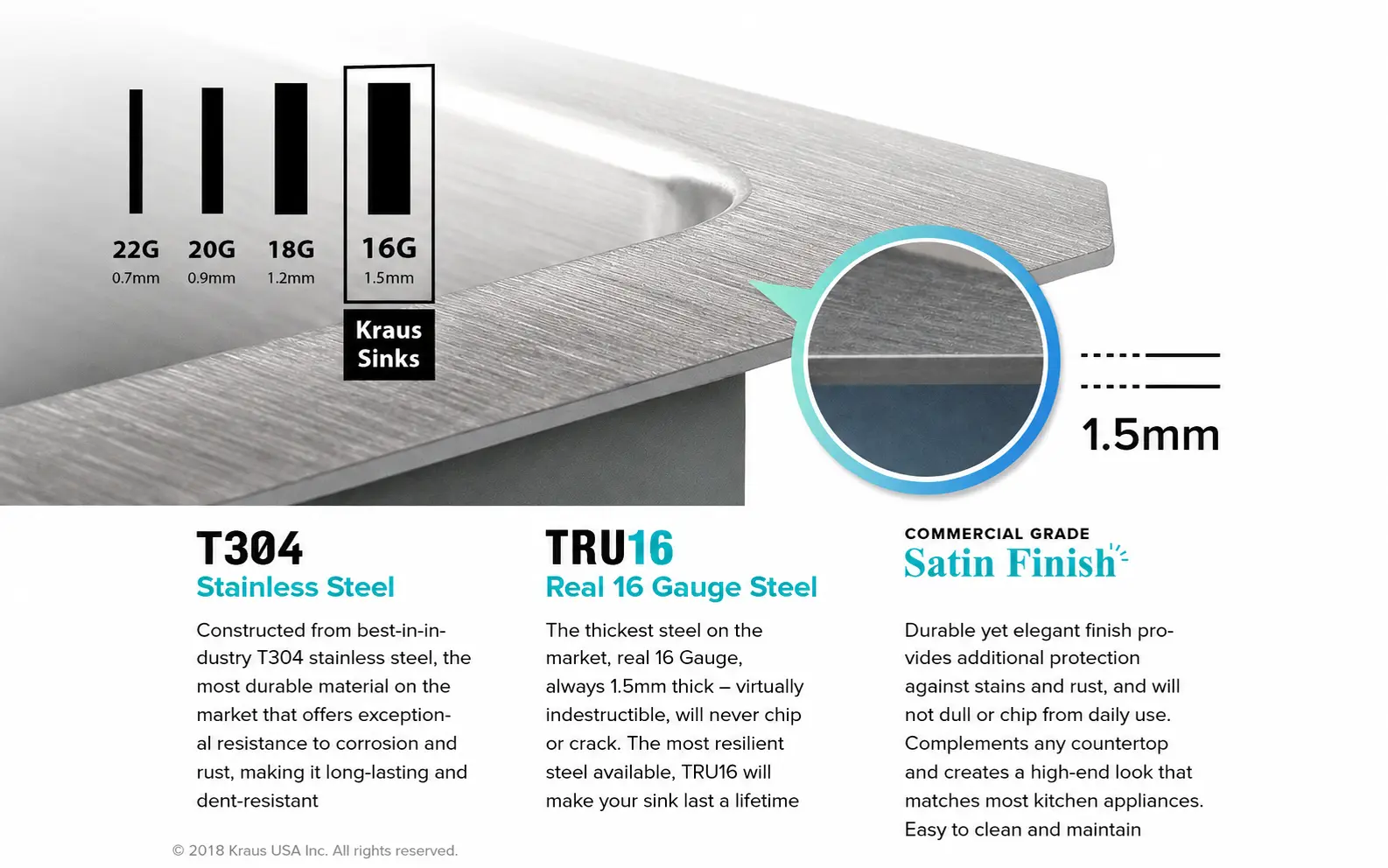
Grade describes the alloy composition. Gauge describes the sheet thickness.
A 16-gauge sink is thicker than an 18-gauge sink, but thickness alone does not make the surface more resistant to chloride pitting. A thicker sink may feel more substantial and resist deformation differently, while corrosion behavior still depends mainly on:
- material grade;
- surface condition;
- fabrication;
- contamination;
- chemical exposure;
- cleaning and maintenance.
A well-finished 18-gauge 304 sink can therefore have better surface performance than a poorly processed thicker sink. See the Matrix 16 gauge vs 18 gauge sink guide for the structural differences.
External iron contamination vs corrosion of the sink body
This is the most important distinction in a rust complaint.
External iron contamination
External iron contamination means ordinary iron or carbon-steel particles are resting on or embedded in the stainless steel surface. Those particles rust when wet.
Common sources include:
- steel wool;
- carbon-steel wire brushes;
- an abrasive previously used on ordinary steel;
- grinding and drilling dust;
- metal tools left in the bowl;
- rusty cookware or wet food cans;
- contaminated factory tables, clamps or racks;
- iron in the water or old plumbing.
After appropriate cleaning, the stainless steel below often remains smooth.
Corrosion of the stainless steel
Actual corrosion means the protective passive layer has been locally defeated and the sink material has started to lose metal.
Possible signs include:
- tiny dark cavities;
- rough pinholes;
- a crater that remains after the orange stain is removed;
- repeated attack at a crevice or weld;
- localized damage after chemical exposure.
Cleaning can remove the corrosion product, but it cannot replace metal that has already been lost.
Diagnose the rust by its pattern and location
| What you see | More likely cause | What to do next |
| Scattered orange pinpoints on smooth steel | Iron dust or steel-wool fragments | Clean gently and identify the contamination source |
| A circular brown mark | Wet can, cast-iron pan or metal object | Inspect the object and the surface below it |
| Yellow-brown streaks below the faucet | Waterborne iron, pipe rust or deposits | Compare other fixtures and investigate the water source |
| Rough dark pinholes | Possible chloride pitting | Stop chemical exposure and inspect after gentle cleaning |
| Rust at a handmade corner or seam | Fabrication contamination, heat tint or trapped residue | Review the weld and finishing process |
| Rust around the drain | Component material, crevice, installation scratch or residue | Inspect the drain assembly separately |
| Broad brown discoloration | Cleaner residue, deposits, iron contamination or environmental staining | Review cleaning, storage and exposure history |
| Rust appearing after renovation | Grinding dust, masonry chemical or contaminated tools | Protect and clean the sink before further use |
The color alone cannot identify the steel grade or root cause. Location, texture, timing and recurrence provide more useful evidence.
The most common causes of rust-colored spots
1. Steel wool or a carbon-steel brush
Steel wool can leave hundreds of microscopic iron fragments on the sink. Once wet, those fragments turn orange and make the stainless steel appear to be rusting.
Use a soft cloth, non-scratch sponge or cleaning tool reserved for stainless steel. Never use the same abrasive on carbon steel and a finished sink.
2. Construction and grinding dust
Cutting metal cabinet parts, grinding frames or drilling nearby hardware can release iron particles. A new sink may show rust after its first water test even though the contamination occurred during installation.
Keep the sink covered during construction, vacuum loose dust and clean it before handover. Do not grind ordinary steel over an uncovered sink.
3. Wet cans, cookware and metal tools
Food cans, cast-iron pans and carbon-steel tools can transfer rust to the bowl. A stain that follows the exact footprint of an object usually indicates contact contamination.
Remove wet metal objects after use instead of leaving them in the sink overnight.
4. Iron in the water or plumbing
Water can carry iron from the source, pipework or water heater. As droplets dry, the iron remains and oxidizes.
If similar yellow-brown deposits appear below the faucet or on several fixtures, investigate the water and plumbing before blaming the sink material.
5. Chlorine bleach and chloride cleaners
Chloride can locally damage the passive layer and initiate pitting. Potential sources include:
- chlorine bleach;
- chloride-containing disinfectants;
- concentrated salt or brine;
- cleaner overspray;
- some dishwasher products;
- salty residue left under a wet cloth or mat.
Food contacting salt briefly is different from concentrated salt solution remaining on the steel. Rinse the sink thoroughly after exposure and do not leave aggressive cleaner residue standing.
6. Hydrochloric acid and renovation chemicals
Hydrochloric acid, also called muriatic acid, is highly aggressive to common stainless steel grades. It may be present in masonry, cement, tile or toilet-cleaning products used during renovation.
Do not use raw acid to remove a rust stain. It can turn a removable deposit into permanent surface damage. Fumes, splashes and contaminated cloths should also be kept away from the sink.
7. Deposits, standing residue and crevices
Water alone is not usually the complete cause. The risk increases when evaporation concentrates salt, cleaner, food residue or iron beneath a deposit.
Restricted areas around the drain, beneath rubber mats or under wet objects may also receive less oxygen, making it harder for the passive surface to remain stable.
8. Welding, grinding and finishing contamination
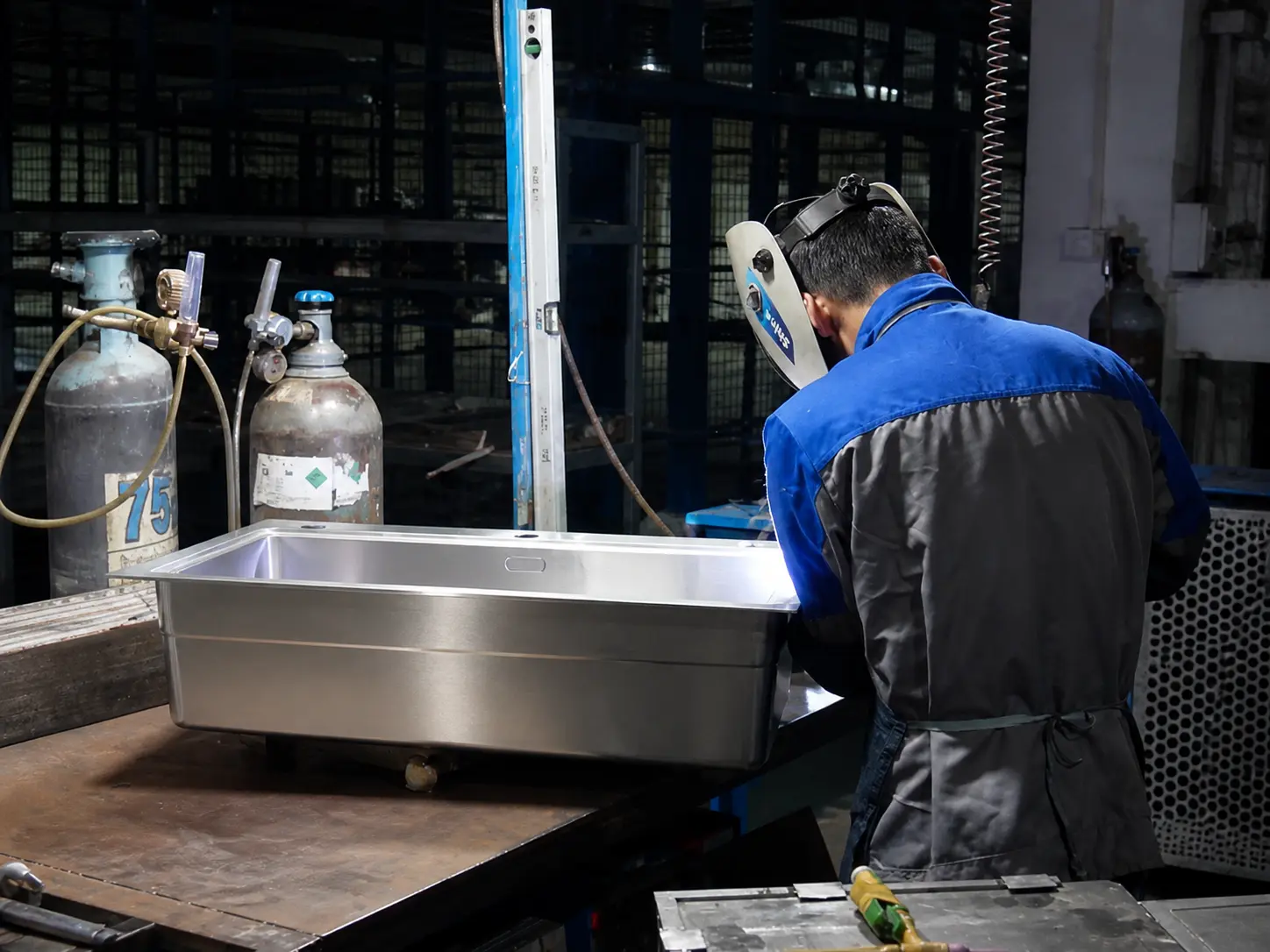
Handmade sinks are cut, bent, welded, ground and refinished. Welding produces an oxide layer around the heat-affected area. If this heat tint is not properly removed and the finish restored, local corrosion resistance may be reduced.
Shared carbon-steel tools, dirty abrasives and airborne grinding dust can create a second problem by transferring iron to the stainless surface.
Repeated rust at the same corner across several units should trigger a review of:
- stainless-only tools and abrasives;
- separation from carbon-steel work;
- weld condition;
- heat-tint removal;
- polishing sequence;
- final cleaning;
- water-test cleanliness;
- drying before packing.
The Matrix overview of stainless steel sink manufacturing explains how forming, welding, polishing and finishing affect the completed sink.
9. Drain, screw or accessory material
The bowl, strainer, screw, overflow, bottom grid and garbage-disposal components may not all use the same material.
If rust is concentrated around one component, clean the area and inspect the component separately. Replacing a corroding screw or strainer may be more appropriate than treating the whole sink as defective.
Check the Matrix guide to drain-hole sizes and garbage-disposal compatibility when approving the complete drain assembly.
10. Wet packaging and storage
A clean sink can develop stains when it is packed wet or stored against contaminated racks, staples, strapping or protective material.
Export and project orders require controlled final cleaning, drying and packaging. The first visible rust mark at installation may have originated before shipment.
Can a magnet tell whether the sink is 304?
No. A magnet cannot reliably confirm the grade of a finished stainless steel sink.
Annealed 304 is normally non-magnetic, but pressing, bending, rolling, grinding and other cold work can make some areas weakly magnetic. Welded areas may also respond differently.
201 is also an austenitic grade and may behave similarly after forming. By contrast, 430 is ferritic and normally shows much stronger magnetic attraction.
A magnet can provide a preliminary clue, but it cannot reliably distinguish 201 from 304 or prove that a formed 304 sink is fake. B2B verification should use supplier material records and an agreed analytical method where required.
How to remove rust stains safely
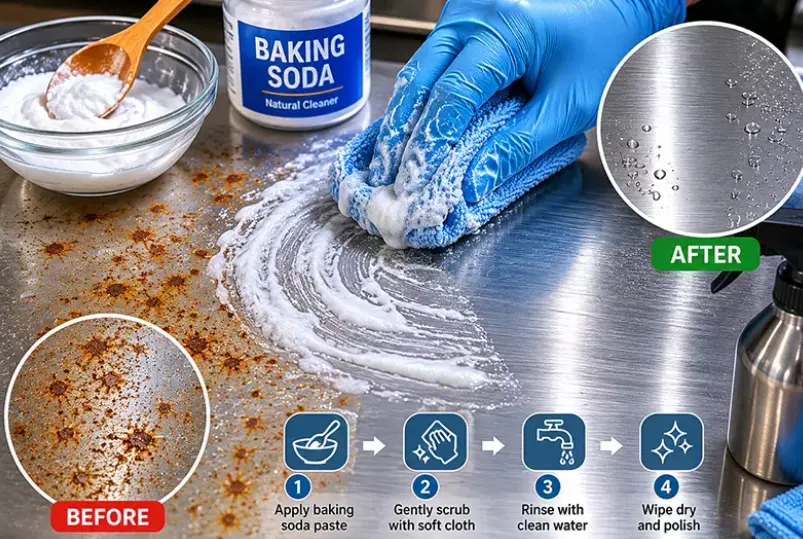
Begin with the least aggressive method.
Step 1: Remove the source
Remove steel wool, wet cans, rusty cookware, metal tools and rubber mats. Stop using suspected chlorine or acid cleaners. Protect the sink from nearby grinding dust.
Step 2: Rinse loose residue
Use clean water to remove salt, food and loose particles. Vacuum dry construction dust before washing so it is not rubbed across the finish.
Step 3: Wash with mild dish soap
Use mild dish soap and a soft, non-scratch cloth or sponge. On a brushed sink, clean with the visible grain rather than scrubbing in random circles.
Step 4: Use a cleaner intended for stainless steel if needed
For a persistent stain, use a non-abrasive cleaner specifically labeled as suitable for stainless steel and the stain being treated. Follow its instructions and test it in a less visible area first.
Do not assume that a stronger chemical will produce a better result.
Step 5: Rinse completely and dry
Cleaner residue can become another source of staining. Rinse the bowl, corners and drain thoroughly, then dry with a clean cloth.
Step 6: Inspect the surface
- Smooth steel after cleaning: likely a deposit or external iron contamination.
- A rough hole remains: possible pitting and actual metal loss.
- The stain quickly returns: the source has not been removed or the surface is continuing to corrode.
If pits remain or the problem repeatedly returns at a weld, contact the supplier or a qualified local professional.
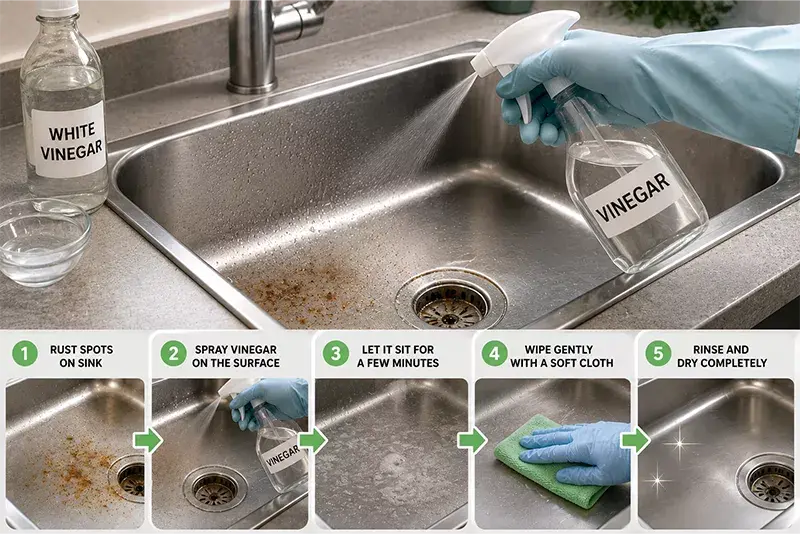
What not to use
Avoid:
- steel wool;
- carbon-steel brushes;
- abrasives previously used on ordinary steel;
- chlorine bleach left on the surface;
- unsuitable chloride cleaners;
- hydrochloric or muriatic acid;
- toilet, masonry, oven or drain cleaner used as sink cleaner;
- harsh abrasive powder on a visible brushed finish;
- unknown homemade chemical mixtures.
Never mix cleaners. Bleach combined with acids or ammonia can release dangerous gases. If an unknown chemical has already been applied, ventilate the area and do not add another product.
How to prevent stainless steel sink rust
For daily kitchen use
- Rinse away salt, food and cleaner residue.
- Dry the sink when water repeatedly leaves deposits.
- Remove wet cans and carbon-steel cookware promptly.
- Use soft cleaning tools dedicated to stainless steel.
- Clean in the direction of the brushed grain.
- Do not leave wet cloths or rubber mats in the bowl for long periods.
- Keep renovation and bathroom chemicals away from the sink.
- Clean around the drain so residue does not remain in the crevice.
For outdoor and coastal sinks
- Select the grade for the real chloride exposure.
- Consider 316 where the environment justifies it.
- Rinse salt deposits regularly.
- Avoid direct pool-chemical splash.
- Do not allow wet covers or leaves to trap moisture.
- Specify compatible drains, screws and accessories.
316 improves chloride resistance, but it does not eliminate the need for cleaning and correct fabrication.
B2B rust-prevention checklist
For brands, importers, wholesalers and project buyers, “304 stainless steel” is not a complete quality specification.
| Control point | What buyers should define | Why it matters |
| Sink application | Indoor, outdoor, coastal, utility or commercial use | Determines the exposure level |
| Bowl material | 201, 304, 316 or another agreed grade | Prevents unclear substitutions |
| Related components | Drain, screws, overflow and accessory materials | A component can become the rust source |
| Material verification | Supplier records and agreed test method | Appearance and magnet response cannot prove grade |
| Tool control | Stainless-only abrasives, brushes and handling surfaces | Prevents free-iron contamination |
| Fabrication area | Separation from ordinary steel grinding | Reduces airborne iron contamination |
| Welding and finishing | Approved weld, heat-tint removal and grain appearance | Protects vulnerable seams and corners |
| Final cleaning | Removal of dust, polishing compound and chemical residue | Reduces stains during storage and first use |
| Water testing | Clean test station and drying after the test | Prevents contamination before packing |
| Packaging | Clean, dry packing without harmful metal contact | Reduces transit and warehouse staining |
| Care guidance | Clear warnings for bleach, acids, salt and steel wool | Reduces avoidable after-sales claims |
The Matrix stainless steel sink quality inspection checklist covers additional controls for material, dimensions, finish, welding, drainage, accessories and packaging.
How B2B buyers should investigate a rust complaint
1. Record the evidence before cleaning
Collect photos of the whole sink, stain pattern, drain, welds, cleaners, water deposits and nearby metal objects. Record the installation date, first appearance and whether construction work occurred nearby.
2. Determine whether the surface is smooth or pitted
Remove the stain gently. A smooth surface suggests contamination or deposits. A remaining cavity suggests localized metal loss.
3. Compare the location across units
- One ring beneath a wet can suggests user contact.
- The same welded corner affected across multiple sinks suggests a process issue.
- Rust around the same supplied drain suggests a component issue.
- Random spots after installation suggest construction contamination.
4. Separate the bowl from the component
Do not classify the whole sink as defective before checking the drain, screw, grid and disposal assembly independently.
5. Test the material only when the dispute concerns grade
Define the sample location, test method and acceptance criteria. A photo, rust color or refrigerator magnet is not a reliable grade test.
Final recommendation
When a stainless steel sink shows rust, use this order of diagnosis:
- Remove external objects and residue.
- Clean gently and inspect the texture.
- Check water, cleaners and nearby construction.
- Inspect the drain, welds and accessories separately.
- Review the material grade only in relation to the actual environment.
- Use agreed material testing if a B2B dispute remains.
201, 304 and 316 can all show rust-colored contamination. 316 generally provides the strongest chloride resistance of these three, while 304 remains the mainstream choice for normal indoor kitchen sinks. A correctly declared and properly processed 201 sink can serve cost-controlled markets, but it should not be sold or specified as 304.
The best corrosion control combines the right grade, clean fabrication, suitable components, proper packaging and realistic care instructions.
Develop corrosion-conscious sink programs with Matrix
Matrix supports brands, wholesalers and project buyers with stainless steel kitchen sink programs covering material selection, dimensions, fabrication, surface finish, drain and accessory matching, sample development, inspection requirements and export packing.
Contact Matrix to discuss a stainless steel sink sample, sourcing requirement or repeat-order quality plan.
Frequently asked questions
Why does my stainless steel sink have orange spots?
The most common causes are steel-wool fragments, metal grinding dust, rusty cookware, wet cans, iron in the water or another corroding component. Clean the spot and check whether the steel remains smooth.
Can a 304 stainless steel sink rust?
Yes. 304 can carry rusting iron contamination and can suffer pitting after concentrated chloride or unsuitable acid exposure. It is corrosion-resistant, not corrosion-proof.
Is 201 stainless steel always more likely to rust than 304?
Not in every mild environment. Exact composition, surface finish, fabrication, chloride exposure and maintenance all matter. However, the two grades should be declared accurately and selected for the target application rather than treated as interchangeable.
Is 316 stainless steel rustproof?
No. 316 generally resists chloride pitting better than 304, but contamination, hydrochloric acid, aggressive cleaners and poor fabrication can still cause staining or corrosion.
How can I tell external contamination from pitting?
After gentle cleaning, external contamination normally leaves a smooth surface. Pitting leaves a dark cavity, rough pinhole or crater because metal has been lost.
Does bleach cause stainless steel sinks to rust?
Chlorine bleach and other chloride-containing products can damage the passive surface and increase the risk of pitting, especially when concentrated or left standing.
Can steel wool make a stainless steel sink rust?
Yes. Steel wool leaves carbon-steel fragments that rust when wet and create small orange spots.
Can a magnet identify a 304 sink?
No. Cold working can make parts of 304 and 201 weakly magnetic, while 430 is normally strongly magnetic. A magnet cannot reliably confirm the exact grade of a finished sink.
Does thicker stainless steel resist rust better?
Not automatically. Thickness affects structure and durability, but corrosion resistance depends mainly on alloy grade, surface condition, fabrication, chemicals and maintenance.
Why does rust appear around the drain?
The drain area traps water and residue, and the strainer, screw or disposal component may use a different material. Inspect the component and sink bowl separately.
Why does the rust return after cleaning?
The source may still be present. Check cleaning tools, water iron, old pipes, wet metal objects, chloride cleaners, drain components, weld areas and nearby grinding dust.